Radon Standards and Conventional Home Loan Requirements
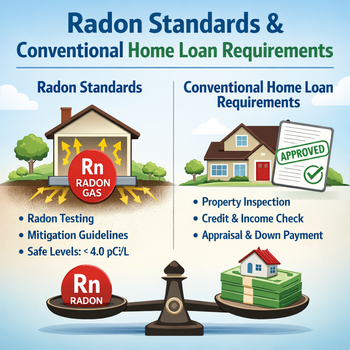 Radon testing and mitigation requirements are critical for homeowners
and buyers seeking conventional financing. Lenders and investors in the conventional
loan market recognize radon as a serious health risk in residential properties.
Properties financed with conventional loans must meet specific
radon mitigation standards to ensure safety and long-term value.
Understanding these requirements helps homeowners protect their families and maintain
property eligibility.
Radon testing and mitigation requirements are critical for homeowners
and buyers seeking conventional financing. Lenders and investors in the conventional
loan market recognize radon as a serious health risk in residential properties.
Properties financed with conventional loans must meet specific
radon mitigation standards to ensure safety and long-term value.
Understanding these requirements helps homeowners protect their families and maintain
property eligibility.
Radon is an invisible, odorless gas that accumulates in homes and causes serious health problems. Conventional mortgage guidelines often require testing and remediation of high radon levels in residential properties. Radon in homes enters through foundation cracks, soil contact, and gaps in building materials. Testing identifies radon problems before health damage occurs. Lenders and appraisers increasingly emphasize mandatory radon inspection standards to protect the safety and marketability of the home.
What is Radon and Why It Matters
Radon is a naturally occurring radioactive gas produced by uranium decay in soil and rock. The gas seeps into homes through foundation cracks and openings in building materials. Unlike volatile gases, radon is colorless, odorless, and tasteless. Homeowners cannot detect radon without professional testing. Conventional loan underwriting often requires radon testing to identify dangerous accumulation, especially in high-risk regions.
Uranium and radium naturally exist in soil throughout North America. As these elements decay, they produce radon gas that moves upward through soil layers. Homes with basements or crawl spaces in contact with soil accumulate radon easily. Even homes built on solid rock develop radon problems when the gas enters through foundation cracks. Properties at high elevation or in granite-rich areas face increased radon risk and are more likely to require testing as part of a conventional loan transaction.
The EPA established action levels for radon in homes based on health research. Homes with radon levels above four picocuries per liter require remediation. Below four picocuries per liter, the EPA considers radon levels acceptable. However, the EPA recommends testing and mitigation even at lower levels to minimize radiation exposure. Conventional lenders generally follow EPA guidelines for radon mitigation requirements, and many will require proof of mitigation before closing if elevated levels are detected.
Health Risks of Radon Exposure
Radon exposure causes serious health problems, particularly lung cancer. The gas decays into radioactive particles that deposit in lung tissue. Inhaled particles damage lung cells and increase cancer risk. Smokers exposed to radon face dramatically higher lung cancer risk than nonsmokers. The EPA estimates radon causes thousands of lung cancer deaths annually in the United States.
| Radon Level Range | Health Risk Level | Recommended Action |
|---|---|---|
| Below 2 pCi/L | Minimal risk | Periodic testing recommended |
| 2 to 4 pCi/L | Low but measurable | Mitigation strongly recommended |
| 4 to 10 pCi/L | Significant risk | Mitigation required by most lenders |
| Above 10 pCi/L | High risk | Immediate mitigation required |
| Above 20 pCi/L | Very high risk | Professional remediation required |
Prolonged radon exposure in homes increases cancer risk over time. Young children living in radon-contaminated homes face lifetime cancer risk from childhood exposure. The radioactive particles continue damaging lung cells throughout life. Conventional loan programs prioritize radon testing and mitigation to protect long-term occupant health and preserve property value. Properties with high radon levels should be remediated before residents move in.
Radon combines with other indoor air pollutants to increase health risks. Tobacco smoke, wood smoke, and chemical fumes compound radon damage. Damp indoor air promotes mold growth alongside radon exposure. The combination of multiple air quality problems accelerates disease development. Conventional loan standards recognize that comprehensive indoor air quality affects homeowner health and property durability.
Radon Testing Requirements for Conventional Loans
While not mandated by a single federal agency, conventional loan investors and lenders frequently require radon testing for residential properties, especially in high-risk areas. Certified radon testers conduct tests following EPA protocols. Standard radon testing requires a minimum of forty-eight hours with closed-window conditions. The tester records temperature, humidity, and barometric pressure during the test. Accurate testing under proper conditions produces reliable radon measurements. Many lenders include radon testing as a condition of the appraisal or home inspection contingency.
Professional radon inspection services use specialized equipment that measures radioactive particle concentration. Alpha-track detectors and continuous monitors both provide accurate readings. The tester places devices in the lowest regularly occupied level of the home. Basement spaces where families spend time receive priority testing. Conventional lenders accept test results from certified professionals meeting EPA training standards.
Short-term radon tests measure gas concentration over two to seven days. Quick initial testing identifies whether high radon levels exist in the home. Long-term radon testing lasts thirty days to several months and provides annual average readings. Long-term results are more reliable because they account for seasonal variations. Most conventional lenders require results demonstrating that radon levels meet acceptable standards before final loan approval, particularly if the appraisal notes conditions that suggest risk.
Appraisers may recommend radon testing when homes show conditions suggesting radon risk. Properties with visible foundation cracks, poor ventilation, or high elevation warrant testing. Previous radon test results from prior owners help determine whether retesting is necessary. Conventional underwriting ensures that test results are recent and reliable before loan closing.
Radon Mitigation Systems and Methods
Radon mitigation systems remove radon gas from homes through ventilation and pressure control. Active soil depressurization is the most effective mitigation approach. This system draws radon gas from beneath the foundation and vents it harmlessly to the atmosphere. Fans maintain negative pressure in the foundation, preventing radon from entering living spaces. Conventional mortgage guidelines recognize active systems as the standard approach for radon mitigation.
Active soil depressurization systems include a vent pipe running from the foundation to the roof. The vent pipe allows radon gas to escape above the home where it disperses into outdoor air. A fan mounted in the vent pipe creates pressure difference that draws radon from soil. The system operates continuously to maintain protective pressure. Annual system maintenance ensures the fan operates properly and radon remains controlled.
Passive radon systems work without powered fans by using natural convection. Pipes extract radon through soil and vent it to the atmosphere. Passive systems work in some climates but provide less reliable mitigation than active systems. For conventional loans, active radon mitigation systems are typically required when radon levels exceed four picocuries per liter.
Sealing foundation cracks reduces radon entry by limiting gaps in building materials. Contractors apply caulk and epoxy sealant to foundation openings. Properly installed sump pump covers with vented lids reduce radon from emerging through the sump. However, sealing alone does not eliminate radon in homes because microscopic cracks remain. Conventional loan guidelines recommend sealing as part of comprehensive radon mitigation strategies.
Radon Mitigation Costs and Financing Options
Radon mitigation system installation costs vary based on home configuration and soil conditions. Basic active radon mitigation systems cost one thousand to two thousand five hundred dollars. Complex systems for split-level homes or multiple foundations cost more. For conventional loans, buyers can often negotiate mitigation costs with sellers, or include them in purchase contingencies. In some cases, renovation conventional products may allow mitigation costs to be financed.
Professional installation ensures radon mitigation systems meet EPA standards and operate effectively. Licensed contractors understand foundation ventilation and pressure dynamics. Poor installation reduces system effectiveness and creates waste. Conventional lenders and appraisers expect that qualified professionals design and install systems. Choosing certified contractors ensures work meets industry standards and protects health.
Radon mitigation system maintenance extends effectiveness and prevents problems. Annual inspections check fan operation and vent pipe integrity. Homeowners should listen for continuous fan operation and watch for warning signs. If the fan stops running or vent pipes separate, radon mitigation fails. Conventional homeowners are encouraged to maintain systems that protect their families from radon exposure and preserve property value.
Geographic Radon Risk and Regional Patterns
Radon levels vary significantly by geography and geology. The EPA created radon potential maps showing regional risk categories. Certain areas have naturally high radon levels due to uranium and radium in soil. Properties in high-potential zones almost certainly require radon mitigation. Conventional lenders consider geographic risk when determining radon testing expectations for specific properties. In Zone 1 and Zone 2 areas, testing is nearly always required.
Appalachia and the Rocky Mountain regions have high natural radon risk. Granite bedrock areas accumulate radioactive materials that produce radon gas. Coastal properties rarely face radon problems because sandstone and shale produce less radon. Midwest farmland experiences moderate radon risk from glacial soils. Conventional loan investors apply region-specific standards recognizing geographic variations in radon risk.
- Zone 1 areas have the highest potential for radon problems - testing is strongly recommended
- Zone 2 areas have moderate radon risk requiring testing for most conventional loans
- Zone 3 areas have lower radon potential but testing is still recommended
- Granite and shale bedrock increases radon levels
- Clay and sandstone soils typically have lower radon
- Elevation affects radon levels in some regions
Properties in high-radon-potential zones face stricter conventional lender requirements. Mandatory radon testing is more likely in areas with known problems. Lenders may require longer testing periods in high-risk zones. Properties with previous owners' radon test results showing high levels need documented mitigation. Understanding your property's geographic radon risk helps you prepare for conventional loan requirements.
Radon Testing Before and After Mitigation
Baseline radon testing establishes whether a home has dangerous radon levels. If initial results show radon above four picocuries per liter, mitigation becomes necessary. The homeowner can request a retest after mitigation to confirm effectiveness. Post-mitigation testing verifies that the system reduced radon to acceptable levels. Most conventional lenders require documentation showing successful radon reduction before loan closing.
Certified radon testers conduct post-mitigation testing under similar conditions as baseline testing. The test lasts minimum forty-eight hours with closed windows. New readings demonstrate whether the radon mitigation system functions properly. Reduction to below four picocuries per liter satisfies typical conventional loan requirements. If levels remain elevated, the contractor must adjust the system and retest.
Periodic radon testing after mitigation confirms ongoing system effectiveness. Annual or biennial testing tracks whether levels remain controlled. Homeowners should retest if they make structural changes affecting foundation ventilation. Sealing additional cracks or installing new windows might reduce radon mitigation effectiveness. Conventional loan experts recommend regular radon testing to maintain long-term property safety and value.
Conventional Loan Requirements and Radon Standards
Conventional loan programs backed by Fannie Mae and Freddie Mac require that the property be safe and marketable. Properties with high radon levels without remediation may not meet these standards. Lenders will not close loans on properties with dangerous radon without remediation. The appraisal process identifies radon risk and may determine testing requirements. Properties in high-radon zones often face mandatory testing before closing. Radon mitigation completion is typically a condition of loan funding.
Property sellers can complete radon mitigation before the sale closes. This allows the buyer to assume a safe, tested property. The buyer receives documentation showing radon test results and mitigation system specifications. Homes with documented mitigation history appeal to buyers because radon problems are already addressed. Conventional lenders accept completed mitigation systems as satisfying property safety requirements.
Buyers can also negotiate repairs and request price reductions reflecting mitigation costs. If the seller refuses to mitigate, the buyer can walk away from the purchase. Conventional loan programs make property safety a financing requirement. Buyers should not proceed without understanding radon status and mitigation needs. Lenders provide clear radon expectations early in the loan process.
Mitigation expenses can be negotiated as part of the purchase agreement. The buyer and seller determine who pays for radon mitigation. Many sellers include mitigation in the property preparation before selling. Others negotiate purchase price reductions allowing buyers to hire contractors. The key is that mitigation must be completed before the conventional loan closes.
Radon and Property Appraisals
Property appraisers evaluate radon risk as part of standard conventional loan appraisals. Appraisers note foundation conditions, soil type, and geographic location suggesting radon risk. The appraiser may require radon testing before completing the appraisal. High-risk properties receive appraisals contingent upon successful radon mitigation. The appraised value might be reduced if active radon mitigation systems are absent or nonfunctional, or if evidence of elevated radon is ignored.
Properties with visible evidence of radon mitigation systems receive favorable appraisal treatment. Vent pipes extending from foundations indicate active radon mitigation systems. Documentation of radon testing and mitigation installation supports property value. Homes with professional system installation and recent test results showing low levels appraise higher. Conventional loan guidelines recognize that mitigated radon risk protects property value and occupant health.
Appraisers assess whether existing radon mitigation systems function properly. An operating fan and intact vent pipes indicate system functionality. The appraiser may recommend testing to verify current radon control. If mitigation systems are nonfunctional, the appraiser requires repair before appraisal approval. Conventional investors want assurance that mitigation systems will continue protecting occupants after purchase.
Preparation and Documentation for Radon Requirements
Property owners preparing to sell should obtain radon testing early. Understanding radon status allows planning for mitigation if needed. Ordering tests from certified professionals ensures results meet lender standards. Documentation of testing and mitigation becomes part of property disclosures. Buyers want confidence that radon problems are identified and solved before purchase.
Homeowners should maintain records of radon testing, mitigation system installation, and annual maintenance. Documentation proves that mitigation systems were professionally installed and properly maintained. Records support property value during appraisals and future sales. Conventional loan programs value properties with documented radon management history. Buyers feel confident purchasing homes with clear radon documentation.
- Obtain certified radon test results from professionals
- Document mitigation system installation and specifications
- Maintain records of annual system maintenance and inspections
- Keep post-mitigation test results showing radon reduction
- Preserve contractor certifications and warranties
- Track ongoing radon testing for long-term monitoring
Buyers should request all radon documentation from sellers before purchase. Complete records reduce uncertainty about radon status and system condition. If documentation is incomplete, buyers can request new testing. Conventional loan programs allow buyer-ordered testing to satisfy requirements. Transparency about radon status and mitigation builds confidence in the purchase transaction.
Frequently Asked Questions About Radon and Conventional Loans
Do all conventional loans require radon testing?
Not every conventional loan requires mandatory radon testing, but testing is strongly recommended and often required in high-radon-potential zones (EPA Zone 1 and Zone 2). Lenders, appraisers, and investors increasingly expect testing, especially when the appraisal indicates risk factors. Contact your loan officer to understand specific radon requirements based on property location.
How long does radon mitigation system installation take?
Professional radon mitigation system installation typically takes one to three days depending on home design and complexity. Simple basement installations are faster than split-level or multi-foundation systems. The contractor must cut through the foundation, install vent pipes, and mount the fan. After installation, the system requires at least forty-eight hours of operation before testing begins. Busy contractors may schedule installations weeks in advance, so plan accordingly before loan closing deadlines.
Can I install a radon mitigation system myself?
Homeowners can perform some radon mitigation work themselves, though professional installation is strongly recommended. Conventional lenders may accept owner-installed systems, but the quality and effectiveness depend on proper technique. Most homeowners lack experience with foundation ventilation and pressure dynamics. Professional contractors understand how to optimize system placement and airflow. Incorrect installation wastes money and fails to reduce radon effectively. The small cost of professional installation ensures the system works properly and protects your family and investment.
What does radon testing cost?
Professional radon testing costs between one hundred fifty and three hundred dollars for a standard forty-eight-hour test. Short-term tests are less expensive than long-term tests lasting months. Retesting after mitigation costs a similar amount. Buyers can often negotiate testing costs as part of purchase agreements. Many prefer paying for professional testing rather than using inexpensive DIY test kits that provide less reliable results.
How often should I test for radon after mitigation?
The EPA recommends testing for radon at least every two years after mitigation. Annual testing is ideal if you want to monitor radon levels closely. If you make structural changes affecting the foundation, retest to ensure mitigation remains effective. Some homeowners prefer annual testing for peace of mind knowing radon remains controlled. Conventional loan guidelines do not mandate specific retesting schedules, but regular testing is recommended to confirm ongoing system effectiveness and family safety.
Connect With Us
Please share – it really helps