FHA Credit Score Requirements: Minimum Scores & Qualifying Standards
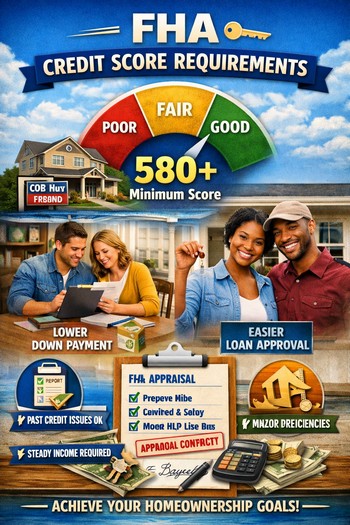 Your FHA credit score determines whether you qualify for an FHA loan and directly impacts the interest rate you'll pay - a single 50-point difference can cost or save you tens of thousands over 30 years. Understanding FHA credit requirements, qualifying standards, and the impact of your FICO score is essential to preparing a strong application and securing the best rates available.
What Is a Credit Score?
A credit score is a three-digit number, typically ranging from 300 to 850, that represents your creditworthiness. It's calculated based on your complete credit history and serves as a snapshot of how likely you are to repay borrowed money on time.
Your credit score, also known as your FICO score, is calculated using specific formulas that measure your financial behavior over time. Lenders use this single number to quickly assess the risk of lending to you.
When you apply for an FHA loan, your FHA FICO requirements will be one of the first things the lender reviews, making it one of the most important numbers in your homebuying journey.
Who Calculates Credit Scores?
Three major credit bureaus independently calculate credit scores based on information they collect about you:
- Equifax
- Experian
- TransUnion
Because each bureau maintains its own database of credit information, you may have three slightly different credit scores depending on which bureau's information is most complete or accurate. Most FHA lenders pull all three scores and use the middle score when making their lending decision.
This is why it's important to understand that your credit score isn't a single, fixed number but rather a set of three scores that lenders use to evaluate your creditworthiness.
How Your Credit Score Is Calculated
Your credit score is determined by five main factors that each contribute a specific percentage to your overall score. Understanding how each factor works will help you identify where you can make the biggest improvements to reach the FHA credit qualifications you need.
Payment History (35%)
This is the most important factor in your credit score calculation. This category measures whether you pay your bills on time, and lenders view this as the strongest indicator of whether you'll pay them on time too.
- On-time payments: Excellent - shows responsible credit use
- Late payments (30, 60, 90 days): Significant deductions - can lower score 50-100 points
- Collections accounts: Major negative impact on your score
- Charge-offs: Serious damage taking years to recover from
- Bankruptcy: Most severe, but impact gradually decreases over time
Collections accounts represent major negative impacts on your score, while charge-offs are serious damage that takes years to recover from. Bankruptcy is the most severe type of negative mark, but its impact does gradually decrease over time.
The key message is clear: a single late payment can drop your score 50 to 100 points, and multiple late payments or collections accounts can lower your score by 150 or more points.
Credit Utilization (30%)
This is the second most important factor and measures how much of your available credit you're actively using. If you have $10,000 in total credit limits across all your credit cards and you're carrying a $8,000 balance, your utilization ratio is 80 percent.
Most lenders prefer to see utilization below 30 percent, which signals responsible credit use. When your utilization falls between 30 and 50 percent, lenders view it as acceptable but not ideal.
| Utilization Rate | Lender View | Credit Impact |
|---|---|---|
| Below 30% | Excellent | Shows responsible use - optimal for your score |
| 30-50% | Acceptable but Not Ideal | Good, but room for improvement |
| 50-80% | Fair - Raises Concern | Signals potential financial stress |
| Above 80% | Poor | Signals potential financial problems |
The good news is that paying down credit card balances is one of the fastest ways to improve your score, making this an excellent strategy for borrowers trying to meet FHA score requirements.
Length of Credit History (15%)
This factor measures how long you've been using credit and contributes 15 percent to your score. Lenders prefer borrowers with longer credit histories because it demonstrates that you can manage credit responsibly over time.
- 10+ years: Excellent
- 5-10 years: Good
- 1-5 years: Fair
- Less than 1 year: Poor
This is an important reason to keep old credit accounts open even if you're not using them, because closing accounts reduces your overall credit history length and can lower your score.
Credit Mix (10%)
Credit mix is the variety of different types of credit you have and accounts for 10 percent of your score. Lenders like to see that you can manage different types of credit responsibly:
- Credit cards (revolving credit)
- Auto loans (installment credit)
- Student loans (installment credit)
- Mortgages (installment credit)
- Lines of credit (revolving credit)
Having multiple types of credit in your history shows lenders that you can handle various financial situations.
New Credit (10%)
This factor looks at whether you've recently opened new credit accounts and accounts for the remaining 10 percent of your score. New credit inquiries and accounts can temporarily lower your score because:
- Hard inquiries (when you apply for credit) lower your score a few points
- New accounts lower your average age of credit
However, this impact is temporary and typically recovers after a few months.
Credit Score Ranges and What They Mean
| Score Range | Rating | Approval Likelihood | Interest Rate Impact |
|---|---|---|---|
| 740-850 | Excellent | Very likely | Best rates |
| 670-739 | Good | Likely | Good rates |
| 580-669 | Fair | Possible (varies) | Higher rates |
| 300-579 | Poor | Difficult | Much higher rates |
FHA Credit Score Requirements: Minimum Scores and Qualifying Standards
Understanding FHA credit score requirements is essential for borrowers considering an FHA loan. The Federal Housing Administration itself has not established an official minimum FHA credit score.
However, individual FHA lenders do set their own FHA credit score minimums, and this is where the actual requirement comes into play. Most mainstream FHA lenders require an FHA score of 580 as their minimum threshold.
Some lenders require 620 or higher. Some specialty lenders may be willing to work with borrowers in the 550 to 580 range, though this is less common and typically comes with higher interest rates and stricter terms.
FHA Score Requirements by Borrower Profile
Your FHA FICO requirements and qualification prospects depend on which specific range your score falls into.
580-619 (FHA Minimum Range)
- You'll likely qualify for an FHA loan, but approval is not automatic
- Interest rates will be higher than borrowers with stronger scores
- You may face additional documentation requirements
- Down payment requirements might be slightly higher
- Fewer lenders may be willing to work with you
620-659 (Acceptable Range)
- Approval becomes more likely with most lenders
- Interest rates improve compared to the 580-619 range
- More lending options become available to you
- Documentation and verification requirements are standard
660+ (Strong Range)
- Approval becomes very likely
- Interest rates improve significantly
- You have the widest range of lender options
- Approval timelines are typically faster
How to Find FHA 580 Lenders
If your credit score is at or near the FHA loan 580 minimum, you may need to search specifically for lenders willing to work with you at this threshold. Finding an FHA 580 lender requires some targeted research.
- Specialty mortgage brokers: Often have relationships with multiple lenders who accept lower credit scores
- Credit unions: Frequently have more flexible FHA credit requirements than traditional banks
- Online lenders: Sometimes specialize specifically in lower-credit borrowers
- Direct contact: Calling lenders and asking about their specific FHA 580 requirements can reveal which ones will work with you
- Mortgage brokers: With connections to multiple lenders, they give you access to more options than you might find on your own
How Your Credit Score Directly Impacts Your Interest Rate
Your credit score has a direct impact on the interest rate you're offered. A lower FHA score means you'll pay a higher interest rate.
Over the course of a 30-year mortgage, this difference can cost you tens of thousands of dollars in additional interest.
Real-World Example: FHA Loan Impact
Consider a $300,000 FHA loan using current market rates:
| Credit Score | Interest Rate | Monthly Payment | 30-Year Interest Paid |
|---|---|---|---|
| 750+ | 6.25% | $1,848 | $364,800 |
| 700-749 | 6.50% | $1,896 | $382,560 |
| 660-699 | 6.75% | $1,944 | $399,840 |
| 620-659 | 7.00% | $1,996 | $418,560 |
| 580-619 | 7.50% | $2,098 | $455,280 |
The Financial Cost of Low Credit
A borrower with an FHA score of 580 versus 750 will pay:
- $250 more per month in mortgage payments
- $3,000 more per year in interest
- $90,480 more over 30 years in total interest paid
This is exactly why improving your credit score before you apply for an FHA loan is so valuable. Even a 20 to 30 point improvement can save you thousands of dollars in interest charges.
What Lenders Look for Beyond Your FHA Credit Score
While your FHA FICO requirements and overall credit score matter tremendously, lenders also examine your complete credit report in detail. They want to see more than just a number. They look at the story your credit tells.
Payment History Details
Lenders want to see:
- Consistent on-time payments: A reliable history of paying on time
- Recent good behavior: Even with past late payments, recent perfect payment history demonstrates recovery
- Account age: Older accounts in good standing are positive indicators
- No recent collections: Recent collection accounts are major red flags
Types of Late Payments (Not All Are Equal)
Not all late payments affect your FHA credit qualifications in the same way:
- Mortgage or rent late: Most serious - lenders worry you might not pay them either
- Credit card late: Concerning but less serious than housing-related lates
- Utility or medical late: Less concerning than credit card late
A single 30-day late credit card payment from two years ago might not prevent your FHA loan approval. But a mortgage late payment from six months ago could be a deal-breaker.
Bankruptcy Recovery
Bankruptcy doesn't automatically disqualify you from getting an FHA loan. The requirements depend on the type:
- Chapter 7 (liquidation): Typically require 2+ years of on-time payments since discharge
- Chapter 13 (reorganization): May approve during payment plan if you're current on payments
Foreclosure or Short Sale Recovery
A foreclosure or short sale doesn't prevent future lending, but lenders need evidence of financial recovery:
- 2+ years of on-time payments since the event
- Stable employment
- Adequate reserves (savings)
Strategies to Improve Your FHA Credit Score Before Applying
If your credit score is lower than you'd like and you're looking to meet stronger FHA score requirements, there are several proven strategies that can help you improve your FHA FICO score before you apply for a loan.
Strategy 1: Pay Down Credit Card Balances (Fastest Impact)
This is the fastest way to improve your score. Reducing your credit card balances lowers your utilization ratio, which accounts for 30 percent of your score.
- Calculate your total credit card limits
- Determine your total balance across all cards
- Target getting below 30% utilization
- Pay down the cards with the highest utilization first
Timeline: 1-2 months of focused payments can improve your score 20-50 points.
Strategy 2: Make All Payments On Time (Critical Foundation)
Late payments damage your score significantly. Start now and maintain perfect on-time payments for at least 6-12 months.
- Set up automatic payments for all of your bills
- Pay at least the minimum on credit cards
- Don't miss a single payment
Timeline: 6-12 months of perfect payment history can improve your score 20-100+ points.
Strategy 3: Don't Close Old Credit Accounts (Protect Your History)
Keep old accounts open even if you're not using them. Closing accounts lowers your available credit and can raise your utilization ratio.
When you close a card with a $10,000 limit, you lose that $10,000 in available credit, which can significantly raise your overall utilization percentage. Keeping these accounts open is free and helps protect your credit profile.
Strategy 4: Dispute Errors on Your Credit Report (Accuracy Matters)
Errors happen on credit reports. If you spot something incorrect, dispute it.
- Get your free credit report from annualcreditreport.com
- Review it carefully for errors like late payments that weren't actually late or accounts you didn't open
- Dispute errors directly with the credit bureau
- Include documentation proving the error
Timeline: Disputes take 30-45 days to resolve, but correcting a major error could improve your score significantly.
Strategy 5: Become an Authorized User (Borrow Good Credit)
If someone with excellent credit is willing to add you, ask to become an authorized user on one of their credit card accounts. Their good payment history can help boost your FHA credit score.
You don't even need to use the card. Just being added as an authorized user can help.
Timeline: You can see score improvements of 20-50+ points in just 1-2 months.
Strategy 6: Don't Apply for New Credit Before Buying (Protect Your Score)
Each credit application (hard inquiry) lowers your score by 5-10 points. Multiple inquiries in a short period look worse to lenders.
- Stop applying for new credit 6 months before you buy
- Don't take on new credit cards, auto loans, or other debt
- If you absolutely need to apply for credit, shop within 14 days (multiple inquiries in 14 days typically count as one inquiry)
Strategy 7: Be Strategic About Paying Off Collections (Timing Matters)
This might sound counterintuitive, but paying off a collections account right before applying for an FHA mortgage can temporarily lower your score. When you pay, the account gets reported as "paid collections," and this recent activity can hurt your score in the short term.
The better approach is to pay off collections now and wait 6 or more months before applying for your FHA loan. This gives the account time to age and minimizes its impact on your score.
Timeline for Credit Score Improvement
Quick Improvements (1-2 Months)
- Paying down credit card balances: 20-50 point increase
- Becoming an authorized user: 20-50 point increase
- Disputing errors: Varies, could be significant
Medium-Term Improvements (3-6 Months)
- 6 months of on-time payments: 30-100 point increase
- Paying off smaller debts completely: 20-50 point increase
- Bringing credit cards below 30% utilization: 30-50 point increase
Long-Term Improvements (6-24 Months)
- 12-24 months of perfect payment history: 100+ point increase
- Collections aging and falling off your report: Significant improvement
- Late payments aging (especially after 24+ months): Gradual improvement
- Bankruptcy recovery (2-7 years): Gradual improvement
FHA Credit Score Strategy Based on Your Timeline
If You're Applying in 1-2 Months
- Focus on paying down credit card balances immediately
- Make sure all of your payments are current with no late payments
- Don't apply for new credit
- Work to get below 30% utilization on all of your cards
If You're Applying in 3-6 Months
- Do everything above
- Make 3-6 months of perfect on-time payments
- Pay off any small collections if possible
- Dispute any errors on your credit report
If You're Applying in 6-12 Months
- Build up 12 months of perfect payment history
- Pay down credit cards aggressively (aim for below 10% if possible)
- Pay off collections accounts and wait 30+ days before applying
- Become an authorized user if possible
- Dispute all errors on your report
What If Your Credit Score Is Really Low (Below 580)?
If your credit score is below 580, getting approved will be difficult, but you still have options. An FHA score of 580 is the standard minimum most lenders accept, but if you're below that threshold, your path forward requires more careful planning.
FHA Is More Flexible
FHA is more flexible than conventional loans when it comes to lower credit scores. While FHA loan 580 is the typical minimum, some specialty FHA lenders may consider scores below this threshold.
However, your options will be limited and your interest rates will be higher. If you're an eligible veteran, VA loans represent an alternative, as they have no official minimum credit score and some VA lenders specialize in working with lower credit scores.
The Best Strategy: Wait and Build Credit
Honestly, if you're below 580, the smartest strategy is spending 6-12 months building your credit before you apply. Focus on:
- Making every single payment on time (set up auto-pay so you don't miss)
- Paying down credit cards to below 30% utilization
- Disputing any errors
- Avoiding new credit applications
Even a 50-100 point improvement opens up far more lender options and can save you tens of thousands in interest over the life of your loan.
Key Takeaways
- No official FHA minimum: The FHA has no official minimum credit score, but most lenders require 580+, some require 620+
- FHA score of 580: This is the threshold accepted by most mainstream FHA lenders
- Finding FHA 580 lenders: Requires research; specialty lenders, credit unions, and mortgage brokers are good options
- Interest rate impact: A 50-point difference can save or cost you tens of thousands over 30 years
- Payment history matters: It's 35% of your score - late payments damage it fastest
- Credit utilization critical: At 30% of your score, paying down cards is your fastest improvement strategy
- Quick wins possible: Card paydown can improve your score 20-50 points in 1-2 months
- Perfect payment history: 6-12 months of on-time payments helps significantly, even with past problems
- If below 580: Waiting and building credit for 6-12 months is worth the effort
Bottom Line
Your FHA credit score is important, but it's not the only factor lenders consider when evaluating your loan application. However, it significantly impacts your interest rate and your approval likelihood.
Your FHA credit requirements are worth taking seriously. If your FHA FICO score is lower than you'd like, focus on the quick wins: paying down credit cards and making every payment on time.
Even modest improvements to your FHA credit qualifications can save you tens of thousands in interest over the life of your loan. Don't rush into homebuying with low credit.
Take time to build it. You'll be rewarded with better rates and more approval options from FHA 580 lenders and mainstream lenders alike.
Your credit score is a tool you can control, and the effort you invest in improving it will pay dividends when you're ready to buy your home.
Sources
- Federal Housing Administration (FHA) Handbook 4000.1: Single Family Mortgage Insurance (https://www.hud.gov/program_offices/housing/sfh/handbook_4000.1)
- FHA Loan Requirements and Guidelines - Credit Score Requirements
- 24 CFR Part 203 - Insuring and Managing Mortgages and Rental Residential Properties
- FHA Technology and Standards Division - Credit History Guidelines
- Fair Isaac Corporation (FICO) - Credit Score Factors and Calculations
- Equifax, Experian, TransUnion - Credit Bureau Reporting Standards
Connect With Us
Please share – it really helps