USDA Loan Limits: How Much Can You Borrow?
 USDA loans don't have a set maximum loan amount like some
government programs do. Instead, your borrowing power is determined
by your income, debt-to-income ratio, and the property value.
Understanding how USDA loan limits work - and how they differ by
location - helps you know what price range you can actually afford
before you start house hunting.
USDA loans don't have a set maximum loan amount like some
government programs do. Instead, your borrowing power is determined
by your income, debt-to-income ratio, and the property value.
Understanding how USDA loan limits work - and how they differ by
location - helps you know what price range you can actually afford
before you start house hunting.
What Are USDA Loan Limits?
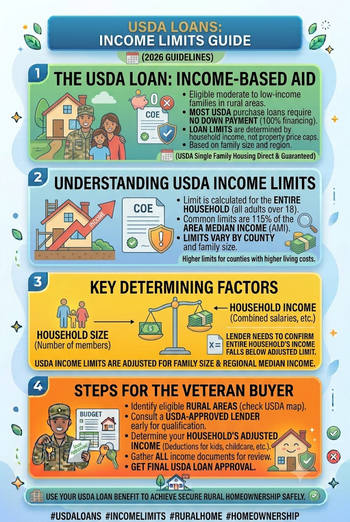
USDA loan limits are tied to area income limits, not loan amounts. The program sets maximum income thresholds by county, and those income limits determine how much you can borrow.
Here's how it works: The USDA establishes an area median income (AMI) for each county. Your household income can't exceed 115% of that AMI to qualify for a USDA loan. The higher your income (as long as you're under the limit), the more you can typically borrow. But the lower your income, the less you can qualify for because lenders use debt-to-income ratios to calculate maximum loan amounts.
So USDA loan limits aren't about a dollar cap on the loan itself - they're about income eligibility, which then affects how much you can borrow through standard mortgage math.
How Income Limits Vary by County
Income limits change annually and vary significantly by location. A rural county in one state might have a $75,000 limit, while a suburban county near a major city might have a $95,000 or higher limit.
The USDA publishes income limits for every county nationwide. These limits depend on the county's actual median household income and the cost of living in that area. Higher-cost counties get higher income limits.
Example: If you're looking at properties in a rural Montana county with a $75,000 income limit, you can earn up to $86,250 (115% of $75,000). If you're looking at properties in a suburban county near Denver with a $92,000 income limit, you can earn up to $105,800.
The income limit is the same whether you're buying a $150,000 home or a $300,000 home - it's purely about qualifying based on household earnings. Your actual borrowing power depends on your income and debt-to-income ratio.
No Official Maximum Loan Amount
Unlike FHA loans (which have max amounts that vary by county) or VA loans (which have no limit), USDA loans have no official maximum loan amount. You could theoretically borrow $500,000 if the property value supports it and you qualify based on income and debt ratios.
In practice, your maximum loan amount is determined by:
Your household income. The higher your income (up to the limit), the more you can borrow.
Your debt-to-income ratio. Lenders typically allow back-end debt ratios up to 41%, meaning your total monthly debts (including mortgage) can be up to 41% of your gross monthly income.
The property's appraised value. You can't borrow more than the property is worth (or slightly more with the guaranty fee added in).
Your credit profile and compensating factors. Lenders may be more flexible with borrowers who have strong credit, stable employment, or significant cash reserves.
Real-World Examples of USDA Loan Limits
Example 1: Lower Income, Smaller Loan
Household income: $50,000 annually Monthly gross income: $4,167 Maximum debt ratio: 41% Maximum total monthly debt: $1,708 Current debts (car, student loans): $400 Available for mortgage payment: $1,308 Estimated maximum loan: $220,000-$240,000 (depending on interest rate, taxes, insurance)
In this scenario, the borrower's income limits how much they can borrow. Even if they found a $400,000 property, they couldn't qualify for the loan because their income doesn't support that payment.
Example 2: Moderate Income, Moderate Loan
Household income: $75,000 annually Monthly gross income: $6,250 Maximum debt ratio: 41% Maximum total monthly debt: $2,562 Current debts: $300 Available for mortgage payment: $2,262 Estimated maximum loan: $380,000-$420,000
This borrower has more borrowing power. If their county's income limit is $75,000, they're right at the threshold. They could qualify for a mid-range home in their area.
Example 3: Higher Income, Larger Loan
Household income: $100,000 annually Monthly gross income: $8,333 Maximum debt ratio: 41% Maximum total monthly debt: $3,416 Current debts: $500 Available for mortgage payment: $2,916 Estimated maximum loan: $490,000-$550,000
This borrower has significant borrowing power. As long as their county income limit is $100,000 or higher (115% = $115,000), they could qualify for a much larger loan amount. Their income is the main limiting factor, not an arbitrary USDA loan cap.
How County Income Limits Affect Your Borrowing Power
County income limits are crucial because they determine your USDA eligibility. If you're above the limit for your county, you don't qualify for USDA at all - there's no exception or appeal process.
But if you're under the limit, the limit doesn't directly cap your loan amount. Instead, your income determines your borrowing power through debt-to-income calculations.
Here's the difference:
If your county has a $75,000 limit and you earn $70,000, you qualify. Your $70,000 income determines how much you can borrow (roughly $220,000-$250,000 depending on other debts).
If your county has a $95,000 limit and you earn $90,000, you qualify. Your $90,000 income determines how much you can borrow (roughly $300,000-$350,000).
The income limit is the ceiling for eligibility. Your actual income determines your borrowing power.
Income Limits Change Annually
USDA updates income limits every year, usually in February or March. If you were above the limit last year, you might qualify this year if your income stayed the same but the limit increased. Conversely, if limits decrease, you might suddenly be ineligible.
This is another reason to check your specific county's current income limit before applying. Don't assume last year's limit applies.
Where to Find Your County's Income Limit
The USDA publishes income limits for every county on their website. You can search by state and county to find the exact limit for the property you're interested in.
The income limits also tell you what properties qualify - USDA specifies eligible areas, and those eligible areas are grouped with income limits. If you're in an eligible area, you can find the income limit for that county immediately.
Ask your lender to confirm the income limit for your specific county and property. Lenders know the limits and can tell you instantly whether you're under the threshold.
USDA Loan Limits vs. FHA and Conventional Limits
| Loan Type | Maximum Loan Amount | Income Limits | How It Works |
|---|---|---|---|
| USDA Loan | No official maximum | Yes (115% of area median income) | Limited by income, not by loan cap. Higher income = higher borrowing power. |
| FHA Loan | Yes, varies by county ($472,030 in most areas) | No income limits | Limited by loan amount cap. Can borrow up to the county maximum regardless of income. |
| Conventional Loan | No official maximum (jumbo loans exist) | No income limits | Limited by credit, down payment, and debt-to-income ratio. No income ceiling. |
The key difference: USDA has income limits (which cap eligibility) but no loan amount limits (you can borrow as much as your income supports). FHA and conventional have loan amount limits in some cases but no income limits.
For rural borrowers, this is usually favorable. You're not capped by an arbitrary loan amount - you're capped by income. If you have good income, you can borrow more with USDA than you might with FHA in the same county.
Can You Exceed the Income Limit?
No. The income limit is absolute. If you earn more than 115% of the area median income, you don't qualify for USDA loans. There's no waiver, exception, or appeal.
This is different from other lending criteria. A lender might stretch your debt ratio or accept a lower credit score with compensating factors. But income limits are hard requirements - exceed them, and you're ineligible.
If you're right at the limit, remember that income is counted on the loan application date. If your income increases after you apply (say, a promotion or bonus comes through), it could affect your eligibility. Lenders typically use the most recent income documentation, so a significant income increase might push you over the limit.
Conversely, if you're just barely under the limit, be careful. A job change, bonus income counted for qualification purposes, or other household income could push you over the threshold.
What Counts Toward the Income Limit?
The USDA counts all household income toward the income limit:
Wages and salary. Self-employment income. Social Security and pensions. Rental income. Child support and alimony. Benefits (unemployment, disability). Bonuses and commissions (if consistent).
Gifts do not count as income - only repayable funds or ongoing income.
If you're on the edge of the income limit, lenders might be able to exclude certain income categories if you request. For example, if you're counting alimony but could divorce and lose that income, a lender might exclude it. But in general, all household income that will continue counts toward the limit.
How to Check Your Borrowing Power
Step 1: Find your county's income limit on the USDA website.
Step 2: Add up all household income (wages, self-employment, benefits, etc.).
Step 3: Verify you're under 115% of the AMI. If yes, you're eligible.
Step 4: List all current debts (car payment, student loans, credit cards, etc.).
Step 5: Calculate your maximum mortgage payment: (Gross monthly income × 0.41) - Current monthly debt payments.
Step 6: Use a mortgage calculator to estimate the loan amount that produces that monthly payment.
Step 7: Contact a USDA lender for an official prequalification based on your actual situation.
The mortgage calculator gives you a ballpark estimate, but only a lender can tell you your actual borrowing power after reviewing all documentation.
Common USDA Loan Limit Questions
Can I borrow more than the property is worth?
No. You can't finance more than the appraised value of the property, except for the guaranty fee which gets rolled into the loan. If a property appraises for $250,000, you can borrow up to $250,000 plus the 1% guaranty fee ($2,500), totaling $252,500. You can't borrow $300,000 for a $250,000 property.
What if I earn exactly the income limit?
You qualify. The limit is 115% of AMI. If the AMI is $75,000, the limit is $86,250. If you earn exactly $86,250, you're at the limit and eligible. If you earn $86,251, you're over the limit and ineligible.
Can the income limit change during my loan process?
Yes. If you're applying in late February or early March when new income limits are released, there could be a change. This is rare, and it would likely help you (limits usually stay the same or increase), but it's possible. Ask your lender if you're applying during this time period.
What if I have a co-borrower with much higher income?
All household income counts. If you earn $50,000 and your co-borrower earns $60,000, your household income is $110,000. Both of you must be under the income limit for the property's county. If you're buying together, you're evaluated as one household.
What if my income is seasonal or varies?
Lenders average your income over the past two years. If you work seasonal jobs or have commission income that fluctuates, they use your average to determine qualifying income. You'll need to provide two years of tax returns to document the average.
Can I get a larger loan if I put money down?
No. USDA loans are zero-down-payment loans. You can't increase your borrowing power by putting money down. Your borrowing power is determined by income and debt-to-income ratio, not down payment amount. (You could use gift money for down payment and reduce the loan amount, but that doesn't increase borrowing power - it decreases it.)
Bottom Line
USDA loan limits aren't about a fixed dollar cap - they're about income eligibility. Your county's income limit determines whether you qualify (115% of area median income). Once you qualify, your actual borrowing power depends on your household income, debt-to-income ratio, and the property's value.
Unlike FHA loans with set maximum amounts, USDA loans have no official cap. You could theoretically borrow $500,000 if you earn enough, have acceptable debts, and find a property worth that much. In practice, most borrowers are limited by their income - which is why knowing your county's income limit upfront is critical.
Check your specific county's income limit before you start house hunting. If you're under the limit, get a prequalification from a USDA lender to find out your actual borrowing power. Then you'll know your budget and can shop confidently in the right price range.
Disclaimer: This article provides general information about USDA loan limits for educational purposes. Income limits, loan terms, and requirements vary by county and change annually. Contact a USDA-approved lender or visit USDA.gov to verify income limits for your specific county, receive an official prequalification, and get current information about USDA lending requirements.
Connect With Us
Please share – it really helps