USDA Direct Loans for Rural Home Buyers
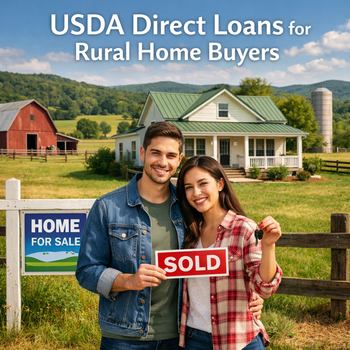 USDA Direct loans are one of the most powerful homeownership
programs available to rural Americans - but they're also one of the
least understood. Here's what makes them different: they're not a
guarantee program. The USDA isn't backing your loan behind the
scenes. Instead, the USDA is the direct lender. The government funds
the loan, sets the rates, and services the account through the
National Financial and Accounting Operations Center (NFAOC) in St.
Louis. If you qualify, you get a loan directly from the federal
government - not from a bank or mortgage company.
USDA Direct loans are one of the most powerful homeownership
programs available to rural Americans - but they're also one of the
least understood. Here's what makes them different: they're not a
guarantee program. The USDA isn't backing your loan behind the
scenes. Instead, the USDA is the direct lender. The government funds
the loan, sets the rates, and services the account through the
National Financial and Accounting Operations Center (NFAOC) in St.
Louis. If you qualify, you get a loan directly from the federal
government - not from a bank or mortgage company.
That distinction matters. A lot.
What Are USDA Direct Loans?
USDA Section 502 Direct loans are part of the Rural Housing Service's mission to help low- and moderate-income rural families own safe, decent homes. The program has been around for decades, but most homebuyers have never heard of it. That's partly because direct loans are only available through USDA field offices, not through traditional mortgage lenders. You won't see direct loans advertised by banks or brokers. You have to go directly to your local USDA Rural Development office to apply.
The core premise is straightforward: if you live in a rural area, have a modest income, and can't get a loan from a private lender, the USDA will lend you the money directly to buy a home. No down payment required. No private mortgage insurance. Competitive interest rates set by the federal government.
Who Can Get a USDA Direct Loan?
Eligibility has three main gates: income, property location, and creditworthiness. Miss one, and you're done.
Income Limits
You must have "adjusted annual income" at or below the low-income limit for your county at the time of loan approval. These limits vary widely by location. A family might qualify in rural Alabama but not in rural Colorado. The USDA publishes income limits by county every year. They're typically in the range of $50,000 to $90,000 for a family of four, but that's just a rough estimate - your actual limit depends entirely on your county.
Here's an important distinction: USDA calculates "adjusted annual income," not gross income. That means certain deductions are allowed - dependent care expenses, medical expenses for elderly household members, disability assistance, and a few others. If you're just barely over the income limit based on gross numbers, you might still qualify once adjusted income is calculated.
Rural Area Designation
The property must be in a designated rural area. The USDA eligibility map has specific geographic boundaries - and they don't always match what people think of as "rural." Some areas 20 miles from a major city are eligible. Some places that feel rural aren't. You can check property eligibility at eligibility.sc.egov.usda.gov. Enter the address and instantly see if it qualifies. If it shows as ineligible, you're done - there's no exception for property location.
Credit and Repayment Ability
You need acceptable credit. The handbook doesn't specify a minimum credit score, but in practice, most field offices expect scores around 600 or higher. Serious delinquencies (payments 30+ days late on multiple accounts within 12 months), unresolved collections, or recent charge-offs are red flags. The underwriter will look at your full credit history and consider extenuating circumstances. Job loss, medical emergencies, or other documented hardships can help explain past problems.
Repayment ability is assessed using two debt ratios:
Front-end ratio (PITI ratio): Your monthly mortgage payment (principal, interest, taxes, insurance) can't exceed 29% of gross monthly income. If you make $4,000 per month, your housing payment limit is roughly $1,160.
Back-end ratio (total debt ratio): Your total monthly debt payments (including the mortgage) can't exceed 41% of gross monthly income. Using the $4,000 example, your total debt ceiling is $1,640.
If your numbers don't fit standard ratios, the underwriter might apply "compensating factors" - things like a large down payment from savings, long-term stable employment, or a low debt-to-income history. But compensating factors aren't guaranteed; the underwriter has discretion.
Other Requirements
You must:
Be a U.S. citizen or eligible non-citizen (green card holders, refugees, asylees qualify; temporary visa holders do not).
Have legal capacity to incur a loan (be of legal age, mentally competent).
Not be suspended or debarred from federal programs (a check done at application).
Personally occupy the dwelling as your primary residence (you can't buy it as an investment property).
Be unable to obtain sufficient credit elsewhere - meaning you've been turned down or can't get affordable terms from a private lender. This is verified through a credit check and documented in the case file.
What Can You Use a USDA Direct Loan For?
The program is strictly for homeownership. You can use direct loan funds for:
Purchasing an existing home in a rural area. The property must be decent, safe, and sanitary - meeting USDA's Minimum Property Standards. Appraisals are required.
Building a new home. You can get a construction loan that converts to permanent financing once the home is complete. The new home must meet all construction standards and code requirements.
Improving or rehabilitating a property you own. Repairs, modernization, or improvements to bring a home up to standards.
Relocating a home to a new site in an eligible rural area.
What you can't use it for: investment properties, rental homes, commercial buildings, or land-only purchases. If the USDA suspects the property will be used for anything other than your primary residence, the loan will be denied.
How Much Can You Borrow?
There's no fixed maximum loan amount. Instead, the USDA calculates how much you can borrow based on your income and repayment ability. The general rule:
Maximum loan amount = Appraised value of the property (or 100% LTV), subject to your repayment ability.
Let's say you want to buy a $200,000 home in an eligible area. Your income qualifies you, and your debt ratios work. You can borrow up to $200,000 with no down payment required. But if your repayment ability only supports a $150,000 loan payment, that becomes your ceiling regardless of property value.
The calculation is complex because it involves your adjusted annual income, the repayment income calculation (which sometimes differs from annual income), dependent deductions, asset income, and the standard 33-year loan term. The USDA uses a system called UniFi to compute this automatically once your income and debt are verified.
In practical terms, most borrowers can expect to qualify for a loan in the $150,000 to $300,000 range, depending on their income and existing debt. A family making $55,000 per year might qualify for a $200,000 loan. A family making $80,000 might qualify for $280,000.
Loan Terms, Interest Rates, and Costs
Loan Term
The standard is 33 years. The USDA can approve up to 38 years in certain situations (typically for applicants with lower incomes or higher debt ratios). Some applicants choose shorter terms, but 33 years is the standard.
Interest Rate
USDA sets the interest rate weekly based on market conditions. The rate you receive depends on when your loan closes. As of early 2026, direct loan rates range from roughly 6.0% to 7.0%, but this changes constantly. You don't lock a rate until your loan is formally approved for a specific property.
Upfront Costs
Application fee: Most field offices charge a modest application fee (typically $100–$300) to cover the cost of credit reports and initial processing.
Appraisal: The property must be appraised. The USDA pays for this directly; you don't pay the appraiser.
Title insurance: Required. Cost varies by state but typically $600–$1,200 for a $200,000 property.
Survey: Usually required for vacant land or new construction. Cost is typically $300–$800.
Closing costs: Attorney or title company fees for closing vary by state. Generally $800–$1,500.
Monthly Costs: The Real Numbers
Let's walk through a real example. Assume you're buying a $210,000 home in a rural area with a 6.5% interest rate, 33-year term, and putting no money down.
Loan amount: $210,000
Principal and interest: $1,336 per month
Property taxes: ~$150/month (varies by county; this is a modest estimate)
Homeowners insurance: ~$100/month
HOA fees (if applicable): $0 (most rural homes have none)
Total PITI payment: ~$1,586 per month
Notice what's missing: mortgage insurance. USDA direct loans require no PMI, no upfront mortgage insurance premium (MIP), nothing. Your payment is just P&I, taxes, and insurance. That's a huge advantage over other programs like FHA or conventional financing with less than 20% down, which add mortgage insurance costs.
Payment Subsidies: The Hidden Benefit
Here's where direct loans get really interesting. If your income is low enough, you may qualify for a "payment subsidy." This is a federal benefit that reduces your monthly mortgage payment permanently.
The subsidy works like this: the USDA calculates a "subsidized rate" based on your adjusted annual income and family size. If your income is very low, that subsidized rate might be 1% or 2%. Your note rate might be 6.5%, but you only pay interest on the subsidy rate amount. The federal government picks up the difference.
Example: You're approved for a $200,000 loan at 6.5%. Your subsidized rate is calculated as 2%. You make payments as if the loan were at 2% interest - roughly $960 per month for principal and interest. The USDA covers the gap between the 2% payment and what the full 6.5% payment would be.
This subsidy is permanent as long as you stay in the home and meet your loan obligations. If you sell the home, the subsidy ends. If you refinance to a different program, the subsidy is lost.
Not all borrowers qualify for subsidies. Generally, your adjusted annual income must be low enough that standard debt ratios would be problematic. The subsidy brings the payment down so it becomes manageable.
Real-World Examples
Example 1: First-Time Buyer, Low Income, Gets a Subsidy
Income: $40,000/year (family of 3)
County income limit: $62,000
Status: Qualifies - adjusted income is below low-income limit
Credit score: 610 (acceptable, no major delinquencies)
Property: $160,000 home in rural Mississippi, eligible area
Down payment: $0
Loan amount: $160,000
Market interest rate: 6.5%
Standard P&I payment at 6.5%: $1,024/month
Result: Income is low enough to qualify for subsidy. Subsidized rate calculated at 2.5%. Actual P&I payment: $565/month. Federal subsidy covers the difference. With taxes (~$90) and insurance (~$80), total monthly payment is $735. Very affordable.
Example 2: Moderate Income, No Subsidy, Still Better Rates
Income: $68,000/year (family of 4)
County income limit: $75,000
Status: Qualifies - adjusted income below limit
Credit score: 675 (good credit, no significant issues)
Property: $275,000 home in rural Texas, eligible area
Down payment: $0
Loan amount: $275,000
Market interest rate: 6.5%
P&I payment at 6.5%: $1,766/month
Result: Income is too high for subsidy. Pays full market rate. But no mortgage insurance is required. Total monthly cost (P&I + taxes + insurance): ~$2,100. Comparable conventional loan with 5% down would have PMI added, raising the payment by $200–$300.
USDA Direct vs. Other Loan Programs
| Feature | USDA Direct | USDA Guarantee | FHA | VA | Conventional |
|---|---|---|---|---|---|
| Down Payment Required | 0% | 0% | 3.5% | 0% | 3%–20% |
| Mortgage Insurance | None | Yes (0.35% annual) | Yes (1.85% upfront + annual) | Funding fee only | Yes (if <20% down) |
| Interest Rate (typical) | 6.0%–7.0% | 6.5%–7.5% | 6.5%–7.5% | 5.5%–6.5% | 6.0%–7.5% |
| Payment Subsidy Available | Yes | No | No | No | No |
| Lender Type | Direct from USDA | Private lenders only | Private lenders only | Private lenders only | Private lenders only |
| Geographic Limitation | Rural areas only | Rural areas only | None | None | None |
| Income Limit | Yes (low-income) | Yes (moderate-income) | None | None | None |
| Credit Score Minimum | ~600 (flexible) | ~640 | 580 | None official | 620 |
| Approval Timeline | 60–90 days typical | 45–60 days typical | 45–60 days typical | 45–60 days typical | 30–45 days typical |
The Application Process
Step 1: Pre-Qualification (1–2 weeks)
Visit or call your local USDA Rural Development office. Bring basic financial information: income (pay stubs, tax returns), bank statements, list of debts. An officer will run a preliminary calculation to estimate how much you might qualify to borrow. This is free and non-binding. You walk away knowing whether direct loans make sense for you.
Step 2: Homeownership Education (varies)
USDA requires homeownership education - typically an 8-hour class covering budgeting, maintenance, homeowner rights, and loan obligations. Some offices offer this in-house; others refer you to approved providers. A few applicants are waived if they've had recent formal education, but most have to take it. Plan 1–2 weeks.
Step 3: Formal Application (1 week)
Complete Form RD 410-4 (Uniform Residential Loan Application) and supporting documents: tax returns (2 years), recent pay stubs, list of assets and liabilities, authorization to release credit information. Submit everything to the field office.
Step 4: Property Selection and Appraisal (2–3 weeks)
Once your application is accepted, you can start house hunting. When you find a property and have it under contract, submit the purchase agreement to USDA. They'll order an appraisal and verify the property is in an eligible area and meets Minimum Property Standards. If the appraisal comes back lower than the purchase price, you either negotiate down or walk away - USDA won't lend more than the appraised value.
Step 5: Underwriting and Approval (2–3 weeks)
The underwriter reviews your complete file: income, credit, assets, liabilities, property condition, appraisal. They verify employment and income right before closing. They'll request additional documentation if needed. This is also when a decision is made on whether you qualify for a payment subsidy and what your interest rate will be.
Step 6: Closing (1 week)
The USDA arranges closing with a title company or attorney in your area. You sign the promissory note, mortgage, and closing papers. Funds are disbursed, and the deed is recorded. You get the keys.
Total timeline: 60–90 days from application to closing is typical. It can be faster or slower depending on documentation and market volume.
Strengths and Limitations
Why Choose USDA Direct?
No down payment. Buy with zero cash out of pocket (minus closing costs, which can sometimes be financed).
No mortgage insurance. Unlike FHA, conventional, or USDA Guarantee loans, no PMI or equivalent fees.
Payment subsidies. Low-income families can get permanent payment reductions that private programs don't offer.
Competitive rates. Federal rates are usually in line with or better than private lenders for similar credit profiles.
Flexibility on credit. No hard minimum score; underwriters consider whole picture and allow compensating factors.
33-year term. Longer amortization than typical 30 years, slightly lower payment.
The Catch?
Rural areas only. You're limited to USDA-designated rural zones. Many properties suburban areas don't qualify.
Income limits. If you earn above your county's low-income limit, you don't qualify. This is a hard boundary - no exceptions.
Primary residence requirement. Can't rent it out or use it as investment property.
Direct from USDA only. You can't shop around or refinance with a bank. The loan stays with USDA/NFAOC for the life of the loan.
Slower processing. Typical timeline of 60–90 days is longer than conventional loans. Government bureaucracy adds time.
Property standards. The home must meet USDA Minimum Property Standards. Unique or nonstandard homes (mobile homes, condos, manufactured homes on leased land) may have trouble qualifying.
No loan assumption for non-qualifying buyers. If you want to sell, the new buyer has to qualify for the loan in their name. They can't simply assume it if they don't meet income/credit requirements.
Manufactured Homes and Special Property Types
USDA Direct loans can finance manufactured homes - but with restrictions. The home must be:
Permanently affixed to a foundation (not a mobile home on a rented lot).
New (less than 1 year old) or being renovated to current HUD standards.
Meet thermal and construction requirements in the handbook.
Financed as real property (not personal property).
Condominiums are allowed if the condominium project is approved by USDA. The condo must meet density and amenity standards, and the homeowner's association must be well-run.
Community land trusts can be financed, though there are special restrictions on resale price and right of first refusal.
Most single-family detached homes on owned land qualify easily. Anything unusual should be verified with your field office before you make an offer.
Servicing: What Happens After You Close?
Once your loan is closed, it's serviced by NFAOC in St. Louis. This means:
You mail your payment to NFAOC (or set up electronic payment).
NFAOC maintains your escrow account for taxes and insurance.
If you hit financial hardship, NFAOC handles loan workout agreements, forbearance, and special servicing.
If you want to sell, refinance, or make major changes to the loan, NFAOC processes those requests.
Property taxes and insurance are impounded in your monthly payment, managed through escrow.
You can't refinance to another lender unless you pay the loan off in full. USDA direct loans don't convert - they stay direct loans for the entire term.
Refinancing Options
If you want to refinance a USDA direct loan, your options are limited:
Refinance into another USDA direct loan (rare; only available in certain situations like reducing interest rate or term).
Refinance into a private loan. You can pay off the USDA loan and refinance with a bank, mortgage company, or other lender. You'd lose any payment subsidy and become subject to typical PMI/rates of whatever program you choose.
Streamline refinance into another government program. In limited cases, you might convert to FHA or conventional, but this is uncommon and sacrifices USDA benefits.
Most borrowers don't refinance direct loans. The program's benefits (especially subsidies) make moving to another lender unattractive. If rates drop significantly, you might consider it - but calculate carefully to see if you truly come out ahead.
Frequently Asked Questions
Can I get a USDA direct loan if I've had foreclosure or bankruptcy?
Not immediately. USDA requires a waiting period: at least 3 years from discharge for bankruptcy, 3 years from foreclosure completion. The underwriter will consider extenuating circumstances. Recent divorce, job loss, medical emergency, or other documented hardship can strengthen your case.
What if my spouse has bad credit but I have good credit?
If you're applying jointly, both spouses' credit is reviewed. If one has serious delinquencies, the whole application may be denied unless compensating factors apply. Some offices allow one spouse to not be on the note if their credit is very poor and the borrowing spouse's alone supports the loan. This is rare and requires field office approval.
Can I use a USDA direct loan to buy a second home or investment property?
No. The property must be your primary residence. You must personally occupy it. If USDA discovers you're renting it out, the loan is in breach and can be called due in full.
How does income get calculated if I'm self-employed?
USDA reviews 2 years of tax returns and may average income or use the most recent year, whichever is less favorable to the applicant. They look for sustainable, documentable income. Boom-and-bust businesses, startups, and seasonal income are scrutinized carefully. You might need accountant documentation or business plan to support income claims.
What if the appraisal comes back low?
You have options: negotiate the purchase price down, bring additional cash to cover the gap, or walk away. USDA will only finance up to the appraised value. If you negotiate down, the loan amount decreases, which also affects your payment and overall affordability. This sometimes forces a renegotiation of the deal.
Can I get a loan if I'm a non-citizen?
Yes, if you're an eligible non-citizen: permanent resident (green card holder), refugee, or asylee. You'll need to provide your immigration status documentation and eligible work authorization. Temporary visa holders, H1-B workers, and undocumented immigrants don't qualify.
What happens if I pay off my loan early?
You can pay it off anytime with no prepayment penalty. If you have a payment subsidy, prepayment doesn't trigger recapture (the government doesn't claw back the subsidy benefit like some other programs). You simply pay the remaining balance and the loan is satisfied.
Can I get a second mortgage or home equity loan while I have a USDA direct loan?
Yes, but the USDA loan is in first lien position. Any second mortgage must be subordinate. USDA must approve subordination in writing. Some field offices are flexible; others restrict it. Ask your loan officer before assuming you can add a second lien.
How long does the application process take?
Typically 60–90 days from initial application to closing, assuming you have all documentation ready and the property appraises at contract price. It can be faster (45 days) if you're organized and there are no red flags. It can be slower (120+ days) if there are credit issues, missing documentation, or property complications that need investigation.
What if I want to refinance into a different program after a few years?
You can refinance with any other program - USDA Guarantee, conventional, FHA, VA (if eligible), etc. You'll have to pay off the direct loan in full and go through a new application. You'll lose the payment subsidy and be subject to new appraisal, credit check, and terms. In some markets, refinancing makes sense after rates drop or if your income increases and you want to move to a non-subsidized program.
Key Takeaways
USDA Direct loans are government-funded loans, not guarantee programs. You borrow directly from the USDA, not from a bank. This means federal rates, federal servicing, and federal flexibility.
No down payment and no mortgage insurance. Unlike FHA, conventional, or even USDA Guarantee, direct loans require zero down payment and impose no PMI cost - a huge advantage for low-income buyers.
Income limits and rural areas are hard boundaries. If your income exceeds the county limit or the property is outside a rural zone, you don't qualify. No exceptions.
Payment subsidies can make ownership affordable. If your income is low, you might qualify for a permanent subsidy that reduces your payment to 2% or 3% interest, even if the actual note rate is 6%+.
The process takes 60–90 days. Government lending is slower than private lenders, but the trade-off is rates and terms often favoring the borrower.
You're locked into USDA for the life of the loan. You can't refinance with other lenders without paying off the loan in full. This is worth thinking about upfront, especially if you have subsidies.
Property must be your primary residence. You can't rent it out, buy it as an investment, or use it for anything but personal occupancy.
Bottom Line
USDA Direct loans are one of the best-kept secrets in rural homeownership. If you live in an eligible area, have low-to-moderate income, and can qualify on credit and repayment ability, a direct loan beats most alternatives. No down payment, no mortgage insurance, competitive rates, and possible payment subsidies add up to real monthly savings for families making $40,000 to $75,000 per year.
The catch is the obscurity and the restrictions: rural-only, income-capped, primary residence-only, and processed through federal offices rather than private lenders. If those boxes check for you, put direct loans at the top of your list.
Start by contacting your local USDA Rural Development office. A quick pre-qualification call will tell you whether you're in an eligible area and what income range you need to hit. From there, the path is straightforward: education, application, property search, appraisal, underwriting, closing. Sixty to ninety days later, you own a home with zero down payment and likely a payment subsidy that makes monthly ownership affordable.
Connect With Us
Please share – it really helps