USDA Loan Credit Score Requirements: Direct vs. Guarantee
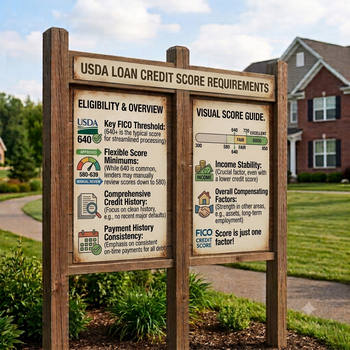 One of the biggest advantages of USDA loans is credit
flexibility. Unlike conventional loans that prefer 680+, USDA Direct
can work with credit scores as low as 580-600. USDA Guarantee
typically requires 640-660. Both programs are more forgiving than
you might think, especially if you have an explanation for past
issues.
One of the biggest advantages of USDA loans is credit
flexibility. Unlike conventional loans that prefer 680+, USDA Direct
can work with credit scores as low as 580-600. USDA Guarantee
typically requires 640-660. Both programs are more forgiving than
you might think, especially if you have an explanation for past
issues.
But here's the catch: low credit scores don't guarantee approval. Both programs look at the whole picture - not just the number. Payment history, recent delinquencies, debt levels, and income stability all matter. A 600 score with clean recent history can beat a 650 score with recent missed payments.
This article breaks down credit requirements for both USDA Direct and USDA Guarantee, what lenders actually care about, and how to improve your chances if your score is borderline.
USDA Direct vs. Guarantee: Credit Score Comparison
| Credit Factor | USDA Direct | USDA Guarantee |
|---|---|---|
| Minimum Credit Score | ~580-600 (flexible) | ~640-660 (stricter) |
| Recent 30-Day Lates | Case-by-case (flexible) | Not acceptable in last 12 months |
| Recent 60-Day Lates | Not acceptable in last 24 months | Not acceptable in last 24 months |
| Bankruptcy | 2+ years if discharged (case-by-case) | 3+ years if discharged |
| Foreclosure | 3+ years (case-by-case) | 3+ years (stricter) |
| Collections | Paid or paid-off (case-by-case) | Must be paid before closing |
| Charge-offs | Can be acceptable with explanation | Typically not acceptable |
| Tax Liens | Must be resolved before closing | Must be resolved before closing |
| Overall Flexibility | High (case-by-case) | Moderate (strict guidelines) |
Part 1: USDA Direct Loan Credit Requirements
Minimum Credit Score
USDA Direct doesn't have a hard minimum, but most loans close with scores of 580-620. Scores below 600 require strong compensating factors (stable income, low debt, good employment history). Scores above 620 are approved more routinely.
Here's what matters: USDA Direct underwriters look at your credit profile holistically. A 600 score with 10 years of perfect payment history beats a 640 score with recent missed payments.
Recent Payment History (Last 24 Months)
This is critical. USDA Direct cares most about what you've done recently. If you've made on-time payments for the last 12-24 months, that counts for a lot - even if you had issues before that.
Recent 30-day lates: These need explanation. One 30-day late from 12 months ago? Might be acceptable with a letter explaining the cause. Multiple recent 30-day lates? Automatic decline.
Recent 60-day lates: Not acceptable in the last 24 months. If you have a 60-day late within the last two years, USDA Direct will likely decline you. Wait it out or apply to USDA Guarantee (which also has the same rule).
Older Negative Items (Paid or Settled)
USDA Direct is forgiving on older issues if you've resolved them. Collections paid in full? Fine. Charge-off from 4 years ago? Case-by-case, but often acceptable if you've been clean since. Bankruptcy discharged 2+ years ago? Can work with strong compensating factors.
The key is demonstrating rehabilitation. If you had a rough patch 3-4 years ago and have been squeaky clean since, USDA Direct will work with you.
Tax Liens and Judgments
All liens must be resolved (paid off or released) before closing. USDA Direct won't close until the lien is gone. This is non-negotiable.
If you have an outstanding IRS tax lien, you'll need to either pay it off, establish a payment plan with the IRS and get written approval from USDA, or resolve it before applying.
Bankruptcy
USDA Direct allows applications 2+ years after discharge with strong compensating factors. You'll need to explain the cause and show you've recovered financially. Job loss? Medical emergency? Divorce? If you can explain it and demonstrate financial recovery, you're eligible.
The underwriter wants to see that the bankruptcy was an isolated event and that your financial situation has stabilized since.
Foreclosure
USDA Direct requires 3+ years since foreclosure completion. The underwriter will want a detailed explanation of what happened (job loss, medical hardship, etc.) and proof that your financial situation is now stable.
A foreclosure is a red flag, but not an automatic decline if you've had three clean years since and can explain the cause.
USDA Direct Credit Summary
USDA Direct is the most flexible federal program. If you have fair-to-good credit (600-680) with a reasonable credit history and explanation for any negative items, you likely qualify. The program focuses on recent payment behavior and evidence of financial recovery, not just the score itself.
Best candidates for USDA Direct: 620+ credit score, one year or more of on-time payments, stable employment, reasonable debt levels.
Part 2: USDA Guarantee Credit Requirements
Minimum Credit Score
USDA Guarantee typically requires 640-660 minimum. Some lenders will go as low as 620 with compensating factors, but it's rare. This is stricter than USDA Direct.
The reason? USDA Guarantee is private lending with USDA backing. Banks set their own credit requirements and tend to be more conservative than the government program.
Recent Payment History (Last 24 Months)
USDA Guarantee follows Fannie Mae guidelines, which are stricter than USDA Direct. Recent 30-day lates are not acceptable in the last 12 months unless it's an isolated incident with excellent explanation. Recent 60-day lates are not acceptable in the last 24 months.
Rule of thumb: If you have any 60-day late in the last two years, both USDA Direct and USDA Guarantee will decline you. Wait it out or apply after the 24-month mark.
Collections and Charge-offs
Collections must be paid in full before closing. A paid collection shows responsibility, but the unpaid collection on your report is a problem.
Charge-offs are typically not acceptable on USDA Guarantee. If you have an unpaid charge-off, you'll likely be declined unless you settle it before application.
Tax Liens and Judgments
Same as USDA Direct: all liens must be resolved before closing. IRS tax liens, court judgments, etc. must be paid off or released.
Bankruptcy
USDA Guarantee requires 3+ years after discharge. This is stricter than USDA Direct (which allows 2+ years). You'll need to document the cause and show financial recovery.
Foreclosure
USDA Guarantee requires 3+ years since foreclosure, same as USDA Direct. Detailed explanation required.
USDA Guarantee Credit Summary
USDA Guarantee is moderate in flexibility. If you have good credit (640+) with clean payment history, you're a strong candidate. If you have fair credit (620-640) or recent negative items, you'll struggle. USDA Guarantee lenders follow stricter guidelines than USDA Direct.
Best candidates for USDA Guarantee: 640+ credit score, two years or more of on-time payments, minimal or no recent negative items, stable employment, low debt.
USDA Direct vs. Guarantee: Which Is Right for Your Credit?
If your credit score is 620-660
Apply to USDA Direct first. You're more likely to be approved. If you don't qualify for Direct, try USDA Guarantee - some lenders will approve at 620+ with compensating factors.
If your credit score is 660+
You qualify for both. Compare terms and interest rates. USDA Guarantee typically has lower rates due to stricter credit requirements, but USDA Direct might offer better terms if you qualify for a payment subsidy.
If you have recent negative items (30-day lates, charge-offs)
USDA Direct is more forgiving. Most USDA Guarantee lenders will decline you until the items age beyond 12-24 months. Wait it out if possible, or apply to USDA Direct and hope for a sympathetic underwriter.
If you have older negative items (paid collections, old charge-offs, bankruptcy 2+ years ago)
USDA Direct is likely your best option. As long as you've been clean for 12-24 months, USDA Direct will consider your application despite the old issues. USDA Guarantee will be more skeptical.
Common Credit Scenarios
Scenario 1: 650 credit score, one 30-day late from 6 months ago, otherwise clean
USDA Direct: Likely to approve with explanation letter. USDA Guarantee: May decline due to recent 30-day late. Recommendation: Apply to USDA Direct.
Scenario 2: 610 credit score, clean payment history for 2 years, one old bankruptcy discharged 3 years ago
USDA Direct: Likely to approve with explanation and compensating factors (low debt, stable income). USDA Guarantee: Possible if lender is flexible, but low credit score is a bigger issue. Recommendation: Apply to USDA Direct first.
Scenario 3: 680 credit score, paid collection from 4 years ago, all recent payments on time
USDA Direct: Should approve - old negative item with clean recent history. USDA Guarantee: Should approve - credit score is strong and negative item is old. Recommendation: Both programs work; compare rates.
Scenario 4: 620 credit score, 60-day late from 12 months ago, otherwise decent
USDA Direct: May decline due to recent 60-day late (outside 24-month window by a few months). USDA Guarantee: Will decline due to both low credit and recent 60-day late. Recommendation: Wait until 60-day late ages out, then reapply.
How to Improve Your USDA Credit Profile
Pay bills on time (most important)
If you're planning to apply within the next 6-12 months, make every single payment on time. Payment history is 35% of your credit score and the biggest factor lenders care about. One year of on-time payments after a rough patch can dramatically improve your approval odds.
Lower your credit utilization
If you're using more than 30% of available credit, pay down balances before applying. Lenders look at this as a sign of financial strain. Lowering utilization can boost your score 20-50 points.
Pay off collections or charge-offs
If you have unpaid collections or charge-offs, settling them before application shows responsibility and can help approval odds (though a paid collection is still slightly negative). For USDA Guarantee, paid collections are required.
Don't apply for new credit
New credit inquiries and new accounts hurt your score and make lenders worried you're desperate. Avoid new credit cards, car loans, and personal loans for 6 months before applying.
Dispute inaccurate items
If you see inaccurate negative items on your credit report, dispute them with the credit bureaus. Inaccuracies are surprisingly common and can be removed, boosting your score significantly.
Get a credit report and understand what's hurting you
Get a free credit report from annualcreditreport.com (the official source). Understand exactly what's hurting your score. Is it too many inquiries? High utilization? Recent lates? Knowing what's dragging you down helps you prioritize improvements.
Will Lenders Actually Look Beyond the Credit Score?
Yes, but with caveats. USDA Direct underwriters are trained to consider the whole picture. A letter explaining a past hardship can make a difference if your recent payment history is clean.
However, don't expect a lender to overlook a recent 60-day late just because you have a good explanation. Some things are automatic declines. But if you have a score of 600, one old bankruptcy, and two clean years since, a sympathetic USDA Direct underwriter will work with you.
USDA Guarantee lenders follow stricter guidelines and have less flexibility. If the automated system flags you as too risky, it's hard to overcome. They're less willing to consider explanations.
Key Takeaways
USDA Direct is the most credit-flexible federal loan program. Scores of 580-620 are possible with good recent payment history and explanation for older issues.
USDA Guarantee requires 640+ typically, stricter guidelines, and minimal recent negative items. It's the conservative option.
Recent payment history matters more than the score itself. One year of perfect payments after a rough patch can make you approvable despite lower credit.
Some things are automatic declines: recent 60-day lates, unpaid tax liens, recent foreclosure (less than 3 years). These are hard to overcome.
Old negative items (paid collections, old bankruptcies, charge-offs from years ago) are increasingly forgivable as time passes, especially if you've been clean since.
If you have fair credit and recent issues, apply to USDA Direct first. If you have good credit and clean history, both programs work - compare rates and terms.
If you're rejected, ask why. Specific feedback helps you improve and reapply in 6-12 months with a stronger profile.
Bottom Line
USDA loans are genuinely credit-flexible compared to conventional and FHA programs. USDA Direct will work with credit scores in the 580-620 range if your recent history is clean. USDA Guarantee requires higher scores and stricter guidelines but is still more flexible than conventional loans.
The key is recent payment behavior. If you've been paying on time for the last 12-24 months, you're in good shape for USDA Direct. If you have recent missed payments, wait it out or build more clean history. The longer your recent positive track record, the better your chances, regardless of score.
Get pre-approved and ask your lender specifically what's holding your application back. Then you can address those issues before final application. Credit is fixable if you have time - start paying bills on time now.
Connect With Us
Please share – it really helps