USDA Loan Debt-to-Income Ratio Requirements: Direct vs. Guarantee
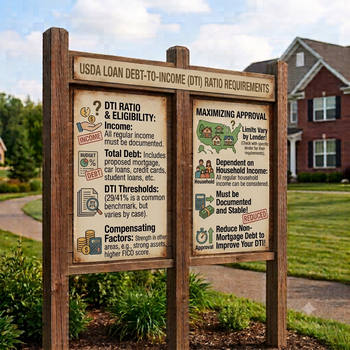 Your debt-to-income ratio (DTI) is one of the biggest factors
lenders use to decide if you can afford a mortgage. USDA loans are
more flexible on DTI than conventional loans, but there are still
limits. USDA Direct and USDA Guarantee have similar DTI
requirements, but they handle exceptions differently.
Your debt-to-income ratio (DTI) is one of the biggest factors
lenders use to decide if you can afford a mortgage. USDA loans are
more flexible on DTI than conventional loans, but there are still
limits. USDA Direct and USDA Guarantee have similar DTI
requirements, but they handle exceptions differently.
Here's the key: USDA Direct typically allows up to 41-43% back-end DTI with compensating factors. USDA Guarantee typically allows 43% but sometimes goes higher with strong compensating factors. Both programs are more flexible than conventional loans (which max out at 43%) because they recognize that rural borrowers sometimes have unique financial situations.
Your DTI matters because it tells lenders whether you have enough income left over after all debts to actually afford the mortgage payment. A high DTI means you're stretched thin. A low DTI means you have cushion.
This article breaks down how DTI is calculated, what ratios USDA lenders accept, and how to improve your DTI if it's too high.
USDA DIRECT VS. GUARANTEE: DTI COMPARISON TABLE
DTI Factor | USDA Direct | USDA Guarantee Front-End Ratio (Housing Only) | 29% (preferred) | 29% (preferred) Back-End Ratio (All Debts) | 41% (standard), up to 43% with compensating factors | 43% (standard), sometimes higher with compensating factors Maximum Back-End (With Strong Factors) | 43-45% (case-by-case) | 45-50% (case-by-case, lender-dependent) Compensating Factors | Significant cash reserves, stable income, low debt | Same as Direct What Counts Toward DTI | All recurring debt payments, new mortgage payment | All recurring debt payments, new mortgage payment What Doesn't Count | Childcare ending in 1-2 years, medical debt being paid off | Same as Direct Student Loans | Include actual payment or 0.5% of balance | Include actual payment or 0.5-1% of balance Car Loans Ending Soon | Can sometimes exclude if ending within 12 months | Can sometimes exclude if ending within 12 months Flexibility on High DTI | High (case-by-case approval with factors) | Moderate (stricter guidelines)
UNDERSTANDING DEBT-TO-INCOME RATIOS
What is DTI?
Debt-to-income ratio is your monthly debt payments divided by your gross monthly income. It shows what percentage of your income goes to debt.
Formula: Monthly Debt Payments / Gross Monthly Income = DTI%
Example: You make $5,000/month gross. Your monthly debts total $1,800 (car loan $400, credit cards $300, student loans $200, new mortgage $900). DTI = $1,800 / $5,000 = 36%.
Front-End Ratio vs. Back-End Ratio
Front-end ratio is just housing costs divided by gross income. This includes only the new mortgage payment (P&I, taxes, insurance, mortgage insurance if applicable).
Back-end ratio includes all debts: the mortgage payment plus car loans, credit cards, student loans, personal loans, child support, alimony, and any other recurring monthly debt.
Lenders care more about back-end ratio because it shows your total debt burden. Front-end is checked but is usually much lower.
Why DTI Matters
A high DTI means little money is left after paying debts. If you lose your job or have an emergency, you're vulnerable. Lenders want to see that you have cushion after all debts are paid.
A person with 40% DTI has 60% of income left for taxes, food, utilities, insurance, childcare, and other living expenses. A person with 50% DTI has only 50% left, which is tight.
PART 1: USDA DIRECT DTI REQUIREMENTS
Standard Back-End DTI: 41%
USDA Direct standard maximum back-end DTI is 41%. This is higher than conventional loans (43% max) because USDA Direct recognizes rural borrowers' situations.
With compensating factors, USDA Direct can approve up to 43% back-end DTI. With very strong compensating factors, some underwriters will go to 45%.
Example: You make $4,500/month gross. All your monthly debts (including new mortgage) total $1,845. DTI = $1,845 / $4,500 = 41%. You're at the standard limit. With strong compensating factors (large cash reserves, stable 10-year employment history), you might be approvable.
Front-End Ratio: 29% (Preferred)
The new mortgage payment alone should not exceed 29% of your gross monthly income. This is a preferred guideline, not a hard rule.
Example: You make $4,500/month. New mortgage payment (P&I, taxes, insurance, PMI) = $1,200. Front-end = $1,200 / $4,500 = 26.7%. This is good - well under 29%.
If your front-end ratio is 35%, lenders look harder at compensating factors. If it's 40%+, approval is unlikely unless you have exceptional circumstances.
What Counts Toward DTI on USDA Direct
Monthly mortgage payment: Principal, interest, taxes, insurance, HOA fees (if applicable).
Auto loans: Full monthly payment.
Credit cards and revolving debt: Either the actual minimum payment OR 5% of the balance (whichever is higher). Most lenders use the minimum payment.
Student loans: Actual payment if you have a payment plan. If in deferment or forbearance, lenders might use 0.5-1% of the total balance.
Personal loans: Full monthly payment.
Child support and alimony: Full monthly amount.
Medical debt: Counted only if it's a documented payment plan with monthly payments.
What Doesn't Count (or Can Be Excluded)
Childcare expenses ending in 1-2 years: Can sometimes be excluded if you document that the expense ends soon (child enters school, etc.).
Accounts in collection: If unpaid and you're working to resolve, might be excluded. If already settled, excluded.
Car payment ending within 12 months: Can sometimes be excluded if you show the loan is nearly paid off.
Income-based expenses: Some unique costs (rural property expenses, farm-related debt) might be negotiable.
Compensating Factors for USDA Direct
If your DTI is above 41% but below 43%, lenders look for compensating factors to justify approval:
Significant liquid reserves: Three to six months of mortgage payments in savings. More reserves = more flexibility on high DTI.
Stable employment history: 10+ years with same employer or steady employment in same field. Job changers are riskier.
Clean payment history: No late payments in the last 24 months. Recent perfection helps offset high DTI.
Increasing income trend: If your income is rising year-over-year, lenders see less risk.
Low consumer debt: High DTI from mortgage is better than high DTI from lots of credit cards.
Significant down payment: Zero-down is riskier than putting 5% down (though USDA allows zero-down).
PART 2: USDA GUARANTEE DTI REQUIREMENTS
Standard Back-End DTI: 43%
USDA Guarantee standard maximum back-end DTI is 43%. This is the same as conventional loans and reflects Fannie Mae guidelines (which USDA Guarantee lenders follow).
With strong compensating factors, USDA Guarantee might approve 45-50% DTI, but this varies by lender. Some USDA Guarantee lenders are stricter and won't exceed 43%.
Example: You make $5,000/month. All debts (including mortgage) = $2,150. DTI = $2,150 / $5,000 = 43%. You're at the standard limit. Approval depends on compensating factors.
Front-End Ratio: 29% (Preferred)
Same as USDA Direct. New mortgage payment should ideally be 29% or less of gross monthly income.
What Counts Toward DTI on USDA Guarantee
Same as USDA Direct. All recurring monthly debt payments count toward DTI calculation.
The main difference: USDA Guarantee lenders (which are private banks) sometimes have stricter interpretations. For example, they might use 1% of student loan balance in deferment instead of 0.5%.
Compensating Factors for USDA Guarantee
Same factors as USDA Direct, but USDA Guarantee lenders are sometimes stricter about what qualifies as a "strong" compensating factor. You might need more cash reserves or longer employment history to justify high DTI on USDA Guarantee.
USDA DIRECT VS. GUARANTEE: WHICH IS MORE FLEXIBLE ON DTI?
USDA Direct is slightly more flexible. The standard 41% (vs. 43% for Guarantee) sounds stricter, but USDA Direct underwriters are more willing to approve cases with DTI above 41% if compensating factors are present. They're trained to look at the whole picture.
USDA Guarantee lenders follow stricter Fannie Mae guidelines. They're more likely to decline a 45% DTI application even with good compensating factors. If the numbers don't fit the formula, approval is harder.
In practice: If your DTI is 40-42%, apply to USDA Direct. If it's 42-45%, compare both programs - Direct might be more flexible. If it's 45%+, Direct is your better bet.
REAL EXAMPLES: DTI CALCULATIONS
Example 1: Married couple, both working, minimal debt
Combined gross income: $6,000/month
Current debts: Car loan $350, credit cards $200, student loans $150 = $700/month
New mortgage payment (estimate for $220K home): $1,400/month P&I, taxes, insurance
Total monthly debt: $700 + $1,400 = $2,100
Back-end DTI: $2,100 / $6,000 = 35%
Front-end DTI: $1,400 / $6,000 = 23%
Assessment: Excellent DTI. Easily approved on both USDA Direct and Guarantee.
Example 2: Single income, moderate debt, older car loan ending soon
Gross income: $4,200/month
Current debts: Car loan $450 (18 months remaining), credit cards $300, student loans $180 = $930/month
New mortgage payment (estimate for $180K home): $1,080/month
Total monthly debt: $930 + $1,080 = $2,010
Back-end DTI: $2,010 / $4,200 = 47.9%
Assessment: High DTI. Standard limits (41-43%) exceeded. BUT: If you exclude the car loan (ending in 18 months), DTI = ($300 + $180 + $1,080) / $4,200 = 37.1%, which is approvable. Lender might allow exclusion because loan is nearly paid off.
Example 3: Married couple, one higher earner, significant existing debt
Combined gross income: $7,000/month
Current debts: Two car loans $600, credit cards $400, student loans $300 = $1,300/month
New mortgage payment (estimate for $250K home): $1,550/month
Total monthly debt: $1,300 + $1,550 = $2,850
Back-end DTI: $2,850 / $7,000 = 40.7%
Assessment: Right at USDA Direct standard limit (41%). Approval depends on compensating factors. If you have $25,000+ in cash reserves and stable 15-year employment history, likely approved on USDA Direct. USDA Guarantee approval is borderline - might require very strong compensating factors or additional underwriting.
Example 4: Self-employed, variable income, high debt from business
Gross income (average last 2 years): $5,500/month
Current debts: Business line of credit $600, personal car loan $350, credit cards $250, student loans $100 = $1,300/month
New mortgage payment: $1,200/month
Total monthly debt: $1,300 + $1,200 = $2,500
Back-end DTI: $2,500 / $5,500 = 45.5%
Assessment: Above both programs' standard limits. Self-employed status makes lenders nervous. Approval possible on USDA Direct with VERY strong compensating factors (6+ months cash reserves, showing increasing income trend, proven business stability). USDA Guarantee unlikely unless self-employment income is eliminated and you requalify on spouse's income alone.
Example 5: Recent college graduate, low debt, just started job
Gross income: $3,800/month
Current debts: Student loans $200, no other debts = $200/month
New mortgage payment: $900/month
Total monthly debt: $200 + $900 = $1,100
Back-end DTI: $1,100 / $3,800 = 28.9%
Front-end DTI: $900 / $3,800 = 23.7%
Assessment: Excellent DTI ratios. BUT: Employment is only 3 months old. Lenders want to see 2 years in the field. Approval might be contingent on written job offer or employer verification that you'll remain employed. DTI is not the issue here - employment history is.
HOW TO CALCULATE YOUR DTI BEFORE APPLYING
Step 1: List all monthly debt payments
Car loans (full payment) Credit cards (minimum payment or 5% of balance, whichever is higher) Student loans (actual payment or 0.5% of balance) Personal loans Child support / alimony Medical debt (if on payment plan) Other recurring debts
Total existing monthly debt: $_
Step 2: Estimate your new mortgage payment
For a rough estimate: Loan amount x 0.005 to 0.006 = monthly P&I
Example: $200,000 loan x 0.0055 = $1,100/month (P&I only)
Add taxes (estimate $200-300/month depending on area), insurance (estimate $100-150/month), PMI if applicable
Total new mortgage payment: $_
Step 3: Calculate back-end DTI
(Existing debt + New mortgage payment) / Gross monthly income = DTI%
Example: ($800 existing + $1,350 mortgage) / $5,000 = 43%
Step 4: Check against USDA limits
If DTI is under 41%, you're good for USDA Direct with no issues.
If DTI is 41-43%, USDA Direct approval depends on compensating factors. USDA Guarantee depends on factors.
If DTI is 43-45%, USDA Guarantee possible with strong factors. USDA Direct possible with very strong factors.
If DTI is 45%+, approval difficult on both programs unless you have exceptional circumstances.
HOW TO IMPROVE YOUR DTI
Pay down existing debt before applying
Every dollar of debt you eliminate reduces your DTI. Paying off a $300 credit card payment saves $300/month from your DTI calculation.
Strategy: Focus on high-balance credit cards first (biggest payment reduction). Even small pay-downs help.
Increase your income
A higher income increases the denominator in the DTI formula, lowering your ratio. If you're about to get a raise or know a bonus is coming, wait until after income verification to apply.
Strategy: Document stable income increases. If you just got promoted with new salary documentation, you might qualify when you wouldn't have three months ago.
Eliminate debts ending soon
If a car loan is ending in 6-12 months, lender might exclude it from DTI calculation. Wait until after the loan is paid off to apply (if possible).
Strategy: Check all loan payoff dates. Any loans within 12 months of payoff might be excluded.
Avoid new debt before applying
Don't take out car loans, credit cards, or personal loans 6 months before applying. Every new debt increases your DTI.
Strategy: Lock in your finances before application. No new purchases, no new debt.
Build cash reserves
Large cash reserves (3-6 months of mortgage payments) are a compensating factor that can justify higher DTI. This takes time but is worth it.
COMMON DTI MISTAKES
Mistake 1: Not including the new mortgage payment in DTI
Wrong: Calculating DTI as only existing debts, not including the mortgage you're about to get.
Right: Always include the estimated new mortgage payment in your DTI calculation.
Mistake 2: Using take-home pay instead of gross income
Wrong: Using your paycheck amount (after taxes) as your income for DTI calculation.
Right: Use gross monthly income (before taxes). DTI is calculated on gross for lender purposes.
Mistake 3: Forgetting about taxes and insurance in the mortgage payment
Wrong: Only calculating P&I (principal and interest) for the mortgage, not including property taxes and homeowners insurance.
Right: Include estimated taxes and insurance. For many rural properties, taxes and insurance add $250-400 to the monthly payment.
Mistake 4: Not counting all debts
Wrong: Forgetting about small credit cards, medical bills on payment plan, or other debts because they're minor.
Right: Include every recurring debt, no matter how small. Even a $50/month payment counts.
Mistake 5: Assuming compensating factors will save you
Wrong: Having 50% DTI and assuming your large savings account will get you approved.
Right: Compensating factors can help with DTI above 41%, but they won't overcome severely high ratios (45%+). They help at the margins, not with extremes.
KEY TAKEAWAYS
USDA Direct standard DTI: 41% back-end, 29% front-end. Can go to 43-45% with strong compensating factors.
USDA Guarantee standard DTI: 43% back-end, 29% front-end. Harder to exceed with compensating factors.
Back-end DTI includes all monthly debt payments plus new mortgage. This is what lenders care about most.
Front-end DTI is just the mortgage payment. Usually lower and less of a constraint.
Compensating factors (cash reserves, stable employment, clean payment history) can justify higher DTI, but they have limits.
DTI is calculated on gross monthly income, not take-home pay. Always use pre-tax income.
Paying down debt before applying is the most effective way to improve DTI.
Eliminating debts within 12 months of payoff can sometimes be excluded from DTI, improving your ratio.
BOTTOM LINE
USDA loans are more flexible on DTI than conventional loans, but there are still limits. Most borrowers with DTI under 41% are approved with no issues. Borrowers at 41-43% might be approved with compensating factors. Borrowers above 43% have a tougher time on both programs.
Calculate your DTI before applying. If it's above 41%, focus on paying down debt or waiting for that raise to come through. Every 1% of DTI improvement increases your approval odds significantly.
Apply to USDA Direct if your DTI is 41-45% with compensating factors. USDA Direct underwriters are more flexible. Apply to USDA Guarantee if your DTI is under 43% and you want a faster, more streamlined approval.
DTI is just one piece of the puzzle. Strong credit history, stable income, and significant cash reserves all matter. But getting DTI as low as possible before application is always a smart move.
Connect With Us
Please share – it really helps