USDA Down Payment Requirements and Zero Down Options
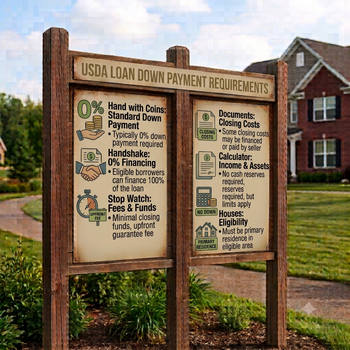 USDA down payment requirements make
homeownership achievable for many rural borrowers who struggle to
save for a traditional down payment. The USDA Rural Development Loan
Program offers the unique benefit of allowing qualified buyers to
purchase homes with zero down payment.
USDA down payment requirements make
homeownership achievable for many rural borrowers who struggle to
save for a traditional down payment. The USDA Rural Development Loan
Program offers the unique benefit of allowing qualified buyers to
purchase homes with zero down payment.
Understanding USDA down payment options helps
you determine if this loan program matches your financial situation.
Many first-time homebuyers discover that zero down payment loans
remove the biggest barrier to homeownership.
The path to rural
homeownership becomes clearer when you explore USDA financing
options.
What Is a USDA Down Payment?
A down payment is the amount of money you contribute toward the purchase price of a home. Most conventional loans require down payments ranging from 3% to 20% of the purchase price. A USDA down payment differs significantly because the USDA allows qualified borrowers to purchase homes with zero down payment.
This means you do not need to save thousands of dollars before
buying a home. USDA down payment assistance comes
in the form of allowing 100% financing, where the loan covers the
entire purchase price.
Your down payment
savings can instead go toward closing costs, home inspections, or
building emergency reserves after purchase.
The USDA Rural Development Loan Program targets borrowers in eligible rural and suburban areas. These borrowers often have lower incomes and limited savings compared to urban homebuyers. The zero down payment structure removes a significant hurdle to achieving homeownership.
Understanding Zero Down Payment USDA Loans
Zero down payment loans represent a major advantage for USDA borrowers. The USDA guarantees a portion of the loan, which allows lenders to offer mortgages without requiring a traditional down payment. This guarantee protects the lender if the borrower stops making payments.
When you obtain a USDA down payment loan with
zero down, the lender provides 100% financing for the home purchase.
You borrow the entire purchase price, and the down payment
requirement disappears.
This structure works because the USDA
stands behind the loan guarantee, reducing the lender's risk.
Your USDA credit score and debt-to-income ratio determine your loan approval more than a large down payment does. Lenders focus on your ability to repay the loan rather than how much money you have saved.
The benefits of zero down payment financing extend beyond just not needing to save:
- You can buy a home sooner without waiting years to save
- Your monthly mortgage payment remains the same whether down payment is 0% or 20%
- You keep your savings for emergencies and home repairs
- You build equity immediately upon purchase
- You can use a USDA seller concession to cover closing costs instead of depleting savings
USDA Down Payment Requirements and Eligibility
While USDA loans offer zero down payment options, borrowers must still meet specific eligibility criteria. Your ability to qualify depends on several factors including income limits, property location, and credit standards.
USDA down payment eligibility requires:
- Purchase of a property in an eligible USDA rural area
- Household income at or below 115% of the area median income
- Proof of U.S. citizenship or legal residency status
- A valid Social Security number
- Acceptable credit history with no recent defaults
- Debt-to-income ratio at or below USDA limits
- Residential occupancy of the purchased property
- Agreement to receive homeownership counseling before closing
The property location check is critical for USDA loans. The USDA
maintains specific maps showing eligible rural areas. Properties in
cities or large suburban areas typically do not qualify for USDA
financing even if you meet all other requirements.
Your real
estate agent can verify property eligibility using the USDA
Eligibility Maps online.
How USDA Down Payment Assistance Works
USDA down payment assistance differs from conventional down payment assistance programs. The USDA does not provide actual grant money for your down payment. Instead, the USDA guarantees the loan, allowing lenders to offer zero down payment financing.
The USDA down payment assistance structure works like this:
- You apply for a USDA loan through an approved lender
- The lender verifies your eligibility for the USDA program
- The USDA provides a guarantee backing a portion of the loan
- The lender approves you for a loan covering 100% of the purchase price
- You close on the home without bringing a down payment to the table
This down payment model removes the obstacle
that stops many aspiring homeowners from purchasing. You do not wait
years accumulating down payment funds. Instead, you move forward
with your homeownership goals immediately.
The USDA guarantee
makes this possible by reducing the lender's financial risk.
Many borrowers use the savings from zero down payment requirements strategically. You might request USDA closing costs assistance from the seller while keeping your own funds intact for post-purchase needs.
USDA Down Payment vs. Other Loan Programs
Comparing USDA down payment requirements to other loan programs shows why USDA loans appeal to many borrowers. Different programs offer different flexibility regarding down payments and who qualifies.
| Loan Program | Minimum Down Payment | Who Qualifies | Best For |
|---|---|---|---|
| USDA Loan | 0% down | Rural property buyers with limited savings | First-time buyers in rural areas |
| FHA Loan | 3.5% down | Borrowers with fair credit and some savings | First-time buyers in urban or suburban areas |
| VA Loan | 0% down | Veterans and active military members | Service members and veterans |
| Conventional Loan | 3% to 20% down | Borrowers with strong credit and income | Buyers with savings and good credit |
The USDA zero down payment feature stands out among loan programs. Only VA loans match this benefit, and VA loans require military service. For rural borrowers without military background, the USDA program provides the only zero down payment option.
FHA loans require a 3.5% down payment, which still represents thousands of dollars on most properties. On a $200,000 home, an FHA down payment requires $7,000. A USDA down payment requires nothing, freeing that $7,000 for other expenses.
Calculating Your USDA Down Payment Savings
Understanding how much you save with zero down payment financing helps you appreciate the USDA program's value. The financial benefit compounds over time as you build equity without initial out-of-pocket investment.
Here is how to calculate your USDA down payment savings:
- Determine the purchase price of the home you want to buy
- Multiply the purchase price by typical down payment percentages (3% to 20%)
- Compare that amount to $0 for a USDA loan
- Add your closing costs to see total out-of-pocket spending with other programs
- Subtract any USDA seller concessions you negotiate
Example calculation: You want to purchase a $200,000 home in an eligible rural area.
- FHA down payment: $200,000 x 3.5% = $7,000
- Conventional down payment: $200,000 x 5% = $10,000
- USDA down payment: $200,000 x 0% = $0
- You save $7,000 to $10,000 with a USDA loan
These savings represent real money you can use for closing costs,
home repairs, or emergency reserves.
Many borrowers find this
advantage makes the USDA program the clear choice for rural
homebuying.
Using Savings Strategically with Zero Down Payment
Smart borrowers use their saved down payment money strategically when obtaining a USDA loan. Rather than spending everything on closing costs, you can allocate funds for multiple purposes after purchase.
Strategic uses for down payment savings include:
- Requesting seller concessions to cover most closing costs
- Setting aside funds for a home inspection and appraisal
- Building an emergency fund for unexpected home repairs
- Purchasing homeowners insurance and property taxes
- Making minor home improvements before moving in
- Maintaining a buffer for the first few months of ownership
This approach strengthens your financial position as a new
homeowner. You own your home without debt beyond the mortgage, and
you have reserves for emergencies.
Many conventional homebuyers
stretch their finances to cover down payments and closing costs,
leaving no safety net. USDA borrowers avoid this trap through zero
down payment financing.
Credit and Income Considerations for USDA Down Payment Loans
While USDA loans offer zero down payment terms, lenders still evaluate your creditworthiness and income carefully. Your USDA qualification depends more on these factors than on how much you can save for a down payment.
Lenders review your credit history to assess your reliability as a borrower. A USDA down payment loan requires:
- Credit score of at least 580 to 620 (varies by lender)
- No recent defaults or late payments
- Acceptable explanation for any past credit issues
- Debt-to-income ratio at or below 41% to 50%
- Stable employment history for the past two years
- Income verification through tax returns and pay stubs
Your income must fall within USDA limits based on family size and
area median income. These income-based guidelines ensure the program
serves borrowers who need it most.
Most USDA borrowers have
household incomes between $45,000 and $75,000 annually, though
limits vary by location.
The absence of a large down payment requirement does not mean the USDA program lacks standards. Lenders apply rigorous income and credit review to ensure you can afford your mortgage payments over the 30-year loan term.
USDA Down Payment and Loan-to-Value Ratios
A USDA down payment of zero percent means your loan-to-value ratio reaches 100%. This metric measures how much you borrow compared to the property value. Understanding this relationship helps explain why the USDA guarantee is so important.
Loan-to-value ratios work like this:
- 100% LTV means you borrow the entire purchase price with zero down payment
- 95% LTV means you bring 5% down and borrow 95% of the price
- 80% LTV means you bring 20% down and borrow 80% of the price
Conventional lenders typically stop lending at 95% LTV without mortgage insurance. Going beyond 95% LTV requires mortgage insurance to protect the lender. USDA loans reach 100% LTV without traditional mortgage insurance through the USDA guarantee instead.
This distinction matters for your monthly payment. USDA loans
include a
USDA funding fee rolled into your loan amount, but this
typically costs less than conventional mortgage insurance premiums.
The net result is that your zero down payment
USDA loan often has a lower monthly payment than an FHA loan
requiring a 3.5% down payment.
Protecting Your Zero Down Payment Investment
Once you close on a home using a USDA down payment of zero percent, protecting your investment becomes important. You have 100% loan-to-value, meaning any property value decrease puts you underwater on the mortgage.
Strategies to protect your zero down payment USDA loan include:
- Maintain the property well to preserve its value
- Make all mortgage payments on time
- Avoid taking on excessive additional debt
- Build equity by paying down your mortgage principal
- Refinance if property values increase significantly
- Keep homeowners insurance current and adequate
Property maintenance is especially important with zero
down payment financing. Deferred maintenance reduces
property value, and you have no equity cushion to absorb value
decreases. Regular repairs and upkeep protect your investment and
maintain loan performance.
Many USDA borrowers take
homeownership seriously because they recognize the responsibility
that comes with 100% financing.
USDA Down Payment Programs and First-Time Buyer Benefits
First-time homebuyers benefit tremendously from USDA down payment programs. The USDA prioritizes helping new homeowners achieve the dream of property ownership without demanding massive down payments.
USDA down payment benefits for first-time buyers include:
- Zero down payment requirement for eligible rural properties
- Lower credit score requirements than conventional loans
- Flexible debt-to-income calculations
- Eligibility for seller concessions to cover closing costs
- Access to homeownership counseling and education
- Longer loan terms spreading payments over 30 years
- Fixed-rate mortgages providing payment stability
These benefits combine to make USDA loans ideal for first-time
rural homebuyers. You do not need substantial savings or perfect
credit to qualify.
The program recognizes that rural borrowers
often earn less than urban counterparts and prioritizes helping them
become homeowners.
Homeownership counseling provided through the USDA program teaches you about budgeting, maintaining your home, and building wealth through property ownership. This education helps you succeed as a homeowner long-term.
Frequently Asked Questions About USDA Down Payment
Can I use a gift for my USDA down payment?
Since USDA loans allow zero down payment, you do not need a down payment from any source, gift or otherwise. However, if you choose to bring money to closing, USDA rules permit gifts from family members. The lender requires documentation showing the gift amount and that the money is truly a gift with no repayment expected. You can also use personal savings or funds from accounts in your name.
What happens to my USDA down payment requirement if I get married before closing?
Marriage does not change your USDA down payment requirement of zero percent. However, marriage may affect your debt-to-income ratio if your spouse has existing debts. Your lender recalculates your qualifying ratios based on combined household income and all debts. The zero down payment remains the same, but your approval amount may change based on the new income and debt picture.
Do I pay USDA funding fees in addition to zero down payment?
Yes, USDA loans include a funding fee that you pay for the USDA guarantee. This fee is not a down payment; rather, it is insurance you pay to get the zero down payment benefit. The funding fee is typically 1% to 3.6% of the loan amount and can be financed into your mortgage. Many borrowers find this fee reasonable compared to the savings from zero down payment requirements.
What happens if USDA down payment rules change after I apply?
USDA loan rules have remained stable for many years, and the zero down payment benefit has been consistent. While regulations can change, historical trends suggest the basic down payment structure will remain unchanged. If rules change, lenders typically grandfather existing applications under prior terms. You should lock in your interest rate once approved to protect your loan terms.
Can I use a USDA down payment loan to buy investment property?
USDA down payment loans require you to occupy the property as your primary residence. You cannot use a USDA loan to purchase rental properties or investment properties where you do not live. The property must be your main home. This requirement ensures the program serves owner-occupants rather than investors. If you want to purchase investment property, you would need a conventional loan instead.
Moving Forward with Your USDA Down Payment Loan
A USDA down payment of zero percent removes one of the biggest obstacles to homeownership. For rural borrowers with limited savings, this program makes homeownership achievable now rather than years away.
The combination of zero down payment requirements, flexible credit standards, and income-based eligibility creates a powerful tool for rural homebuyers. When you add seller concessions and favorable interest rates, USDA loans become highly competitive compared to other mortgage options.
Taking the next step toward homeownership through a USDA loan
begins with finding an approved lender. Your lender verifies your
USDA mortgage eligibility and guides you through the application
process.
The zero down payment advantage awaits
qualified borrowers ready to purchase homes in eligible rural areas.
Connect With Us
Please share – it really helps