USDA Guarantee Loan: How It Works & What You Get
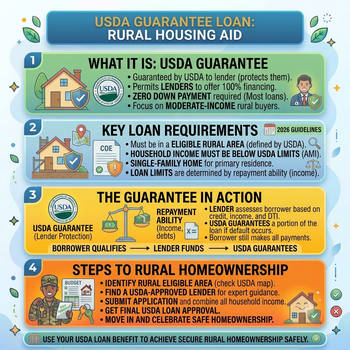 A USDA guarantee loan isn't a loan from the government - it's a
loan from a bank or mortgage lender that's backed by a government
guarantee. The USDA doesn't lend you money directly. Instead, it
promises to cover a portion of the lender's loss if you default on
the loan. This guarantee makes lenders willing to offer better
terms, lower interest rates, and zero down payment financing to
rural homebuyers who might not qualify for conventional mortgages.
A USDA guarantee loan isn't a loan from the government - it's a
loan from a bank or mortgage lender that's backed by a government
guarantee. The USDA doesn't lend you money directly. Instead, it
promises to cover a portion of the lender's loss if you default on
the loan. This guarantee makes lenders willing to offer better
terms, lower interest rates, and zero down payment financing to
rural homebuyers who might not qualify for conventional mortgages.
What Is a Loan Guarantee?
A loan guarantee is a promise from a third party (in this case, the USDA) to pay a lender if the borrower stops paying. The USDA doesn't originate the loan, service it, or collect your payments - the lender handles all of that. But if you default, the USDA will compensate the lender for the loss up to the guarantee amount.
Here's the key difference: With a direct loan, the government is the lender. With a guaranteed loan, a private lender is the lender, and the government guarantees it.
Think of it like insurance. When you buy car insurance, the insurance company promises to cover damage if you get in an accident. With a USDA guarantee, the USDA promises to cover the lender's loss if you default. The insurance protects the insured party (the lender), not you.
Who Offers USDA Guarantee Loans?
USDA guarantee loans are offered by approved private lenders - banks, credit unions, mortgage companies, and other financial institutions. The USDA doesn't lend directly in the guarantee program. Instead, it approves lenders to participate and issues guarantees on loans those lenders originate.
To find a USDA-approved lender, you can search the USDA Rural Development website for a list of participating lenders in your state. Not every bank offers USDA loans, so you may need to shop around or contact multiple lenders to find one in your area.
Common USDA lenders include major national banks, regional banks, credit unions, and mortgage companies. Some lenders specialize in USDA loans and have more experience with the program.
What Does the USDA Guarantee Cover?
The USDA guarantee covers a portion of the loss if you default on the loan. The guarantee is typically issued as a Loan Note Guarantee, a legal document that outlines what the USDA will pay and under what circumstances.
What's Covered
The guarantee covers losses from foreclosure or other liquidation of the property. If you stop paying the mortgage and the lender forecloses, sells the property, and still incurs a loss, the USDA reimburses the lender for that loss (up to the guarantee limit).
Covered losses include principal, accrued interest, taxes paid by the lender, insurance, and reasonable and customary foreclosure costs.
What's Not Covered
The guarantee does NOT cover losses caused by the lender's negligence. If the lender fails to follow USDA program requirements during origination or servicing, the USDA may deny the loss claim or reduce the payout.
The guarantee also does NOT cover losses that result from fraud or misrepresentation by the borrower. If you misrepresented your income or employment on the application, the USDA may refuse to pay the claim.
The guarantee does NOT cover loans made to ineligible borrowers or for ineligible purposes. If the lender originated a loan to someone who didn't qualify (wrong income, wrong property location, wrong property type), the guarantee won't protect the lender.
How Much Does the USDA Guarantee?
The USDA guarantees a maximum of 90% of the loan loss. This means if you borrow $200,000 and default, and the lender forecloses and sells the property for a loss, the USDA will pay up to 90% of that loss. The lender absorbs the remaining 10% loss.
The guarantee doesn't have a fixed dollar limit - it's 90% of whatever loss occurs on that specific loan, up to the original loan amount.
This 90% guarantee encourages lenders to make loans to borrowers who might be riskier (lower credit scores, higher debt ratios, no down payment) because the USDA is sharing most of the risk.
When Does the Guarantee Get Issued?
The USDA guarantee is issued at closing, when the loan funds. The lender submits closing documents to the USDA, the USDA reviews them, and if everything is in order, the USDA issues a Loan Note Guarantee.
The borrower receives a copy of the Loan Note Guarantee as proof that the loan is guaranteed. This document is important if the loan is ever sold to another lender.
The guarantee is in effect for the life of the loan. If you pay off the loan early, the guarantee expires. If you refinance, the guarantee typically transfers to the new loan (if it's a USDA refinance).
How the Guarantee Protects the Lender, Not the Borrower
This is important to understand: The USDA guarantee protects the lender, not you the borrower. You still have to make all the monthly payments, pay your property taxes, maintain homeowners insurance, and comply with all loan terms.
The guarantee doesn't reduce your obligations or protect you if you default. If you stop paying, the lender can still foreclose, you can still lose your home, and your credit will still be damaged.
What the guarantee does is give the lender confidence to lend to you with zero down payment and a lower interest rate, because the lender knows the USDA will cover most of the loss if things go wrong.
Upfront Guarantee Fee
For this guarantee, you pay a one-time upfront guaranty fee of 1% of the loan amount. This fee compensates the USDA for issuing the guarantee and is rolled into your loan balance at closing.
Example: On a $200,000 loan, the guaranty fee is $2,000. You finance $202,000, so you pay for this fee over the life of the loan through your monthly payment.
This fee is non-refundable, even if you pay off the loan early.
Annual Guarantee Fee
In addition to the upfront fee, you pay an annual guaranty fee of 0.35% of your outstanding loan balance each year. This is paid annually and is typically included in your monthly escrow payment or added to your monthly mortgage payment.
Example: On a $200,000 loan, the annual fee is $700 per year, or about $58 per month. As you pay down the principal, this annual fee decreases.
The annual fee continues for the life of the loan.
USDA Guarantee vs. Mortgage Insurance (PMI)
USDA guarantee loans use a guarantee system instead of mortgage insurance. But both serve the same purpose: protecting the lender if you default.
Key differences:
USDA Guarantee: 1% upfront fee rolled into loan, 0.35% annual fee on outstanding balance. No PMI required regardless of down payment.
Conventional Loan with PMI: No upfront fee, but annual PMI of 0.55%-1.5% depending on down payment and credit score. PMI is removed when you reach 20% equity.
VA Loan (if eligible): No upfront guarantee fee for eligible veterans, annual fee varies. No PMI required.
For most borrowers, USDA guarantee fees are comparable to or lower than PMI on conventional loans, especially when you factor in zero down payment.
What Happens If You Default?
If you stop paying your USDA guaranteed loan, here's what happens:
The lender contacts you and tries to collect the payment. If you don't respond, the lender sends a formal notice that you're in default.
The lender tries to work with you on a loss mitigation option: forbearance, loan modification, or a repayment plan. The goal is to get you back on track without foreclosure.
If you don't respond or aren't able to get current, the lender begins foreclosure proceedings. The property is sold at auction or through a real estate agent.
If the foreclosure sale doesn't cover what you owe (including costs), the lender files a loss claim with the USDA. The USDA pays up to 90% of the loss.
Your credit is damaged, you lose the home, and you may owe taxes on any forgiven debt (though the USDA guarantee claim may protect you from a deficiency judgment).
Transferring Your USDA Guarantee if You Sell the Loan
If your lender sells your loan to another lender, the USDA guarantee transfers with the loan. The new lender receives the original Loan Note Guarantee and becomes entitled to file loss claims if you default.
You don't have to do anything - the lenders handle this transfer. Your monthly payment still goes to the servicing lender (the company collecting payments), which may be the original lender or a new servicer.
The guarantee remains in effect regardless of who holds the loan.
Can You Get a USDA Guarantee?
You can get a USDA guarantee if you:
- Are buying in an eligible rural or suburban area. The property must be located in a designated USDA-eligible area.
- Have household income below the area median income limit (115% of AMI). Income limits vary by county.
- Are using the property as your primary residence. Investment properties don't qualify.
- Have acceptable credit and debt-to-income ratio. Minimum 580 credit score, back-end debt ratio up to 41%.
- Are a U.S. citizen or eligible non-citizen. Non-citizens must have valid work authorization.
- Don't have a suspension or debarment from federal programs.
- Meet all other USDA underwriting requirements.
Common Questions About USDA Guarantees
Does the USDA guarantee mean I don't have to pay back the loan?
No. The guarantee only protects the lender if you default. You're still fully responsible for repaying the entire loan. The guarantee doesn't reduce your obligation or forgive the debt.
Can the USDA take my house if I default?
The USDA can't take your house directly - only the lender can foreclose. But if the lender forecloses because you stopped paying, you lose your home. The USDA guarantee protects the lender's loss, not your home.
What if my property value drops - does the guarantee protect me?
No. The guarantee protects the lender from loss if you default, not from property value decline. If your property declines in value and you default, the lender may suffer a loss on foreclosure, and the USDA guarantee covers 90% of that loss. But you still lose the home and your down payment (if any).
Can I refinance and get a new USDA guarantee?
Yes. If you refinance with a USDA loan, you get a new guarantee with a new 1% upfront fee and a new 0.35% annual fee. If you refinance to a conventional loan, the guarantee ends and you'll have PMI instead.
Is the USDA guarantee transferable if I sell my home?
The USDA guarantee stays with the property loan, not with you. If you sell and pay off the loan, the guarantee expires. If the buyer takes out a new USDA loan to purchase the property, they get their own guarantee.
What if the lender goes out of business - does the guarantee still apply?
Yes. The USDA guarantee is independent of the lender's status. Even if the lender fails, if you default on your loan, the USDA will honor the guarantee claim. The loan may be transferred to another servicer, but the guarantee continues.
Can the USDA change the terms of my guarantee?
No. Once the Loan Note Guarantee is issued at closing, the terms are fixed for the life of the loan. The USDA can't change the guarantee percentage, coverage, or terms after closing.
Why doesn't the USDA guarantee cover 100%?
The 90% guarantee encourages lenders to make sound underwriting decisions and service loans responsibly. If the USDA covered 100%, lenders would have no incentive to avoid risky loans. The 10% lender liability keeps lenders accountable.
Bottom Line
A USDA guarantee loan is a loan from a private lender that's backed by a USDA guarantee. The guarantee protects the lender, not you, but it benefits you by enabling zero-down-payment financing and competitive interest rates in rural areas where you might not otherwise qualify.
The guarantee costs 1% upfront (rolled into the loan) plus 0.35% annually (0.35% of outstanding balance). These fees are modest compared to conventional mortgage insurance and give rural homebuyers access to affordable financing they wouldn't have otherwise.
You're still fully responsible for repaying the loan, maintaining the property, and meeting all loan obligations. The guarantee just protects the lender's investment if you default.
If you're buying in a rural or suburban USDA-eligible area and your income is below the limit, a USDA guarantee loan can be an excellent path to homeownership with minimal upfront costs.
Disclaimer: This article provides general information about USDA guarantee loans for educational purposes. Guarantee terms, coverage, and requirements vary by loan program and change over time. Contact a USDA-approved lender or visit USDA.gov for current information about USDA guarantee loan programs and requirements.
Connect With Us
Please share – it really helps