USDA Loan Income Requirements: Direct vs. Guarantee by County
 One of the biggest myths about USDA loans is that they're only
for poor borrowers. That's not true. USDA Direct has income limits,
but they're surprisingly high. USDA Guarantee has no income limits
at all. Both programs work for middle-income borrowers in rural
areas.
One of the biggest myths about USDA loans is that they're only
for poor borrowers. That's not true. USDA Direct has income limits,
but they're surprisingly high. USDA Guarantee has no income limits
at all. Both programs work for middle-income borrowers in rural
areas.
Here's the reality: USDA Direct caps you at low-income limits (usually $50,000-$75,000 depending on county). USDA Guarantee caps you at moderate-income limits (usually $80,000-$110,000+). Both limits are adjusted annually for inflation. And both are based on area median income (AMI), not your state or national income.
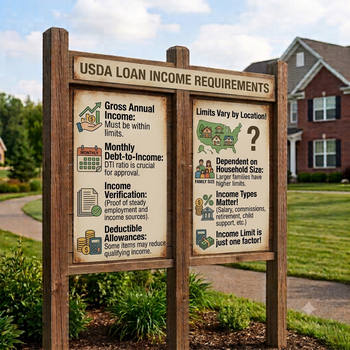
The catch? These limits vary dramatically by county. A rural county with lower median income might have a $55,000 limit. A rural county near a metro area might have a $95,000 limit. You need to check your specific county.
This article breaks down how USDA income limits work, how to verify your county limits, and how both Direct and Guarantee handle income verification.
USDA Direct vs. Guarantee: Income Limits Comparison
| Income Factor | USDA Direct | USDA Guarantee |
|---|---|---|
| Income Limit Type | Low-income limit (80% of AMI) | Moderate-income limit (115% of AMI) |
| Typical Limit Range | $50,000-$75,000 | $80,000-$110,000+ |
| Single County Example | A rural county might be $58,500 | Same county might be $84,450 |
| Income Verification | W-2s, tax returns, pay stubs | Same as Direct |
| Self-Employed Income | Last 2 years of tax returns required | Last 2 years of tax returns required |
| Income from Rental Property | Allowed (after expenses) | Allowed (after expenses) |
| Co-borrower Income Counted | Yes (if on mortgage) | Yes (if on mortgage) |
| Bonus/Overtime Income | Allowed if 2-year history | Allowed if 2-year history |
| No Income Cap | No (hard ceiling at AMI limit) | Yes (no upper limit) |
How USDA Income Limits Work
Area Median Income (AMI) vs. Income Limits
USDA limits are based on Area Median Income (AMI) for your specific county. The USDA sets limits at a percentage of AMI:
USDA Direct: Low-income limit = 80% of AMI
USDA Guarantee: Moderate-income limit = 115% of AMI
Example: Rural County XYZ has an AMI of $65,000. USDA Direct limit would be 80% x $65,000 = $52,000. USDA Guarantee limit would be 115% x $65,000 = $74,750.
The higher the county's AMI, the higher both limits. Rural counties near metro areas have higher AMI and therefore higher USDA income limits.
Why County Limits Vary So Much
Rural counties in different regions have very different median incomes. A rural county in the Midwest might have a median income of $52,000 (making USDA Direct limit $41,600). A rural county outside a major metro area might have a median income of $80,000 (making USDA Direct limit $64,000).
You cannot compare your county's limit to another state's limit. Each county has its own separate limit based on its own AMI.
Annual Adjustments
USDA updates income limits every year (usually March/April) based on HUD's AMI data. Limits typically increase 2-3% annually with inflation. If you were just over the limit last year, you might qualify this year after the adjustment.
Part 1: USDA Direct Income Requirements
The Low-Income Limit (80% of AMI)
Your adjusted gross income (after household deductions) must be at or below your county's low-income limit. This is a hard ceiling. No exceptions. If your income exceeds the limit by even $100, you don't qualify for USDA Direct.
How much income is "adjusted gross income"? The USDA starts with your total household income and makes adjustments:
Include: Wages, salary, self-employment income, rental income (net of expenses), Social Security, pension, investment income, spouse's income (if on the loan).
Exclude: Child support received, public assistance, student loan disbursements, one-time income (inheritance, insurance proceeds).
The underwriter will carefully document all income sources and subtract allowed deductions to calculate your adjusted gross income.
What "Adjusted Gross Income" Means
USDA Direct uses a specific calculation that's different from your tax return AGI. It includes more types of income and makes specific deductions. Common deductions include:
Dependent care costs. If you pay for childcare, this reduces your adjusted income.
Elderly or disabled household member expenses. Care costs for elderly or disabled dependents reduce income.
Calculation example: Household gross income is $62,000. Deductions for dependent care are $4,000. Adjusted gross income = $58,000. If your county limit is $60,000, you qualify.
Household Income Definition
Household income includes all members of the household who will occupy the property as a primary residence, plus certain family members who contribute to household expenses (even if not on the mortgage).
Example: You, your spouse, and your adult child all live in the home. Your child works and contributes to household expenses. All three incomes count toward the household income limit.
Example 2: Your elderly parent lives with you but receives Social Security and you don't expect them to contribute. Their income might still count toward household limit depending on whether they're claimed as a dependent.
Verifying Your County Income Limit
To find your specific county income limit, visit eligibility.sc.egov.usda.gov and search by county. The website shows both USDA Direct (low-income) and USDA Guarantee (moderate-income) limits for every county.
Write down the low-income limit for your county. Compare it to your adjusted gross income. If you're at or below, you can apply to USDA Direct.
If Your Income Exceeds the Direct Limit
If you exceed your county's low-income limit, you don't qualify for USDA Direct. But you might qualify for USDA Guarantee (which has a higher moderate-income limit) if your income is at or below that limit.
Check the moderate-income limit for your county. If you're below that, apply to USDA Guarantee instead.
Part 2: USDA Guarantee Income Requirements
The Moderate-Income Limit (115% of AMI)
Your adjusted gross income must be at or below your county's moderate-income limit. Like USDA Direct, this is a hard ceiling based on your specific county.
The moderate-income limit is typically 40% higher than the low-income (Direct) limit. If Direct is $60,000, Guarantee is usually around $85,000.
Same calculation as USDA Direct applies: start with gross household income, make adjustments, compare to the moderate-income limit.
No Upper Income Limit After Guarantee Threshold
Wait - USDA Guarantee actually has no income limit at all if your income exceeds the moderate-income limit. You can still get a USDA Guarantee loan.
Here's the catch: If you exceed moderate-income, you lose certain benefits. Specifically, you cannot use the subsidy (if Direct was an option) and you pay a slightly higher guarantee fee (0.35% annually vs. lower rates for moderate-income borrowers).
But you can still get the loan if your income is $150,000 or even $200,000. USDA Guarantee truly has no hard income ceiling for loan approval.
Verifying Your County Income Limit
Same website: eligibility.sc.egov.usda.gov. Search your county and note the moderate-income limit. If your adjusted gross income is at or below, you can apply to USDA Guarantee regardless of how much higher your income might be later.
Real Examples: Income Limits by County
Example 1: Rural County in Iowa (Low Median Income Area)
County median income: $52,000
USDA Direct low-income limit: 80% x $52,000 = $41,600
USDA Guarantee moderate-income limit: 115% x $52,000 = $59,800
Your household: $45,000 gross, $2,000 dependent care deduction = $43,000 adjusted income. Qualifies for USDA Direct.
Example 2: Rural County Near Metro Area (Higher Median Income)
County median income: $78,000
USDA Direct low-income limit: 80% x $78,000 = $62,400
USDA Guarantee moderate-income limit: 115% x $78,000 = $89,700
Your household: $68,000 gross, no deductions = $68,000 adjusted income. Does NOT qualify for USDA Direct (exceeds $62,400). Qualifies for USDA Guarantee ($68,000 < $89,700).
Example 3: Suburban Rural County (Very High Median Income)
County median income: $95,000
USDA Direct low-income limit: 80% x $95,000 = $76,000
USDA Guarantee moderate-income limit: 115% x $95,000 = $109,250
Your household: $100,000 gross, no deductions. Does NOT qualify for USDA Direct or USDA Guarantee using the moderate-income limit. But you CAN still get USDA Guarantee as a higher-income borrower (over moderate-income but USDA Guarantee has no hard cap).
Income Verification Requirements
Documentation You'll Need
W-2 employees: Last 2 years of W-2s and recent pay stubs (30 days).
Self-employed: Last 2 years of federal tax returns (Schedule C), profit and loss statement, business license.
Rental income: Last 2 years of tax returns showing rental income, lease agreement, bank deposits if applicable.
Social Security/Pension: Award letter showing monthly benefit amount and recent deposit verification.
Bonus/Overtime: Must have 2-year history of receiving it. Documentation showing it's likely to continue.
Military BAH/housing allowance: Leave and earnings statement or military pay documents.
Lenders Verify Everything
Lenders will verify employment directly with your employer. They'll request recent paystubs. They'll review tax returns for accuracy. They'll verify deposits in your bank account.
Any discrepancies between what you report and what verifies will flag your application for further review. Be accurate and document everything.
Income That Doesn't Count
Child support received: Not counted (though child support paid reduces your income).
Public assistance: Not counted toward income for Direct, but might be counted toward Guarantee in some cases.
Inheritance/insurance proceeds: Not counted as ongoing income.
Temporary bonuses or one-time payments: Not counted unless you have a 2-year history.
Student loans: Disbursements don't count as income.
Household Income Scenarios
Scenario 1: Married couple, single income
Primary earner makes $58,000. Spouse doesn't work. Household income is $58,000. Both incomes count (spouse's is $0). County limit is $65,000. Qualifies for USDA Direct.
Scenario 2: Married couple, both working
Primary earner: $42,000. Spouse: $28,000. Total household income: $70,000. County Direct limit: $65,000. Does NOT qualify for USDA Direct (exceeds by $5,000). Check Guarantee limit which might be $94,000. If yes, qualifies for USDA Guarantee.
Scenario 3: Single parent with dependent child
Parent income: $48,000. Child doesn't work. Household income: $48,000. Plus $3,000 dependent care deduction. Adjusted income: $45,000. County Direct limit: $50,000. Qualifies for USDA Direct.
Scenario 4: Adult children living at home
Parent: $52,000. Adult child 1: $24,000 (works, contributes to household). Adult child 2: $18,000 (works, contributes to household). Total household: $94,000. County Direct limit: $65,000. County Guarantee limit: $94,000. Does NOT qualify for Direct or Guarantee using income limits (exceeds Guarantee moderate-income limit).
Scenario 5: Retired person with Social Security plus rental income
Social Security: $28,000/year. Rental property income (net of expenses): $22,000/year. Total household: $50,000. County Direct limit: $55,000. Qualifies for USDA Direct. Both income sources count toward limit.
Common Income Limit Mistakes
Mistake 1: Using your state's or national median income instead of your county's
Wrong: "My state's median income is $65,000, so my limit is probably $52,000."
Right: Check your specific county on eligibility.sc.egov.usda.gov. It might be $45,000 or $72,000 depending on the county.
Mistake 2: Including income that doesn't count
Wrong: Counting child support received, public assistance, or inheritance as ongoing income.
Right: Only count income likely to continue for the next 3 years (employment, rental income, Social Security, pension).
Mistake 3: Not accounting for deductions
Wrong: Using gross household income without subtracting dependent care or other allowed deductions.
Right: Calculate adjusted gross income by subtracting allowed deductions. This might bring you below the limit even if gross income exceeded it.
Mistake 4: Assuming you can't qualify because you're "too rich"
Wrong: Thinking rural areas have very low income limits and you obviously exceed them.
Right: Check your county. Many rural counties near metro areas have income limits of $80,000-$110,000+. You might qualify.
Mistake 5: Applying to Direct when Guarantee is available at your income level
Wrong: Only applying to USDA Direct and assuming you don't qualify anywhere if you're denied.
Right: If you exceed Direct limit, check Guarantee limit. You might qualify there with the same income.
If You're Over the Income Limit
Option 1: Wait for annual adjustment
USDA updates limits every year. If you're close to the limit now, next year's adjustment might push the limit up enough to include you. Check back in March/April when new limits are published.
Option 2: Reduce your documented household income
If an adult household member's income is pushing you over the limit and they don't need to be on the mortgage, consider removing them from the application. Only include household members who are necessary.
Example: If your adult child lives with you but doesn't need to be on the mortgage, exclude their income. This reduces your household income total.
Option 3: Apply for USDA Guarantee if you're over Direct limit
USDA Guarantee has a higher limit (moderate-income). Even if you exceed Direct, you might qualify for Guarantee. Both programs have the same loan benefits except Guarantee has no subsidy.
Option 4: Try conventional or FHA
If you exceed both Direct and Guarantee income limits, conventional or FHA loans might work. Both have no income limits (though they have debt ratio requirements).
Key Takeaways
USDA Direct income limit is 80% of your county's area median income. Typical range: $50,000-$75,000. This is a hard ceiling - no exceptions.
USDA Guarantee income limit is 115% of your county's area median income for certain benefits. Typical range: $80,000-$110,000. Borrowers above this limit can still get USDA Guarantee loans but lose some benefits.
Income limits vary dramatically by county. Check eligibility.sc.egov.usda.gov for your specific county's limits.
Adjusted gross income is used, not gross income. Deductions for dependent care and other allowed items can reduce your income below the limit.
All household members' income counts if they live in the home, contribute to household expenses, or are claimed as dependents.
USDA updates income limits annually. If you're just over the limit, check back next year.
If you exceed Direct limit, check Guarantee limit before assuming you don't qualify anywhere.
Bottom Line
USDA income limits are higher than most people think. Rural counties near metro areas have limits of $80,000-$110,000+. Even middle-income families often qualify for at least USDA Guarantee.
The key is checking your specific county limit on the USDA website, calculating your adjusted gross income properly, and understanding that Guarantee has a higher limit than Direct.
If you're told you don't qualify due to income, verify it yourself on eligibility.sc.egov.usda.gov. Lenders sometimes make mistakes. Also ask whether the limit applies to Direct or Guarantee - there's a big difference. You might not qualify for Direct but absolutely qualify for Guarantee at your income level.
Income limits increase annually and vary by county. Don't assume you're over the limit without checking your specific county's current limits. You might be approvable.
Connect With Us
Please share – it really helps