USDA Upfront Funding Fee Costs and Financing Options
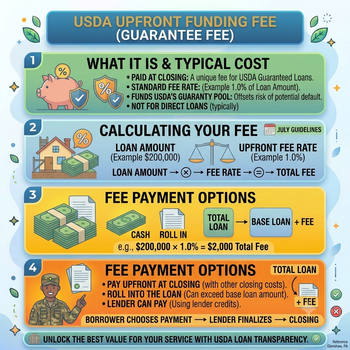 USDA upfront funding fee is a one-time charge
that protects lenders when borrowers default on loans. The USDA
Rural Development Loan Program requires all borrowers to pay this
fee as part of loan approval. Understanding this cost helps you plan
your finances accurately when buying a rural home.
USDA upfront funding fee is a one-time charge
that protects lenders when borrowers default on loans. The USDA
Rural Development Loan Program requires all borrowers to pay this
fee as part of loan approval. Understanding this cost helps you plan
your finances accurately when buying a rural home.
The upfront funding fee for USDA loans typically
ranges from 1% to 3.6% of the total loan amount. Most borrowers find
it reasonable when compared to mortgage insurance required by other
loan programs.
Learning how this fee works and what you can do
about it empowers you to make informed decisions.
What Is the USDA Upfront Funding Fee?
The USDA upfront funding fee is insurance that protects the USDA loan guarantee. When you borrow through the USDA program, the USDA guarantees a portion of the loan to the lender. If you stop paying your mortgage, the USDA guarantee protects the lender from financial loss. The upfront funding fee is what you pay for this protection.
Unlike traditional mortgage insurance that requires monthly
payments, the upfront funding fee is collected
upfront. Most borrowers roll this fee into their loan amount,
spreading the cost across 30 years of payments rather than paying
cash at closing.
This approach makes the fee manageable and
allows borrowers to finance the cost.
The USDA funding fee requirement applies to virtually all USDA loan borrowers. Very few people qualify for exemptions, so most borrowers must budget for this cost.
How Much Is the USDA Upfront Funding Fee?
The USDA upfront funding fee amount depends on several factors including your loan type, military status, and whether you have previously used a USDA loan guarantee. The fee ranges from 1% to 3.6% of your total loan amount.
Typical upfront funding fee percentages include:
- 1% for borrowers with prior USDA loans and good payment history
- 2% for most new USDA borrowers without prior guarantees
- 3% for borrowers with lower credit scores or higher risk profiles
- 3.6% for certain loan purposes or borrower situations
To calculate your USDA upfront funding fee, multiply your total loan amount by the applicable percentage. If you borrow $200,000 and the fee is 2%, you pay $4,000 total. This $4,000 can be financed into your mortgage.
Your lender provides your specific fee percentage during pre-approval. Factors affecting your fee amount include your credit score, debt-to-income ratio, and whether you have used USDA benefits previously.
When Do You Pay the USDA Upfront Funding Fee?
Most USDA borrowers pay the upfront funding fee at closing by financing it into the loan. The fee amount is added to your total borrowing, so you do not need to bring cash to closing for this expense. This financing option makes homeownership more accessible since the cost spreads across your loan term.
Payment options for the USDA upfront funding fee include:
- Finance the fee into your mortgage (most common)
- Pay the fee in cash at closing (rare)
- Use seller concessions to cover the fee
- Combine financing with a partial cash payment
If you finance the upfront funding fee, the
amount becomes part of your loan principal. Your monthly mortgage
payment includes this fee amount spread across 30 years.
This
approach works well for borrowers who do not have large sums of cash
available at closing.
Some borrowers pay the fee in cash if they have sufficient savings. Paying cash reduces your total borrowing and lifetime interest costs. However, this strategy only makes sense if you have emergency reserves after the payment.
USDA Upfront Funding Fee vs. Mortgage Insurance
Many borrowers compare the USDA upfront funding fee to mortgage insurance required by other loan programs. While both serve similar purposes, they work quite differently.
| Feature | USDA Upfront Funding Fee | FHA Mortgage Insurance | Conventional PMI |
|---|---|---|---|
| One-Time or Monthly | One-time upfront | Monthly payment required | Monthly payment required |
| Cost Amount | 1% to 3.6% of loan | 1.75% upfront plus 0.5% to 1% monthly | 0.5% to 1.5% monthly |
| Can Be Financed | Yes, into mortgage | Yes, but monthly cost continues | Yes, but monthly cost continues |
| Removal Options | No removal after loan closes | Can be removed with refinance | Removed when equity reaches 20% |
The USDA upfront funding fee is often lower in total cost compared to mortgage insurance. FHA loans require both an upfront mortgage insurance premium and monthly payments that continue for the life of the loan in many cases. The USDA fee comes only once.
This one-time fee structure makes USDA loans attractive compared to other programs requiring ongoing insurance costs. Once you finance the upfront funding fee, you have no additional insurance costs to worry about.
Calculating Total Cost of USDA Upfront Funding Fee
Understanding the true cost of the USDA upfront funding fee requires looking at the total amount you pay over your loan term. When you finance the fee, you pay interest on it just like any other part of your loan.
To calculate total upfront funding fee cost:
- Determine your loan amount and applicable fee percentage
- Multiply to find the upfront fee amount
- Multiply that fee by your loan's interest rate
- Consider the 30-year loan term for total interest paid
Example: A $200,000 loan with a 2% upfront funding fee costs
$4,000. If your interest rate is 6% over 30 years, you pay
approximately $2,882 in interest on the fee alone.
The total
cost of the upfront funding fee becomes roughly
$6,882 over the life of the loan.
This cost still typically remains lower than the combined cost of FHA mortgage insurance or conventional PMI. Your lender provides detailed calculations showing the exact cost impact of the upfront funding fee.
Reducing Your USDA Upfront Funding Fee
While the USDA requires the upfront funding fee for most borrowers, strategies exist to minimize this cost. Understanding your options helps you save money over the life of your loan.
Ways to reduce USDA upfront funding fee costs include:
- Improve your credit score before applying
- Reduce your debt-to-income ratio through debt payoff
- Increase your down payment if using down payment funds
- Use seller concessions to cover the fee amount
- Make a substantial down payment to reduce loan amount
- Look for lenders offering competitive fee rates
- Consider accelerated payoff to reduce interest on the fee
Your credit score directly affects your upfront funding fee percentage. Borrowers with higher credit scores qualify for lower fee rates. If your score is below 620, improving it by even 20 points can lower your fee percentage from 3% to 2%.
Seller concessions provide another strategy to reduce your upfront costs. If the seller agrees to contribute toward closing costs, you can use those funds to pay down the upfront funding fee or cover other expenses.
USDA Upfront Funding Fee Exemptions
Very few borrowers qualify for exemptions from the USDA upfront funding fee. Understanding who qualifies helps you determine if you might avoid this cost entirely.
Borrowers who may qualify for upfront funding fee exemptions include:
- Disabled veterans with service-connected disability ratings
- Surviving spouses of deceased veterans
- Borrowers with prior USDA loans closed more than 5 years ago
- Certain American Indian tribal members in specific circumstances
If you believe you qualify for an exemption, discuss this with
your lender immediately. Your lender verifies exemption eligibility
and adjusts your loan estimate accordingly.
Most borrowers do
not qualify for exemptions and must budget for the upfront
funding fee.
Financing the USDA Upfront Funding Fee Into Your Mortgage
Financing the USDA upfront funding fee into your mortgage represents the most practical option for most borrowers. This approach allows you to pay the fee gradually through your monthly mortgage payments rather than in a lump sum.
Process for financing the upfront funding fee:
- Your lender calculates the fee amount during pre-approval
- The fee amount is added to your loan estimate
- At closing, the fee is financed into the total loan amount
- Your monthly mortgage payment includes the fee cost spread over time
- You pay interest on the fee amount just like the rest of your loan
This financing structure spreads a $4,000 fee over 360 monthly
payments on a 30-year loan. Your actual monthly payment impact is
relatively modest, making the cost manageable.
Most lenders
recommend this approach since it preserves your savings and closes
without financial strain.
USDA Upfront Funding Fee at Refinancing
When you refinance your USDA loan, the situation with the upfront funding fee changes. Refinancing creates a new loan, which means you may face a new upfront funding fee depending on the refinance type.
Different refinance scenarios affect the upfront funding fee:
- Cash-out refinance: New fee typically applies
- Rate-and-term refinance: May qualify for reduced fee
- USDA streamline refinance: Reduced fee of 0.25% to 1%
- Conventional refinance: No USDA fee applies
The USDA streamline refinance program offers lower
upfront funding fees than standard refinancing. If you
refinance within the USDA program to lower your rate, the new
upfront funding fee is substantially reduced.
This makes USDA streamline refinancing attractive when interest
rates drop.
Impact of USDA Upfront Funding Fee on Monthly Payment
The USDA upfront funding fee affects your monthly mortgage payment by being financed into your loan. Understanding this impact helps you budget accurately for homeownership.
Example monthly payment impact:
- Loan amount: $200,000
- Upfront funding fee: 2% ($4,000)
- Total financed amount: $204,000
- Interest rate: 6%
- Monthly payment increase: approximately $24 per month
The monthly payment impact of the upfront funding fee
is manageable for most borrowers. Over a 30-year loan, the fee adds
roughly $24 per month to your payment.
This modest increase is
the cost of accessing USDA financing with favorable terms and zero
down payment requirements.
Your lender provides exact payment calculations showing the upfront funding fee impact on your specific loan.
Comparing USDA Upfront Funding Fee Across Lenders
While the USDA sets maximum upfront funding fee rates, individual lenders may charge different amounts depending on their specific circumstances. Comparing fees across lenders helps you find the best deal.
Factors affecting upfront funding fee rates by lender:
- Lender's cost to fund and guarantee loans
- Competition in your local market
- Lender's risk management policies
- Volume of USDA loans they originate
- Loan type and borrower qualifications
Contact multiple lenders and request loan estimates that clearly
show the upfront funding fee amount. Compare the
fee percentages and the resulting monthly payment impacts.
A
difference of 0.5% in your fee percentage can save hundreds of
dollars over the life of your loan.
Frequently Asked Questions About USDA Upfront Funding Fee
Can I pay the USDA upfront funding fee out of pocket at closing?
Yes, you can pay the USDA upfront funding fee in cash at closing if you have the funds available. However, most borrowers finance the fee into their mortgage. Paying cash reduces your total loan amount and lifetime interest costs, but only makes sense if you retain adequate emergency savings after the payment. Discuss your specific situation with your lender.
Is the USDA upfront funding fee refundable if I pay off my loan early?
The USDA upfront funding fee is not refundable when you pay off your loan early. Once you close your loan and finance the fee, it becomes part of your loan principal. If you refinance or pay off the loan, the remaining fee amount is not returned to you. This is why some borrowers choose to pay the fee upfront rather than finance it.
What if I cannot afford the USDA upfront funding fee?
If you cannot afford to pay the USDA upfront funding fee in cash, financing it into your mortgage is the standard solution. Most USDA borrowers use this option. If you cannot afford the financed fee because your monthly payment would exceed acceptable limits, speak with your lender about adjusting your purchase price or loan amount.
Does the USDA upfront funding fee apply to all USDA loans?
The USDA upfront funding fee applies to the vast majority of USDA loans. Very few borrowers qualify for exemptions based on disability status or other limited circumstances. If you believe you qualify for an exemption, provide documentation to your lender during the application process. Most borrowers should expect to pay the fee.
Can I use a gift to pay the USDA upfront funding fee?
USDA gift money can be used to pay the upfront funding fee in some cases. However, most borrowers find it more practical to finance the fee rather than deplete family gifts meant for closing costs or emergency reserves. Consult your lender about the best strategy for your specific situation.
Understanding Your USDA Upfront Funding Fee
The USDA upfront funding fee represents the cost of accessing favorable USDA loan terms. For most borrowers, this one-time fee is significantly less expensive than ongoing mortgage insurance required by other programs.
Financing the upfront funding fee into your mortgage spreads the cost across 30 years, making it manageable on a monthly basis. This approach allows you to qualify for a USDA loan without depleting your savings.
Understanding how the USDA upfront funding fee
works and affects your monthly payment helps you budget accurately.
Work with your lender to calculate your specific fee amount and
explore all options available to you.
The investment in
understanding this fee pays dividends when you make informed
decisions about your rural home purchase.
Connect With Us
Please share – it really helps