USDA vs. FHA Loans: Which Zero-Down Program Saves More Money?
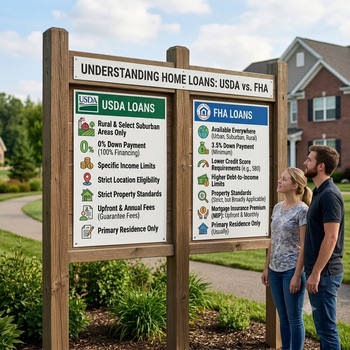 If you're buying a home with little to no down payment saved, you
have two main federal options: USDA loans and FHA loans. USDA lets
you buy with zero down payment. FHA requires 3.5% down (unless you
qualify for a 203(h) exception for disaster relief). Both are
government-backed and popular with first-time homebuyers and
borrowers with fair credit. But they work very differently - and the
monthly payment difference can be $200 to $300.
If you're buying a home with little to no down payment saved, you
have two main federal options: USDA loans and FHA loans. USDA lets
you buy with zero down payment. FHA requires 3.5% down (unless you
qualify for a 203(h) exception for disaster relief). Both are
government-backed and popular with first-time homebuyers and
borrowers with fair credit. But they work very differently - and the
monthly payment difference can be $200 to $300.
Here's the core distinction: USDA loans are for rural properties only and have income limits. FHA loans work anywhere and have no income cap. USDA has zero mortgage insurance (though USDA Guarantee charges a guarantee fee). FHA requires mortgage insurance upfront and annually, which costs significantly more. USDA Direct offers payment subsidies that can reduce your rate to 2-3%. FHA offers nothing similar.
Which saves you more depends on where you're buying, your income, and what you qualify for. Let's break both down.
USDA vs. FHA: Quick Comparison
| Feature | USDA Direct | USDA Guarantee | FHA |
|---|---|---|---|
| Down Payment | 0% | 0% | 3.5% |
| Mortgage Insurance | None | None (guarantee fee) | Yes (1.75% upfront + 0.55% annual) |
| Interest Rate | 6.0%-7.0% | 6.5%-7.5% | 6.5%-7.5% |
| Payment Subsidy | Yes (low-income) | No | No |
| Income Limit | Yes (hard ceiling) | Yes (higher than Direct) | No limit |
| Rural Required | Yes | Yes | No (works anywhere) |
| Credit Score Min | ~600 (flexible) | ~640 | 580 |
| Approval Timeline | 60-90 days | 45-60 days | 45-60 days |
| Refinancing | Limited (locked) | Unlimited | Unlimited |
| Property Use | Primary only | Primary only | Primary only |
Real Example: $220,000 Home
USDA Direct (zero down)
Loan amount: $220,000 at 6.5% for 33 years = $1,406/month P&I. Add $165 taxes and $110 insurance. Total: $1,681/month.
USDA Guarantee (zero down)
Loan amount: $220,000 at 7.0% for 30 years = $1,468/month P&I. Add $165 taxes and $110 insurance. Total: $1,743/month.
FHA (3.5% down)
Down payment: $7,700. Loan amount: $212,300 at 6.75% for 30 years = $1,421/month P&I. Add $165 taxes, $110 insurance, and $221 mortgage insurance (MIP - both upfront and annual). Total: $1,917/month.
Monthly comparison:
USDA Direct: $1,681/month (cheapest)
USDA Guarantee: $1,743/month ($62 more than Direct)
FHA: $1,917/month ($236 more than Direct, $174 more than Guarantee)
Over 10 years, FHA costs $28,320 more than USDA Direct. Plus, the FHA borrower had to come up with $7,700 down payment upfront.
The Mortgage Insurance Problem with FHA
This is where FHA gets expensive. Because you're putting down only 3.5%, the lender charges mortgage insurance to protect themselves if you default. FHA requires an upfront mortgage insurance premium (UFMIP) of 1.75% of the loan amount, which gets financed into the loan. Then there's an annual MIP of 0.55% that's added to your monthly payment.
On a $212,300 FHA loan, that's $3,715 financed upfront plus $1,168 per year in ongoing insurance. That $221/month in insurance never goes away unless you refinance to a different program after reaching 20% equity - which takes years.
USDA Direct has zero mortgage insurance. USDA Guarantee has a guarantee fee built into the rate but doesn't charge the separate MIP like FHA does. The difference is dramatic over time.
The Location Problem with USDA
USDA loans only work in designated rural areas. The property must be in a USDA-eligible zone. You can check eligibility.sc.egov.usda.gov, but if the property is outside the boundary, USDA isn't available. FHA works anywhere - cities, suburbs, rural areas, doesn't matter.
This is USDA's biggest limitation. If you're buying in a suburb or city, FHA is your zero-down option (USDA isn't available). If you're buying rural, USDA could save you thousands.
The Income Limit Problem with USDA
USDA loans have income limits. Direct caps you at low-income (usually $50,000-$75,000). Guarantee allows higher income (usually $80,000-$110,000+). But both have ceilings. If you exceed the limit, USDA isn't available.
FHA has no income limit. A family making $200,000/year can get an FHA loan if they qualify on credit and debt ratios. This makes FHA accessible to middle-to-upper income borrowers who want a low-down-payment option.
The Payment Subsidy Advantage of USDA Direct
If your income is low enough, USDA Direct offers payment subsidies. The USDA reduces your interest rate permanently. You might pay as if the loan is at 2-3% even though the note rate is 6.5%. The government covers the difference.
Example: $220,000 loan at 6.5%, but you qualify for a 2.5% subsidy. Your P&I is $900/month instead of $1,406/month. That's $506/month savings, or $6,072/year. FHA offers nothing like this.
This subsidy is USDA Direct's secret weapon for low-income borrowers. It can make homeownership affordable when standard financing wouldn't work.
Credit Score Flexibility
USDA Direct accepts credit scores around 600 with flexibility on past issues. The underwriter considers the whole picture. FHA requires minimum 580, but scores below 620 get higher interest rates or denial. Conventional prefers 640+.
If you have fair credit (600-660) with good explanation, USDA Direct is most forgiving. FHA is middle-ground. Conventional is strictest.
Approval Timeline
USDA Direct: 60-90 days (slowest - government lending moves slow).
USDA Guarantee: 45-60 days.
FHA: 45-60 days (same as Guarantee).
If you need to close quickly, FHA or USDA Guarantee are faster than Direct.
Which Program Wins? Three Scenarios
Scenario 1: You're buying rural, income qualifies for USDA Direct, staying 10+ years
Best choice: USDA Direct. If you also get a payment subsidy, even better - you could save $300-$500/month vs. FHA. Over 10 years, that's $36,000-$60,000 in total savings. USDA Direct is the clear winner here.
Scenario 2: You're buying rural, income exceeds Direct but qualifies for Guarantee, want flexibility
Best choice: USDA Guarantee. You save $150-$200/month vs. FHA over time, can refinance anytime, and close faster than Direct. Total 10-year savings vs. FHA: $18,000-$24,000.
Scenario 3: You're buying in suburbs or city, or income exceeds USDA limits
Best choice: FHA. USDA isn't available (either location or income), so FHA is your zero-down option. Yes, you'll pay more in mortgage insurance, but it's your only federal zero-down path.
Three Questions to Decide
Question 1: Is the property in a rural area?
For USDA: Must be in a USDA-designated rural area. Check eligibility.sc.egov.usda.gov. No flexibility on this.
For FHA: Works anywhere - city, suburb, rural, doesn't matter.
If the property is urban/suburban, USDA isn't available. FHA is your federal option.
Question 2: Does your income qualify?
For USDA Direct: Adjusted annual income at or below county low-income limit (typically $50K-$75K). Hard ceiling, no exceptions.
For USDA Guarantee: Income at or below county moderate-income limit (typically $80K-$110K+).
For FHA: No income limit whatsoever.
If your income exceeds USDA limits, FHA is your option (assuming you qualify on credit and debt ratios).
Question 3: Can you afford a down payment?
For USDA (Direct or Guarantee): Both require zero down payment. You only need closing costs ($1,500-$3,000).
For FHA: Requires 3.5% down payment. On a $220,000 home, that's $7,700 upfront.
If you have zero savings, both USDA programs are better (true zero down). If you have $5,000-$10,000 saved, FHA becomes possible but still more expensive long-term due to mortgage insurance.
Common Questions
Can I get both USDA and FHA and choose the cheaper one?
Yes. If you qualify for USDA (rural property, income qualifies), get pre-approved for both and compare. USDA is almost always cheaper, especially if you qualify for a subsidy. But getting pre-approved for both helps you verify.
What if I have fair credit? Which is easier to get?
USDA Direct is most forgiving. USDA Guarantee is middle-ground. FHA is stricter. With a 620 credit score and reasonable explanation, USDA Direct is most likely to approve you.
Can I refinance a USDA loan to FHA later?
Yes. USDA Direct borrowers can pay it off and refinance to FHA (or conventional) anytime. But if you have a payment subsidy on Direct, you'll lose it when you refinance away. Not a good trade-off unless rates drop dramatically.
What if I pay off my USDA loan early - do I owe the subsidy back?
No. There's no recapture on USDA Direct subsidies. You can pay it off anytime with zero penalty. That's an advantage over some other subsidy programs.
Which mortgage insurance costs more - USDA guarantee fee or FHA MIP?
FHA MIP costs more. FHA's 1.75% upfront plus 0.55% annual typically runs $200-$300/month total. USDA Guarantee's fee is built into the rate, so it's less visible but lower in actual cost.
Can I use FHA to buy a second home or investment property?
FHA requires primary residence only. Same restriction as USDA. You can't rent it out or use it as investment property.
Key Takeaways
USDA Direct is the cheapest if you qualify. Zero down, zero mortgage insurance, and possible payment subsidies create $200-$300/month savings vs. FHA. Over 10 years, that's $24,000-$36,000 minimum.
USDA Guarantee is the faster, more flexible option. Zero down, lender choice, unlimited refinancing. Monthly savings vs. FHA: $150-$200.
FHA is the fallback. If you're buying in a city/suburb or your income exceeds USDA limits, FHA is your zero-down federal option. But you'll pay mortgage insurance, which costs significantly more long-term.
Location and income are the deciding factors. If USDA eligibility applies, USDA almost always wins on cost. If USDA doesn't apply, FHA is your federal zero-down option.
Payment subsidies are USDA Direct's secret weapon. Low-income borrowers can save $300-$500/month - sometimes the difference between affording homeownership and not.
The best choice depends on your situation. Check if the property is rural and your income qualifies. That tells you if USDA is available. If yes, USDA wins. If no, FHA is your option.
Bottom Line
If you're buying a rural property and your income qualifies for USDA Direct or Guarantee, choose USDA. You'll save $20,000-$40,000+ over 10 years compared to FHA due to zero mortgage insurance and possible payment subsidies. If you're buying in a city or suburb, or your income exceeds USDA limits, FHA is your federal zero-down option - it costs more in mortgage insurance, but it's available to you.
Don't assume FHA is your only option. Check USDA eligibility first. The savings are real if you qualify.
Connect With Us
Please share – it really helps