USDA vs. VA Loans: Which Zero-Down Program is Better for Rural Homebuyers?
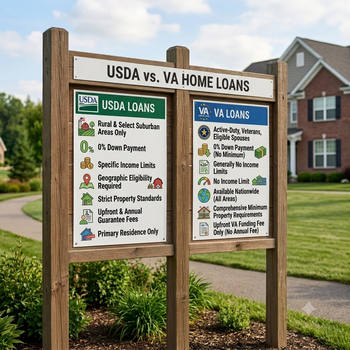 If you're military or a veteran buying a home in a rural area,
you might have three loan options available: USDA Direct, USDA
Guarantee, and VA loans. All three offer zero down payment and no
mortgage insurance (though USDA Guarantee and VA charge fees). All
three are government-backed. All three are designed to help
borrowers who might not qualify for conventional financing. But they
work very differently - and the monthly payment can differ by $200 to
$400.
If you're military or a veteran buying a home in a rural area,
you might have three loan options available: USDA Direct, USDA
Guarantee, and VA loans. All three offer zero down payment and no
mortgage insurance (though USDA Guarantee and VA charge fees). All
three are government-backed. All three are designed to help
borrowers who might not qualify for conventional financing. But they
work very differently - and the monthly payment can differ by $200 to
$400.
Here's the core distinction: USDA Direct is government-funded with possible payment subsidies for low-income borrowers. USDA Guarantee is private lending with USDA backing and no subsidies. VA loans are exclusively for military/veterans with no income limits. USDA programs work only in rural areas. VA works anywhere. VA typically has the lowest interest rates. USDA Direct offers the deepest subsidies for low-income borrowers.
For veterans in rural areas, choosing between three programs requires understanding the trade-offs. Let's break all three down.
USDA Direct, USDA Guarantee, and VA: Quick Comparison
| Feature | USDA Direct | USDA Guarantee | VA Loan |
|---|---|---|---|
| Down Payment | 0% | 0% | 0% |
| Mortgage Insurance | None | None (guarantee fee) | None (VA funding fee) |
| Interest Rate (typical) | 6.0%-7.0% | 6.5%-7.5% | 5.5%-6.5% |
| Payment Subsidy | Yes (low-income) | No | No |
| Income Limit | Yes (hard ceiling) | Yes (higher than Direct) | No limit |
| Rural Required | Yes | Yes | No (works anywhere) |
| Eligibility | Any qualified borrower | Any qualified borrower | Military/veteran/spouse only |
| Lender Type | USDA only | Private lenders (shop rates) | Any approved lender |
| Loan Term | 33 years standard | 30 years standard | 30 years standard |
| Credit Score Min | ~600 (flexible) | ~640 | No official minimum |
| Approval Timeline | 60-90 days | 45-60 days | 45-60 days |
| Refinancing | Limited (locked in) | Unlimited | Unlimited |
| Debt Ratio Flexibility | Up to 41% (flexible) | Typically 43% max | Up to 41% (flexible) |
Real Example: $220,000 Rural Home
USDA Direct (zero down)
Loan amount: $220,000 at 6.5% for 33 years = $1,406/month P&I. Add $165 taxes and $110 insurance. Total: $1,681/month.
USDA Guarantee (zero down)
Loan amount: $220,000 at 7.0% for 30 years = $1,468/month P&I. Add $165 taxes and $110 insurance. Total: $1,743/month.
VA Loan (zero down, with funding fee)
Loan amount: $220,000 at 5.75% for 30 years = $1,285/month P&I. Add $165 taxes, $110 insurance, and $0 separate PMI/guarantee fee (funded into loan). Total: $1,560/month.
Monthly comparison:
USDA Direct: $1,681/month (cheapest if you get subsidy, second otherwise)
USDA Guarantee: $1,743/month ($62 more than Direct, $183 more than VA)
VA Loan: $1,560/month (cheapest on interest rate)
Over 10 years, VA saves $14,520 vs. USDA Direct just on monthly payments. But if USDA Direct borrower qualifies for a subsidy, the picture changes dramatically.
Understanding USDA Guarantee vs. USDA Direct
Many borrowers don't realize there are two separate USDA loan programs. Here's the difference.
USDA Direct is government-funded. The USDA is the actual lender. You work directly with USDA servicing (NFAOC in St. Louis). You have one option for lender and rate. But you get access to payment subsidies if your income is low enough.
USDA Guarantee is private lending with USDA backing. Banks and mortgage companies originate the loans. You can shop rates and terms. But there are no payment subsidies. You pay market rates for a government-backed loan.
For rural borrowers, this choice matters. USDA Direct might be $60-$100/month cheaper if you get a subsidy. USDA Guarantee is faster (45-60 days vs. 60-90 days) and more flexible (you can refinance anytime).
Most rural borrowers with low income should check if they qualify for USDA Direct subsidy. Most higher-income rural borrowers prefer USDA Guarantee for flexibility.
The Interest Rate Advantage of VA
VA loans typically have lower interest rates than USDA Direct loans. Why? VA loans are backed by the government (the VA guarantees the lender's loss), which makes them less risky for lenders. That lower risk translates to lower rates.
In our example, VA is 5.75% while USDA Direct is 6.5% - a 0.75% difference. On a $220,000 loan, that's $121/month savings for VA.
This rate advantage is consistent. VA loans almost always beat USDA Direct on interest rate, even when both borrowers have identical credit and income.
The VA Funding Fee
VA loans charge a funding fee instead of mortgage insurance. For first-time VA borrowers with zero down, the funding fee is typically 2.3% of the loan amount. For subsequent VA loans, it drops to 3.6%. The fee gets financed into the loan.
On a $220,000 VA loan, the 2.3% funding fee is $5,060, which gets rolled into the financed amount. This is built into the rate, so you don't see it as a separate charge like FHA's mortgage insurance.
USDA Direct has zero funding fee, zero mortgage insurance. So on the surface, USDA looks cheaper. But the lower VA interest rate usually more than compensates for the funding fee.
The Payment Subsidy Advantage of USDA Direct
This is where USDA Direct has an advantage. If your income is low enough (usually under $50,000), the USDA reduces your interest rate permanently through a payment subsidy.
Example: You're approved for $220,000 USDA Direct at 6.5%. Your income qualifies you for a 2.5% subsidized rate. You pay as if the loan is at 2.5%, roughly $900/month P&I. The USDA covers the gap between 2.5% and 6.5%.
VA loans offer no subsidy. You pay the market rate based on your creditworthiness and loan terms.
For low-income borrowers, a USDA Direct subsidy can create $300-$500/month savings, which beats VA's rate advantage.
The Location Problem with USDA
USDA loans only work in designated rural areas. The property must be in a USDA-eligible zone. VA loans work anywhere - cities, suburbs, rural areas, doesn't matter.
This is USDA's biggest limitation for rural veterans. If you want to buy in a city or suburb, VA is your only option. If you're buying rural, you can choose between both programs.
The Income Limit Problem with USDA
USDA Direct has a hard income limit. If your adjusted annual income exceeds your county's low-income limit (typically $50,000-$75,000), you don't qualify. No exceptions.
VA loans have no income limit. A veteran making $150,000 can get a VA loan if they qualify on credit and debt ratios. This makes VA accessible to higher-earning veterans.
Approval Timeline
USDA Direct: 60-90 days (slowest - government lending moves slow).
VA Loan: 45-60 days (faster than USDA Direct).
If you need to close quickly, VA is the better choice.
Refinancing Flexibility
USDA Direct: You're locked into USDA servicing for 33 years. You can't refinance with another lender without paying off the entire loan. If you have a payment subsidy, refinancing away loses it permanently.
VA Loan: You can refinance anytime with any lender. If rates drop, you can shop around and switch lenders. VA loans are also eligible for VA streamline refinances, which are fast and require minimal paperwork.
This is a major advantage for VA borrowers. Long-term flexibility beats short-term payment savings.
Debt Ratio Flexibility
Both USDA Direct and VA loans allow back-end debt ratios up to 41% with compensating factors. Both are more flexible than conventional loans (which cap at 43%) and more flexible than FHA.
If you have high existing debt but stable income, both programs will work with you. This is an advantage for both over conventional financing.
Which Program Wins? Four Scenarios
Scenario 1: You're a veteran buying rural, income qualifies for USDA Direct (under $50K), staying 10+ years
Best choice: USDA Direct (if you get a payment subsidy). Payment subsidies can save $300-$500/month, beating both USDA Guarantee and VA on total cost. Over 10 years, that's $36,000-$60,000 in savings. This is the cheapest option if you qualify for subsidy.
If you don't qualify for subsidy, VA wins due to the lower interest rate ($120-$150/month savings vs. Direct).
Scenario 2: You're a veteran buying rural, income $50K-$110K, want flexibility
Best choice: USDA Guarantee or VA Loan. Both allow unlimited refinancing. VA typically has a lower interest rate (0.5%-1.0% lower), saving $80-$150/month. USDA Guarantee is faster to close. Compare actual offers - VA usually wins on cost, but Guarantee might win on approval timeline.
Scenario 3: You're a veteran, income exceeds USDA limits (over $110K), buying rural
Best choice: VA Loan. USDA programs have income ceilings. VA has no limit. You'll save $150-$300/month vs. conventional due to VA's lower rates.
Scenario 4: You're a veteran buying in a city or suburb
Best choice: VA Loan. USDA programs are rural-only. VA works anywhere and typically offers 0.5%-1.0% lower rates than conventional, saving $150-$300/month.
Three Questions to Decide
Question 1: Are you military, a veteran, or an eligible spouse?
For USDA: No military service required. Any qualified civilian borrower can use USDA.
For VA: Must be military, veteran, or eligible spouse with a Certificate of Eligibility.
If you're not military-eligible, USDA is your only option.
Question 2: Is the property in a rural area?
For USDA: Must be in a USDA-designated rural area. Check eligibility.sc.egov.usda.gov.
For VA: Works anywhere - city, suburb, rural, doesn't matter.
If you're buying urban/suburban, VA is your option.
Question 3: Does your income qualify for USDA?
For USDA Direct: Adjusted annual income at or below county low-income limit (typically $50K-$75K).
For VA: No income limit whatsoever.
If your income exceeds USDA limits, VA is your option. If you do qualify for USDA and income is low, check if you qualify for a payment subsidy - that could beat VA's rate advantage.
Common Questions
Can I use both VA and USDA for the same purchase?
No. You need to choose one lender. But you can get pre-approved for both and compare offers before choosing.
If I'm a veteran buying rural with low income, which should I choose?
Get pre-approved for both. If you qualify for a USDA Direct payment subsidy, USDA will likely be cheaper. If you don't qualify for subsidy, VA wins on the interest rate. Compare actual numbers before deciding.
Can I refinance a VA loan to USDA later?
No. Once you have a VA loan, you can refinance to another VA loan (streamline) or to conventional/FHA/etc. But USDA only accepts new borrowers, not refinances from other programs.
Can I refinance a USDA loan to VA later?
Yes. You can pay off the USDA loan and refinance to VA. But if you have a payment subsidy on USDA Direct, you'll lose it permanently. Not a good trade-off unless rates drop significantly.
Which program is easier to qualify for with fair credit?
USDA Direct is most forgiving (accepts ~600 credit scores). VA has no official minimum but lenders typically want 580+. FHA wants 580+. If you have fair credit (600-640), USDA Direct is easiest to approve.
What about the VA residual income requirement?
VA loans require residual income (money left over after all debts are paid). This is additional to debt ratio limits. It's designed to ensure you can actually afford the home. USDA Direct uses standard debt ratios but no residual income requirement. Both approaches work, just different criteria.
Key Takeaways
USDA Direct is cheapest for low-income borrowers with payment subsidies ($300-$500/month savings). But you're locked into USDA servicing for 33 years. Only available in rural areas with income cap (typically $50K-$75K).
USDA Guarantee is the middle option. Zero down, no mortgage insurance, you can shop lenders and refinance anytime. But you pay market rates with no subsidies. Available in rural areas with higher income limits than Direct (typically $80K-$110K+). Closes faster than Direct (45-60 days).
VA loans have the lowest interest rates (0.75%-1.0% lower than USDA Direct). No income limits, works anywhere, unlimited refinancing. But you must be military/veteran/eligible spouse. Faster approval than USDA Direct.
For veterans in rural areas: If income qualifies for USDA Direct subsidy, USDA Direct wins. If income exceeds USDA limits or you want flexibility, VA wins. If income is $50K-$110K and you want faster closing, compare USDA Guarantee vs. VA.
Payment subsidies are USDA Direct's secret weapon for low-income borrowers. Refinancing flexibility is VA's advantage for long-term planning.
Bottom Line
For veterans buying rural property, you have three programs to compare: USDA Direct, USDA Guarantee, and VA loans. If your income qualifies for USDA Direct and you get a payment subsidy, USDA Direct is cheapest ($300-$500/month savings). If your income is $50K-$110K and you want flexibility, USDA Guarantee is faster than Direct with unlimited refinancing. If your income exceeds USDA limits or you're buying urban/suburban, VA wins with the lowest interest rates and no income cap.
Get pre-approved for all available programs and compare actual loan offers. The monthly payment difference is real - $150-$500/month depending on program, income, and property location. Run the numbers for your specific situation before deciding.
Connect With Us
Please share – it really helps