VA Appraisal and Inspection Requirements: What Every Veteran Needs to Know
 Getting a VA loan comes with distinct conditions that often catch buyers off guard. The VA appraisal is far from a rubber-stamp process. It is a rigorous evaluation that can make or break your home purchase.
Many veterans assume this step is quick and painless because the government backs the loan. Yet the reality involves detailed property inspections, strict standards, and potential financial pitfalls. Understanding these requirements could save you significant money and stress.
This guide breaks down the entire VA appraisal process. You will learn exactly what appraisers look for, which deficiencies can derail your deal, and how to negotiate repairs effectively. Whether you are buying your first home or your fifth, this information will help you move forward with confidence.
The Dual Purpose of a VA Appraisal
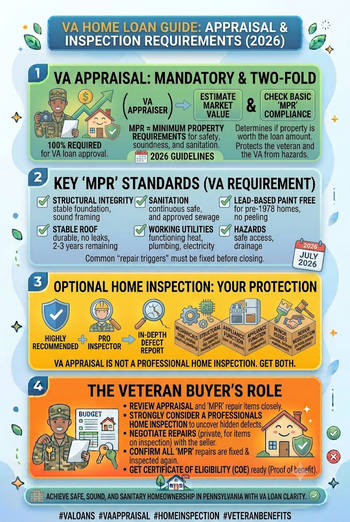
A VA appraisal serves two distinct functions simultaneously. This dual role creates confusion for many borrowers who assume it works like a conventional property valuation.
- Property Valuation: The appraiser establishes fair market value by analyzing comparable sales, property condition, and local market data. This figure determines the maximum loan amount the VA will guarantee.
- Standards Compliance: The appraiser verifies that the property meets VA minimum property standards for safety, soundness, and habitability.
These two purposes mean a property can appraise at the purchase price yet still fail to qualify for financing. The property must satisfy both value and condition requirements simultaneously. This distinction separates VA loans from conventional financing options.
The VA appraisal is legally binding on both parties. Deficiencies must be corrected before closing. Neither the seller nor the buyer can simply ignore required repairs. The appraiser's findings carry substantial weight throughout the transaction.
VA Minimum Property Standards: The Full Framework
The VA Handbook 4000.1 spells out detailed property standards. These are not vague suggestions but specific, measurable requirements that apply to every VA-financed property.
Understanding these standards helps you anticipate potential problems before they derail your purchase. Knowledge of the requirements puts you in a stronger negotiating position when deficiencies appear.
The Five Core Principles
Every VA property standard traces back to five foundational concepts:
- Safety: The property must be free from hazards that could harm occupants
- Soundness: Structural integrity must adequately protect occupants and their belongings
- Sanitation: Water supply and waste disposal systems must meet health requirements
- Adequate Utility Systems: Heating, cooling, electrical, and plumbing must function safely
- Habitability: The property must support year-round residential occupancy
Structural Requirements in Detail
The VA appraisal starts with a thorough structural evaluation. Here is what appraisers specifically examine.
Foundation Issues
Foundation problems appear frequently in VA appraisals. Appraisers check for:
- Cracks exceeding one-quarter inch with signs of structural movement
- Settling patterns that affect door and window operation
- Water intrusion evidence such as dampness, efflorescence, or mold
- Inadequate drainage around the foundation perimeter
- Concrete or masonry deterioration
Not every crack signals a deficiency. Cosmetic cracks under one-eighth inch are generally acceptable. However, structural movement cracks require investigation and possible repair before the loan can close.
Roof Condition and Life Expectancy
Roof problems trigger more deficiency notices than almost any other component. The VA sets specific requirements:
- At least two years of remaining useful life
- All active leaks repaired before closing
- Missing or damaged shingles corrected
- Flashing around chimneys, vents, and penetrations must be sound
- Gutters and downspouts must direct water away from the foundation
A roof with 18 months of remaining life will fail appraisal. A roof with 25 years of potential life but active leaks will also fail. The VA examines both remaining lifespan and current condition.
Exterior Wall Condition
The exterior envelope protects interior spaces from weather and pests. Inspectors evaluate:
- Siding must be weather-tight with no missing pieces or rot
- Brick or stone should show no water penetration evidence
- Windows must function properly and seal against weather
- Doors must operate with proper seals in place
- No evidence of pest infestation
Systems That Must Function
Beyond the structure itself, the VA requires all major home systems to work safely.
| System | Functional Requirement | Common Deficiencies |
|---|---|---|
| Heating | Adequate for climate; safe operation | Non-functional furnace, no AC in hot climates, space heaters as primary system |
| Water Supply | Safe, adequate, and reliable | Low pressure, contaminated well water, inadequate capacity |
| Sewage | Sanitary and adequate for household waste | Failed septic, backed-up plumbing, inadequate tank size |
| Electrical | Safe with adequate capacity | Knob-and-tube wiring, aluminum wiring issues, insufficient amperage |
| Plumbing | Functional and sanitary throughout | Lead pipes, corroded pipes, non-functional fixtures, water damage |
Environmental and Health Hazards
The VA takes environmental hazards extremely seriously. Properties must be free from:
- Lead-Based Paint: Properties built before 1978 may contain lead paint. Federal law requires disclosure, and the VA may mandate testing and remediation.
- Asbestos: Friable asbestos that can become airborne is a significant deficiency requiring correction.
- Mold: Visible mold requires remediation. Surface mold differs from mold indicating structural moisture problems.
- Radon: Some appraisers note radon levels, though the VA does not mandate testing. Elevated levels may be flagged.
- Pest Infestation: Evidence of termites, carpenter ants, rodents, or cockroaches constitutes a deficiency.
- Moisture Intrusion: Dampness, water staining, or mold indicating water problems must be addressed.
The VA Appraisal Process Step by Step
Step 1: Lender Orders the Appraisal
Your lender orders the appraisal after issuing a conditional commitment. This typically happens within 24 to 48 hours. The lender selects a VA-approved appraiser from their network or through an appraisal management company.
Cost ranges from $400 to $650 depending on property location and complexity. Borrowers typically pay this fee upfront or at closing.
Timeline: 1 to 3 days from order to appraiser assignment
Step 2: Property Inspection
The appraiser contacts the listing agent or seller to schedule the inspection. This visit typically takes 2 to 4 hours, depending on the property's size.
Appraisers bring specialized equipment including measuring tools, moisture meters, photography equipment, flashlights, electrical testers, and roof ladders or binoculars.
During inspection, they photograph every major component, measure rooms, test utilities, and document condition. They pay special attention to defects, deterioration, recent repairs, non-permitted additions, and environmental concerns.
Timeline: 3 to 7 days from scheduling to completion
Step 3: Researching Comparable Properties
The appraiser researches comparable sales in the area. They look for properties sold within the previous 90 days that are similar in size, age, construction type, condition, location, and features.
Most appraisers use 3 to 5 comparable sales and adjust for differences. For example, if a comparable sold for $250,000 but had an updated kitchen worth $15,000 that your property lacks, the appraiser would adjust the value downward.
Timeline: 2 to 5 days for research and analysis
Step 4: Appraisal Report Preparation
The appraiser compiles findings into a detailed report containing property descriptions, photographs, measurements, condition assessments, deficiency lists, comparable sales analysis, final appraised value, and VA compliance determination.
The lender receives this report through the appraisal management company. Borrowers do not typically receive the report directly, though lenders share key information.
Timeline: 3 to 5 days for preparation and submission
Step 5: Lender Review and Condition Issuance
The lender's processor or loan officer reviews the appraisal. If any deficiencies are found, the lender issues conditional approval. Conditions are communicated to the seller or borrower through their real estate agent.
Properties with no deficiencies may receive clear-to-close approval for the appraisal portion of the loan.
Timeline: 1 to 2 days for review and condition issuance
Step 6: Deficiency Resolution
Sellers typically have 10 to 21 days to address deficiencies, though this timeline is negotiable in the purchase agreement. Once repairs are complete, sellers must provide paid invoices from licensed contractors, permits and inspection certificates, and before-and-after photos.
The lender reviews documentation. Major repairs may require a re-inspection to verify proper completion.
Timeline: 7 to 21 days for repair completion and verification
Step 7: Final Approval
Once all appraisal conditions are satisfied, the lender issues final approval. The loan proceeds to closing.
Total Timeline: 14 to 28 days from order to final approval under typical circumstances
Deficiency Categories: What Must Be Fixed
Not all deficiencies carry equal weight. VA appraisers categorize findings into two distinct types. Understanding this difference helps you negotiate effectively.
Conditional Deficiencies
These deficiencies directly violate VA minimum property standards. The loan cannot close until they are resolved.
- Structural Safety Issues: Roofs with less than two years remaining life, foundation cracks indicating movement, water intrusion damage
- Non-Functional Systems: Furnaces that do not operate, plumbing that fails, electrical hazards
- Health Hazards: Mold from structural moisture problems, active pest infestations, contaminated well water
- Code Violations: Knob-and-tube wiring, unsafe stairways, missing handrails
- Environmental Concerns: Friable asbestos, improperly vented combustion appliances
A conditional deficiency does not mean the property is a poor investment. It means a specific issue requires correction. Once fixed, the property becomes as loan-eligible as any other.
Noted Items
Some items do not violate minimum standards but deserve attention. These are documented but typically do not delay closing.
- Cosmetic wear and tear
- Minor deferred maintenance
- Outdated but functional fixtures
- Age-appropriate wear such as carpet in a 30-year-old home
- Minor landscaping issues
Noted items serve as a buyer's reference for future maintenance planning. They have no effect on loan approval.
Common VA Appraisal Deficiencies
Based on appraisal data, these deficiencies appear most frequently.
1. Roof Age and Remaining Life
Occurs in approximately 35 percent of appraisals on homes 15 years or older. Asphalt shingles typically last 15 to 20 years. Less than two years of remaining life constitutes a deficiency. Resolution costs range from $5,000 to $15,000 or more. If the seller will not replace the roof, negotiate a credit equal to 15 to 20 percent of the actual replacement cost.
2. Water Intrusion and Moisture Damage
Found in about 25 percent of appraisals. Water damage indicates compromised structural integrity. Costs range from $2,000 to $20,000 or more. Require a professional moisture remediation contractor to provide a repair plan before agreeing to any price reduction.
3. HVAC System Failure
Occurs in roughly 22 percent of appraisals. Heating and cooling systems that do not operate are non-compliant. Furnace replacement runs $4,000 to $8,000. AC replacement costs $5,000 to $12,000. Many appraisers accept repairs under $500 rather than requiring full replacement.
4. Electrical System Issues
Found in about 18 percent of appraisals. Outdated wiring, inadequate service, and non-functioning outlets are common problems. Costs range from $1,500 to $15,000 or more. Targeted repairs often address issues without requiring full panel upgrades.
5. Plumbing and Well Water Issues
Occurs in approximately 16 percent of appraisals, with higher rates in rural areas. Costs vary from $500 to $10,000 or more. Well water testing, costing $200 to $400, can determine whether contamination is treatable with chlorination.
6. Mold and Moisture Problems
Found in about 12 percent of appraisals. Visible mold indicates moisture problems. Costs range from $500 to $10,000 or more. Surface mold differs from mold in attics or crawlspaces. Understand the root cause before accepting a repair credit.
7. Pest Infestation
Occurs in about 8 percent of appraisals. Active termites, carpenter ants, or rodent droppings require treatment. Costs range from $1,000 to $15,000 including inspection, treatment, and repairs.
8. Septic System Failure
Found in approximately 7 percent of appraisals, primarily in rural areas. Replacement costs range from $2,000 to $20,000 or more. Professional septic inspection and possible repair may resolve the issue.
9. Lead-Based Paint
Occurs in about 6 percent of appraisals on pre-1978 homes. Abatement costs range from $2,000 to $8,000. Many lenders do not require full abatement if paint is encapsulated or covered.
10. Structural Issues
Found in about 5 percent of appraisals. Foundation cracks, bowing walls, and settling require professional assessment. Costs range from $2,000 to $50,000 or more depending on severity.
Who Pays for Appraisal Repairs?
The VA handbook states sellers are responsible for correcting deficiencies to comply with minimum property standards. The purchase agreement negotiates who actually pays.
In a seller's market, buyers sometimes agree to pay for repairs. In a buyer's market, sellers typically accept responsibility. Your leverage depends on local market conditions and your contract terms.
When deficiencies appear, you have several options. The seller can hire contractors and complete repairs with proper documentation. The seller can provide a repair credit to reduce the purchase price while you arrange repairs. You may pay for repairs yourself if costs are minor. You can also walk away if your contract includes an appraisal contingency.
Negotiate repair credits carefully. Get multiple estimates before agreeing to any credit amount. The seller's credit should cover actual replacement costs, not just partial amounts.
Low Appraisals: When Value Falls Short
Low appraisals occur in roughly 8 to 12 percent of VA appraisals. This stressful scenario can significantly impact your purchase.
An appraisal comes in below the purchase price for several reasons. Declining markets produce lower comparable sales. Property condition, features, or location differences affect value. Over-market purchases happen in competitive markets. Appraiser errors, while less common, do occur.
If the property appraises at $250,000 but you are purchasing for $260,000, the VA only guarantees a loan on $250,000. You must pay the $10,000 difference in cash at closing. The lender cannot finance this gap.
You have several response options. Request a reappraisal if you have evidence of appraiser error. Be aware that second appraisals can come in lower. Negotiate the purchase price down using the appraisal as objective market validation. Pay the difference in cash if you believe the property is worth the premium. Walk away if your contract includes an appraisal contingency.
Always include an appraisal contingency in your purchase agreement. This protects you from overpaying and allows you to renegotiate or withdraw without penalty.
VA Appraisal Timeline
| Process Step | Typical Duration | Factors Affecting Timeline |
|---|---|---|
| Lender orders appraisal | 24-48 hours after conditional commitment | Lender processing speed |
| Appraiser assignment | 1-3 days | Appraiser availability in area |
| Schedule property inspection | 2-5 days | Seller availability, appraiser schedule |
| Conduct inspection | 2-4 hours on-site | Property size, complexity |
| Appraisal report prep | 3-5 days | Appraiser workload |
| Lender review and condition issuance | 1-2 days | Lender processing queue |
| Repair execution if needed | 7-21 days | Contractor availability, repair complexity |
| Repair verification | 1-5 days | Lender requirements, major repairs |
| Total Timeline | 14-28 days or longer with repairs | Multiple variables |
VA Appraisal vs. Home Inspection
Many veterans mistakenly believe the VA appraisal covers everything. This assumption can be costly.
The appraisal verifies value and minimum standards. A home inspection provides comprehensive condition analysis. Both serve different purposes, and both protect your interests.
Home inspectors spend 3 to 4 hours examining every system. Appraisers typically spend 2 to 4 hours on both inspection and value assessment. The inspector works for you, not the lender. Their findings give you leverage to negotiate repairs beyond VA minimum standards.
Schedule your home inspection before the VA appraisal if possible. This gives you time to identify issues and potentially correct them before the appraiser arrives.
A home inspection costs $300 to $500 and often pays for itself many times over. Inspectors catch deferred maintenance, upcoming repairs, and issues that appraisers might note but not flag as deficiencies. This information helps with budgeting and financial planning after purchase.
Special Property Types
VA Approved Condos Florida
VA loans can finance condominiums, but the project must be VA-approved. Requirements include at least 51 percent owner-occupied units, well-funded homeowners association reserves, no single owner controlling more than 10 percent of units, and sound association management and financials.
The appraisal evaluates both individual units and common area condition. If the building has structural problems or inadequate reserves, the entire project may not qualify for VA financing. Buyers seeking VA-approved condos in Florida should verify project approval status before making an offer.
Manufactured Homes
Manufactured homes can be VA-financed if built after June 15, 1976, permanently affixed to a permanent foundation, not on leased land, and suitable for year-round occupancy. Appraisals include special attention to foundations, tie-downs, and connections. Older manufactured homes typically cannot be VA-financed.
New Construction
New homes present appraisal challenges due to fewer recent comparable sales. Appraisers use other new homes by the same builder, recently finished homes from the same phase, and cost approach methods. Builders must agree in writing to correct any construction defects found before closing.
Frequently Asked Questions
Do you have to have an inspection with a VA loan?
Yes and no. The VA appraisal includes an inspection component that verifies minimum property standards. However, this is not a comprehensive home inspection. VA loan inspection requirements are satisfied by the appraisal process, but veterans are strongly advised to obtain a separate home inspection for their own protection. The home inspection covers items the appraisal does not and provides detailed information for future maintenance planning.
What are the VA loan appraisal requirements?
VA loan appraisal requirements include establishing fair market value and verifying compliance with VA minimum property standards. The property must be safe, structurally sound, and habitable. Specific requirements cover roofing, foundations, electrical systems, plumbing, heating, and environmental hazards. The appraisal must be performed by a VA-approved appraiser and is valid for 120 days.
What are the VA loan inspection requirements?
VA loan inspection requirements are embedded in the appraisal process. The appraiser inspects the property for safety, soundness, and habitability. Specific requirements include adequate roofing with at least two years of remaining life, functional heating and cooling, safe electrical systems, sanitary plumbing, and no environmental hazards. The VA does not require a separate home inspection, but veterans should obtain one for comprehensive condition analysis.
What is the difference between a VA loan appraisal and a home inspection?
A VA loan appraisal inspection is performed by a VA-approved appraiser to determine value and verify minimum property standards. A home inspection is performed by a licensed home inspector to evaluate all systems and components in detail. The appraisal is mandatory and legally binding. The home inspection is optional and informational only. The appraisal primarily serves the lender while the inspection serves the buyer.
Can the VA appraisal kill a deal?
Yes, the VA appraisal can kill a deal if significant deficiencies are found and cannot be resolved. If the property fails to meet VA minimum property standards or if the seller refuses to make required repairs, the loan cannot close. Low appraisals can also kill deals if buyers cannot cover the gap and sellers will not reduce the price. However, most issues are resolvable with proper negotiation and planning. The appraisal protects buyers from overpaying and purchasing unsafe properties.
Key Takeaways
- VA appraisals serve dual purposes: establishing value AND verifying minimum property standards compliance. Both matter equally to loan approval.
- Minimum property standards are specific and well-documented. Research exact requirements for your property type before making an offer.
- Deficiencies must be corrected before closing. Negotiate repair responsibility in your purchase agreement, not during the appraisal process.
- Get a home inspection in addition to the VA appraisal. They evaluate different things, and both protect your interests.
- Low appraisals happen in 8 to 12 percent of cases. Include an appraisal contingency in your contract to protect yourself.
- Common deficiencies such as roof issues, HVAC problems, and water intrusion are predictable. Address obvious issues before the appraisal if possible.
- The appraisal process typically takes 14 to 28 days. Plan your closing timeline accordingly.
- Appraisals are valid for 120 days. If closing is delayed beyond this, expect a reassessment or a new appraisal.
Conclusion
Understanding VA appraisal and inspection requirements transforms you from a passive borrower into an informed negotiator. You will know what is negotiable and what is not. You will understand why deficiencies appear and how to resolve them efficiently. You will know the difference between the VA appraisal and a home inspection and why both matter.
The VA appraisal process exists to protect veterans who have earned the right to finance a quality home at fair value. When you understand how it works, you can use it to your advantage instead of being surprised by it.
The appraisal process is normal and expected. Deficiencies are common and usually manageable. Low appraisals are disappointing but not deal-ending if you have planned ahead with an appraisal contingency. A home inspection adds peace of mind that the VA appraisal alone cannot provide.
Disclaimer: This article provides general educational information about VA loan appraisal and inspection requirements. For specific guidance on your VA loan, consult with your lender and review the VA Handbook 4000.1. Requirements may vary by location and change over time. This article is current as of March 2026.
Connect With Us
Please share – it really helps