VA Closing Costs: What You Pay and How to Minimize Them
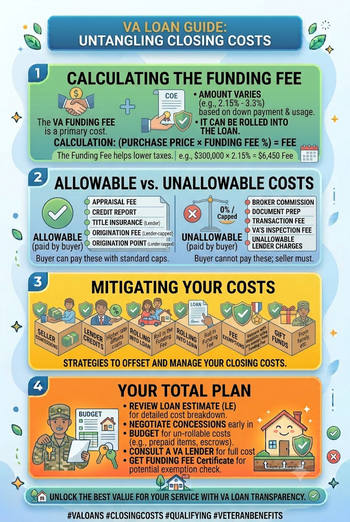 Closing costs are the fees and expenses you pay when you close on
your home. VA loans are known for having lower closing costs than
conventional loans, but understanding what you're paying for and how
much you should expect will help you budget properly and avoid
surprises at closing.
Closing costs are the fees and expenses you pay when you close on
your home. VA loans are known for having lower closing costs than
conventional loans, but understanding what you're paying for and how
much you should expect will help you budget properly and avoid
surprises at closing.
What Are Closing Costs?
Definition
Closing costs are all the fees and expenses associated with finalizing your mortgage loan and transferring ownership of the property. These are fees paid to third parties (appraisers, title companies, attorneys, lenders, etc.) and prepaid items (property taxes, insurance, HOA fees).
Who Pays What?
Closing costs are divided between you (the buyer) and the seller. With VA loans, the VA has restrictions on what lenders and sellers can charge, which keeps costs lower.
Buyer typically pays: Appraisal (sometimes), title insurance (your portion), recording fees, homeowners insurance, property taxes (prorated), HOA fees (prorated), VA funding fee
Seller typically pays: Real estate agent commissions, seller's portion of title insurance, transfer taxes (in some states), owner's title insurance
Typical VA Closing Costs by Amount
Percentage of Loan Amount
VA closing costs typically range from 2% to 5% of your loan amount, depending on your location and property type.
Low-cost scenario (2%):
- Loan amount: $300,000
- Closing costs: $6,000
Mid-range scenario (3%):
- Loan amount: $300,000
- Closing costs: $9,000
Higher-cost scenario (5%):
- Loan amount: $300,000
- Closing costs: $15,000
Why VA Closing Costs Are Lower
VA loan closing costs are lower than conventional loans because:
- VA limits lender fees: The VA caps what lenders can charge for origination, processing, and underwriting fees
- VA restricts seller charges: Sellers cannot charge certain costs they could charge conventional buyers
- No mortgage insurance: VA loans don't require PMI, which conventional loans do (saves ~0.5%-1% annually)
- Seller usually pays concessions: VA allows 100% of allowable closing costs coverage plus 4% prepaids coverage, so sellers often cover much of the cost
Breakdown of VA Closing Costs
Lender Fees (What the Lender Charges)
Origination fee: 0.5%-1% of loan amount (what lender charges for processing the loan). VA limits this.
Processing fee: $300-$500 (fee to process your application). VA limits this.
Underwriting fee: $300-$500 (fee for underwriting the loan). VA limits this.
Appraisal fee: $400-$700 (cost to appraise the property). VA allows this; sellers often pay.
Credit report fee: $25-$50 (cost to pull your credit). VA allows this; sellers sometimes pay.
Flood determination fee: $15-$50 (verify property isn't in a flood zone). VA allows this.
Total lender fees: Typically $1,500-$3,500
Title and Recording Fees
Title search: $200-$500 (search to verify clear ownership). Sellers sometimes pay.
Title insurance (buyer's portion): $500-$2,000 (protects you if title problems arise). Sellers often pay.
Recording fees: $100-$300 (to record the deed with the county). Sellers usually pay.
Transfer taxes: Varies by state (some states have transfer taxes, some don't). Sellers usually pay.
Attorney fees: $200-$500 (if an attorney handles closing, varies by state). Sellers sometimes pay.
Total title and recording: Typically $1,000-$3,500
Prepaid Items (Costs That Continue After Closing)
Homeowners insurance (first year): $800-$2,000 (depends on home value and location). VA allows sellers to pay this.
Property taxes (prorated): $1,000-$5,000 (taxes from closing date to end of year). VA allows sellers to pay up to 4% for prepaids.
HOA fees (prorated): $200-$2,000 (if property has HOA). VA allows sellers to pay.
Homeowners association prepaid reserves: $0-$2,000 (if required). VA allows sellers to pay.
VA funding fee: 2.3% of loan amount if zero down (first-time use). You pay this; cannot be paid by seller. Often rolled into the loan instead of paid at closing.
Total prepaids: Typically $3,000-$10,000
Real-World VA Closing Cost Examples
Example 1: $300,000 Home, No Seller Concessions
Your closing costs:
- Lender origination fee (0.5%): $1,500
- Processing fee: $400
- Underwriting fee: $400
- Appraisal fee: $550
- Credit report: $40
- Title insurance (your portion): $900
- Recording fees: $150
- Homeowners insurance (first year): $1,200
- Property taxes (prorated): $2,000
- HOA fees (prorated): $600
- Flood determination: $25
- VA funding fee (2.3%, rolled into loan): $6,900
- Total closing costs: $14,665
What you pay at closing (cash): $14,665 minus VA funding fee (if rolled into loan) = $7,765
What's rolled into loan: $6,900 (VA funding fee)
Example 2: $300,000 Home, Seller Pays All Allowable Costs
Same closing costs as above: $14,665
What seller pays: All allowable closing costs ($1,500 + $400 + $400 + $550 + $40 + $900 + $150 = $3,940) PLUS prepaids up to 4% of purchase price ($12,000 available, actual prepaids are $3,800)
Total seller contribution: $3,940 (closing costs) + $3,800 (prepaids) = $7,740
What you pay at closing (cash): $14,665 - $7,740 = $6,925 (excluding VA funding fee)
What's rolled into loan: $6,900 (VA funding fee)
Your actual cash at closing: Approximately $0-$1,000 depending on exact costs
Example 3: $450,000 Home, Maximum Seller Help
Closing costs breakdown:
- Lender fees: $2,000
- Title and recording: $1,500
- Homeowners insurance: $1,500
- Property taxes (prorated): $3,000
- HOA fees (prorated): $1,500
- Miscellaneous: $500
- VA funding fee (2.3%, first-time): $10,350
- Total: $20,350
What seller pays: All allowable closing costs ($3,500) PLUS up to 4% of purchase price for prepaids ($18,000 maximum, actual prepaids $6,500)
Total seller contribution: $3,500 + $6,500 = $10,000
What you pay at closing (cash): $20,350 - $10,000 = $10,350 (excluding VA funding fee)
But wait - VA funding fee ($10,350) can be rolled into the loan
Your actual cash at closing: Approximately $0-$500 depending on exact costs
Understanding Your Closing Disclosure
When You Get It
Lenders must provide you with a Closing Disclosure at least three business days before closing. This document shows all costs and terms.
What It Shows
- Loan terms: Loan amount, interest rate, monthly payment, total amount paid over loan life
- Closing costs: Itemized breakdown of every fee and charge
- Loan estimate comparison: How final costs compare to original estimate
- Seller credits: Any seller concessions or credits
- What you're paying at closing: Total cash due from you
Review It Carefully
Compare your Closing Disclosure to your original Loan Estimate. Costs shouldn't change dramatically. If they do, ask your lender for explanation.
Look for:
- Unexpected new fees
- Significantly higher amounts than estimated
- Fees that should have been paid by seller but weren't
- Mathematical errors
How to Minimize Your Closing Costs
Strategy 1: Negotiate Seller Concessions (Most Important)
Request that the seller pay all allowable closing costs and up to 4% of purchase price for prepaids. This can reduce your closing costs to near zero.
Impact: Can eliminate $5,000-$15,000 of your out-of-pocket costs
Strategy 2: Use Gift Money
Family members can give you gift money for closing costs. This reduces what you need to pay.
Impact: Can reduce your costs by $5,000-$10,000
Strategy 3: Shop Lenders
Different lenders charge different fees. Get quotes from multiple lenders. VA lenders and compare closing costs.
Impact: Can save $500-$2,000 in lender fees
Strategy 4: Roll VA Funding Fee Into Loan
Instead of paying the funding fee at closing, roll it into your loan. This is the standard approach and reduces your cash need at closing.
Impact: Reduces cash needed at closing by $6,000-$12,000
Strategy 5: Ask What Seller Must Pay
Clarify with your agent and lender exactly what closing costs the seller is paying. Make sure seller contributions are maximized.
Impact: Ensures you're not paying for costs the seller should cover
Strategy 6: Compare Title Company Quotes
Different title companies charge different rates. Get quotes from multiple title companies.
Impact: Can save $200-$500 in title fees
Strategy 7: Verify Every Fee
Review your Closing Disclosure carefully. Question any fee that seems high or unexplained. Lenders may waive or reduce fees if asked.
Impact: Can save $300-$1,000 in miscellaneous fees
What You Cannot Avoid Paying
These costs are unavoidable:
- Property taxes: Required; paid to county/state
- Homeowners insurance: Required by lender; protects the property
- Appraisal: Lender requires this; seller often pays, but you might
- VA funding fee: Only avoidable if you have disability rating or qualify for exemption
These costs are often negotiable:
- Lender origination fee: May be negotiable or waivable
- Title insurance: Often paid by seller
- Recording fees: Often paid by seller
- Processing/underwriting fees: May be bundled or negotiable
Comparing VA Closing Costs to Other Loans
| Loan Type | Typical Closing Costs | As % of Loan | Can Seller Help? |
|---|---|---|---|
| VA Loan | 2-5% of loan amount | 2-5% | Yes, 100% of allowable + 4% prepaids |
| FHA Loan | 2-5% of loan amount | 2-5% | Yes, up to 6% of purchase price |
| Conventional Loan | 2-5% of loan amount | 2-5% | Limited (2-3% of purchase price) |
VA advantage: Seller can pay 100% of allowable closing costs with no limit, making your actual costs significantly lower.
Common Closing Cost Questions
Do Closing Costs Change After the Loan Estimate?
Closing costs should be similar to the Loan Estimate, but minor changes are normal. Appraisal fees, title insurance, and property taxes might vary slightly. Major changes (over $300) should be explained.
Can I Negotiate Closing Costs?
Yes. You can negotiate with your lender (ask about fee waivers), with the seller (ask for more concessions), and by shopping different vendors (title company, appraisals).
What If Closing Costs Are Higher Than Expected?
Review the Closing Disclosure and ask your lender for explanation. If fees are unexplained or seem unreasonable, ask them to be reduced or removed. Lenders sometimes waive fees if you push hard enough. back professionally.
Can I Roll All Closing Costs Into the Loan?
You can roll the VA funding fee into the loan, but not all closing costs. Some costs (property taxes, insurance, etc.) must be paid at closing or in escrow. Talk to your lender about what can be rolled in.
Key Takeaways
- VA closing costs are 2-5% of the loan amount. Lower than conventional due to VA restrictions.
- Seller can pay 100% of allowable closing costs. No limit on what seller can contribute to allowable costs.
- Seller can pay up to 4% of purchase price for prepaids. Property taxes, insurance, HOA fees.
- Combined seller help often covers nearly all your costs. You may pay zero at closing with proper negotiation.
- VA funding fee is typically rolled into loan. Reduces cash needed at closing.
- Review Closing Disclosure carefully. Verify all costs and compare to original estimate.
- Shop multiple lenders. Can save $500-$2,000 in lender fees.
- No PMI with VA loans. Saves 0.5%-1% annually compared to conventional.
- Ask for fee reductions. Lenders may waive or reduce fees if requested professionally.
- Three days to review before closing. Use this time to verify everything is correct.
Bottom Line
VA closing costs are lower than conventional loans, and sellers can help pay a significant portion or even nearly all of them through concessions and gift money. Most VA borrowers pay minimal out-of-pocket closing costs - sometimes zero - if they negotiate. properly. The key is to request maximum seller concessions upfront, use gift money strategically, shop lenders and vendors, and roll the VA funding fee into your loan. With these strategies, your actual cash at closing can be minimal despite what your total closing costs appear to be on paper.
Connect With Us
Please share – it really helps