Maximum Seller Paid Costs for a Conventional Loan
 In the lexicon of real estate, the "sale price" is king. It’s the
number that gets the attention, the headline in the local paper, and
the ego boost for the seller. But for the savvy buyer, the strategic
agent, and the pragmatic lender, the sale price is merely a facade.
The true architecture of a successful transaction is often built in
the fine print of the closing disclosure - specifically, in the line
item labeled "seller concessions."
In the lexicon of real estate, the "sale price" is king. It’s the
number that gets the attention, the headline in the local paper, and
the ego boost for the seller. But for the savvy buyer, the strategic
agent, and the pragmatic lender, the sale price is merely a facade.
The true architecture of a successful transaction is often built in
the fine print of the closing disclosure - specifically, in the line
item labeled "seller concessions."
When combined with a conventional loan, the seller-paid closing cost is not just a gift or a sign of desperation; it is a sophisticated financial instrument. It is a mechanism for liquidity management, a tool for overcoming appraisal gaps, and a way to reshape the risk profile of a transaction. To understand this dynamic is to understand how modern real estate is actually won.
The Foundation: What Are We Actually Paying?
Closing costs are the silent partner in every home purchase. Typically ranging from 2% to 5% of the loan amount, they represent the friction of the transaction - the cost of moving capital and transferring title.
For a conventional loan backed by Fannie Mae or Freddie Mac, these costs fall into three distinct buckets:
- Lender Fees: Origination charges, underwriting fees, and the cost of buying down the interest rate (discount points).
- Third-Party Services: Appraisals, title insurance, escrow fees, and surveys.
- Prepaids and Reserves: The often-overlooked cash drain where buyers must fund property taxes and homeowner’s insurance premiums months in advance.
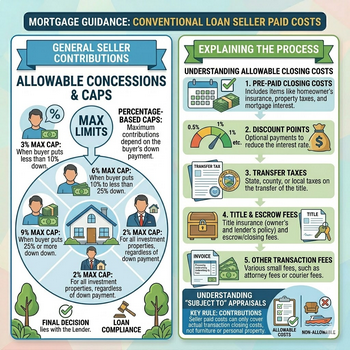
A seller-paid concession is simply a credit from the seller to the buyer to cover these expenses. However, unlike in government-backed loans (FHA or VA), where concessions are heavily regulated and capped based on strict percentages, conventional loans offer a wider, albeit complex, playing field.
The Rules of Engagement: Conventional Loan Limits
The first thing a buyer must understand is that the generosity of a seller has limits dictated by the loan’s structure. For a conventional loan, the rules are defined by the loan-to-value (LTV) ratio and the occupancy type.
- Primary Residences: If a buyer is putting down less than 10%, the maximum seller concession is typically 3% of the sale price. If the down payment is 10% or more, that cap usually rises to 6% .
- Second Homes: The cap is typically 2% .
- Investment Properties: The cap is usually 2% .
This is a critical distinction from government loans. While an FHA loan allows up to 6% regardless of down payment, a conventional loan ties the concession cap to the buyer’s skin in the game. The logic is simple: the lender views a buyer who is putting very little down (3% to 5%) as a higher risk. They limit concessions to ensure the buyer still has enough financial "pain" in the deal to discourage default.
The Strategic Depth: Why Use Seller Concessions?
If a buyer has the cash to cover closing costs, why would they ask the seller to pay them? The answer lies in opportunity cost and leverage.
1. The Liquidity Play
Most Americans purchase a home with savings. By asking the seller to cover closing costs, a buyer can preserve their liquid capital. Instead of sinking $15,000 into closing costs, that money can remain in the bank for immediate repairs, furniture, or an emergency reserve. In essence, the buyer is financing their closing costs by accepting a slightly higher purchase price (or maintaining the current price) in exchange for the seller writing a check at the table.
2. The Appraisal Gap Shield
This is where the strategy becomes high-level. Imagine a home listed at $400,000. A buyer knows it needs $10,000 in repairs and they don’t want to drain their savings. They could offer $390,000 with no concessions. Alternatively, they could offer $415,000 with a $15,000 seller concession.
If the house appraises at $415,000, the deal holds. The seller nets their desired amount (after paying the concession), and the buyer rolls their closing costs into the financed amount. If the house appraises at only $400,000, the buyer now has leverage. They can renegotiate, or the concession acts as a buffer. This strategy allows buyers to bid aggressively in a competitive market without bringing extra cash to closing.
3. The Interest Rate Buy-Down (The 2-1 Buydown)
Within the conventional loan framework, seller concessions are uniquely suited for temporary buydowns. A seller can contribute funds to reduce the buyer’s interest rate for the first two years (a 2-1 buydown) or permanently buy down the rate (discount points).
In a high-interest-rate environment, this is often more valuable than a price reduction. A $10,000 price cut saves a buyer perhaps $50 a month. A $10,000 seller concession used to buy down the rate might save them $300 a month for the first two years, making the mortgage payment affordable while the buyer anticipates refinancing later.
The Hidden Calculus: It’s Not Free Money
For the seller, agreeing to concessions is not simply a deduction from the profit. It is a tax and net-proceeds calculation.
If a seller agrees to a $400,000 sale with $15,000 in concessions, they are effectively selling for $385,000. However, the commission paid to the real estate agents is typically calculated on the gross sale price ($400,000), not the net. This means the seller pays commission on money they are immediately giving back to the buyer. Sellers and their agents must run a net sheet to ensure that the concession doesn’t erode the profit margin to an unacceptable level.
For the buyer, the risk is over-leveraging. If a buyer uses a concession to cover their down payment and closing costs on a conventional loan, they are starting with zero equity. If the market corrects or they need to sell within two years, they may find themselves "underwater" - owing more than the house is worth.
The Underwriting Microscope
Lenders scrutinize seller concessions on conventional loans with extreme prejudice. They are looking for one thing: is this a "haircut" transaction?
If a seller agrees to an exorbitant concession (e.g., 9% on a primary residence), the appraiser will be forced to make an adjustment. The appraiser must determine if the concession is "excessive" and whether it inflated the sale price. If the concession is above market norms for that area, the appraiser will deduct the concession amount from the comparable sales value, effectively lowering the appraisal and killing the deal.
This is why structuring the concession is an art. It must align with market norms. In a neutral or buyer’s market, concessions of 3% are standard. In a seller’s market, asking for concessions might lose the bid, but offering a higher price with a concession to cover buydowns can be a stealth tactic that wins.
The Verdict: A Tool, Not a Crutch
Seller-paid closing costs in a conventional loan represent the intersection of math and strategy. For the cash-poor but income-rich buyer, it is the key to homeownership without draining reserves. For the seller in a slow market, it is the incentive that makes a listing stand out without publicly dropping the list price (preserving neighborhood comps).
However, it requires discipline. A buyer who uses concessions to simply "get in the door" without understanding the increased monthly payment (due to a higher loan amount) or the lack of immediate equity is engaging in risky leverage.
Conversely, the sophisticated investor or homeowner who uses a seller concession to execute a temporary buydown - lowering payments until refinancing becomes viable - is engaging in modern financial engineering.
In the end, a conventional loan offers the flexibility to craft these deals, but it demands honesty. Honesty about the appraisal, honesty about the buyer’s cash reserves, and honesty about the seller’s net proceeds. When structured correctly, a seller concession is not a discount; it is a reallocation of capital that allows both parties to cross the finish line with their financial goals intact.
And in a transaction as complex as real estate, crossing the finish line is the only thing that matters.
Connect With Us
Please share – it really helps