VA Purchase Program
How to Buy a Home with VA Loan
Eligibility
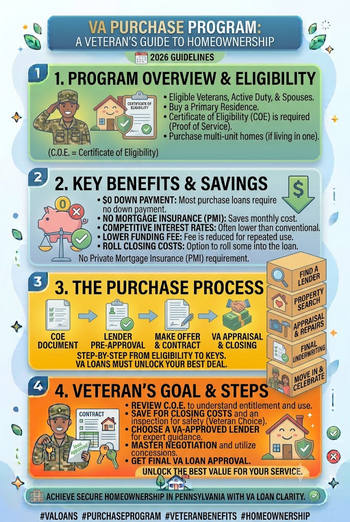 Did you know? Being eligible for a VA loan and
actually being approved for one are two completely different things.
Many veterans are eligible but still don't qualify. Understanding
this difference is the key to successfully buying a home using your
VA loan benefits.
Did you know? Being eligible for a VA loan and
actually being approved for one are two completely different things.
Many veterans are eligible but still don't qualify. Understanding
this difference is the key to successfully buying a home using your
VA loan benefits.
What Does VA Loan Eligibility Actually Mean?
The VA makes a clear distinction between three important concepts: eligibility, entitlement, and qualification. Many veterans - and even some lenders - mix these terms up. But they mean very different things, and understanding the difference can help you successfully buy a home.
The Three Essential Terms
Eligibility: This is determined by your military service. Did you serve long enough? Was your discharge good? That's eligibility. It's a simple yes or no.
Entitlement: This is measured in dollars. If you're eligible, the VA gives you a certain amount of loan guarantee. The basic amount is $36,000, but depending on where you live, you might have access to much more.
Qualification: This is what your lender cares about. Even if you're eligible and have plenty of entitlement, you still need to pass a credit check, prove your income, and show that your debt-to-income ratio is acceptable. This works a lot like qualifying for a conventional loan.
Here's the critical point: being eligible for a VA loan does not mean you will qualify for one. Your eligibility is based on your military service. Your qualification is based on your finances. These are completely separate things. You could be 100% eligible but still not qualify for a loan if your credit is poor or your debt-to-income ratio is too high.
The Certificate of Eligibility (COE): What It Is and Why It Matters
The only acceptable proof of VA loan eligibility is a document called a Certificate of Eligibility (COE). Your lender will require this before they even start processing your loan application. Discharge papers, DD-214 forms, or any other military documents will not be accepted. Only the COE will do.
What Information Does the COE Provide?
The COE is much more than just a piece of paper that says you're eligible. It contains several important pieces of information that your lender will use:
- Eligibility confirmation: The fact that you have a COE means the VA has confirmed you meet the basic eligibility requirements.
- Entitlement amount: This is shown prominently on the COE in bold, all-caps letters. It tells your lender how much the VA will guarantee on your behalf.
- Funding fee status: The COE shows whether you're exempt from paying a funding fee or not - and if there are any conditions attached.
- Service-connected disability information: If applicable, this information helps determine your funding fee exemption.
- Special conditions: If there are any restrictions on how you can use your entitlement, the COE will explain them.
How to Get Your Certificate of Eligibility
Getting your COE is straightforward and can be done online in most cases. Here's how:
- Visit the VA benefits portal at ebenefits.va.gov
- Log in with your credentials
- Request your COE through the system
- In most cases, you'll receive it in seconds
- In some special cases, you may need to submit additional documentation
Many lenders can also help you obtain your COE if you prefer. The online system is recommended by the VA and is much faster than the old mail-in option.
Understanding VA Loan Entitlement
Your entitlement is the amount of the loan that the VA will guarantee to your lender. This guarantee is what makes VA loans attractive to lenders, which is why you can get better interest rates and avoid PMI.
How Entitlement Works
The VA guarantees 25% of your home loan, up to a maximum of $36,000 in basic entitlement. This means:
- With just basic entitlement, you could theoretically borrow up to $144,000 (because $36,000 is 25% of $144,000)
- However, a $144,000 home isn't practical in most parts of the country
- This is where additional entitlement comes in
Additional Entitlement Based on Your County
The VA offers additional entitlement depending on what county you're buying in. This is based on the average home prices in that area. In most U.S. counties, the additional entitlement brings your maximum loan amount up to $832,750. In high-cost areas like Hawaii, the limit can be even higher - $1,249,125 .
| Loan Amount | VA Guarantees | Your Benefit |
|---|---|---|
| $144,000 | $36,000 (25%) | Basic entitlement only |
| $417,000 | $104,250 (25%) | Most U.S. counties (with additional entitlement) |
| $766,550+ | Up to $191,637 (25%) | High-cost areas (Hawaii, parts of California) |
What If You've Already Used Your Entitlement?
If you've used your VA loan benefits before and didn't pay back the loan completely - perhaps because of a short sale or foreclosure - your available entitlement might be less than the full amount. Your COE will show exactly how much entitlement you have remaining.
In this situation, you have two options:
- Get a loan anyway: Your lender can proceed knowing that the VA's guarantee is limited to your available entitlement. However, this might result in less than a 25% guarantee, which could affect the loan terms.
- Restore your entitlement: You can apply to have your entitlement restored, but this almost never happens unless you've paid back the VA in full.
Important Note: Even if you have partial or no basic entitlement, you may still be able to get a VA loan for more than $144,000 in certain situations. However, the VA's guarantee might be less than 25%. Your lender will decide if this is acceptable based on secondary market requirements.
What Your Lender Needs to Verify Your Eligibility
Your lender's job is to confirm your eligibility before they process your loan application. In fact, they must have proof of your eligibility before closing on the loan. Here's what they need:
For Veterans Who Have Been Discharged
If you've left the military, provide your DD Form 214 (Certificate of Release or Discharge From Active Duty). This form shows your length of service and character of discharge. You don't need the original - a legible copy is fine.
Special note: If you were discharged before January 1, 1950, any official documentation showing your length and character of service is acceptable.
If you were discharged after October 1, 1979, make sure your DD-214 includes the character of service and the narrative reason for separation. Many lenders specifically ask for Member 4 copy of the DD-214 because it includes all this information.
For Active Duty Service Members
If you're still serving on active duty, you won't have a DD-214. Instead, you'll need a statement of service that is either signed by or issued at the direction of:
- The adjutant of your unit
- Your personnel officer
- Your commanding officer
- Someone from higher headquarters
This statement doesn't have to be on a specific form. It's often typed on military letterhead, but that's not required. What matters is that it shows:
- Your full name
- Your SSN (or at least the last 4 digits)
- The date you started active duty
- Any periods of lost time
- The name of the command providing the information
For National Guard and Reserve Members
If you've been discharged: You need either an NGB Form 22 (Report of Separation and Record of Service) or a retirement points statement. Either one will work. Both must be legible copies.
If you're still serving: You need a statement of service signed by or at the direction of your unit's adjutant, personnel officer, commander, or higher headquarters. It must show:
- Your full name
- Your SSN (or last 4 digits)
- The date you started Guard/Reserve duty
- The name of the command
- A statement that you are an active reservist/guardsman and not in a control group
Can't Find Your Service Documents?
If you can't locate your DD-214, discharge papers, or service statement, you can request them through:
- The VA benefits portal (ebenefits.va.gov)
- The Request Pertaining to Military Records (Form SF-180), which you can submit by mail
You can also request military records from the National Archives or the applicable branch of service directly.
Service Time Requirements: How Long Do You Need to Serve?
The VA has different eligibility requirements depending on when you served. The following table shows what you need:
| Service Era | Dates | Minimum Time Required |
|---|---|---|
| World War II | September 16, 1940 – July 25, 1947 | 90 days |
| Post-World War II | July 26, 1947 – June 26, 1950 | 181 days |
| Korean War Era | June 27, 1950 – January 31, 1955 | 90 days |
| Post-Korean War Era | February 1, 1955 – August 4, 1964 | 181 days |
| Vietnam War Era | August 5, 1964 – May 7, 1975 | 90 days (or 180 days for continuous service) |
| Post-Vietnam Era | May 8, 1975 – September 7, 1980 | 181 days |
| Modern Era | September 8, 1980 – Present | 24 months of continuous active duty or selected reserve |
These requirements can be complex, especially if you served during multiple eras or had breaks in service. Your Certificate of Eligibility confirms that you meet the requirements for your particular situation.
Funding Fee Status: What It Means and Why It Matters
Your COE will show your funding fee status. This is a one-time fee that some (but not all) veterans have to pay when they take out a VA loan.
The Three Possible Statuses
EXEMPT: You don't have to pay a funding fee. This usually applies to veterans with service-connected disabilities who receive disability compensation from the VA.
NON-EXEMPT: You will need to pay a funding fee. This is the most common status, since not many borrowers qualify for exemption.
CONTACT RLC: The VA system couldn't determine your status automatically. You'll need to contact the VA Regional Loan Center to clarify.
Conditions on Your Exemption or Non-Exemption Status
Your COE might include additional information about your funding fee status. For example:
- If EXEMPT: You might see a note about receiving service-connected disability compensation and the monthly amount.
- If NON-EXEMPT: The COE will simply confirm that you're not exempt.
- If CONTACT RLC: You'll see instructions to contact the VA Regional Loan Center with specific forms.
If there's a condition listed, your lender will follow the instructions to ensure proper processing of your loan.
Special Conditions That May Appear on Your COE
Beyond eligibility and entitlement, your COE might include special conditions. Here are the most common ones and what your lender needs to do:
Active Duty Status Condition
What it says: "Valid unless discharged or released subsequent to the date of this certificate."
What your lender does: Confirms you're still on active duty before closing. If you're discharged before closing, the lender requests a new eligibility determination from the VA.
Previously Used Entitlement Condition
What it says: "Excluded entitlement previously used for VA Loan [Number]."
What your lender does: If you need that entitlement for your new loan, makes sure the new loan is secured by the same property as the old one (typical in cash-out refinances).
Manufactured Home Entitlement Condition
What it says: "Remaining entitlement for additional manufactured home use is: $[amount]."
What your lender does: Makes sure your manufactured home purchase doesn't exceed the remaining entitlement limit.
Property Disposal Requirement
What it says: "Not eligible for any loan to purchase a manufactured home until veteran disposes of unit purchased with manufactured home loan [number]."
What your lender does: Confirms that you've sold the previous manufactured home before approving the new loan.
The Difference Between Eligibility and Qualification
This is the most important concept to understand. Even with a valid COE, you still need to qualify for the loan. Here's what your lender will check:
Credit History
Your lender will pull your credit report. They're looking for:
- Payment history (do you pay your bills on time?)
- Amount of debt you're carrying
- Length of credit history
- Any collections, charge-offs, or bankruptcies
VA lenders tend to be more flexible with credit than conventional lenders, but you still need to show responsible credit management.
Income and Employment
You'll need to prove you have stable income. Your lender will verify:
- Your current job and employment history
- Your income from the last two years (usually through tax returns and recent pay stubs)
- Any other income sources (rental income, side business, etc.)
Debt-to-Income Ratio
This is the percentage of your gross monthly income that goes to all your debts (mortgage, car payments, credit cards, student loans, etc.). Most VA lenders prefer this to be 41% or lower, though some will go higher if you have compensating factors.
Assets and Savings
Your lender might ask about your savings and assets. This shows you have some financial stability and can handle unexpected expenses.
How Your Lender Verifies Your Eligibility
By law, your lender must verify your eligibility before they begin processing your loan. The only acceptable proof is the Certificate of Eligibility. Here's what they're looking for:
- Valid COE on file: You must provide a current, valid COE. Discharge papers and DD-214 forms alone are not enough.
- Eligibility confirmation: The COE must clearly show that you are eligible for VA loan benefits.
- Current entitlement: The COE shows how much entitlement you have available.
- No inaccuracies: If your lender has reason to believe the COE is inaccurate, they'll request an updated one from the VA.
Your lender is not allowed to make judgment calls about who is eligible and who isn't. They simply verify that you have a valid COE and use the information provided.
What If You Don't Qualify After Proving Eligibility?
This happens more often than you might think. You can be 100% eligible for a VA loan but still not qualify because:
- Your credit score is too low
- You have too much existing debt
- Your income isn't high enough compared to the loan amount
- You have a recent bankruptcy or foreclosure
- You can't document your income (self-employed, irregular income)
If this happens, here are some steps you can take:
- Work on your credit: Give yourself 6-12 months to build your credit score if it's low.
- Pay down debt: Reducing your existing debt can improve your debt-to-income ratio.
- Increase your income: A promotion or additional income source can help.
- Save more: Having more cash reserves shows financial stability.
- Try a different lender: Some VA lenders are more flexible than others.
- Look for a less expensive home: Sometimes the issue is just the loan amount you're trying to borrow.
Key Takeaways About VA Loan Eligibility
- Eligibility is based on military service. Did you serve long enough? Was your discharge good? That's eligibility.
- Entitlement is measured in dollars. It's the amount the VA will guarantee. Basic entitlement is $36,000, but additional entitlement can bring it much higher.
- Qualification is based on finances. Even if you're eligible, you still need good credit, stable income, and an acceptable debt-to-income ratio.
- The COE is your proof of eligibility. Your lender must have it before processing your loan. Discharge papers don't count.
- Eligibility does not guarantee approval. Many eligible veterans don't qualify because they don't meet the lender's financial standards.
- Getting your COE is easy. You can get it in seconds online through ebenefits.va.gov or with help from your lender.
Next Steps: Getting Your VA Home Loan
Now that you understand VA loan eligibility, here's what to do next:
- Get your Certificate of Eligibility: Visit ebenefits.va.gov or ask your lender to help you obtain it.
- Check your credit: Get a free credit report and see where you stand.
- Gather your documents: Have your DD-214, pay stubs, tax returns, and asset statements ready.
- Contact a VA lender: Find a lender who specializes in VA loans. They understand the program better than conventional lenders.
- Get pre-approved: This shows you're serious and helps you understand your buying power.
- Start shopping: Once you know your loan amount, you can begin looking for homes.
The VA loan program is one of the most generous benefits available to veterans. Taking the time to understand eligibility, entitlement, and qualification puts you in the best position to use this benefit successfully.
Questions about VA loan eligibility? Contact a VA loan specialist who can review your specific situation and answer your questions. Every veteran's circumstances are unique, and a VA lender can help you understand exactly what you qualify for.
Connect With Us
Please share – it really helps