VA Approved Condos in Pennsylvania: Requirements and Guidelines
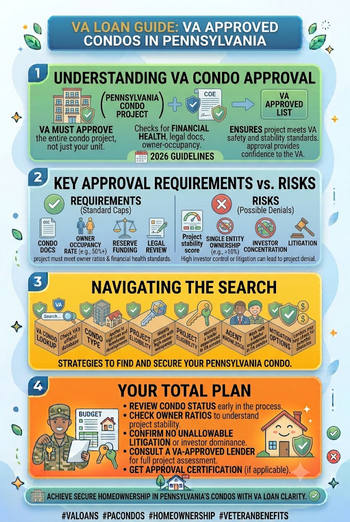 Purchasing a condo in Pennsylvania with a VA loan is entirely achievable, and the prerequisites are generally less onerous than those for FHA financing. Still, the Department of Veterans Affairs maintains distinct benchmarks that both the condominium building and its homeowners association must satisfy. Familiarizing yourself with these stipulations will help you pinpoint VA-approved condos in Florida or Pennsylvania properties that meet eligibility criteria, steering you clear of those that do not.
How VA Condo Requirements Differ from FHA
The VA exhibits considerably more latitude than the FHA regarding condo approvals. Whereas FHA enforces rigid owner-occupancy percentages and caps on investor ownership, the VA prioritizes the property's fundamental soundness. This practical approach means a greater number of Pennsylvania condos will qualify for VA loans compared to FHA loans.
Nevertheless, the VA still mandates that the building adhere to minimum standards and that the HOA demonstrate fiscal responsibility. Loans will not be approved for structures plagued by major structural defects, insufficient insurance coverage, or financial instability.
VA Condo Building Requirements
For a condominium building in Pennsylvania to receive VA approval, it must satisfy these specific criteria:
Legal Structure
The building must function as a properly established condominium under Pennsylvania law, complete with a recorded master deed and declaration. The VA requires documentation confirming the condo's legal establishment and proper registration.
No Blanket Prohibitions
The VA will not approve loans in buildings that contain blanket prohibitions against VA financing. Some older HOAs maintain restrictive covenants that prevent VA, FHA, or certain loan types. Scrutinize the HOA documents to verify that VA loans are not forbidden.
Structural Soundness
The building must demonstrate structural integrity without major defects. The VA appraiser will examine the exterior, roof, foundation, and common areas to confirm the building remains in acceptable condition.
Safety and Code Compliance
The building must comply with local building codes and fire safety regulations. Common areas require safety and proper upkeep. Individual units must remain free from hazards such as lead-based paint, mold, or electrical deficiencies.
HOA Financial Stability
The HOA must exhibit financial stability. While the VA imposes less stringent reserve requirements than FHA, it still expects the HOA to manage maintenance and repairs effectively. The VA will review HOA financial statements and evaluate the likelihood of special assessments.
Unlike FHA, the VA does not prescribe a specific reserve percentage. However, alarmingly low reserves may prompt the VA appraiser to flag the issue.
Homeowners Association Documentation
The VA requires the HOA to furnish specific documentation, including:
- Bylaws and governing documents
- HOA financial statements (typically for the past 1-2 years)
- Current HOA budget
- HOA rules and regulations
- Insurance information
- Disclosure of any pending litigation
- Special assessments (both current and planned)
The VA demonstrates greater tolerance regarding documentation completeness than FHA. If you cannot obtain all documents immediately, the VA often permits you to proceed with the available materials and a written explanation for the missing items.
VA Appraiser's Role in Condo Approval
The VA appraiser holds a pivotal position in determining condo qualification. Unlike FHA's desk review process, the VA appraiser physically inspects the property and exercises professional judgment regarding whether the building meets VA standards.
What the VA Appraiser Evaluates
- Your unit: Your specific unit must remain in safe, livable condition without major structural, mechanical, or safety issues.
- Common areas: Hallways, stairwells, lobbies, parking areas, and other shared spaces require safety and reasonable maintenance.
- Building exterior: Roof, siding, windows, doors, and foundation must be in acceptable condition.
- Amenities: Pool, fitness center, or other amenities must be safe and functional or clearly designated as out of service.
- Overall condition: The appraiser renders a judgment about whether the building receives adequate maintenance.
VA Appraiser Standards Are Reasonable
The VA appraiser understands that older buildings are not perfect. They do not seek pristine conditions; they look for safety and basic maintenance. A building with cosmetic wear, older appliances, or minor maintenance issues will still qualify. However, a building with deferred maintenance, safety hazards, or structural problems may not.
VA vs. FHA Condo Requirements Comparison
| Requirement | VA | FHA |
|---|---|---|
| Owner-Occupancy % | No requirement | Must be 50%+ |
| Investor Ownership Cap | No cap | Max 10% |
| Reserve Requirement | No specific % required | 10-25% of annual budget |
| Building Inspection | VA appraiser visits | FHA appraiser visits + desk review |
| HOA Documentation | Less strict | Very strict |
| Litigation Impact | Case-by-case | Major litigation = denial |
| Flexibility | More flexible | Stricter standards |
Why This Matters
Because the VA offers more flexibility, buildings that might fail FHA requirements often qualify for VA financing. An investor-heavy building with 70% rented units would fail FHA but could pass VA scrutiny. A building with lower reserves might struggle with FHA yet qualify with VA. This flexibility benefits VA borrowers throughout Pennsylvania.
Pennsylvania-Specific Condo Considerations for VA Loans
PA Condo Law Compliance
The HOA must comply with Pennsylvania's Uniform Condominium Act. The VA will verify that the HOA operates legally and that your purchase constitutes legitimate condo ownership.
Common PA Building Issues and VA Approval
Many Pennsylvania condo buildings constructed during the 1970s-1990s possess aging systems. Here is how these typically fare with VA approval:
- Older roofs: If the roof remains serviceable despite age, the VA typically approves. Only active leaks or obvious failure will cause denial.
- Aging HVAC systems: Operational systems receive VA approval. The appraiser notes age but does not require replacement.
- Outdated plumbing: Older plumbing proves acceptable if not actively failing. The VA does not mandate modernization.
- Parking lot deterioration: Some cracking and wear prove acceptable. Only significant deterioration affecting safety poses a problem.
- Deferred maintenance: This represents the primary concern. Clearly neglected common areas may prompt the appraiser to flag issues.
The VA's approach remains pragmatic: the building need not be new or flawless, but it must be safe and reasonably maintained.
Homestead Property Tax Exemption
Pennsylvania homeowners may claim a homestead property tax exemption for their primary residence. Check with your local assessor to confirm your condo qualifies. This can substantially reduce your property taxes.
PA Real Estate Transfer Tax
Pennsylvania imposes a 1% real estate transfer tax on purchase price, plus possible local transfer taxes. Budget for this when calculating closing costs.
HOA Documents and VA Approval
While the VA exercises less strictness than FHA regarding HOA documentation, your lender will still request certain documents:
Documents Your Lender Will Request
- HOA bylaws and declaration
- Current HOA budget
- Last 1-2 years of HOA financial statements
- HOA contact information
- Current HOA rules and regulations
- Disclosure of any special assessments (current or planned)
- Insurance information
- Disclosure of any litigation
VA's Flexibility on Missing Documents
If the HOA cannot produce a reserve study, the VA typically does not require it, unlike FHA. If some financial documents prove missing, the VA lender may permit proceeding with a written explanation. This flexibility renders VA loans more workable for condos with less-organized HOAs.
Potential Issues That Could Prevent VA Approval
Major Structural Problems
Significant foundation issues, roof leaks, water damage, or structural defects will likely prevent approval. The VA appraiser will identify these during inspection.
Safety Hazards
Electrical problems, gas leaks, mold, lead paint in units built before 1978, asbestos, or other health hazards will prevent approval.
Extreme Deferred Maintenance
If common areas display clear neglect, including broken railings, non-functional lights, cracked walls, or trash accumulation, the appraiser may withhold approval.
Non-Compliant HOA
If the HOA operates illegally under Pennsylvania law or violates its own bylaws, the VA may not approve.
Blanket VA Loan Prohibition
Some older HOA documents contain restrictions prohibiting VA or FHA loans. If the HOA maintains such a prohibition in its bylaws, the VA will not approve loans there.
Solution: The HOA can amend its bylaws to remove this restriction. However, this requires a vote and may take time.
Extreme Financial Distress
If the HOA faces insolvency or bankruptcy, the VA will likely deny the loan. The appraiser will note red flags like an inability to pay for basic maintenance.
Questions to Ask the HOA Before Making an Offer
To avoid surprises, ask these questions before committing to purchase:
- Can you provide the HOA bylaws and declaration?
- Are there any restrictions on VA loans in the HOA documents?
- What are the current monthly HOA fees?
- What is included in the HOA fees?
- Are there any special assessments current or planned?
- Are there any pending lawsuits against the HOA or building?
- Can you provide the last two years of HOA financial statements?
- What is the HOA's funding for major repairs (reserves)?
- What percentage of units are owner-occupied vs. rented?
- Are there any major repairs planned (roof, parking lot, siding, etc.)?
A well-run HOA will answer these questions promptly and completely. Evasiveness signals a red flag.
The VA Loan Approval Process for Pennsylvania Condos
- Find a condo: Locate a Pennsylvania condo you wish to purchase.
- Get pre-approved: Your VA lender pre-approves you for the loan amount.
- Make an offer: You submit an offer to the seller.
- Offer accepted: The seller accepts your offer.
- Full application: You submit a complete VA loan application.
- HOA documents requested: Your lender requests HOA documents from the seller or HOA.
- Lender review: Your lender reviews the condo and HOA documentation for VA eligibility.
- VA appraisal ordered: If the lender approves, a VA appraisal is ordered.
- Appraiser inspects: The VA appraiser visits the building and your unit, inspecting for VA compliance.
- Appraisal report: The appraiser submits findings to your lender.
- Final underwriting: Based on the appraisal and all documents, the lender issues final approval or conditions.
- Clear to close: Once all conditions are met, you receive clear to close.
- Closing: You sign documents and receive the keys.
The entire process typically spans 30-45 days, with condo approval generally not adding significant time because the VA process remains streamlined.
Key Takeaways
- More PA condos qualify for VA than FHA. The VA offers greater flexibility regarding investor ownership and reserves.
- Building must be structurally sound. Major structural problems prevent approval.
- Safety is non-negotiable. Lead paint, mold, electrical problems, and other hazards prevent approval.
- HOA doesn't need a specific reserve level. Unlike FHA, the VA has no percentage requirement.
- VA appraiser visits the building. The appraiser makes a judgment call about whether the building meets VA standards.
- HOA documentation required but flexible. The VA is less strict than FHA about documentation completeness.
- No investor ownership cap. Buildings with mostly rental units can still qualify for VA.
- Vet the HOA before buying. Ask questions about financial health, special assessments, and litigation.
- The VA approach is pragmatic. The building doesn't need perfection; it needs safety and reasonable maintenance.
Bottom Line
Purchasing a VA-approvable condo in Pennsylvania generally proves easier than obtaining FHA approval. The VA's more flexible standards mean more buildings qualify. However, you must still confirm the building is structurally sound, safe, and adequately maintained. A poorly maintained building or an HOA facing a financial crisis can still result in denial.
Perform your due diligence: inspect the building carefully, ask the HOA the right questions, and do not skip the underwriting process. A quality condo building will have no trouble qualifying for VA approval. Take advantage of your VA benefit and use your strong negotiating position as a VA buyer to secure a solid Pennsylvania condo.
Frequently Asked Questions
What is the difference between VA-approved condos in Florida and Pennsylvania requirements?
While the core VA requirements remain consistent nationwide, state laws and local practices create some variation. Florida has its own condominium statutes that HOAs must follow, and the climate presents unique maintenance concerns, such as hurricane resistance. However, the fundamental VA approval process and building standards are identical across all states.
Are VA-approved townhomes included in the VA-approved condominium list?
Yes, townhomes that are legally structured as condominiums often appear on the VA approved townhomes list. However, fee-simple townhomes, in which you own the land outright, do not require condo approval. The VA approved condominium list typically includes townhome-style condos that share common elements and HOA governance.
How can I check spot approval for VA condo properties?
Your lender initiates the spot approval for VA condo process through the VA's portal. This involves submitting HOA documents, financial statements, and building information for review. The VA provides a determination within a few weeks. This process works well for individual units in buildings without blanket approval.
Do I need to find VA-approved condos in California or Pennsylvania before making an offer?
While finding VA approved condos California or Pennsylvania properties listed as approved can simplify your search, you can still pursue properties that are not on the VA approved condominium list. Your lender can request spot approval, though this introduces some uncertainty about the timeline. Work with an experienced VA lender who understands the approval process.
Where can I find a VA-approved townhomes list for my area?
The VA maintains a searchable online database of approved condominiums, including townhomes. Your lender can also access this information directly. Many real estate websites now include filters for VA-approved properties, making it easier to identify eligible townhomes and condos in your target area.
Connect With Us
Please share – it really helps