VA Cash-Out Refinance: How to Access Your Home Equity
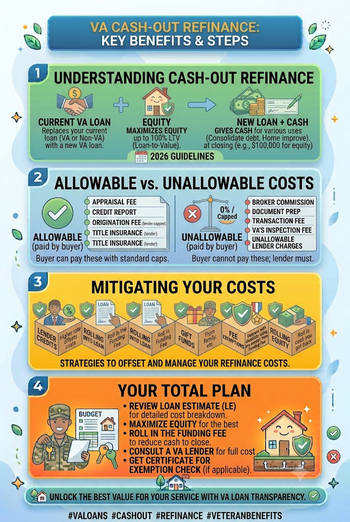 Paying down your VA mortgage does more than reduce your debt. It builds a reservoir of equity within your property. You can tap into this reservoir for home improvements, debt consolidation, tuition, or other financial necessities through a cash-out refinance. Grasping the mechanics of VA cash-out refinances will clarify whether this approach aligns with your financial goals.
What is a VA Cash-Out Refinance?
A cash-out refinance occurs when you replace your existing VA loan with a new one for a sum greater than your current balance. You then pocket the difference in cash. The fresh loan extinguishes the old one, and you depart the closing table with funds in hand.
Simple Example
Consider a home bought for $300,000 using a VA loan. You have paid the balance down to $250,000. Today, the property appraises at $400,000. With a $250,000 balance, your equity stands at $150,000.
Through a cash-out refinance, you might secure a new loan of $320,000. This new loan settles your old $250,000 obligation. After closing costs, you receive approximately $70,000 in cash.
Your mortgage balance increases, but you gain liquid capital for other purposes.
How Much Cash Can You Take Out?
The cash you can extract depends on your home's appraised value and the equity you have accumulated.
The Equity Calculation
Your accessible equity is governed by the loan-to-value (LTV) ratio. The VA generally permits borrowing up to 100% of your home's appraised value.
Formula: Cash out = (Home value × 100%) - Current loan balance - Closing costs
Example
Home value: $400,000
Current loan: $250,000
Estimated closing costs: $5,000
Maximum new loan: $400,000
Cash received: $400,000 - $250,000 - $5,000 = $145,000
You could access up to $145,000 in cash through this refinance.
Practical Limit: Usually 75-80% LTV
Though the VA permits 100% LTV, most lenders exercise greater caution. They typically prefer borrowers retain at least 20% equity in the home. This preference means most lenders cap cash-out refinances at 80% LTV.
Conservative example (80% LTV):
Home value: $400,000
Maximum new loan: $320,000 (80% of value)
Current loan: $250,000
Closing costs: $5,000
Cash received: $320,000 - $250,000 - $5,000 = $65,000
More conservative lenders might cap you at 75% LTV, further reducing your cash access.
VA Cash-Out Refinance Requirements
Cash-out refinances carry different stipulations than rate-and-term refinances, such as the IRRRL.
Existing VA Loan
You must possess an existing VA loan. A cash-out refinance cannot be executed with a conventional, FHA, or USDA loan unless you first satisfy that debt and utilize a VA purchase loan, which necessitates the property being a new acquisition.
Home Must Appraise
Unlike the IRRRL, a cash-out refinance demands a full appraisal. The lender requires a precise valuation to determine your borrowing capacity.
The lender typically orders the appraisal, costing between $400 and $700 depending on the property and geographic location.
Sufficient Equity
You must possess enough equity to access cash. A short tenure in the home or a declining market could leave you with insufficient equity for a cash-out refinance.
Income Verification
Unlike the IRRRL, a cash-out refinance requires income verification, employment confirmation, and a credit review. The process mirrors that of obtaining a new loan.
You will need to provide:
- Last two years of tax returns or W-2s
- Recent pay stubs (typically covering the last 30 days)
- Bank statements (to verify assets and down payment)
- Employment verification letter
Credit Check
The lender will pull your credit report and evaluate your credit score. Most lenders prefer a score of 620 or higher for a cash-out refinance, though some require 640 or above.
Debt-to-Income Ratio
The lender will compute your DTI, including the new mortgage payment. You typically need a DTI of 41% or lower, though some VA lenders offer more flexibility.
Primary Residence
The property must serve as your primary residence. A cash-out refinance on a rental property or vacation home using a VA loan is not permitted.
VA Cash-Out Refinance Costs
Funding Fee
VA cash-out refinances carry a 2.3% funding fee, identical to a purchase loan. This is substantially higher than the 0.5% funding fee on an IRRRL.
Example: For a $320,000 loan, the funding fee amounts to $7,360. This fee can be incorporated into your loan amount.
Veterans exempt from funding fees due to service-connected disability pay nothing.
Closing Costs
Closing costs for a cash-out refinance typically range from $2,000 to $5,000, depending on loan size and location. These costs include:
- Appraisal: $400-$700
- Title search and insurance: $300-$600
- Origination fee: 0.5-1% of loan amount
- Processing and underwriting: $300-$500
- Recording and transfer fees: $100-$300
- Other miscellaneous costs: $200-$500
Interest Rate
Cash-out refinance rates typically run 0.25-0.75% higher than rate-and-term refinance rates. This premium reflects the additional risk lenders perceive when borrowers extract cash.
Shopping around is wise, as rates vary considerably between lenders.
Break-Even Analysis for Cash-Out Refinance
Because cash-out refinances carry higher rates and substantial closing costs, careful evaluation is necessary. You must determine whether the cash you access justifies the expense.
The Calculation
Determine your monthly payment increase, if any, and calculate how long it takes for the cash value to offset any additional costs.
Example:
Current loan: $250,000 at 6.5% = $1,581/month
New loan: $320,000 at 7.0% = $2,128/month
Monthly payment increase: $547
Closing costs: $3,500
Cash received: $65,000
In this scenario, you pay $547 more per month but receive $65,000 in cash. Whether this makes sense depends on your intended use of the cash.
When Cash-Out Refinance Makes Sense
Ask yourself: "Will the cash I receive be worth the higher monthly payment?"
- Home improvements that increase value: Taking $50,000 to renovate your kitchen and add a bathroom that adds $75,000 to your home value makes sound financial sense.
- Debt consolidation at lower rates: Consolidating high-interest credit card debt (18-21%) into a mortgage (7%) saves money even with higher monthly payments.
- Major life expense: Education, medical bills, or starting a business represent situations where the cash has clear, tangible value.
When Cash-Out Refinance Doesn't Make Sense
- Just to have cash: Refinancing solely to extract money for discretionary spending increases debt without a clear benefit.
- Lifestyle inflation: Taking $50,000 for a vacation or new car leaves you with a higher mortgage and nothing durable to show for it.
- When rates are rising: Locking into a higher rate commits you to elevated costs for 30 years.
Specific Uses for Cash-Out Refinances
Home Improvement
This ranks as the most popular use. You refinance and take cash to renovate your kitchen, add a bathroom, replace the roof, or enhance your landscaping.
The advantage is that home improvements often increase your home's value. Your home equity after the refinance may remain similar to before, especially if the improvement adds value exceeding the interest rate increase.
Debt Consolidation
If you carry high-interest credit card debt, student loans, or car payments, you can refinance and take cash to settle these obligations.
Example:
- Credit card debt: $30,000 at 18% = $540/month in interest alone
- Refinance and take $30,000 cash to pay off credit cards
- New mortgage increases by $200/month
- Net savings: $340/month ($540 interest - $200 payment increase)
Debt consolidation through refinancing often saves money because mortgage rates are substantially lower than credit card rates.
Emergency Fund / Cash Reserves
Some homeowners refinance to build a cash reserve for emergencies or future opportunities. This approach carries more risk because you increase debt without a specific purpose. However, it can represent prudent financial planning in certain circumstances.
Education Costs
Taking cash to pay for your child's college or your own education is a valid use. Education represents an investment in future earning potential.
Business Investment
If you are starting or expanding a business, refinancing your home to fund the venture can work. However, this carries significant risk. If the business fails, you still have the higher mortgage.
Investment Property Purchase
Some veterans refinance their primary residence and take cash to purchase an investment property. The risk here is taking on additional debt on your primary home to buy a rental property that may or may not generate positive cash flow.
Comparison: Cash-Out Refinance vs. HELOC vs. Home Equity Loan
| Feature | Cash-Out Refi | HELOC | Home Equity Loan |
|---|---|---|---|
| Interest rate | 7-8% typically | 8-10% (variable) | 7-9% typically |
| Closing costs | $2,000-$5,000 | $500-$2,000 | $1,000-$3,000 |
| Time to access cash | 30-45 days | 20-30 days | 20-30 days |
| Debt structure | Single large loan | Draw as needed | Single lump sum |
| Rate type | Fixed | Variable | Fixed |
| VA option | Yes | No (conventional only) | No (conventional only) |
| Best for | Large one-time needs | Flexible/ongoing access | Medium one-time needs |
When to Choose Cash-Out Refinance Over Other Options
Cash-out refinancing proves most advantageous when:
- You need a large amount of cash ($20,000+)
- You want a fixed interest rate, not variable
- You prefer a single debt payment
- You want VA loan benefits (if eligible)
- You are comfortable extending your mortgage term
A HELOC or home equity loan might be preferable if you need smaller amounts or desire flexibility to access cash over time.
Common Mistakes with Cash-Out Refinances
Mistake 1: Not Shopping Interest Rates
Cash-out refinance rates can vary by 0.5-1% between lenders. Obtain quotes from at least 3-5 lenders. A 0.5% difference on a $300,000 loan saves $150/month ($1,800/year).
Mistake 2: Ignoring Closing Costs
Some borrowers fixate on interest rates while overlooking closing costs. Request a full Loan Estimate that itemizes all expenses. Compare total costs, not merely the rate.
Mistake 3: Taking Out More Cash Than Needed
Just because you can borrow $100,000 does not mean you should. The more you borrow, the higher your monthly payment. Only take what you actually require.
Mistake 4: Refinancing for Discretionary Spending
Taking $30,000 for a vacation or car purchase increases your mortgage for 30 years for something that loses value immediately. Avoid this approach.
Mistake 4: Not Considering Future Plans
If you are contemplating selling or moving within a few years, a cash-out refinance might not make sense. You will not remain in the home long enough to benefit from the cash.
Mistake 5: Refinancing Too Often
Each refinance incurs closing costs. Refinancing multiple times in quick succession erodes your benefits. Space out your refinances.
Cash-Out Refinance Process
- Determine your need: How much cash do you need and why?
- Check your home value: Get a preliminary estimate of current value.
- Calculate available equity: Value minus current loan balance equals equity available.
- Shop lenders: Get quotes from 3-5 VA lenders.
- Compare Loan Estimates: Look at rates, fees, and total costs.
- Choose lender and apply: Submit application with income documentation.
- Appraisal ordered: Lender orders appraisal (you typically pay).
- Underwriting: Lender reviews your finances and appraisal.
- Clear to close: Once approved, you get clear to close.
- Closing: Sign documents, receive cash, new loan funds.
Timeline: 30-45 days from application to closing.
Key Takeaways
- Cash-out refinances let you access home equity. Borrow against your equity to get cash.
- Most lenders cap at 80% LTV. You keep at least 20% equity in the home.
- Appraisal required. Lender needs to know home value to determine borrowing power.
- Funding fee is 2.3%. Same as a purchase loan; much higher than IRRRL's 0.5%.
- Closing costs are $2,000-$5,000. Shop around to minimize costs.
- Interest rates are higher. Typically 0.5-1% higher than rate-and-term refinances.
- Income verification required. Full documentation like a new loan application.
- Only for primary residence. Cannot use on investment properties with a VA loan.
- Calculate true cost. Make sure the cash value justifies the higher monthly payment.
- Best for home improvements or debt consolidation. Avoid for discretionary spending.
Bottom Line
VA cash-out refinances represent a legitimate mechanism for accessing the equity you have accumulated in your home. They prove most beneficial for home improvements that increase property value and debt consolidation that reduces interest expenses. However, the elevated rates, substantial funding fee, and closing costs require a clear, valuable purpose for the cash. Avoid refinancing merely to have money sitting in the bank. Be strategic, compare lenders carefully, and only access cash for purposes that will improve your financial situation over the long term.
Connect With Us
Please share – it really helps