Credit Score Requirements: Minimum Scores and Qualifying Standards
 Your credit score is one of the biggest factors lenders evaluate
when deciding whether to approve your home loan. Understanding
credit score requirements and how to build or maintain good credit
will help you get approved and secure the best interest rates
available to you.
Your credit score is one of the biggest factors lenders evaluate
when deciding whether to approve your home loan. Understanding
credit score requirements and how to build or maintain good credit
will help you get approved and secure the best interest rates
available to you.
What is a Credit Score?
A credit score is a three-digit number (typically 300-850) that represents your creditworthiness. It's calculated based on your credit history and shows lenders how likely you are to repay borrowed money on time.
Who Calculates Credit Scores?
Three major credit bureaus calculate your score:
Each bureau may calculate slightly different scores based on their data, so you might have three different credit scores. Lenders typically pull all three and use the middle score for loan decisions.
Try our credit score average calculator
How Credit Scores Are Calculated
Your credit score is determined by five main factors:
Payment History (35%)
This is the most important factor. Do you pay your bills on time? Lenders look at:
- On-time payments: Excellent (35% points)
- Late payments (30, 60, 90 days): Significant deduction
- Collections accounts: Major negative impact
- Charge-offs: Serious damage
- Bankruptcy: Severe damage, but recovers over time
One late payment can drop your score 50-100 points. Multiple lates or collections can drop it 150+ points.
Credit Utilization (30%)
This is how much of your available credit you're using. If you have $10,000 in credit limits across all cards and you're using $8,000, your utilization is 80%.
Lenders prefer utilization below 30%. Here's why:
- Below 30%: Excellent (shows responsible use)
- 30-50%: Good (acceptable but not ideal)
- 50-80%: Fair (raises concern about financial stress)
- Above 80%: Poor (signals potential financial problems)
Paying down credit card balances is one of the fastest ways to improve your score.
Try our credit utilization calculator
Length of Credit History (15%)
How long have you had credit? Lenders prefer borrowers with longer credit histories because they show you can manage credit over time.
- 10+ years of credit history: Excellent
- 5-10 years: Good
- 1-5 years: Fair
- Less than 1 year: Poor
This is why you shouldn't close old credit accounts—they help your credit history length.
Credit Mix (10%)
This is the variety of credit types you have. Lenders like to see you can manage different types of credit:
- Credit cards (revolving credit)
- Auto loans (installment credit)
- Student loans (installment credit)
- Mortgages (installment credit)
- Lines of credit (revolving credit)
Having multiple types of credit in your history shows you can manage different credit situations responsibly.
New Credit (10%)
Have you recently opened new credit accounts? New credit inquiries and accounts can temporarily lower your score slightly because:
- Hard inquiries (when you apply for credit) lower your score a few points
- New accounts lower your average age of credit
However, this impact is temporary. After a few months, the score typically recovers.
Credit Score Ranges and What They Mean
| Score Range | Rating | Approval Likelihood | Interest Rate Impact |
|---|---|---|---|
| 740-850 | Excellent | Very likely | Best rates |
| 670-739 | Good | Likely | Good rates |
| 580-669 | Fair | Possible (varies) | Higher rates |
| 300-579 | Poor | Difficult | Much higher rates |
Minimum Credit Score Requirements by Loan Type
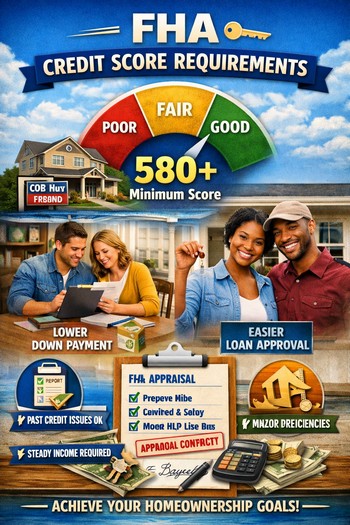
VA loans have no official minimum credit score requirement, though most lenders require 620+; FHA typically requires 580+; and conventional loans are strictest, usually requiring 620-680+. Your credit score directly impacts your interest rate—a 50-point difference can cost or save you tens of thousands over the life of the loan.
VA Loans
Official VA requirement: No minimum credit score
Typical lender requirement: 620+
Some lenders will consider: 580-620
Rare lenders will work with: 550-580
VA loans are the most flexible on credit scores. The VA itself doesn't set a minimum—it's the individual lenders who do. This means you have more options if your score is below 620.
FHA Loans
Official FHA requirement: No official minimum
Typical lender requirement: 580+
Some lenders require: 620+
FHA is flexible on credit scores, similar to VA. However, if your score is below 580, approval becomes very difficult. Most lenders won't touch scores below 580 for FHA loans.
Conventional Loans
Official requirement: No official minimum
Typical lender requirement: 620-680
Prime conventional rates: 740+
Most lenders won't consider: Below 620
Conventional loans are stricter on credit. If your score is below 620, approval is difficult. If it's below 580, most conventional lenders won't work with you at all.
How Credit Score Affects Interest Rates
Your credit score directly impacts your interest rate. A lower score means a higher rate.
Real-World Example
For a $300,000 VA loan (current market rates):
| Credit Score | Interest Rate | Monthly Payment | 30-Year Interest Paid |
|---|---|---|---|
| 750+ | 6.25% | $1,848 | $364,800 |
| 700-749 | 6.50% | $1,896 | $382,560 |
| 660-699 | 6.75% | $1,944 | $399,840 |
| 620-659 | 7.00% | $1,996 | $418,560 |
| 580-619 | 7.50% | $2,098 | $455,280 |
The Cost of Low Credit
A borrower with a 580 score versus a 750 score pays:
- $250/month more
- $3,000/year more
- $90,480 more over 30 years
This is why improving your credit score before applying is so valuable. Even a 20-30 point improvement can save thousands.
What Lenders Look for Beyond the Score
While your credit score is important, lenders also examine your credit report in detail.
Payment History Details
Lenders want to see:
- On-time payments: Consistent history of paying on time
- Recent good behavior: Even with past late payments, recent on-time history matters
- Account age: Older accounts in good standing are positive
- No recent collections: Recent collections are major red flags
Types of Late Payments
Not all late payments affect your approval the same way:
- Mortgage/rent late: Most serious. Lenders see this as a warning that you might not pay them.
- Credit card late: Concerning but less serious than mortgage late.
- Utility or medical late: Less concerning than credit card late.
A single 30-day late payment on a credit card 2 years ago might not prevent approval. But a mortgage late payment from 6 months ago could be a deal-breaker.
Bankruptcy
Bankruptcy doesn't automatically disqualify you, but lenders want to see clean history since the discharge:
- Chapter 7 (liquidation): Typically want to see 2+ years of on-time payments since discharge
- Chapter 13 (reorganization): May approve during payment plan if you're current on payments
Foreclosure or Short Sale
Similar to bankruptcy, a foreclosure or short sale doesn't prevent future lending, but lenders want evidence of financial recovery:
- 2+ years of on-time payments since the event
- Stable employment
- Adequate reserves (savings)
How to Improve Your Credit Score
If your credit score is lower than you'd like, here are strategies to improve it.
Strategy 1: Pay Down Credit Card Balances (Fast Impact)
This is the fastest way to improve your score. Reducing credit card balances lowers your utilization ratio, which is 30% of your score.
Action plan:
- Calculate your total credit card limits
- Determine your total balances
- Target getting below 30% utilization
- Pay down the cards with highest utilization first
Timeline: 1-2 months of payments can improve your score 20-50 points
Strategy 2: Make All Payments On Time (Ongoing)
Late payments damage your score significantly. Start now and maintain on-time payments for at least 6-12 months.
Action plan:
- Set up automatic payments for all bills
- Pay at least the minimum on credit cards
- Don't miss a single payment
Timeline: 6-12 months of perfect payment history improves score 20-100+ points
Strategy 3: Don't Close Old Credit Accounts
Keep old accounts open, even if you're not using them. Closing accounts lowers your available credit and reduces your credit history length.
Why: Closing a card with $10,000 limit means you lose that $10,000 in available credit, which could raise your utilization ratio.
Strategy 4: Dispute Errors on Your Credit Report
Errors happen. If you see something wrong, dispute it.
Action plan:
- Get your free credit report from annualcreditreport.com
- Review for errors (late payments that weren't late, accounts you didn't open, etc.)
- Dispute errors directly with the credit bureau
- Include documentation proving the error
Timeline: Disputes can take 30-45 days to resolve, but correcting a major error could improve your score significantly
Strategy 5: Become an Authorized User
If someone with excellent credit is willing, ask to become an authorized user on one of their credit card accounts. Their good payment history can boost your score.
Important: You don't even need to use the card. Just being added as an authorized user can help.
Timeline: Score improvements vary but can be 20-50+ points in 1-2 months
Strategy 6: Don't Apply for New Credit Right Before Homebuying
Each credit application (hard inquiry) lowers your score 5-10 points. Multiple inquiries in a short period look worse.
Action plan:
- Stop applying for new credit 6 months before homebuying
- Don't take on new credit cards, car loans, or other debt
- If you need a loan, shop within 14 days (multiple inquiries in 14 days count as one)
Strategy 7: Don't Pay Off Collections Accounts Right Before Applying
This might sound counterintuitive, but paying off a collections account right before applying for a mortgage can actually lower your score temporarily. The account gets updated and reported as "paid collections," but it's recent activity.
Better approach: Pay off collections now, wait 6+ months for the impact to minimize, then apply for your loan.
Timeline for Score Improvement
How long until your score improves depends on your situation:
Quick Improvements (1-2 Months)
- Paying down credit card balances: 20-50 point increase
- Becoming authorized user: 20-50 point increase
- Disputing errors: Varies, could be significant
Medium-Term Improvements (3-6 Months)
- 6 months of on-time payments: 30-100 point increase
- Paying off smaller debts completely: 20-50 point increase
- Bringing credit cards below 30% utilization: 30-50 point increase
Long-Term Improvements (6-24 Months)
- 12-24 months of perfect payment history: 100+ point increase
- Collections aging and falling off report: Significant improvement
- Late payments aging (especially after 24+ months): Gradual improvement
- Bankruptcy recovery (2-7 years): Gradual improvement
Credit Score Strategy for Mortgage Applications
If you're planning to buy a home, here's a timeline for credit improvement:
If Applying in 1-2 Months
- Focus on paying down credit card balances
- Make sure no payments are late
- Don't apply for new credit
- Work to get below 30% utilization on all cards
If Applying in 3-6 Months
- Do everything above
- Make 3-6 months of perfect on-time payments
- Pay off any small collections if possible
- Dispute any errors on your report
If Applying in 6-12 Months
- Build 12 months of perfect payment history
- Pay down credit cards aggressively (below 10% if possible)
- Pay off collections accounts and wait 30+ days
- Become authorized user if possible
- Dispute all errors
What If Your Score Is Really Low (Below 580)?
If your credit score is below 580, you still have options, but approval will be difficult.
VA Loans Are Your Best Bet
Some VA lenders specialize in working with borrowers with low credit scores. You might find approval with a 550-580 score from a specialty VA lender.
Drawback: You may pay higher interest rates and face more restrictive terms.
FHA Might Work
FHA is flexible on credit, but below 580 is very difficult. Some lenders might consider you, but options are limited.
Conventional Is Unlikely
Most conventional lenders won't work with scores below 580.
Strategy: Wait and Build Credit
If you're below 580, honestly the best strategy is to spend 6-12 months building your credit. Focus on:
- Making every payment on time (set up auto-pay)
- Paying down credit cards to below 30% utilization
- Disputing any errors
- Avoiding new credit applications
Even a 50-100 point improvement opens up many more lender options and saves you thousands in interest.
Key Takeaways
- VA loans have no official minimum credit score. Most VA lenders require 620+, but some work with 580-620.
- FHA typically requires 580+. Below 580 is very difficult.
- Conventional requires 620+. Most lenders won't consider below 620.
- Credit score directly impacts your interest rate. A 50-point difference can save/cost you tens of thousands.
- Payment history is 35% of your score. Late payments are the fastest way to damage your score.
- Credit utilization is 30% of your score. Paying down cards is the fastest way to improve.
- Quick improvements are possible. Paying down cards can improve your score 20-50 points in 1-2 months.
- Don't apply for new credit before buying. Each application lowers your score.
- Perfect payment history matters. Even with past problems, 6-12 months of perfect payments helps significantly.
- If below 580, wait and build credit. Spending 6-12 months improving your score is worth it.
Bottom Line
Your credit score is important, but it's not the only factor lenders consider. However, it significantly impacts your interest rate and approval likelihood. If your score is below where you'd like it, focus on the quick wins: paying down credit cards and making every payment on time. Even modest improvements can save you tens of thousands in interest over your loan. Don't rush into homebuying with low credit—take time to build it and you'll be rewarded with better rates and more approval options.
Connect With Us
Please share – it really helps