VA Down Payment: Zero Down Payment Explained
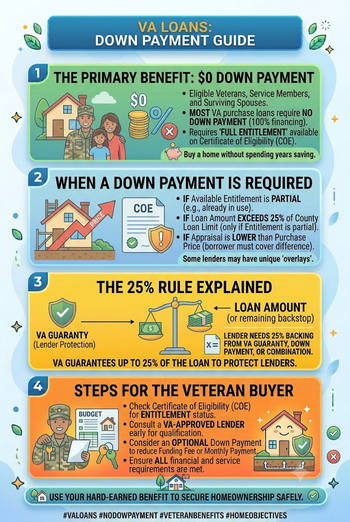 One of the most significant advantages of VA loans is that no
down payment is required. This is a massive benefit that sets VA
loans apart from conventional and FHA loans. Understanding how the
zero down payment requirement works will help you appreciate the
power of this benefit and plan your home purchase strategy.
One of the most significant advantages of VA loans is that no
down payment is required. This is a massive benefit that sets VA
loans apart from conventional and FHA loans. Understanding how the
zero down payment requirement works will help you appreciate the
power of this benefit and plan your home purchase strategy.
The VA Down Payment Requirement: Zero
What Does This Mean?
VA loans require zero down payment. You do not need to save a down payment to buy a home with a VA loan. You can borrow 100% of the purchase price with no money down.
How This Compares to Other Loans
| Loan Type | Down Payment Requirement | Can You Get 100% Financing? |
|---|---|---|
| VA Loan | 0% | Yes |
| FHA Loan | 3.5% minimum | No |
| Conventional Loan | 3-20% typically | Not without PMI |
| USDA Loan | 0% | Yes (rural only) |
VA loans are unique: Zero down payment is the standard, not an exception. Every eligible veteran can qualify without saving a down payment.
Why VA Loans Have Zero Down Payment
The VA Funding Fee Instead
Instead of requiring a down payment, the VA loan program charges a funding fee. This fee compensates the VA for the risk of guaranteeing your loan without a down payment.
How It Works
The VA guarantees a portion of your loan to the lender. If you default, the VA covers part of the lender's loss. This guarantee allows lenders to lend 100% of the purchase price without requiring a down payment.
The trade-off: You pay a funding fee instead of a down payment. This fee is typically 2.3% of the loan amount for a first-time VA purchase with zero down.
The Math
Conventional loan example:
- Home price: $300,000
- Down payment (5%): $15,000 (from your savings)
- Loan amount: $285,000
- You keep the remaining savings: $285,000
VA loan example:
- Home price: $300,000
- Down payment: $0 (from your savings)
- Loan amount: $300,000
- Funding fee (2.3%): $6,900 (rolled into loan)
- Total loan: $306,900
- You keep all your savings: $300,000
The benefit: You can buy the same $300,000 home with VA loan and have $15,000 in savings left over. With a conventional loan, you'd have no savings left.
VA Funding Fee Details
What Is the VA Funding Fee?
The VA funding fee is a one-time charge paid to the VA to compensate for the risk of the VA guarantee. It's paid at closing or rolled into your loan amount (which is typical).
Funding Fee Rates by Situation
Purchase loans (zero down):
- First-time use: 2.3% of loan amount
- Subsequent use (entitlement already used): 3.6% of loan amount
- Active duty: 2.3% (first time), 3.6% (subsequent)
Refinancing (IRRRL):
- Rate-and-term refinance: 0.5% of loan amount
- Cash-out refinance: 2.3% of loan amount
Funded loans (with down payment):
- If you put down 5% or more: 1.5% of loan amount
- If you put down 10% or more: 1.25% of loan amount
- If you put down 20% or more: 0.25% of loan amount
Real Funding Fee Examples
Example 1: Zero down purchase (first-time use)
- Loan amount: $300,000
- Funding fee (2.3%): $6,900
- Total loan: $306,900
- Monthly payment increase due to funding fee: ~$42/month
Example 2: 10% down purchase
- Home price: $300,000
- Down payment (10%): $30,000 (from your savings)
- Loan amount: $270,000
- Funding fee (1.25%): $3,375
- Total loan: $273,375
- Benefit: Lower funding fee because you put down money
Example 3: 20% down purchase
- Home price: $300,000
- Down payment (20%): $60,000 (from your savings)
- Loan amount: $240,000
- Funding fee (0.25%): $600
- Total loan: $240,600
- Benefit: Minimal funding fee because of substantial down payment
Who Is Exempt from the VA Funding Fee?
Service-Connected Disability Exemption
If you have a service-connected disability rating (any percentage), you are exempt from paying the VA funding fee. This is a huge benefit for disabled veterans.
Who qualifies: Any veteran with a VA disability rating (1% or higher)
Benefit: You get zero down payment AND no funding fee. This is the best scenario.
Example: 30% disabled veteran buying a $300,000 home
- Loan amount: $300,000
- Funding fee: $0 (exempt due to disability)
- Total loan: $300,000
- Savings compared to conventional loan with 5% down: $15,000 + $6,900 = $21,900
Surviving Spouse Exemption
Surviving spouses of veterans who died in service or from service-connected disabilities are exempt from the funding fee.
Purple Heart Recipients Exemption
Veterans who received a Purple Heart are exempt from the funding fee.
Down Payment: Zero or Optional?
You Don't Need a Down Payment
The core benefit of VA loans is that you can buy a home with zero down payment. This is not optional - it's the standard feature.
Can You Put Down a Down Payment?
Yes, but it's optional. You can choose to put down a down payment if you want to. This would reduce your loan amount and your funding fee.
Why Would You Put Down a Down Payment?
There are strategic reasons to put down a down payment, even though it's not required:
- Reduce funding fee: Larger down payment = lower funding fee
- Lower monthly payment: Smaller loan = smaller payment
- Better interest rate: Some lenders offer slightly better rates with a down payment
- Faster equity buildup: More equity from day one
- Strategic timing: If you have extra cash and rates are favorable, putting down money might make sense
Why Most Veterans Don't Put Down a Down Payment
Most VA buyers choose zero down because:
- Preserves cash: Keep savings for emergencies, repairs, etc.
- Flexibility: May need cash for other life expenses
- Investment returns: Savings in investment accounts might earn more than you save on funding fee
- Peace of mind: Having reserves is more valuable than a smaller payment
- No mortgage insurance: VA loans don't require PMI regardless of down payment amount
Real-World Down Payment Scenarios
Scenario 1: Zero Down (Most Common)
Situation: First-time VA buyer, no disability rating, buying $350,000 home
Zero down option:
- Down payment: $0
- Loan amount: $350,000
- Funding fee (2.3%): $8,050
- Total loan: $358,050
- Monthly payment (6.5%): ~$2,265
- Cash you need at closing: Closing costs (seller may pay; VA allows 100% closing cost coverage)
5% down option:
- Down payment: $17,500 (from your savings)
- Loan amount: $332,500
- Funding fee (2.3%): $7,648
- Total loan: $340,148
- Monthly payment (6.5%): ~$2,153
- Monthly savings: $112/month
- Cash you need at closing: $17,500 down + closing costs
Analysis: Zero down is better in this case because you save $17,500 in cash and the monthly payment difference ($112) would take 156 months (13 years) to equal your savings.
Scenario 2: Disabled Veteran (No Funding Fee)
Situation: 50% disabled veteran, buying $300,000 home
Zero down option:
- Down payment: $0
- Loan amount: $300,000
- Funding fee: $0 (exempt due to disability)
- Total loan: $300,000
- Monthly payment (6.5%): ~$1,896
- Cash you need at closing: Closing costs only (possibly covered by seller)
Benefit: Zero down payment with zero funding fee. This is the best-case scenario.
Scenario 3: Veteran with Significant Savings
Situation: Veteran with $60,000 in savings, buying $400,000 home
Zero down option:
- Down payment: $0
- Loan amount: $400,000
- Funding fee (2.3%): $9,200
- Total loan: $409,200
- Monthly payment (6.5%): ~$2,587
- Remaining savings after closing: ~$50,000 (after paying closing costs)
20% down option:
- Down payment: $80,000
- Loan amount: $320,000
- Funding fee (0.25%): $800
- Total loan: $320,800
- Monthly payment (6.5%): ~$2,029
- Monthly savings: $558/month
- Remaining savings after down payment and closing: ~$0
Analysis: Zero down is better for liquidity. You keep $50,000 in cash reserves. The $558/month savings on the 20% down option would take 89 months to equal what you'd gain by keeping the $50,000 liquid.
VA Funding Fee: Can It Be Avoided or Reduced?
Avoiding the Funding Fee
Methods to avoid funding fee:
- Service-connected disability: Any VA disability rating exempts you
- Purple Heart: Automatically exempt
- Surviving spouse of service-connected death: Exempt
- Surviving spouse of service death: Exempt
If you don't qualify for exemptions: You cannot avoid the funding fee entirely, but you can reduce it by putting down a down payment.
Reducing the Funding Fee
Put down a larger down payment:
- 5%+ down: 1.5% funding fee (vs. 2.3%)
- 10%+ down: 1.25% funding fee (vs. 2.3%)
- 20%+ down: 0.25% funding fee (vs. 2.3%)
Example: Reducing funding fee from 2.3% to 1.5% on $300,000 loan
- 2.3% fee: $6,900
- 1.5% fee: $4,500
- Savings: $2,400
- Cost: 5% down payment ($15,000) from savings
- Net: You pay $15,000 to save $2,400 in funding fee (not a good trade-off)
Comparing VA Zero Down to Conventional Down Payments
The Financial Advantage
Conventional loan example (5% down):
- Home price: $300,000
- Down payment: $15,000
- Loan amount: $285,000
- PMI (required without 20% down): ~$180/month
- Interest rate (typical): 6.5%
- Monthly payment (P&I): ~$1,804
- Total monthly (including PMI): ~$1,984
- Savings used: $15,000
VA loan example (zero down):
- Home price: $300,000
- Down payment: $0
- Loan amount: $300,000
- Funding fee: $6,900 (rolled into loan)
- Total loan: $306,900
- PMI: $0 (not required)
- Interest rate (typical): 6.5%
- Monthly payment (P&I): ~$1,943
- Total monthly: ~$1,943
- Savings kept: $15,000
The Comparison
- Monthly payment difference: VA pays $41 more per month (due to higher loan amount including funding fee)
- Cash at closing: VA saves $15,000
- PMI: VA saves ~$180/month ($2,160/year) until 20% equity is reached
- Net benefit: VA loan saves money and preserves cash
Key Takeaways
- VA loans require zero down payment. This is the standard feature, not an exception.
- You can put down a down payment if you want. It's optional, not required.
- Funding fee is the trade-off for zero down. Typically 2.3% for first-time users (rolled into loan).
- Service-connected disability = no funding fee. Huge benefit for disabled veterans.
- No mortgage insurance required. VA loans don't require PMI regardless of down payment.
- Larger down payment reduces funding fee. But the savings may not justify the cost.
- Zero down preserves your cash. Having reserves is often more valuable than reducing the loan amount.
- VA loans beat conventional loans financially. Zero down + no PMI + no down payment = significant savings.
- You keep your savings for emergencies. Home repairs, job transitions, unexpected expenses - you have a cushion.
- Seller can pay closing costs. You may need zero cash out of pocket at closing.
Bottom Line
The zero down payment requirement for VA loans is one of the most powerful benefits available to veterans. Unlike conventional loans that require 3-20% down, VA loans let you buy a home with no down payment. Instead of a down payment, you pay a funding fee (typically 2.3%), which is rolled into your loan amount. The advantage is massive: you preserve your savings, avoid mortgage insurance, and get a better overall deal than conventional borrowers. For disabled veterans exempt from the funding fee, the benefit is even greater. Whether you choose to put down money is entirely your decision, but the zero down option gives you flexibility other borrowers simply don't have.
Connect With Us
Please share – it really helps