VA Income Requirements: How Much Do You Need to Earn?
 One of the biggest advantages of VA loans is that the VA doesn't
set a minimum income requirement. Unlike some loan programs, there's
no income ceiling or floor - you can earn $30,000 or $300,000 and
still be eligible for a VA loan. However, your lender will verify
that your income is sufficient to support the mortgage payment
you're requesting. Understanding how lenders evaluate income will
help you get approved for the right loan amount.
One of the biggest advantages of VA loans is that the VA doesn't
set a minimum income requirement. Unlike some loan programs, there's
no income ceiling or floor - you can earn $30,000 or $300,000 and
still be eligible for a VA loan. However, your lender will verify
that your income is sufficient to support the mortgage payment
you're requesting. Understanding how lenders evaluate income will
help you get approved for the right loan amount.
The Bottom Line: No VA Income Minimums
The VA itself has zero income requirements. You could theoretically earn minimum wage and still qualify for a VA loan, as long as your income is stable and documented. However, most lenders require a minimum debt-to-income ratio, which indirectly creates an income floor based on the loan amount you want.
How It Works
If you want to borrow $400,000 and your DTI limit is 41%, you need approximately $75,000+ in gross annual income ($6,250/month). If you only earn $30,000/year ($2,500/month), you can't support a $400,000 loan, even though you're technically VA-eligible.
So while there's no minimum income requirement, your actual borrowing power is limited by your income.
How Lenders Calculate Debt-to-Income Ratio (DTI)
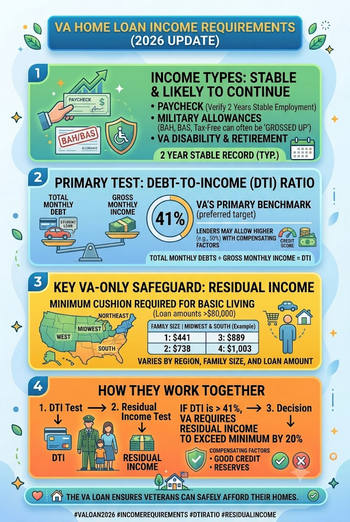
The DTI ratio is critical to VA loan approval. Your DTI is your total monthly debt payments divided by your gross monthly income.
DTI Formula
Total monthly debt / Gross monthly income = DTI ratio
Example
Gross monthly income: $6,000
New mortgage payment: $2,000
Car payment: $300
Student loans: $200
Credit cards (minimum): $100
Total debt: $2,600
DTI: $2,600 / $6,000 = 43.3%
VA DTI Limits
Preferred DTI: 41% or lower
Acceptable DTI: 41-50% with compensating factors (excellent credit, large savings, stable employment)
Difficult DTI: 50-60% (many lenders won't approve; requires strong compensating factors)
Too high DTI: Above 60% (most lenders won't approve)
What Income Counts Toward VA Loans?
Not all income is treated equally. Here's what lenders typically count:
Earned Income (Wages/Salary)
What counts: W-2 income, salary, wages from employment
Documentation needed:
- Last 30 days of pay stubs
- Last two years of tax returns
- Last two years of W-2s
- Verification of Employment letter from employer
Stability requirement: Two years of income history at similar or increasing levels
Self-Employment Income
What counts: Income from your own business (solo practitioner, business owner, contractor)
Documentation needed:
- Last two years of tax returns
- Profit and loss statements
- Bank statements
- Business license
Special consideration: Lenders typically average your income over two years. If your business is new (less than 2 years), it's harder to qualify. Most lenders want to see stable or increasing income.
Example: If you earned $40,000 in year one and $50,000 in year two, lenders typically average to $45,000 for qualification purposes.
Bonus and Commission Income
What counts: Bonuses, commissions, tips (if documented)
Documentation needed:
- Last two years of tax returns
- Written statement from employer confirming bonus/commission structure
- Evidence bonus/commission will continue
Special consideration: Must have received it for two years to count it. Most lenders average it over two years.
Example: If you earned bonuses of $5,000 in year one and $8,000 in year two, lenders average to $6,500.
Rental Income
What counts: Income from rental properties you own
Documentation needed:
- Last two years of tax returns
- Lease agreements for rental properties
- Bank statements showing deposits
Special calculation: Lenders typically count only 75% of rental income (accounting for vacancies and maintenance). If your rental produces $2,000/month, lenders count $1,500.
Important: If you have a mortgage on the rental property, lenders subtract that payment from the rental income when calculating your DTI.
Social Security, Pension, or Disability Income
What counts: Regular monthly benefits from government or private pensions
Documentation needed:
- Benefit statement showing monthly amount
- Award letter from Social Security or pension administrator
Special consideration: If you're under 70 years old, lenders count the full amount. If you're 70+, lenders may apply a life expectancy factor and count a reduced amount.
Example: If you receive $2,500/month in Social Security, lenders count the full $2,500 if you're under 70. If you're 75, they might count $2,000 based on life expectancy.
Alimony and Child Support Income
What counts: Court-ordered alimony or child support you receive
Documentation needed:
- Divorce decree or court order
- Recent bank statements showing deposits
- Documentation that payments are current and on-time
Special consideration: Income must be likely to continue for at least three more years. If your support payments are scheduled to end in two years, lenders won't count it.
Alimony and Child Support Obligations
What counts: These are deductions from income, not additions. If you pay child support or alimony, lenders subtract it from your income when calculating DTI.
Example: If you earn $5,000/month gross income but pay $400/month in child support, lenders may count your income as $4,600 for DTI calculation purposes.
Military Pay and Allowances
What counts: Active duty base pay, BAH (Basic Allowance for Housing), BAS (Basic Allowance for Subsistence)
Documentation needed:
- Current Leave and Earnings Statement (LES)
- Military ID
- Letter from commanding officer confirming service
Special consideration: If you're near the end of your service contract, lenders may be concerned about future income. You should provide a reenlistment letter or new job offer to show continued income after separation.
Non-Taxable Military Income
What counts: Combat zone tax exclusion income (income earned in combat zones)
Documentation needed:
- Last two years of tax returns
- Military Leave and Earnings Statement showing combat zone income
Special consideration: If you're counting combat zone income, the income must be likely to continue. Once you leave the combat zone, lenders typically won't count this income going forward.
Income Not Counted
Lenders typically don't count:
- Unemployment benefits: Usually temporary; won't count toward income
- Welfare or public assistance: Won't count as income
- Tax refunds: Not recurring income
- One-time bonuses: If not part of regular compensation structure
- Gifts: Won't count as income (though they can help with down payment)
- Stock dividends or investment income: Usually minimal; rarely counted
Income Verification Process
What Lenders Will Request
When you apply for a VA loan, lenders will request extensive income documentation:
- Recent pay stubs (usually last 30 days)
- Last two years of W-2s or 1099s
- Last two years of complete federal tax returns (all pages)
- Verification of Employment (VOE) letter from current employer
- If self-employed: Profit and loss statements, business tax returns
- If recently changed jobs: Offer letter from new employer or letter from new employer confirming position and salary
- If commission/bonus income: Written statement from employer confirming compensation structure
- For rental income: Lease agreements and bank statements showing deposits
Verification Methods
Lenders may verify income directly by:
- Calling your employer: Confirming your position, tenure, and income
- Ordering VOE: Third-party company calls employer on lender's behalf
- IRS verification: Lender may request IRS Form 4506 to verify tax return information directly with IRS
- Bank statement review: Examining deposits to confirm income amounts
Special Income Situations
Recently Started a New Job
Challenge: If you just started a job, you have minimal documentation. Most lenders want two years of income history.
Solution: Get an offer letter from your new employer or a letter from HR confirming your position, start date, and salary. Many lenders will count new job income with this documentation, even if you just started.
Seasonal Income
Challenge: If you work seasonal jobs (construction, agriculture, retail), your income varies throughout the year.
Solution: Lenders will average your seasonal income over 12-24 months. You need to show documentation of both your peak and off-season work.
Recently Self-Employed
Challenge: If you've been self-employed for less than 2 years, approval is difficult.
Solution: Provide as much documentation as possible (profit/loss statements, bank statements, business license) and explain your business. Some lenders will work with you with less than 2 years of history if your business looks stable.
Income Drop Due to COVID-19 or Recent Circumstances
Challenge: If your income dropped recently but is recovering, lenders may use the lower income.
Solution: Get a letter from your employer explaining the temporary income reduction and confirming that you're back at normal income levels. Include recent pay stubs showing the increase.
Retired Military with Variable Income
Challenge: If you receive military retirement plus other income, documenting the combination can be complex.
Solution: Provide your military retirement statement (showing monthly benefit amount) plus documentation of any other income. Many lenders are experienced with military retirement income and can handle it smoothly.
Income Stability and Continuity
Beyond the amount of income, lenders care about stability and continuity. Here's what they evaluate:
Employment History
Lenders want to see:
- 2+ years with current employer: Best case; shows stability
- 1-2 years with current employer: Acceptable, especially with offer letter from new employer
- Frequent job changes: Concern; lenders may require explanation
- Gaps in employment: Concern; may require explanation or additional documentation
Income Trend
Lenders want to see:
- Stable or increasing income: Excellent; shows career progression
- Decreasing income: Concern; lenders may use lowest year of income
- Volatile income: Challenge; lenders will average and may discount
How Your Income Affects Loan Amount
Quick Calculation
Your income directly determines how much you can borrow. Here's a rough guide:
At 41% DTI (preferred): You can afford monthly debt equal to 41% of your gross income
Example:
Gross monthly income: $6,000
41% of income: $2,460 available for all debt
Existing debts: $460 (car loan, credit cards, student loans)
Available for mortgage: $2,000/month
At 6.5% interest: $2,000/month mortgage = ~$320,000 loan
Income Impact
Higher income = Higher loan amount potential
If your income was $8,000/month instead:
41% of income: $3,280 available for all debt
Existing debts: $460
Available for mortgage: $2,820/month
At 6.5% interest: $2,820/month mortgage = ~$470,000 loan
A $2,000/month income increase increases your borrowing power by ~$150,000.
Income Documentation Checklist
When applying for a VA loan, have ready:
- Last 30 days of pay stubs
- Last two years of W-2s
- Last two years of complete federal tax returns
- Verification of Employment letter (or lender will order it)
- If recently changed jobs: Offer letter from new employer
- If self-employed: Last two years of tax returns plus current year P&L
- If commission/bonus: Written statement from employer
- If rental income: Lease agreements and bank statements
- If benefits: Award letters from government agencies
- Bank statements (recent, showing 2 months minimum)
Key Takeaways
- No VA minimum income. The VA sets no income floor, but lenders do indirectly through DTI limits.
- DTI is the key metric. Your borrowing power is determined by your DTI ratio, typically capped at 41-50%.
- Two years of income history standard. Lenders want to see 2 years of documentation for all income types.
- Self-employed income is possible. Can count self-employment income with proper documentation.
- Stability matters. Stable, consistent income is better than volatile high income.
- Multiple income sources OK. Rental income, bonuses, pensions can all be counted.
- Recent job changes require explanation. Offer letter helps offset short tenure at new job.
- Income trend matters. Increasing income is better than decreasing income.
- Military income is straightforward. Base pay and allowances are well-understood by VA lenders.
- Self-employment income averaged. Typically averaged over 2 years to smooth out fluctuations.
Bottom Line
While the VA has no minimum income requirement, your actual borrowing power depends on your income and existing debts. The key is having stable, documented income that lenders can verify. If you're self-employed, have variable income, or recently changed jobs, be prepared with extra documentation showing your income is stable and likely to continue. The more stable and well-documented your income, the easier your approval and the better terms you'll receive.
Connect With Us
Please share – it really helps