Interest Rate Reduction Refinance Loan Explained
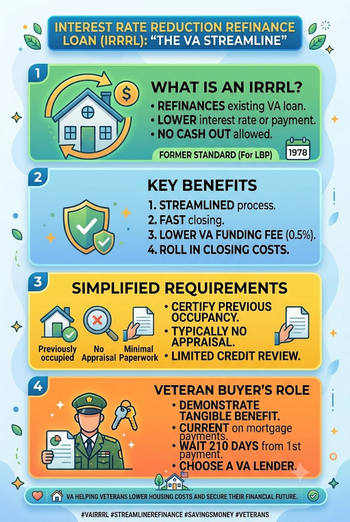 If you have an existing VA loan, you have access to one of the
most powerful refinancing tools available: the VA Interest Rate
Reduction Refinance Loan, commonly called the VA IRRRL or
"streamline" refinance. This program lets you refinance your VA
mortgage quickly, with minimal paperwork, and often without an
appraisal. For many veterans, the IRRRL is a game-changer that saves
tens of thousands of dollars.
If you have an existing VA loan, you have access to one of the
most powerful refinancing tools available: the VA Interest Rate
Reduction Refinance Loan, commonly called the VA IRRRL or
"streamline" refinance. This program lets you refinance your VA
mortgage quickly, with minimal paperwork, and often without an
appraisal. For many veterans, the IRRRL is a game-changer that saves
tens of thousands of dollars.
What is an IRRRL?
The VA IRRRL is a streamlined refinancing program exclusively for borrowers with existing VA loans. It's designed to help you lower your interest rate with minimal hassle.
Key Characteristics
- Faster process: Typically closes in 15-30 days (vs. 30-45 for traditional refinancing)
- Minimal documentation: Much simpler than getting a new loan
- No appraisal required: In most cases, the VA doesn't require a new appraisal
- No income verification: You don't need to re-prove your income
- No credit check: The VA typically doesn't pull a new credit report
- Low funding fee: Only 0.5% (vs. 2.3% for a new VA loan)
- Can be rolled into the loan: The funding fee can be added to your loan amount, so no cash needed upfront
IRRRL Eligibility Requirements
To qualify for an IRRRL, you must meet specific requirements.
You Must Have an Existing VA Loan
This is the fundamental requirement. The IRRRL only works if you already have a VA-financed mortgage. If your current loan is conventional, FHA, or USDA, you cannot do an IRRRL.
You Must Occupy the Property as Primary Residence
The property must be your primary residence. You cannot do an IRRRL on a property you've converted to a rental (though the VA is sometimes flexible on this if you lived there initially).
There Must Be a Net Tangible Benefit
This is the critical requirement. You must demonstrate a "net tangible benefit" to refinancing. What does this mean?
Net tangible benefit typically means one of these:
- Lower interest rate: Your new rate is lower than your current rate (most common)
- Shorter loan term: You're reducing the loan term (e.g., 30 years to 15 years) even if the rate stays the same or goes slightly higher
- Change in loan type: Converting from adjustable to fixed rate, or vice versa (if it benefits you)
- Cash-out refinance with clear benefit: Taking cash out but saving money overall through lower rate or better terms
The VA doesn't want borrowers refinancing just to take out cash without any real financial benefit. There must be a tangible reason that helps your financial situation.
Minimum Time in Current Loan
There's no official minimum time you must wait before refinancing. Technically, you could refinance immediately after getting your original VA loan. However, practically speaking, you should have at least made a few payments on your current loan.
Certificate of Eligibility
You still need a valid COE, just like for your original VA loan. If your COE is lost or expired, you'll need to get a new one from the VA.
How the IRRRL Process Works
The IRRRL process is much simpler than a traditional refinance.
Step 1: Gather Basic Information
You contact a VA lender and provide:
- Your current loan number
- Current property address
- Current mortgage payment and interest rate
- Desired new rate or loan term
That's it. No extensive documentation needed.
Step 2: Lender Pulls Loan Information
Your VA lender will contact your current servicer and pull your loan file. They'll review your payment history to ensure you're current on the loan and eligible for an IRRRL.
Step 3: Determine Net Tangible Benefit
The lender calculates whether the refinance makes financial sense. They typically show you:
- Current monthly payment
- New monthly payment
- Monthly savings
- Closing costs
- How many months to break even (closing costs / monthly savings)
If the numbers don't make sense, a reputable lender will tell you upfront.
Step 4: Application and Pre-Approval
You complete a simplified loan application. Minimal documentation is provided. Pre-approval happens quickly (usually within days).
Step 5: Lock Your Rate
You lock your new interest rate. Rate locks typically last 30-60 days, which gives you time to close.
Step 6: Appraisal (Maybe)
In most IRRRL cases, no appraisal is required. The VA has streamlined this process. However, the lender may order an appraisal if:
- The property value has changed significantly since your original purchase
- The lender wants to verify equity (for cash-out refinances)
- There's concern about the property condition
Even if an appraisal is required, it's faster and cheaper than a traditional appraisal.
Step 7: Underwriting
Because there's no income verification or credit check, underwriting is fast. The lender simply reviews your loan history and confirms you're eligible.
Step 8: Clear to Close
Once underwriting approves, you get clear to close. The lender prepares closing documents.
Step 9: Closing
You sign documents (can be done in-person or by mail in many cases). The new loan funds and pays off your old loan. Your lender may even handle most communication so you don't have to deal with your old servicer directly.
Timeline
The entire IRRRL process typically takes 15-30 days from application to closing. Compare this to a traditional refinance (30-45 days) or a new VA loan purchase (30-45 days). The IRRRL is significantly faster.
IRRRL Costs: Funding Fee and Closing Costs
One of the IRRRL's best features is the low cost.
Funding Fee
The VA IRRRL funding fee is 0.5%. This is dramatically lower than the 2.3% funding fee on a new VA purchase loan.
Example: You're refinancing a $300,000 loan. The 0.5% funding fee is $1,500. Compare this to 2.3% on a new purchase ($6,900). You save $5,400 by doing an IRRRL instead of a new loan.
The funding fee can be rolled into your loan amount, so you don't need cash to pay it upfront.
Closing Costs
IRRRL closing costs are typically $500-$2,000, depending on your lender and location. This includes:
- Loan origination fee (often waived or reduced)
- Appraisal (if required)
- Title search (usually waived for IRRRL)
- Recording fees
- Processing and underwriting fees
Compare this to a traditional refinance ($2,000-$5,000) or new VA purchase loan ($3,000-$7,000). The IRRRL is significantly cheaper.
Break-Even Calculation
Your lender should calculate how long it takes for your monthly savings to cover the closing costs and funding fee.
Example:
- Current rate: 7.0% on $300,000 = $1,996/month
- New rate: 6.5% on $301,500 (includes funding fee) = $1,917/month
- Monthly savings: $79
- Total closing costs: $1,500
- Break-even: $1,500 / $79 = 19 months
In this example, you break even in 19 months. After that, it's pure savings.
If the break-even is 5+ years, the refinance may not make sense unless you plan to stay in the home that long.
Types of IRRRL: Standard vs. Cash-Out
Standard IRRRL (Rate-and-Term)
This is the most common type. You refinance your existing loan balance at a new (usually lower) interest rate. You don't take any cash out.
- Funding fee: 0.5%
- Process: Very streamlined, no appraisal usually required
- Time to close: 15-30 days
- Best for: Lowering your rate or changing loan terms
Cash-Out IRRRL
You refinance your loan and take out cash. This is useful if you need money for home improvements, debt consolidation, or other purposes.
- Funding fee: Still 0.5% (same as standard IRRRL)
- Process: Slightly more complex. Appraisal may be required to verify you have equity.
- Time to close: 20-40 days
- Requirement: Must demonstrate net tangible benefit. Usually requires a rate reduction even with the cash-out.
- Best for: Getting cash out while also lowering your rate
Example of Cash-Out IRRRL
You have a $250,000 balance on your home valued at $350,000. You want to take out $30,000 for home improvements. You refinance:
- Old loan: $250,000 at 7.0%
- New loan: $280,000 at 6.5% (includes $1,400 funding fee, you take out $28,600 in cash)
- Old payment: $1,663
- New payment: $1,775
- Monthly payment increases slightly, but you have $28,600 in cash and a lower rate going forward
The net tangible benefit comes from the rate reduction even though you're borrowing more.
IRRRL vs. Traditional Refinance vs. Home Equity Loan
| Feature | VA IRRRL | Traditional Refi | Home Equity Loan |
|---|---|---|---|
| Eligibility | Existing VA loan only | Any mortgage type | Any mortgage type |
| Time to close | 15-30 days | 30-45 days | 20-40 days |
| Funding fee | 0.5% | $0 (but other fees) | $0 (but other fees) |
| Closing costs | $500-$2,000 | $2,000-$5,000 | $1,000-$3,000 |
| Appraisal required | Usually not | Usually yes | Sometimes |
| Income verification | No | Yes | Yes |
| Credit check | No | Yes | Yes |
| Can take cash out | Yes | Yes | Yes |
| Best for lowering rate | Excellent | Good | Not applicable |
Why IRRRL Wins
For VA borrowers with existing VA loans, the IRRRL is almost always the best refinancing option because it's faster, cheaper, and easier than alternatives.
When Does IRRRL Make Sense?
Not every rate reduction justifies refinancing. Here's how to decide:
The 0.5% Rule
A common guideline is that refinancing makes sense if you can reduce your rate by at least 0.5%. This usually results in enough monthly savings to cover closing costs in a reasonable timeframe (18-24 months).
The Break-Even Analysis
Calculate how many months it takes for your monthly savings to equal your total closing costs and funding fee.
If break-even is:
- Less than 12 months: Definitely refinance
- 12-24 months: Probably refinance (good investment)
- 24-36 months: Maybe refinance (depends on how long you'll stay)
- More than 36 months: Probably don't refinance (unless planning to stay 5+ years)
How Long You Plan to Stay
If you plan to sell or move in 2 years, refinancing may not make sense even if the numbers look good. You need time to recoup closing costs.
Rate Environment
If rates are already low (5-6%), getting a 0.5% reduction is difficult. If rates are high (7-8%), getting a 1% reduction is easier.
Real-World IRRRL Scenario
Situation: You got a VA loan in 2022 at 3.5% on a $350,000 home. Rates have come down to 6.5%.
Current loan: $350,000 at 3.5% = $1,561/month
Wait, that doesn't make sense. Rates went UP, not down. Let me recalculate:
You got a VA loan in 2021 at 3.5% on a $350,000 home. You've paid down the balance to $340,000. Current rates are 6.5%, but you're thinking about an IRRRL to reduce your rate.
Hmm, that still doesn't work - rates are higher, not lower.
Let me provide a realistic modern scenario:
Situation: You got a VA loan in 2023 at 6.5% on a $350,000 home. Current rates have dropped to 5.5%. You've paid down the balance to $335,000.
Current loan: $335,000 at 6.5% = $2,114/month
New IRRRL loan: $336,675 (includes $1,675 funding fee) at 5.5% = $1,916/month
Analysis:
- Monthly savings: $2,114 - $1,916 = $198/month
- Closing costs: $1,200
- Funding fee: $1,675 (rolled into loan)
- Total upfront cost: $1,200
- Break-even: $1,200 / $198 = 6 months
- 5-year savings: $198 × 60 months = $11,880
- 30-year savings: $198 × 360 months = $71,280
Decision: Refinance. You break even in 6 months and save $71,000 over the loan's life.
Common Misconceptions About IRRRL
Misconception 1: "IRRRL is only for veterans with low credit scores"
Reality: IRRRL is for all VA borrowers. It's not a "bad credit" program. Even borrowers with excellent credit benefit from the streamlined process.
Misconception 2: "I need to wait a certain amount of time before I can IRRRL"
Reality: There's no minimum waiting period. You can IRRRL immediately if rates drop and you can demonstrate net tangible benefit.
Misconception 3: "IRRRL always requires an appraisal"
Reality: Most IRRRL loans don't require an appraisal. The VA streamlined this to save time and money.
Misconception 4: "I can do unlimited IRRRL refinances"
Reality: Yes, you can do unlimited IRRRL refinances as long as you meet the net tangible benefit requirement each time. Some lenders restrict you (e.g., one per year), but the VA doesn't.
Misconception 5: "IRRRL costs are always less than I think"
Reality: Shop around. Some lenders charge hidden fees. Compare loan estimates from multiple lenders before committing.
Shopping for an IRRRL Lender
Not all VA lenders are equal on IRRRL. Here's what to compare:
Interest Rate
Get rate quotes from at least 3-5 lenders. A 0.25% difference in rate means significant long-term savings.
Funding Fee
The 0.5% funding fee is standard, but some lenders may negotiate. Worth asking.
Closing Costs
Get a Loan Estimate from each lender. Compare line by line. Some lenders have lower origination fees or waive certain costs.
Speed to Close
Ask how quickly they can close. Some IRRRL lenders can close in 10-15 days; others take 30+.
Customer Service
Read reviews. You want a lender who understands the IRRRL process and can answer questions clearly.
Key Takeaways
- IRRRL is for VA borrowers only. You must have an existing VA loan to qualify.
- Process is streamlined. No income verification, no credit check, usually no appraisal.
- Funding fee is only 0.5%. Much lower than new purchase (2.3%).
- Closes fast. 15-30 days vs. 30-45 for traditional refinancing.
- Net tangible benefit required. Usually a rate reduction of at least 0.5%.
- Calculate break-even. Make sure monthly savings cover closing costs in reasonable timeframe.
- No appraisal usually needed. Speeds up the process and saves money.
- Shop multiple lenders. Rates and closing costs vary significantly.
- Can take cash out. Cash-out IRRRL available if you meet net tangible benefit.
- Refinance multiple times. No limit on number of IRRRL refinances.
Bottom Line
The VA IRRRL is one of the best programs available to veterans with existing VA loans. If rates drop even modestly, seriously consider refinancing. The process is fast, cheap, and straightforward. Even a 0.5% rate reduction can save you tens of thousands of dollars over the life of your loan. Don't sleep on this benefit - it's designed to help you save money and improve your financial situation.
Connect With Us
Please share – it really helps