VA Loan Limits: What You Need to Know as a Veteran Homebuyer
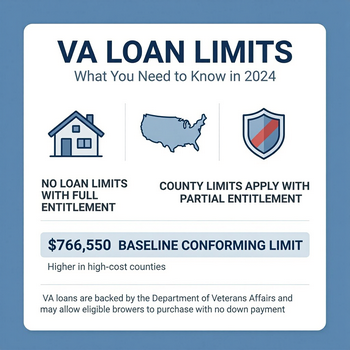 VA loan limits represent the maximum amount the Department of
Veterans Affairs will guarantee to a lender if you default on your
mortgage. However, a common misconception persists: veterans often
conflate these limits with borrowing caps. In reality, the VA
doesn't restrict how much you can borrow - it restricts how much it
will guarantee.
VA loan limits represent the maximum amount the Department of
Veterans Affairs will guarantee to a lender if you default on your
mortgage. However, a common misconception persists: veterans often
conflate these limits with borrowing caps. In reality, the VA
doesn't restrict how much you can borrow - it restricts how much it
will guarantee.
This distinction fundamentally altered the veteran homebuying landscape in 2020 when Congress eliminated loan limits for veterans with full entitlement status. The change recognized that housing markets had evolved far beyond the ceiling imposed by previous regulations, and that veterans' service shouldn't be geographically constrained by arbitrary borrowing limits.
The 2026 VA Loan Limit Landscape
The 2026 VA loan limit baseline stands at $832,750 for single-family homes in most U.S. counties - a $26,250 increase from 2025. This figure mirrors the Federal Housing Finance Agency's conforming loan limit, which adjusts annually to reflect changes in median home values.
High-cost counties command significantly elevated limits. The ceiling for 2026 reaches $1,249,125 in select metropolitan areas. Alaska, Hawaii, Guam, and the U.S. Virgin Islands operate under special statutory provisions, with ceiling limits extending to $1,873,675 - accounting for substantially higher regional housing costs.
These annual adjustments follow a formula established by the Housing and Economic Recovery Act of 2008. The FHFA analyzes its House Price Index and adjusts baseline limits proportionally. When home prices decline nationally, the floor prevents retrograde adjustment - limits remain at current levels until appreciation once again surpasses previous peaks.
Full Entitlement: Liberation from Limits
Veterans with full entitlement status enjoy unprecedented borrowing freedom. Full entitlement means your VA benefit remains completely available - you've never used a VA loan, or you've used one, sold the property, and fully repaid the obligation.
For these borrowers, county loan limits impose no ceiling on zero-down borrowing. A veteran with full entitlement can finance a $2 million home purchase with zero down payment, provided the lender approves the transaction and the property appraisal supports the value. The VA will guarantee 25% of the loan amount (or $36,000 for loans under $144,000), and approval hinges entirely on income, credit, and lender underwriting standards.
This represents a seismic shift from pre-2020 regulations. The Blue Water Navy Vietnam Veterans Act of 2019, signed into law, eliminated these artificial constraints. Lawmakers recognized that veterans in high-appreciation markets - California, Washington D.C., the Northeast corridor - faced de facto benefit denial simply because county limits lagged market realities. Removing caps for full-entitlement borrowers redistributed housing opportunity more equitably.
Partial Entitlement: County Limits and Bonus Entitlement
Veterans with partial entitlement encounter a different framework. Partial entitlement arises when you currently maintain an active VA loan on an owned property, or when a previous foreclosure or short sale resulted in incomplete VA reimbursement.
County loan limits become the operative constraint for zero-down borrowing. The VA calculates "bonus entitlement" (also termed "secondary entitlement") by taking 25% of the county loan limit and subtracting previously used entitlement.
Consider a veteran in a standard-cost county ($832,750 limit) who has $60,000 of entitlement already charged to an active loan:
Calculation:
- County limit × 25% = $832,750 × 0.25 = $208,188
- Remaining bonus entitlement = $208,188 − $60,000 = $148,188
- Zero-down capacity ≈ $148,188 × 4 = $592,750
This formula reveals why county limits matter for partial-entitlement borrowers. Lenders often employ a 4:1 leverage ratio on remaining entitlement, meaning your zero-down purchasing power extends to four times the amount the VA will guarantee.
The Entitlement Guaranty Mechanism
Understanding VA guaranty percentages clarifies why entitlement calculations matter. The mechanism operates in two tiers:
Tier One (Basic Entitlement): For loans of $144,000 or less, the VA guarantees up to $36,000. This represents the historical baseline established decades ago when home prices were substantially lower.
Tier Two (Bonus Entitlement): For loans exceeding $144,000, the VA guarantees 25% of the loan amount. This secondary tier accommodates modern housing costs and allows for proportional guaranty scaling.
A $500,000 loan would trigger 25% guaranty: $500,000 × 0.25 = $125,000. The lender absorbs the remaining exposure. This structure incentivizes responsible lending - the VA's skin in the game diminishes proportionally as loan size escalates, compelling lenders to maintain rigorous underwriting discipline for jumbo VA mortgages.
County-by-County Variations and High-Cost Area Designations
VA loan limits vary by county because they track local median home values. The FHFA designates high-cost areas when 115% of the county's median home value exceeds the baseline conforming limit. These designations update annually.
California markets exemplify high-cost tier differentiation. Standard counties operate at the $832,750 baseline. However, Alameda, Contra Costa, Los Angeles, Marin, Orange, San Benito, San Francisco, San Mateo, Santa Clara, and Santa Cruz counties command the $1,249,125 ceiling. This $416,375 differential acknowledges that a starter home in these metros requires substantially deeper pockets.
New York's secondary mortgage market mirrors this stratification. While rural upstate counties align with the baseline, the New York City metropolitan area - encompassing Bergen, Essex, Hudson (NJ), and the five boroughs - reaches $1,209,750. Westchester and Rockland counties join this tier, reflecting the spillover effect of Manhattan's real estate premium.
Colorado demonstrates moderate high-cost designation. The Denver metropolitan area (Adams, Arapahoe, Broomfield, Clear Creek, Denver, Douglas, Elbert, Gilpin, Jefferson, Park) qualifies at $862,500 - higher than baseline but below the $1,249,125 ceiling, positioning these counties in an intermediate tier.
The strategic importance of identifying your county's specific limit cannot be overstated. Veterans frequently discover mid-transaction that their target market operates under a higher ceiling, materially improving their zero-down capacity. Conversely, those relocating from high-cost to moderate-cost regions may find their remaining entitlement allows substantially greater purchasing power.
Calculating Your Remaining Entitlement
The Certificate of Eligibility (COE) provides the foundation for entitlement calculations. Your COE documents:
- Basic Entitlement: $36,000 for full-entitlement borrowers
- Entitlement Charged: The amount you've already used across prior VA loans
- Remaining Basic Entitlement: Typically zero for those with an active VA loan
To calculate remaining bonus entitlement when considering a new purchase with partial entitlement:
Step 1: Obtain your COE from VA.gov and note the "Entitlement Charged" figure.
Step 2: Identify the county loan limit where the target property is located. The FHFA publishes conforming loan limits for every county and county-equivalent jurisdiction.
Step 3: Multiply the county loan limit by 0.25 (representing the VA's 25% guaranty percentage).
Step 4: Subtract your entitlement charged from the result in Step 3.
Step 5: Multiply the result by 4 to estimate your zero-down purchasing capacity (assuming standard lender leverage ratios).
Worked Example:
- County loan limit: $900,000
- Entitlement already charged: $50,000
- $900,000 × 0.25 = $225,000
- $225,000 − $50,000 = $175,000 remaining bonus entitlement
- $175,000 × 4 ≈ $700,000 zero-down capacity
This calculation provides an estimate only. Actual approval depends on income verification, debt-to-income ratios, credit scoring, and lender-specific overlays.
Distinguishing Loan Limits from Guaranty Limits
A critical distinction separates loan limits from guaranty limits - and this distinction explains recent regulatory evolution.
Loan Limits historically represented hard ceilings on total borrowing. Pre-2020, veterans couldn't borrow above county limits without substantial down payments, regardless of lender willingness or personal financial capacity.
Guaranty Limits represent the maximum amount the VA will reimburse a lender upon default. Even after 2020's elimination of loan limits for full-entitlement borrowers, guaranty limits remain unchanged. The VA continues guaranteeing 25% of loan amount (or $36,000 for smaller mortgages).
This semantic shift matters profoundly. A veteran with full entitlement can now finance a $2 million property, but the VA guarantees only $500,000 (25% of the purchase price). The lender absorbs $1.5 million in exposure. This structure places premium emphasis on borrower creditworthiness and documentation rigor while preserving the zero-down benefit.
The Impact of Down Payments on Entitlement
Down payments interact with entitlement calculations in nuanced ways. When a veteran makes a down payment, the VA's guaranty obligation decreases proportionally.
A veteran with $148,188 remaining entitlement purchasing a $650,000 property without a down payment would require the lender to extend credit beyond standard leverage ratios - likely necessitating a small down payment to bridge the gap.
However, if that same veteran contributed 10% down ($65,000), the VA's exposure becomes manageable within standard parameters:
- Loan amount: $585,000
- VA guaranty at 25%: $146,250
- Remaining entitlement deployed: $146,250
This illustrates why many lenders incentivize small down payments even when zero-down technically remains possible - it streamlines underwriting and aligns VA guaranty with seasoned lending standards.
Restoration of Entitlement: Unlocking Future Borrowing
Entitlement restoration represents a vital but underutilized mechanism for repeated VA homebuying. When a veteran sells a VA-financed property and uses the proceeds to fully repay the VA loan, entitlement restores completely. This permits unlimited subsequent VA home purchases using full-entitlement status.
However, foreclosures and short sales complicate restoration. If a lender absorbs a loss during foreclosure or short sale, the VA may not restore full entitlement until the borrower reimburses the shortfall. This preserved liability can persist for years, constraining subsequent borrowing.
Veterans should understand that selling profitably and paying off the existing VA loan restores full entitlement immediately, without waiting for VA processing or approval. This mechanism permits strategic redeployment of the VA benefit across multiple properties over a veteran's lifetime.
Jumbo VA Loans and Lender Overlays
Beyond conforming loan limits sit jumbo VA mortgages - loans that exceed county limits. While the VA places no cap on these transactions for full-entitlement borrowers, individual lenders impose protective overlays.
Jumbo VA loans typically require:
- Higher credit scores: Conventional VA loans may accept 580-620 FICO scores; jumbo products often demand 680-700+
- Larger cash reserves: Lenders may require 2-6 months of PITI in accessible reserves
- Lower debt-to-income ratios: Stricter income documentation and ratio thresholds
- Comprehensive employment history: Deep verification of income stability and predictability
- Appraisal conservatism: More stringent property valuations to ensure collateral adequacy
These overlays reflect lender risk assessment, not VA requirements. The VA will guarantee a $2 million loan for a full-entitlement veteran; the lender may simply decline to originate it based on internal risk parameters.
Understanding jumbo-market conventions becomes essential for veterans contemplating high-value purchases. Shopping among VA-experienced lenders reveals substantial variation in jumbo appetite and overlay severity.
Comparing 2026 Limits to Historical Baselines
The trajectory of VA loan limits over two decades illuminates policy evolution:
- 2005: $417,000 baseline (pre-financial crisis)
- 2015: $636,150 baseline (post-crisis recovery)
- 2020: $765,600 baseline (with loan limit elimination for full entitlement)
- 2023: $726,200 baseline (post-pandemic normalization)
- 2024: $766,550 baseline
- 2025: $806,500 baseline
- 2026: $832,750 baseline
The 3.3% increase from 2025 to 2026 reflects modest home price appreciation - substantially more moderate than pandemic-era appreciation (which frequently exceeded 10% annually). The floor-against-decline mechanism prevented retrograde adjustment after 2022's market correction.
For veterans with partial entitlement, these incremental annual increases compound meaningfully. A $25,000 baseline increase translates to $6,250 in additional bonus entitlement (at the 25% calculation), potentially unlocking $25,000 in additional zero-down purchasing power.
Applying VA Loan Limits in Practice
Real-world application demands personalized calculation. Consider three scenarios:
Scenario One: Full Entitlement, Standard County
- Status: Never used VA loan
- Target property: $850,000 in standard-cost county
- Outcome: Zero-down financing available; VA guarantees 25% ($212,500); lender approval determines actual qualification
Scenario Two: Partial Entitlement, Trading Up
- Status: Active VA loan with $100,000 charged; current home value $400,000; current loan balance $350,000
- Target property: $650,000 in standard-cost county ($832,750 limit)
- Bonus entitlement calculation: ($832,750 × 0.25) − $100,000 = $108,188
- Zero-down capacity: ~$432,750 (108,188 × 4)
- Outcome: Seller net proceeds ($400k − $350k = $50k) could bridge the $217,250 gap, or a modest down payment reconciles the differential
Scenario Three: Foreclosure History, High-Cost County
- Status: Previous foreclosure; $75,000 shortfall unrepaid; attempting to rebuild in San Francisco Bay Area ($1,249,125 limit)
- Bonus entitlement: ($1,249,125 × 0.25) − $75,000 = $237,281
- Zero-down capacity: ~$949,124
- Outcome: Full-market participation restored despite foreclosure history, provided sufficient time has elapsed for credit rehabilitation
These scenarios demonstrate that entitlement status and county limits combine to create highly individualized borrowing scenarios.
Strategies for Maximizing VA Benefit Utilization
Veterans should approach VA homebuying with strategic foresight:
Preserve Entitlement for High-Opportunity Moments: If you can afford a conventional loan, defer VA deployment until positioning yourself in a market with genuine appreciation prospects. Entitlement restoration unlocks when you sell and pay off, permitting redeployment in superior markets.
Coordinate Entitlement Across Multiple Properties: VA entitlement permits concurrent usage across multiple properties. A veteran could maintain one VA-financed primary residence while using remaining entitlement for a cash-flowing investment property.
Monitor Annual Limit Increases: Each January, county limits refresh. Veterans contemplating purchases should revisit calculations annually, as increases may have elevated their zero-down capacity since the prior year.
Obtain COE Early: Request your Certificate of Eligibility months before house-hunting begins. Processing delays occasionally occur, and documentation must be accurate for lender pre-qualification.
Engage VA-Experienced Lenders: Not all mortgage lenders maintain deep VA expertise. Specialists understand entitlement mechanics, jumbo overlays, and creative structuring that generalist originators overlook.
The Regulatory Framework Underlying VA Limits
VA loan limits trace to the Housing and Economic Recovery Act of 2008 and subsequent amendments, particularly the Blue Water Navy Vietnam Veterans Act of 2019. This legislative framework directs the VA to adopt FHFA conforming loan limits and eliminates its authority to impose independent ceiling restrictions on full-entitlement borrowers.
Regulatory circulars - issued periodically by the VA - provide operational guidance. Circular 26-25-10, effective January 1, 2026, memorializes the 2026 conforming loan limit integration and provides detailed calculation methodologies for remaining entitlement.
Understanding this regulatory architecture helps veterans anticipate future changes. When Congress acts, conforming loan limits adjust; VA loan limits follow automatically. Veterans monitor legislative developments affecting FHFA authority to predict coming limit movements.
VA Loan Limits: Frequently Asked Questions
Expert answers to the most common questions veterans ask about VA home loan limits and entitlement in 2026.
What is the VA loan limit for 2026, and how does it affect my borrowing power?
In 2026, the VA loan limit baseline is $832,750 for single-family homes in most U.S. counties - a $26,250 increase from 2025. Its effect on your borrowing power depends entirely on your entitlement status.
For veterans with full entitlement: The loan limit does not restrict your borrowing. You can finance properties exceeding $832,750 with zero down payment, provided a lender approves the loan and the property appraisal supports the purchase price. Full entitlement means you've never used a VA loan, or you've used one, sold the property, and repaid it in full.
For veterans with partial entitlement: The county loan limit determines your zero-down capacity. Calculate your remaining entitlement as 25% of the county limit, minus any entitlement you've already used. Lenders typically allow you to borrow up to four times your remaining entitlement without requiring a down payment.
Example: If you have $60,000 entitlement charged and live in a standard county ($832,750 limit), your bonus entitlement = ($832,750 × 0.25) − $60,000 = $148,188. Your zero-down capacity ≈ $592,750.
The annual increase matters most for partial-entitlement borrowers. The $26,250 baseline increase translates to $6,562 in additional bonus entitlement (at 25%), unlocking $26,250 in additional zero-down purchasing power.
What's the difference between a VA loan limit and a VA guaranty limit, and why does it matter?
This distinction - often confused by borrowers - shaped VA lending policy changes in 2020 and remains critical to understanding your borrowing options today.
Loan Limit: Historically, this was a hard ceiling on total borrowing without a down payment. Before 2020, veterans couldn't exceed county limits regardless of creditworthiness or lender willingness. The Blue Water Navy Vietnam Veterans Act of 2019 eliminated loan limits for full-entitlement borrowers, recognizing that housing markets in high-cost areas made these caps obsolete.
Guaranty Limit: This is the maximum amount the VA will reimburse a lender upon your default. It remains unchanged regardless of entitlement status. The VA guarantees 25% of your loan amount (or $36,000 for loans under $144,000), whichever is greater.
A full-entitlement veteran financing a $2 million property has no loan limit restriction. However, the VA guarantees only $500,000 (25% of purchase price). The lender absorbs $1.5 million in exposure - which is why they maintain rigorous credit and income requirements even for full-entitlement borrowers.
Why it matters: Understanding this distinction clarifies why county limits don't cap full-entitlement borrowing, yet lenders still impose qualification hurdles. It's not a VA restriction - it's lender risk management on the non-guaranteed portion.
I have a VA loan on my current home and want to buy a second home. How much can I borrow with my remaining entitlement?
When you maintain an active VA loan, you have partial entitlement remaining. Your second home's zero-down capacity depends on three factors: your remaining entitlement balance, your target property's county, and standard lender leverage practices.
Step-by-step calculation:
- Check your Certificate of Eligibility (COE) for "Entitlement Charged" - the amount you're currently using
- Identify your target property's county and its 2026 loan limit (see county limits table or FHFA website)
- Calculate: County limit × 0.25 = maximum VA guaranty in that county
- Subtract your entitlement charged: Maximum guaranty − Entitlement charged = Remaining bonus entitlement
- Multiply by 4: Remaining bonus entitlement × 4 ≈ Zero-down purchase capacity
Real example: Current home loan is $250,000 with $75,000 charged to entitlement. Target property is $550,000 in a high-cost county ($1,249,125 limit).
- Bonus entitlement: ($1,249,125 × 0.25) − $75,000 = $237,281
- Zero-down capacity: $237,281 × 4 = $949,124
- Result: You can purchase a $550,000 property with zero down payment, since $550,000 < $949,124.
Important caveat: This calculation assumes you maintain the first property and keep that VA loan active. If you sell the first home and pay off the VA loan with the proceeds, your entitlement fully restores - you'd regain full entitlement status for the second purchase.
Do county loan limits differ, and how do I find the limit for my specific county?
Yes, county limits vary significantly - ranging from the standard $832,750 baseline to $1,873,675 in Alaska, Hawaii, Guam, and the U.S. Virgin Islands. These variations reflect local median home values and cost-of-living differences.
High-cost area designations: The Federal Housing Finance Agency (FHFA) designates counties as "high-cost areas" when 115% of the median home value exceeds the baseline conforming limit. These high-cost areas receive elevated ceilings - currently $1,249,125 for most, with special provisions for island territories.
Examples of 2026 county-level variation:
- Standard baseline: Most rural and mid-sized metro counties = $832,750
- California high-cost tier: Alameda, Contra Costa, Los Angeles, Marin, Orange, San Francisco, San Mateo, Santa Clara, Santa Cruz = $1,249,125
- New York metro: Bronx, Kings, Nassau, New York, Queens, Westchester = $1,209,750
- Colorado intermediate: Denver metro area counties = $862,500
- Alaska/Hawaii ceiling: All counties = $1,873,675
How to find your specific county limit:
- Visit the FHFA website: fhfa.gov/CLL
- Search by county name or state - the site provides complete 2026 conforming loan limits for every U.S. jurisdiction
- Use the "One-Unit Limit" figure (even if your property has multiple units)
- Cross-reference with your COE to calculate remaining entitlement
Strategic insight: Moving from a standard-cost county ($832,750) to a high-cost county ($1,249,125) increases your bonus entitlement calculation base by $416,375 - potentially unlocking $104,094 in additional bonus entitlement (at 25% and without prior charges), or ~$416,375 in additional zero-down capacity.
What happens to my VA entitlement if I default, foreclose, or do a short sale on a VA loan?
Foreclosure, short sale, and default scenarios create complex entitlement consequences that frequently surprise veterans. Understanding these outcomes helps you plan strategically around future homebuying.
Foreclosure with VA loss: If your home forecloses and the VA pays a loss to your lender, your entitlement does not automatically restore. Instead, you carry a "debt to the VA" equal to the loss amount. Your remaining entitlement is reduced by this debt until you repay it - which could take years, effectively constraining your future zero-down capacity.
Short sale with shortfall: When a short sale produces a loss that the lender absorbs, the VA may designate you as having an outstanding debt. Until repaid, this debt reduces your available bonus entitlement for future purchases. Full entitlement restoration does not occur automatically.
Example: Your VA loan forecloses with a $100,000 loss. The VA absorbs $50,000. You now carry a $50,000 "debt to the VA." This debt reduces your bonus entitlement calculations until it is repaid - even if you have $36,000 in basic entitlement remaining, that $50,000 debt hangs over future transactions.
Entitlement restoration after default: To fully restore entitlement after foreclosure or short sale, you must typically:
- Repay any amount the VA absorbed during the loss
- Wait a specified period (typically 2 years minimum, though lenders impose longer waiting periods)
- Demonstrate credit rehabilitation and financial stability
- Request formal entitlement restoration from the VA
The profitable exit scenario: If you sell a VA-financed property at a profit and use proceeds to fully repay the loan before the sale closes, entitlement restores immediately - no debt, no waiting period, no VA approval required. This "clean exit" strategy should inform your long-term real estate planning
Conclusion: Empowered Borrowing in Modern Markets
VA loan limits have evolved from restrictive ceilings into flexible frameworks that accommodate modern housing costs while preserving rigorous underwriting. Full-entitlement veterans enjoy unprecedented freedom; partial-entitlement borrowers benefit from annual limit increases that expand zero-down capacity.
The 2026 baseline of $832,750 - with ceiling limits reaching $1,873,675 in special jurisdictions - reflects robust policy recognition that veteran housing benefits must remain relevant in contemporary markets.
Understanding your entitlement status, calculating remaining bonus entitlement, identifying your county's specific limit, and engaging experienced VA lenders transforms abstract policy into concrete purchasing power. Veterans armed with this knowledge navigate modern housing markets from positions of genuine strength and informed strategic choice.
About the Author: This FAQ was prepared by W.A. MacDonald, a retired loan officer with extensive experience in VA mortgage lending. For additional details on VA loans, entitlement calculations, or county-specific limits, consult your VA-experienced mortgage lender or visit VA.gov/housing-assistance.
Connect With Us
Please share – it really helps