VA Loans for Rental Properties: Can Veterans Use VA Loans to Invest?
 Many veterans want to use their VA loan benefit to invest in real
estate and build wealth through rental properties. Unfortunately, VA
loans cannot be used for investment properties. The VA loan program
is designed exclusively for primary residences. However, this
doesn't mean veterans can't invest in real estate - it just means
they'll need to use different financing strategies.
Many veterans want to use their VA loan benefit to invest in real
estate and build wealth through rental properties. Unfortunately, VA
loans cannot be used for investment properties. The VA loan program
is designed exclusively for primary residences. However, this
doesn't mean veterans can't invest in real estate - it just means
they'll need to use different financing strategies.
The Bottom Line: VA Loans Are For Primary Residences Only
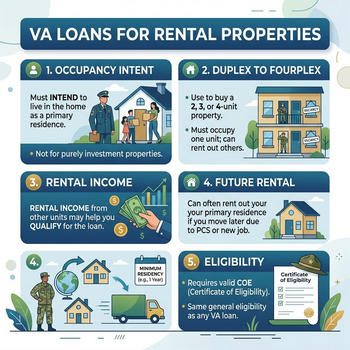
The VA loan program has one fundamental restriction: you must occupy the property as your primary residence. This means you cannot use a VA loan to purchase an investment property, second home, vacation property, or rental unit.
This isn't a gray area or something negotiable with a lender. It's a firm VA requirement written into the regulations. Every VA loan document will state that the borrower intends to occupy the property as a principal residence.
What Happens If You Violate This Requirement?
If you misrepresent the intended use of the property when applying for a VA loan, you're committing loan fraud. This can result in:
- Immediate loan acceleration (entire balance due immediately)
- Criminal charges and prosecution
- Civil penalties and fines
- VA benefit restoration suspension
- Legal action against you
Don't even think about lying about your intent. It's not worth the legal consequences.
Why VA Loans Require Primary Residence Occupancy
The VA loan program was created to help military service members and veterans achieve homeownership. The benefit is meant to help you buy a home for yourself and your family, not to build an investment portfolio.
The Policy Rationale
The VA's primary residence requirement serves several purposes:
- Honors military service: The benefit rewards those who served by helping them get housing, not by funding investment vehicles.
- Protects the program: If investment properties were allowed, wealthy veterans could use VA loans for portfolio building, exhausting the program's resources.
- Manages risk: Owner-occupied homes have lower default rates than investment properties. The VA's guarantee is safer when borrowers have skin in the game.
- Preserves affordability: Keeps VA loans focused on actual homeownership, not real estate speculation.
Can You Rent Your Home After Buying With a VA Loan?
This is a common question, and the answer is more nuanced than a simple yes or no.
The Technical Answer
You must have the intent to occupy the property as your primary residence at the time you get the VA loan. Once you own the home free and clear (or after some time has passed), you can generally rent it out without violating your VA loan obligation.
What "Intent to Occupy" Means
When you apply for a VA loan, you're signing documents stating that you intend to occupy the property as your primary residence. This is your genuine intent at the time of purchase. You're not lying - you actually plan to live there.
However, circumstances change. If you get a job offer in another state a year after buying, you can reasonably rent out your VA-financed home and move. The VA understands that life happens.
The Key: Timing
Most lenders and the VA are comfortable with you renting out a property after you've lived there for a reasonable period (typically at least 1-2 years). This shows that your original intent was genuine.
However, if you buy a home and immediately rent it out without living there, you're violating the program's intent and potentially exposing yourself to legal risk.
Practical Guidance
If you're considering buying a home with a VA loan and later renting it out:
- Live in the home for at least 1-2 years first
- Document your residence (utility bills, driver's license address, etc.)
- When you rent it out, don't tell the VA or your lender - just stop living there
- Understand that you're no longer building VA entitlement for that property (you'll need to restore it if you sell)
This is different from buying the property with intent to rent it from day one, which would be fraud.
Alternatives for Veterans Interested in Investment Properties
If you want to use your VA loan benefit for homeownership and also invest in real estate, here's a strategic approach:
Strategy 1: Buy Primary Residence with VA Loan, Then Invest Separately
Use your VA loan to buy your primary residence with zero down payment and excellent rates. This builds equity in your home while preserving capital. Then use conventional financing (or cash) to invest in additional properties.
- Advantage: Gets you into a home affordably; you can still invest.
- Disadvantage: Conventional investment loans require more down payment and have higher rates.
Strategy 2: Use VA Loan for First Home, Restore Entitlement, Buy Second Property
If you sell your first VA-financed home and pay off the loan completely, your VA entitlement is restored. You can then use the VA loan again for another primary residence.
This allows you to buy multiple properties over time using VA loans, though each must be your primary residence at the time of purchase.
- Advantage: Multiple VA loans mean multiple zero-down purchases.
- Disadvantage: Each property must be your primary residence; you can't have multiple active VA loans for investment properties simultaneously.
Strategy 3: Conventional Loans for Investment Properties
If you're serious about real estate investing, you'll likely use conventional financing for investment properties. Here's what to expect:
Down Payment
Conventional investment property loans typically require:
- 25% down payment for single-family rentals
- 30-35% down for multi-unit properties
- Higher down payments mean lower loan amounts
Interest Rates
Investment property loans have higher interest rates than owner-occupied loans (usually 0.5-1% higher). This reflects the higher risk lenders see in investment properties.
Credit Requirements
Stricter than owner-occupied loans. Most lenders want 680+ credit score for investment properties.
Debt-to-Income Limits
More restrictive than owner-occupied. Most lenders cap DTI at 36% or lower for investment properties.
Appraisal
Investment property appraisals focus on rental income potential. The appraisal value is often tied to what the property can rent for, not just comparable sales.
Strategy 4: House Hacking with VA Loan
This is a popular strategy for veterans who want to invest while using their VA benefit.
What is House Hacking?
Buy a multi-unit property (duplex, triplex, fourplex) with a VA loan as your primary residence. You live in one unit and rent out the others. The rental income helps cover your mortgage.
VA Loan Eligibility
VA loans can finance up to a fourplex (4-unit property) if you occupy one unit as your primary residence. This is allowed because you're still owner-occupying.
Example
You buy a fourplex for $400,000 with a VA loan. You live in one unit; the other three units generate $3,500/month in rental income. Your mortgage payment is $2,500/month. The rental income covers your mortgage and builds equity.
Advantages
- Zero down payment (VA loan)
- Rental income helps cover mortgage
- Build equity while getting help from tenants
- Potential tax benefits from rental income deductions
Disadvantages
- Living in a multi-unit property may not be ideal
- Landlord responsibilities (tenant management, maintenance)
- Vacancy risk (if units aren't rented, you cover full mortgage)
- Special appraisal requirements (lender evaluates income potential)
Strategy 5: Portfolio Building Over Time
Use your VA loan multiple times over your life to build a real estate portfolio:
- Buy home #1 with VA loan, live there 5 years
- Sell home #1, pay off VA loan, restore entitlement
- Rent out home #1 (no longer a VA loan concern)
- Buy home #2 with VA loan in a different area, live there 5 years
- Repeat process
Over time, you own multiple properties (some rented, some with VA loans paid off). The earlier properties become your investment portfolio while you use the VA benefit for current primary residence.
The House Hacking Deep Dive
Since house hacking is the best way for veterans to use VA loans for real estate investing, let's explore it in detail.
VA Loan Requirements for Multi-Unit Properties
- Maximum units: Four units (fourplex). Beyond 4 units, VA won't finance.
- Occupancy requirement: You must occupy one unit as your primary residence.
- Unit types: Can be attached (townhouses) or detached (single-family homes on one property).
- Appraisal: Appraiser evaluates rental income potential. May use rent comparables in addition to sales comparables.
Income Calculation for House Hacking
When you apply for a VA loan on a multi-unit property, the lender calculates your debt-to-income ratio differently than for single-family homes.
Example: You buy a duplex for $200,000 with zero down. You live in one unit (rent would be $1,200/month). The other unit rents for $1,200/month.
Lender calculation:
- Your mortgage payment: $1,300
- Your credit cards: $200
- Your gross monthly income: $5,000
- Rental income from other unit: $1,200 (minus 25% for vacancy/maintenance) = $900
- Your effective housing expense: $1,300 - $900 = $400
- Your total debt: $400 + $200 = $600
- Your DTI: $600 / $5,000 = 12%
The rental income significantly improves your DTI, making approval much easier.
House Hacking Challenges
- Tenant issues: You're living next to or above your tenants. If they're problematic, you can't easily escape.
- Landlord responsibilities: You're responsible for maintenance and repairs. If the roof leaks, you have to fix it.
- Vacancy risk: If a unit sits empty, you cover the entire mortgage.
- Refinancing complications: When you later refinance or sell, lenders may question the ongoing VA loan eligibility.
- Market risks: If rental rates drop, your income drops.
House Hacking Success Factors
- Choose a good location with strong rental demand
- Buy a property where rents exceed your mortgage payment
- Plan to stay at least 2-3 years (to justify initial occupancy intent)
- Set aside reserves for vacancies and maintenance (aim for 3-6 months of expenses)
- Screen tenants carefully (your neighbors are your tenants)
- Have clear lease agreements and collect rent on time
Key Takeaways
- VA loans cannot be used for investment properties. Must be primary residence only.
- Intent to occupy is required at purchase. You must genuinely plan to live there.
- You can rent the property later. After 1-2 years of occupancy, circumstances change and renting becomes acceptable.
- House hacking is VA-loan-eligible. Multi-unit properties (up to 4 units) work if you occupy one unit.
- Conventional loans are needed for pure investment properties. They require 25%+ down and higher rates.
- VA entitlement can be used multiple times. Restore it by paying off previous loans and you can use the benefit again.
- Portfolio building takes time. Use VA loans strategically over decades to build wealth.
- Fraud risk is real. Don't misrepresent your intent - the consequences are severe.
Bottom Line
While you can't use a VA loan directly for investment properties, you have alternatives. The best approach for most veterans is to use the VA loan for primary residence purchase (which builds equity and saves on interest), then pursue additional investment properties with conventional financing or house hacking strategies.
Real estate investing is an excellent wealth-building strategy for veterans. Your VA loan gives you a massive advantage for your primary residence - zero down payment and excellent rates. Use that advantage wisely, then leverage your equity and income to invest in additional properties outside the VA program.
Connect With Us
Please share – it really helps