VA Manufactured Home Requirements
 Manufactured homes (also called mobile homes or modular homes)
offer affordable homeownership, but financing them is different from
traditional single-family homes. VA, FHA, and conventional loans all
have specific requirements that manufactured homes must meet.
Knowing these requirements will help you determine if a
manufactured home qualifies for financing and which loan program
works best.
Manufactured homes (also called mobile homes or modular homes)
offer affordable homeownership, but financing them is different from
traditional single-family homes. VA, FHA, and conventional loans all
have specific requirements that manufactured homes must meet.
Knowing these requirements will help you determine if a
manufactured home qualifies for financing and which loan program
works best.
What is a Manufactured Home?
A manufactured home is a dwelling that's built in a factory and transported to a site where it's placed on a permanent foundation. It's constructed to federal HUD code standards. Manufactured homes are different from site-built homes (traditional stick-built homes) and from RVs or travel trailers.
Manufactured vs. Modular Homes
These terms are sometimes confused:
Manufactured homes: Built to HUD code in a factory, single or multi-section, placed on a permanent foundation. Subject to specific financing rules.
Modular homes: Built according to local building codes in a factory, transported to site, and placed on a permanent foundation. Financed like traditional homes with no special requirements.
This article focuses on manufactured homes (HUD code). Modular homes are financed like regular homes.
Land Ownership: The Critical Issue
The biggest difference between manufactured homes and traditional homes is the land issue. Most manufactured home financing requires that you own the land outright or own both the home and land together. This is the key to understanding manufactured home lending.
Scenario 1: You Own Both Home and Land
This is the easiest scenario for financing. You own the manufactured home and the land it sits on. All three loan programs (VA, FHA, conventional) will finance this as a standard real estate loan.
- VA loans: Can finance
- FHA loans: Can finance
- Conventional loans: Can finance
Scenario 2: You Own the Home yet Rent the Land (Lot Rent)
This is where it gets complicated. If you own the manufactured home and rent the lot from a mobile home park owner, financing becomes difficult.
- VA loans: Generally will NOT finance if you're renting the lot. VA requires you to own the land or own both home and land together.
- FHA loans: May finance if the lot rental agreement is long-term (at least 30 years remaining), but this is restrictive, and many FHA lenders won't touch it.
- Conventional loans: More flexible than VA or FHA, but most lenders will still require you to own the land or have a very long lease (50+ years).
What This Means
If you're buying a manufactured home in a mobile home park where you rent the lot, getting financing will be extremely difficult. Most lenders won't do it. This severely limits your options if you don't own the land.
Recommendation: If you're buying a manufactured home, strongly consider purchasing land with it. This opens up all financing options and protects your investment.
VA Loan Requirements for Manufactured Homes
VA loans for manufactured homes have specific requirements that are more restrictive than for traditional homes.
Land Ownership (Critical)
You must own the land outright or own both the home and land together. The VA will not finance a manufactured home if you're renting the lot, even with a long-term lease.
The land and home must be financed together as a single unit in most cases. Some VA lenders may allow separate financing, but this is rare and not recommended.
Age of Manufactured Home
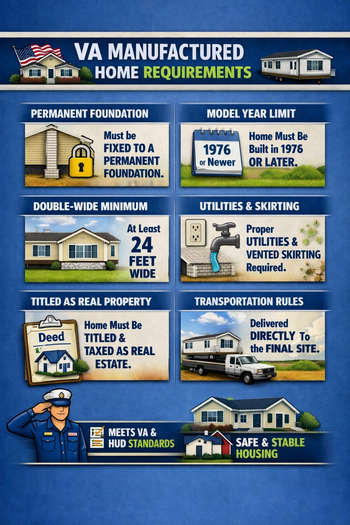
The manufactured home must have been built after 1976 (when HUD federal standards took effect). Homes built before 1976 don't meet modern safety standards and won't qualify for VA financing.
Construction Standards
The home must meet HUD construction and safety standards. The VA appraiser will verify that the home was built to code and is in acceptable condition.
Permanently Affixed to Land
The manufactured home must be permanently affixed to the land with a firm foundation (not a trailer hitch). The VA requires:
- Permanent foundation (concrete, block, or equivalent)
- Proper anchoring to the foundation
- Proper utility connections
- Removal of wheels/axles (if applicable)
The home must be situated as a permanent dwelling, not as a mobile unit that could be moved.
Minimum Square Footage
The VA typically requires a minimum of 400 square feet for a single-section home and 600 square feet for a multi-section home. Very small manufactured homes may not qualify.
Appraisal Requirements
The VA appraiser must inspect the manufactured home and verify it meets VA standards. The appraisal process is similar to traditional homes but with special attention to:
- Structural strength of the home and foundation
- Roof condition and durability
- HVAC systems and functionality
- Plumbing and electrical systems
- Overall condition and maintenance
Entitlement Considerations
Important: If you use VA entitlement to buy a manufactured home, your remaining entitlement for future VA loans may be limited. VA distinguishes between:
- Manufactured home entitlement: Specific amount available for manufactured home purchases.
- Regular home entitlement: Available for traditional home purchases.
Using manufactured home entitlement may limit your ability to buy a traditional home later. Review your COE carefully to understand your manufactured home entitlement limits.
FHA Loan Requirements for Manufactured Homes
FHA is more flexible than VA on some points but has its own strict requirements.
Land Ownership
FHA prefers that you own the land, but will consider financing if you have a long-term lease (at least 30-40 years remaining on the lease). However, many FHA lenders are reluctant to finance lot-rental situations.
Age of Home
Must be built after 1976 to HUD standards. FHA will not finance pre-1976 manufactured homes.
HUD Label
The home must have a HUD certification label proving it was built to HUD code standards. The label should be visible on the exterior of the home (typically on the front or side).
Foundation Requirements
Must be on a permanent foundation (concrete, block, or equivalent). Must be properly anchored. Wheels and axles must be removed.
Minimum Size
Typically requires at least 400 square feet. Very small units won't qualify.
Condition and Appraisal
FHA appraiser will inspect for condition, safety, and compliance with FHA property standards. The home must be in acceptable condition with no major defects.
Down Payment
FHA requires a 3.5% down payment on manufactured homes. You must have savings for this down payment.
Mortgage Insurance
FHA manufactured home loans require mortgage insurance for the life of the loan (just like FHA site-built homes).
Conventional Loan Requirements for Manufactured Homes
Conventional lenders vary in their willingness to finance manufactured homes, but general requirements include:
Land Ownership (Strongly Preferred)
Most conventional lenders prefer you own the land. Some will finance lot-rental situations with a long lease (50+ years remaining), but this is uncommon.
Age and Condition
Home must be relatively modern and in good condition. Lenders typically want homes less than 20-25 years old, though this varies by lender.
Down Payment
Conventional loans typically require 5-20% down. You'll need significant savings.
Credit and Income
Standard conventional loan requirements apply. Minimum credit score (usually 620+) and income verification required.
Appraisal
Appraisal is required and is more detailed than for traditional homes because of the different nature of manufactured home construction.
Comparison Table: Manufactured Home Requirements
| Requirement | VA Loan | FHA Loan | Conventional Loan |
|---|---|---|---|
| Land Ownership | Must own land | Prefer own; lease 30-40 yrs OK | Prefer own; lease 50+ yrs OK |
| Year Built | After 1976 | After 1976 | Varies; typically recent |
| Down Payment | 0% | 3.5% | 5-20% |
| Mortgage Insurance | None | Lifelong | Required if < 20% down |
| Minimum Size | 400-600 sq ft | 400+ sq ft | Varies by lender |
| Permanent Foundation | Required | Required | Required |
| Age Flexibility | Strict (1976+) | Strict (1976+) | More flexible |
| Lot Lease OK | No | Limited | Limited |
The HUD Label: Critical for Financing
For any manufactured home built after 1976, the HUD label should be present on the home. This is a metal plate typically affixed to the exterior (often on the front or side of the home). The label certifies that the home was built to HUD code standards.
What the HUD Label Shows
- Year of manufacture
- Manufacturer and plant code
- Dimensions and square footage
- HUD compliance certification
- Serial number
When you're looking at a manufactured home you want to finance, find and photograph the HUD label. Your lender will need proof that it exists and what it says.
Foundation: The Key to Permanent Status
The foundation is critical. All three loan programs require the manufactured home to be on a permanent foundation. Here's what qualifies:
Acceptable Foundations
- Concrete slab on grade
- Concrete block foundation
- Treated wood foundation (in some cases)
- Masonry foundation
- Piers with concrete footings (permanent, not temporary blocks)
Not Acceptable
- Cinder blocks without footings (temporary)
- Wooden blocks (temporary)
- Gravel or dirt pads (not foundation)
- No foundation (home sitting on blocks or bricks)
If the home is sitting on temporary blocks or has no proper foundation, you'll need to invest in a proper foundation before any lender will finance it. This can cost $3,000-$10,000 depending on the home size and soil conditions.
Condition and Appraisal for Manufactured Homes
Manufactured homes are appraised similarly to traditional homes, but appraisers pay special attention to:
What Appraisers Inspect
- Exterior: Siding, roof, windows, doors. Any leaks, damage, or deterioration.
- Roof: Many manufactured homes have standard roofing. Appraisers examine for leaks, age, and remaining useful life.
- Foundation: Proper foundation, no cracks, settling, or movement issues.
- HVAC: Heating and cooling systems must be functional.
- Plumbing: No active leaks; water systems must work.
- Electrical: Proper wiring, no obvious hazards. Breaker box must be accessible.
- Interior: Overall condition, no major damage, walls intact.
- Structural strength: No sagging, no obvious structural issues.
Age Considerations
In contrast to traditional homes where a 40-50 year old home can still appraise well if maintained, manufactured homes tend to depreciate faster. A 30-year-old manufactured home may have significantly less value than a 30-year-old traditional home.
Interest Rates and Financing Costs
Manufactured home loans typically have slightly higher interest rates than traditional home loans because lenders view them as higher-risk due to:
- Faster depreciation
- More difficult to resell
- Smaller pool of potential buyers
- More maintenance issues as homes age
You can expect to pay 0.25-0.75% more in interest on a manufactured home loan compared to a traditional home loan, depending on the lender and program.
Common Issues That Prevent Manufactured Home Financing
Home Too Old
Homes built before 1976 won't qualify for VA or FHA. Conventional lenders may reject homes over 25-30 years old.
No HUD Label
If the HUD label is missing or damaged, the lender can't verify the home meets HUD standards. The homeowner can request a replacement label from HUD, but this process takes time.
Inadequate Foundation
If the home is on temporary blocks or has no proper foundation, financing won't happen until the foundation is fixed.
Lot Rental Without Long Lease
If you don't own the land and the lease is short-term, most lenders won't finance. This is a common deal-killer.
Deferred Maintenance
If the home needs major repairs (roof, plumbing, electrical, structural), the appraisal may fail, and financing may be denied until maintenance is made.
Roof Issues
Many manufactured homes have roofing issues. If the roof is leaking or nearing the end of its life, appraisers may flag it as a problem.
VA Manufactured Home Entitlement Strategy
If you're a veteran considering a manufactured home, understand the entitlement implications:
Manufactured Home Specific Entitlement
Some veterans have entitlement specifically designated for manufactured homes (different from regular home entitlement). Check your COE to see if you have manufactured home entitlement limitations.
Using Regular Entitlement for Manufactured Home
You can use your regular home entitlement to buy a manufactured home, but this may limit your ability to buy a traditional home later, depending on your available entitlement.
Strategic Consideration
If you plan to buy a manufactured home now but might want a traditional home later, discuss entitlement strategy with your VA lender. Make sure you understand how this purchase affects your upcoming borrowing options.
Key Takeaways
- Land ownership is critical. Own the land or the deal likely won't finance.
- Home must be post-1976. All programs require HUD-code homes built after 1976.
- Permanent foundation required. Must be on a solid, permanent foundation - not temporary blocks.
- HUD label must exist. Proof of HUD compliance is essential for all lenders.
- VA has no down payment. VA loans are zero down for manufactured homes.
- FHA requires 3.5% down. You must have savings for the down payment.
- Conventional requires 5-20% down. You need more savings than FHA.
- Rates are higher than traditional homes. Expect slightly higher interest rates on manufactured home loans.
- Depreciation is faster. Manufactured homes don't hold value like traditional homes.
- Lot rental is a major issue. If you rent the lot, financing becomes extremely difficult.
Bottom Line
Manufactured homes can be financed, but there are more requirements and restrictions than for traditional homes. The main factor is land ownership - if you own the land, your financing options open up significantly. If you're renting the lot, you'll struggle to find a lender.
For veterans, VA loans are the best option for manufactured homes because they offer zero down payment. For non-veterans, FHA is more accessible than conventional because of the 3.5% down option.
If you're considering a manufactured home, ensure the home meets all financing requirements before you fall in love with it. Check the HUD label, verify the foundation, understand the land situation, and get pre-approval from a lender experienced in manufactured home financing.
Connect With Us
Please share – it really helps