Essential Documentation for a VA Loan: Complete Checklist
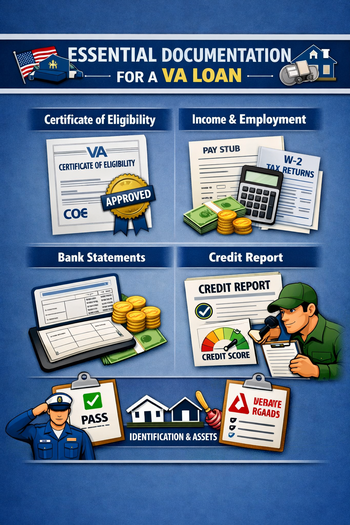 Gathering the right documentation upfront is critical to a smooth
VA loan approval process. Lenders need extensive financial
documentation to verify your income, employment, assets, and
creditworthiness. Having everything organized and ready before you
apply will speed up the process and prevent delays. This guide walks
you through every document you'll need.
Gathering the right documentation upfront is critical to a smooth
VA loan approval process. Lenders need extensive financial
documentation to verify your income, employment, assets, and
creditworthiness. Having everything organized and ready before you
apply will speed up the process and prevent delays. This guide walks
you through every document you'll need.
The Most Important Document: Certificate of Eligibility (COE)
What It Is
Your Certificate of Eligibility proves you're a veteran or service member eligible for VA loan benefits. It's the first document every VA lender will request.
How to Get It
You can obtain your COE in three ways:
- Online at VA website: Go to va.gov, use ebenefits, and request your COE (instant electronic version)
- By mail: Request from Department of Veterans Affairs, and they'll mail it to you (takes 1-2 weeks)
- Through your lender: Many lenders can request it directly from the VA on your behalf (fastest method)
What It Shows
Your COE confirms your service dates, discharge status (honorable, other than dishonorable, etc.), service branch, and remaining entitlement available for VA loans.
Timeline Tip
Get this first. Don't wait until after you find a house to request your COE. Have it ready before pre-approval.
Identity and Personal Documents
Government-Issued Photo ID
Lender needs a copy of one of:
- Driver's license
- Passport
- Military ID
- State ID
Social Security Card
Lender needs a copy (front and back) or document showing your Social Security number. The card is the clearest proof.
Marital Status Documentation (If Applicable)
If you've been married, divorced, or widowed, lenders may request:
- Marriage certificate (if married)
- Divorce decree (if divorced)
- Death certificate of spouse (if widowed)
Income Documentation: The Core of Your Application
W-2 Employment (Salaried or Hourly)
Required: Last two years of W-2s (from your employer)
Why: Proves your income history for past two years
Example: If you've worked for the same employer for 5 years, lender still only needs last two W-2s, but may request more if income changes considerably
Recent pay stubs: Last 30 days of pay stubs showing current income and YTD (year-to-date) earnings
Verification of Employment (VOE): Letter from your employer confirming your position, start date, current income, and likelihood you'll continue in the position. Lender may order this directly from your employer, or you can provide one your HR department writes.
Self-Employment Income (1099s)
Required: Last two years of complete federal tax returns (all pages, including schedules C, D, K-1, etc.)
Why: Lenders need to see your net profit/loss to verify self-employment income
Profit and Loss Statement (P&L): Current year P&L (if more than 6 months into the year) showing income and expenses
Business License: Copy of current business license or EIN from IRS
Bank Statements: Business bank statements (last 2 months) showing deposits and account activity
Important: Lenders average self-employment income over 2 years and may discount it if declining. Consistent or growing income is best.
Bonus and Commission Income
Required: Last two years of tax returns showing the bonus/commission on your tax return
Written statement from employer: Confirming you receive bonuses or commissions and the likelihood it will continue
Recent pay stubs: Showing bonus or commission payments (if paid recently)
Important: Lenders average bonus/commission over 2 years. If you just received a large bonus, it may not be fully counted. If it is not consistent.
Rental Income
Required: Last two years of tax returns showing the rental income
Lease agreements: For each rental property (shows rental amount)
Bank statements: Showing rental deposits (last 2 months)
If mortgage on rental: Mortgage statement showing monthly payment (lenders subtract this from rental income)
Important: Lenders count only 75% of gross rental income (accounting for vacancies and maintenance)
Retirement Income (Pension, Social Security, Military Retirement)
Social Security or pension award letter: From Social Security Administration or pension administrator showing monthly benefit amount
Current benefit statement: Recent statement showing ongoing benefits
Military retirement: Leave and Earnings Statement (LES) or military retirement statement showing monthly benefit
Important: Must be likely to continue for your loan term. If retired, lender assumes income continues.
Alimony or Child Support Income
Court order: Showing the alimony or child support amount you receive
Bank statements: Showing regular deposits (last 2-3 months) proving you're receiving the payments
Important: Must be likely to continue for at least 3 more years. If scheduled to end soon, may not count.
Tax Return Documentation
Complete Federal Tax Returns (Last Two Years)
Required: All pages of your federal tax returns for the last two years
Includes: Form 1040, all schedules (A, C, D, E, F, etc.), and any supporting pages
Lender will verify: The IRS may verify your tax returns directly using IRS Form 4506 (Request for Tax Return Transcript)
Important: Lenders review your actual tax returns, not estimates. Don't provide estimates; provide your actual filed returns.
IRS Authorization (Form 4506-C)
What it is: Authorization for the lender to request your actual tax return transcripts directly from the IRS
Lender needs you to sign: This form so they can verify your income with the IRS
Processing time: IRS typically responds within 5-10 business days
Important: If your filed tax returns don't match your stated income, this will delay approval.
Asset and Bank Documentation
Bank Statements
Required: Last 2 months of statements for all bank accounts (checking, savings, money market)
Why: Shows you have funds for down payment and closing costs, and verifies your liquid assets
What lender looks for: Account balance, regular deposits, no unusually large deposits (which may need explanation if gift funds)
All pages: Provide complete statements, not just summary pages
Gifts for Down Payment
If using gift funds: You must provide gift letter from the person giving you money
Gift letter should include: Amount of gift, date, relationship to borrower, confirmation that it's a gift, not a loan, and statement that donor has no repayment expectations
Bank statements from donor: Demonstrating they have sufficient funds to give the gift
Important: VA loans allow 100% of down payment to be a gift (no requirement to use your own funds)
Stock, Bond, and Investment Accounts
Required: Statements from brokerage accounts showing current value
Why: Part of your liquid assets and reserves
Timeline: Most recent statement (within 90 days)
Retirement Accounts (401k, IRA, etc.)
Recent statement: Showing current balance
Important: Lenders typically don't count retirement accounts as accessible assets (you'd face penalties withdrawing early)
Exception: If you're planning to withdraw for down payment, provide a letter of authorization from the account custodian showing you can withdraw without penalty
Employment and Income Verification
Verification of Employment (VOE) Letter
What it is: Letter from your employer confirming your employment
Should include: Your name and position, start date, current salary/hourly rate, whether employment is permanent/temporary, and likelihood of continued employment
Who provides: Human Resources department or direct supervisor
Timing: Should be dated within 10 days of your loan application (lenders want recent employment verification)
Recently Changed Jobs?
Offer letter from new employer: Showing position, start date, and salary
Why important: If you just changed jobs, lender needs to verify new income is reliable
Pay stubs from new job: If you've already started, showing you're actually receiving the offered pay
Lender consideration: If you've just started (less than 30 days), lender may want letter stating you'll continue in role and won't be in probationary period
Self-Employed or Freelance?
Business license: Current business license or articles of incorporation
EIN letter: From IRS showing your business EIN (Employer Identification Number)
Last 2 years of tax returns: Complete returns showing business income
Current profit and loss: P&L statement for current year (if more than 6 months in)
Business bank statements: Last 2 months showing business deposits
Debt and Credit Documentation
List of Debts
What to provide: Written list of all debts and monthly payments including:
- Creditor name
- Account number (last 4 digits)
- Outstanding balance
- Monthly payment amount
- Interest rate
Includes: Credit cards, auto loans, student loans, personal loans, mortgages (if buying investment property), child support, alimony, etc.
Credit Report Authorization
What it is: Your permission for lender to pull your credit report from credit bureaus
Standard form: Most lenders include this with their application
Important: You'll typically sign this and the lender pulls the report directly
Documentation for Special Situations
Recently Divorced or Widowed
Divorce decree: Shows division of assets and debts, alimony, child support obligations
If receiving alimony/child support: Documentation proving regular receipt (bank statements, court order)
If obligated to pay: Proof of payments and court order
Co-Borrower or Spouse
Co-borrower needs same documentation: COE, ID, Social Security card, income verification, tax returns, bank statements, employment verification
Spouse (if not a co-borrower): Still may need to provide income documentation and sign authorization forms
Recent Bankruptcy or Collections
Bankruptcy discharge papers: Showing date of discharge and debts included
Explanation letter: Explaining what caused the bankruptcy and how you've recovered
Documentation of paid collections: Proof that collection accounts were paid or settled
Recent payment history: Bank statements showing 12+ months of on-time payments since bankruptcy
Recent Job Change or Gaps in Employment
Offer letter: From new employer if recently hired
Letter explaining gap: If you have employment gaps, provide written explanation
Updated VOE: Confirming current employment
Recent pay stubs: If newly employed
Co-Signer
If using a co-signer: Co-signer must provide all income documentation, employment verification, bank statements, and sign authorization forms
Important: VA loans don't typically require co-signers, but if you choose to use one, they must meet all requirements
Purchase-Specific Documentation
Purchase Contract
What it is: The signed contract between you and the seller showing purchase price and terms
Lender needs: Copy of the fully executed contract
Earnest Money Deposit Proof
What it is: Proof that you've deposited good-faith money with the title company
Typically a check stub or bank statement: Showing the deposit
Property Information
Address and legal description: Full property address and property details
Homeowners insurance quote: Lender will need proof you have homeowners insurance (or quote if not finalized)
Documentation Checklist by Timeline
Before Pre-Approval
- Certificate of Eligibility (COE)
- Government-issued photo ID
- Social Security card
- Last 30 days of pay stubs
- Last two years of W-2s or 1099s
- Last two years of complete federal tax returns
- Last 2 months of bank statements
Before Formal Application (After Offer Accepted)
- Everything from pre-approval (updated if more than a month has passed)
- Verification of Employment letter
- IRS Form 4506-C (authorization for IRS verification)
- Updated pay stubs (if more than 30 days have passed)
- Copy of signed purchase contract
- Proof of earnest money deposit
- If self-employed: P&L statement, business license, business bank statements
- If rental income: Lease agreements, property tax statements, rental mortgage statement
- If alimony/child support: Court orders, proof of receipt
- If gifts: Gift letters and donor bank statements
Before Closing
- Updated pay stubs (from final month before closing)
- Updated bank statements (from final month before closing)
- Final verification of employment (day or two before closing)
- Homeowners insurance declarations page
- Proof of concluding walkthrough completed
- Any amended documentation requested by underwriter
Tips for Documentation Success
Organize Everything Upfront
Create a folder (physical or digital) with all documents organized by category. This makes it easy to provide everything when requested and prevents delays.
Provide Complete Documents
Don't crop or edit pages. Provide complete, unaltered documents. If you have 6 pages of bank statements, provide all 6, not just one page. 1.
Keep Documents Current
Bank statements and pay stubs older than 90 days should be replaced with current ones. If you're in underwriting for more than a month, provide the latest documentation.
Be Honest About Everything
All information must be accurate. Lenders verify income and employment. False information can result in loan denial or fraud. charges.
Respond to Requests Quickly
When the lender asks for extra documentation, respond within 24 hours if possible. Delays in providing documents delay your entire loan.
Use Official Documents
For verification of employment, use official company letterhead. For employer letters, get them directly from HR. For bank statements, use official statements from financial institutions.
Ask Questions
If the lender asks for documents you don't understand, ask for clarification. Don't guess or provide wrong documents.
Key Takeaways
- COE is the foundation. Get your Certificate of Eligibility first before anything else.
- Income documentation is most extensive. Tax returns and pay stubs are critical; have 2 years of documents prepared.
- Bank statements show your financial soundness. Lenders need 2 months of current statements.
- Employment verification is mandatory. Get a VOE letter from your employer upfront.
- Amended documents are necessary. Documents older than 60-90 days may need to be replaced.
- Be complete and accurate. Incomplete or inaccurate documentation delays approval.
- Organize everything upfront. Having everything ready prevents back-and-forth delays.
- Self-employed situations need more documentation. Provide 2 years of tax returns, P&Ls, and business bank statements.
- Special circumstances need explanation. Bankruptcies, collections, job changes - provide letters explaining them.
- Respond quickly to requests. Each delay in providing documents delays your entire loan process.
Bottom Line
VA lenders need extensive documentation to verify your financial picture. Having everything organized and ready upfront is the best. way to secure a smooth, fast approval process. Don't wait for the lender to ask for documents - provide everything from the start. The more organized and complete you are with documentation, the faster you'll close on your home.
Connect With Us
Please share – it really helps