VA vs. Conventional Loans: Which is Better for Veterans?
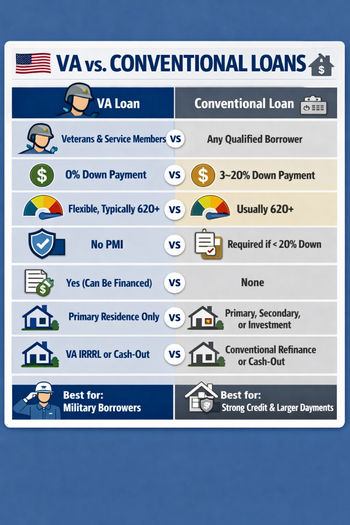 If you're a veteran thinking about buying a home, you have
choices. While the VA loan is a powerful benefit, conventional
mortgages are also available to you. Understanding the real
differences between these two options will help you make the right
decision for your situation.
If you're a veteran thinking about buying a home, you have
choices. While the VA loan is a powerful benefit, conventional
mortgages are also available to you. Understanding the real
differences between these two options will help you make the right
decision for your situation.
The Bottom Line Comparison
In most cases, VA loans are better for veterans. They require zero down payment, have lower interest rates, don't require mortgage insurance, and have more flexible credit requirements. However, there are specific situations where a conventional loan might make sense. Let's break down exactly where each wins.
Down Payment Requirements
VA Loan: Zero down payment required (in most cases). You can buy a home with no money down and no savings. required.
Conventional Loan: Typically requires 3-20% down payment. Most borrowers put down 5-10%, which means coming up with $15,000-$50,000 for a $300,000 home.
Winner: VA Loans - The zero down payment advantage is massive, especially for first-time home buyers who don't have substantial savings.
The Real Cost of Conventional Down Payments
That 5% down payment on a $300,000 home ($15,000) isn't just sitting in the lender's pocket. It's your equity. But more importantly, it represents money you could use for emergencies, home repairs, or other investments. VA loans let you keep that cash in your pocket.
Mortgage Insurance
VA Loan: No mortgage insurance required, ever. This is true even with zero down payment.
Conventional Loan: Requires Private Mortgage Insurance (PMI) if you put down less than 20%. PMI costs 0.55-2.25% of your loan amount per year.
Winner: VA Loans - The lack of PMI alone saves you thousands of dollars over the life of the loan.
What Does PMI Cost?
On a $300,000 conventional loan with 5% down ($15,000), you'd borrow $285,000. If PMI costs 1%, that's $2,850 per year or $237.50 per month. Over 30 years, that's $85,500 in PMI payments - on top of your mortgage.
VA borrowers pay zero for this protection.
Interest Rates
VA Loan: Typically 0.5-1% lower than conventional loans. This is because the VA guarantee makes the lender's risk lower.
Conventional Loan: Higher rates because the lender bears more risk without a government guarantee.
Winner: VA Loans - Lower rates compound over 30 years into massive savings.
Real Dollar Comparison
On a $300,000 loan:
- VA Loan at 6.5%: $1,897 monthly payment
- Conventional Loan at 7.2%: $1,996 monthly payment + $237.50 PMI = $2,233.50 total
The VA borrower saves $336.50 per month, or $4,038 per year. Over 30 years, that's over $120,000 in savings.
Closing Costs and Fees
VA Loan: The VA caps lender fees and seller concessions cannot be used to cover your costs. However, you typically pay lower total closing costs. Average: $6,000-$10,000 on a $300,000 home.
Conventional Loan: Closing costs are not regulated and can be higher. Average: $9,000-$15,000 on a $300,000 home.
VA Loan Funding Fee: Most VA borrowers pay a one-time funding fee (2.3% on first purchase, zero down). On a $300,000 loan, that's $6,900. This gets rolled into your loan, so it's financed over 30 years.
Winner: VA Loans - Even with the funding fee, total costs are typically lower.
The Funding Fee Explained
The VA funding fee isn't profit for the lender - it funds the entire VA loan program. Without it, Congress would have to allocate much more taxpayer money. It's a reasonable trade-off for the benefits you receive.
Credit Score Requirements
VA Loan: No minimum credit score required by the VA. Most VA lenders want 620+, but some work with scores as low as 580.
Conventional Loan: Typically requires 620-680 minimum. FHA loans are more flexible (580+), but conventional loans are stricter.
Winner: VA Loans - More flexible credit requirements make approval easier.
Why Credit Flexibility Matters
Life happens. If you had a rough patch - medical bills, job loss, divorce - that dinged your credit, VA lenders are more forgiving. They understand that a single event doesn't define your entire financial history. Some conventional lenders won't even look at you with a 600 credit score.
Debt-to-Income Ratio (DTI)
VA Loan: Preferred DTI is 41% or lower, but many lenders will approve up to 50% with compensating factors (excellent credit, large savings, stable employment).
Conventional Loan: Most conventional lenders cap DTI at 43-50%, and some require 36% or lower.
Winner: Tie - Both are fairly flexible on DTI, though VA lenders are slightly more accommodating.
Property Appraisal Standards
VA Loan: The VA has strict property standards. The home must be safe, structurally sound, and sanitary. It can't have lead-based paint, major safety hazards, or significant defects. This protects you from buying a lemon.
Conventional Loan: Lenders conduct appraisals, but standards vary. Some conventional lenders are more lenient about property condition.
Winner: VA Loans - VA property standards protect you from costly mistakes.
What This Means in Practice
A property might appraise fine for a conventional loan but fail VA inspection because of deferred maintenance, code violations, or safety issues. The VA appraisal protects you from inheriting the seller's problems. You won't buy a money pit.
Loan Limits
VA Loan: No limits for borrowers with full entitlement. You can borrow $1 million or more if you qualify. For borrowers with partial entitlement, limits match FHFA conforming limits ($832,750 standard, up to $1,249,125 in high-cost areas for 2026).
Conventional Loan: Conforming loans are limited to $832,750 (2026 standard). Jumbo loans exceed this, but they require 10-20% down, higher credit scores, and higher interest rates.
Winner: VA Loans - Unlimited borrowing for full-entitlement borrowers; conventional jumbo loans are expensive.
Occupancy Requirements
VA Loan: You must occupy the property as your primary residence. You can't use a VA loan to buy an investment. property, second home, or rental.
Conventional Loan: You can buy investment properties, vacation homes, or rental properties.
Winner: Conventional Loans - If you want to invest in real estate, conventional is your only option.
Refinancing Options
VA Loan: VA borrowers have access to the VA Interest Rate Reduction Refinance Loan (IRRRL), also called a "streamline" refinance. It's faster, has fewer requirements, and costs just a 0.5% funding fee.
Conventional Loan: You can refinance, but it's the same process as getting a new loan. Full application, credit check, appraisal, and underwriting required.
Winner: VA Loans - The IRRRL is a game-changer for refinancing, saving time and money.
Income Documentation
VA Loan: Two years of income documentation required. Self-employed borrowers need two years of tax returns.
Conventional Loan: Similar requirements - two years of documentation. Some lenders are slightly more flexible with self-employed borrowers, but it varies.
Winner: Tie - Documentation requirements are essentially the same.
Pre-Approval Timeline
VA Loan: Typically 3-5 business days for pre-approval.
Conventional Loan: Similar timeline, 3-5 business days.
Winner: Tie - Both are reasonably fast.
Closing Timeline
VA Loan: Typically 30-45 days from offer to closing.
Conventional Loan: Similar, 30-45 days.
Winner: Tie - Processing times are comparable.
Scenario: When Conventional Might Be Better
While VA loans are superior in most situations, there are rare cases where conventional makes sense:
Buying an Investment Property
VA loans require owner-occupancy. If you want to buy a rental property or vacation home, conventional is your only option.
Buying a Non-Standard Property
If you're buying a property that doesn't meet VA standards (a mobile home that's under 10 years old, a manufactured home, a condo in a non-approved building, etc.), conventional might work when VA won't.
You Have Partial Entitlement and Want to Borrow Beyond Limits
If you have partial entitlement and want to buy a $1 million home without a down payment, a conventional jumbo loan could work - but expect to pay much higher rates and need 10-20% down anyway. Still not better than VA.
You Don't Want a Funding Fee
If you're exempt from the VA funding fee, VA is even better. But if you're not exempt and the $6,900-$10,000 funding fee bothers you, conventional avoids it. However, you'd pay more in PMI and higher interest rates anyway.
Side-by-Side Comparison Table
| Feature | VA Loan | Conventional Loan |
|---|---|---|
| Down Payment | 0% | 3-20% |
| Mortgage Insurance | None | Required if down payment < 20% |
| Interest Rate | Lower (0.5-1% advantage) | Higher |
| Credit Score Required | 620+ (some lenders 580+) | 620-680+ |
| DTI Limit | 41% preferred, up to 50%+ | 43-50% |
| Property Appraisal Standards | Strict (VA standards) | Lender-determined |
| Closing Costs | Lower (with funding fee) | Higher |
| Investment Properties | Not allowed | Allowed |
| Borrowing Limit (full entitlement) | Unlimited | $832,750 (2026) standard; jumbo higher |
| Refinancing Options | IRRRL (streamline) | Standard refinance process |
| Occupancy Requirement | Primary residence only | Any property type |
The Real Numbers: A $300,000 Home Purchase
Veteran Buying with VA Loan (zero down, 6.5% rate):
- Down payment: $0
- Funding fee (rolled into loan): $6,900
- Loan amount: $306,900
- Monthly payment (principal & interest): $1,956
- Property tax, insurance, HOA (estimated): $400/month
- Total monthly: ~$2,356
- 30-year interest paid: ~$405,000
Veteran Buying with Conventional Loan (5% down, 7.2% rate):
- Down payment: $15,000 (out of pocket)
- Loan amount: $285,000
- Monthly payment (principal & interest): $1,896
- PMI (1% annually): $238/month
- Property tax, insurance, HOA (estimated): $400/month
- Total monthly: ~$2,534
- 30-year interest paid: ~$397,000
- PMI paid over 11 years (until 20% equity): $31,416
The Difference:
- VA borrower keeps $15,000 cash upfront
- VA borrower saves $178/month ($2,136/year)
- Over 30 years, VA borrower saves ~$64,080 in payments
- Plus VA borrower avoids $31,416 in PMI
- Total advantage: ~$110,000 in favor of VA loan
And that's being conservative. In real-world scenarios with better VA rates, the advantage is often larger.
Who Should Choose VA?
If you're a veteran eligible for a VA loan and want to buy a primary residence, the answer is almost always VA. You'd have to have a very specific reason to choose conventional instead.
Choose VA If:
- You want to buy a home with zero down payment
- You want to avoid PMI
- Your credit score is below 650
- Your DTI is above 45%
- You want the lowest possible interest rate
- You might refinance in the future
- You want property protection (VA appraisal standards)
Choose Conventional If:
- You want to buy an investment property
- You want to buy a second home or vacation property
- The property doesn't meet VA standards
- You're buying a jumbo property (extremely high price) with a large down payment
The Verdict
For the vast majority of veterans buying a primary residence, VA loans are significantly better than conventional loans. You save money on down payment, mortgage insurance, and interest rates. You qualify with lower credit scores and higher debt levels. You get better property protection and better refinancing options.
The only veterans who should seriously consider conventional loans are those buying investment properties, second homes, or property that fails VA standards. Everyone else should use their VA. benefit.
Your VA loan benefit is one of the most valuable benefits available to you. Use it.
Connect With Us
Please share – it really helps