VA vs. FHA Loans: Which Loan Program is Best?
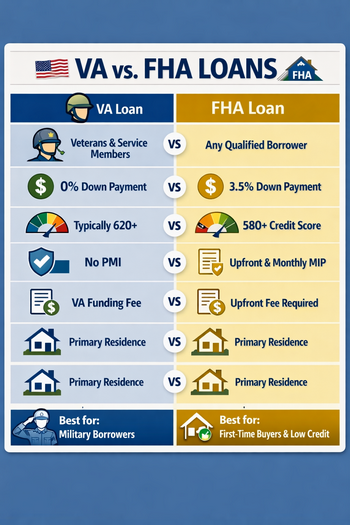 Both VA and FHA loans are government-backed programs designed to help borrowers who might not qualify for conventional mortgages. They serve similar populations but operate under vastly different rules. VA loans and FHA loans each have distinct advantages, yet one program consistently outperforms the other. For veterans, the choice is often straightforward. A direct comparison reveals why.
Quick Comparison: VA Wins on Most Fronts
For veterans, VA loans are superior in almost every category. They require zero down payment. FHA demands 3.5 percent. VA loans have no mortgage insurance. FHA premiums last for the entire loan term. Interest rates are lower with VA financing. Credit requirements are more forgiving. The only scenario in which FHA might have an edge involves veterans with severely damaged credit. Non-veterans who need government backing also turn to FHA. Otherwise, VA dominates.
Down Payment Requirements
VA Loan: Zero down payment required in most cases. You can finance the full purchase price. No cash upfront for the down payment.
FHA Loan: Minimum 3.5 percent down payment required. On a $300,000 home, that equals $10,500 out of pocket. Many buyers struggle to accumulate that sum.
Winner: VA Loans - Zero down offers a massive advantage over 3.5 percent. The gap is substantial.
The Real Impact of Down Payments
That 3.5 percent figure might appear small at first glance. It adds up quickly. For a $300,000 home, FHA borrowers need to save $10,500 before applying. Many first-time buyers lack that amount. VA borrowers need nothing. For a veteran with minimal savings, this transforms their purchasing power. The difference is profound.
Mortgage Insurance
VA Loan: Zero mortgage insurance. Ever. No matter your down payment or loan amount. This benefit stands alone.
FHA Loan: Mortgage insurance required for the life of the loan. Building 20 percent equity does not remove it. The payments continue indefinitely.
Winner: VA Loans - This category showcases VA's true dominance over FHA. The savings are immense.
What FHA Mortgage Insurance Costs
FHA mortgage insurance consists of two components:
- Upfront Mortgage Insurance Premium (UFMIP): 1.75 percent of the loan amount. This fee rolls into your loan balance. On a $290,500 loan, that adds $5,084.
- Annual Mortgage Insurance Premium (MIP): 0.55 to 0.80 percent per year. The exact rate depends on loan amount and down payment. On a $295,584 loan, that equals $1,626 to $2,365 annually. Monthly payments range from $135 to $197.
Over 30 years, FHA mortgage insurance totals roughly $50,000 to $70,000 on a $300,000 home purchase. VA borrowers pay zero. That money stays in their pockets.
Interest Rates
VA Loan: Typically 0.3 to 0.7 percent lower than FHA loans. VA rates often match or beat conventional rates. The advantage compounds over time.
FHA Loan: Higher rates prevail because lenders view FHA borrowers as higher risk. Lower down payments and flexible credit standards contribute to this perception.
Winner: VA Loans - Lower rates translate into significant savings over 30 years. The difference accumulates.
Real Dollar Comparison on a $300,000 Home
VA Loan (zero down, 6.5% rate):
- Loan amount: $306,900 (includes $6,900 funding fee)
- Monthly payment: $1,956
- Total 30-year interest: Approximately $405,000
FHA Loan (3.5% down, 7.0% rate):
- Down payment: $10,500
- Loan amount: $295,584 (includes $5,084 upfront mortgage insurance)
- Monthly payment: $1,964 + $165 MIP = $2,129
- Total 30-year interest: Approximately $411,000
- Total mortgage insurance: Approximately $59,400
The Difference:
- VA borrower saves $10,500 upfront with no down payment
- VA borrower saves $173 per month on payments and insurance
- Over 30 years, VA borrower saves roughly $62,280
- Plus avoids $59,400 in mortgage insurance
- Total VA advantage: ~$131,780
Credit Score Requirements
VA Loan: No minimum credit score mandated by the VA itself. Most lenders prefer 620 or higher. Many accept scores as low as 580. Flexibility abounds.
FHA Loan: No official minimum exists. Lenders typically require 580 for approval. Some demand 620 or above. FHA offers more flexibility than conventional loans. Yet VA remains more accommodating.
Winner: VA Loans - More lenders work with lower credit scores. The options are superior.
The Credit Flexibility Edge
Both programs extend flexibility on credit. VA lenders provide slightly better options for borrowers with problematic histories. Some VA lenders specialize in low-credit borrowers. They understand that a single financial setback does not define your entire credit profile. This perspective matters.
Debt-to-Income Ratio (DTI)
VA Loan: Preferred DTI sits at 41 percent or lower. Many lenders approve up to 50 percent with compensating factors. The guidelines bend.
FHA Loan: Front-end ratio should be 31 percent of gross income for housing payments. Back-end ratio should fall between 43 and 50 percent for all debt.
Winner: Tie - Both programs demonstrate flexibility on DTI. Guidelines differ slightly, but both accommodate borrowers.
Property Appraisal Standards
VA Loan: The VA enforces strict property standards. Homes must be safe, structurally sound, and sanitary. Lead-based paint presents a dealbreaker. Major safety hazards or significant defects disqualify properties.
FHA Loan: FHA appraisals are thorough but less stringent. Properties must meet minimum safety standards. FHA shows greater willingness to approve homes with minor defects when they are disclosed and accepted by the buyer.
Winner: VA Loans - VA standards offer stronger protection against defective properties. Buyers gain peace of mind.
Loan Limits
VA Loan: No limits for borrowers with full entitlement. You can borrow $1 million or more if you qualify financially. Partial entitlement borrowers face county limits. The standard limit sits at $832,750 in 2026. High-cost areas allow up to $1,249,125.
FHA Loan: FHA loans are capped by county. The standard limit ranges from $472,030 to $708,675. High-cost areas can exceed this, but cap out at around $1,089,300.
Winner: VA Loans - Much higher limits apply, especially for full-entitlement borrowers. The difference is substantial.
What This Means
Consider a $500,000 home purchase. VA offers unlimited borrowing with full entitlement. FHA might hit its limit, restricting how much you can borrow and forcing a down payment. VA wins for expensive properties. The advantage grows with home prices.
Occupancy Requirements
VA Loan: You must occupy the property as your primary residence. Investment properties and second homes do not qualify.
FHA Loan: You must occupy the property as your primary residence. The same restriction applies.
Winner: Tie - Both programs require owner-occupancy. No distinction exists.
Assumptions (Taking Over Someone Else's Loan)
VA Loan: VA loans are assumable. A non-veteran can assume your VA loan. A veteran who assumes your loan can use the same entitlement restoration benefit. This adds value for future sales.
FHA Loan: FHA loans are assumable. The borrower must qualify with the lender. A credit check is required. Rates may not be assumable, as lenders can adjust the rate.
Winner: VA Loans - VA assumptions carry more value and transfer more easily. The process is smoother.
Refinancing Options
VA Loan: VA borrowers access the Interest Rate Reduction Refinance Loan (IRRRL). This streamlined refinance requires minimal documentation. The funding fee is only 0.5 percent.
FHA Loan: FHA borrowers can use the FHA Streamline Refinance. This process is faster than standard refinancing. Yet it still requires documentation and sometimes an appraisal.
Winner: VA Loans - The IRRRL surpasses FHA Streamline in efficiency and cost. It stands superior.
Seller Concessions
VA Loan: Sellers can contribute up to 4 percent of the purchase price toward closing costs. This helps in negotiations.
FHA Loan: Sellers can contribute up to 6 percent of the purchase price. This is slightly higher than VA.
Winner: FHA Loans (slightly) - Higher seller concessions help cover more costs. The advantage exists.
The Practical Reality
In competitive markets, VA buyers often negotiate better. Sellers prefer VA loans because they close faster and appraise more reliably. The seller concession advantage of the FHA is often offset by the VA's stronger negotiating position. The reality favors VA.
Processing and Closing Timeline
VA Loan: Typically 30 to 45 days from offer to closing. VA appraisals are streamlined and move quickly.
FHA Loan: Typically 30 to 45 days from offer to closing. Similar to VA, though FHA appraisals sometimes take slightly longer.
Winner: Tie - Both close within similar timeframes. No meaningful difference exists.
Underwriting and Approval Standards
VA Loan: VA underwriting is standardized across lenders. You know what to expect. Consistency prevails.
FHA Loan: FHA guidelines allow for lender discretion. Underwriting standards vary more from lender to lender. Uncertainty creeps in.
Winner: VA Loans - Consistency helps when shopping multiple lenders. Predictability matters.
Side-by-Side Comparison Table
| Feature | VA Loan | FHA Loan |
|---|---|---|
| Down Payment | 0% | 3.5% |
| Mortgage Insurance | None | Lifelong (MIP) |
| Credit Score Required | 620+ (some 580+) | 580+ |
| DTI Flexibility | 41% preferred, up to 50%+ | 43-50% back-end |
| Interest Rates | Lower (0.3-0.7% advantage) | Higher |
| Property Standards | Strict (VA appraisal) | Moderate (FHA appraisal) |
| Loan Limits | Unlimited (full entitlement) | County-based limits |
| Seller Concessions | All closing costs and pp to 4% for escrow and prepaids | Up to 6% |
| Refinancing | IRRRL (streamline) | FHA Streamline |
| Assumability | Assumable, valuable | Assumable, standard |
| Primary Residence Only | Yes | Yes |
| Occupancy Timeline | 30-45 days | 30-45 days |
When Should You Choose Each Loan?
Choose VA If:
- You are a veteran eligible for a VA loan
- You want to buy with zero down payment
- You want to avoid mortgage insurance entirely
- Your credit score falls below 600
- Your DTI exceeds 45 percent
- You plan to refinance in the future
- You are buying an expensive home ($500,000+)
Choose FHA If:
- You are not a veteran and need a government-backed loan
- You are a veteran but ineligible for VA loans
- You want seller concessions to cover more closing costs
- You plan to keep the home for five or more years
Real Scenarios: When Each Wins
Scenario 1: First-Time Home Buyer with $5,000 Saved
Veteran: Uses a VA loan, puts $0 down, keeps $5,000 for emergencies.
Non-Veteran: Uses FHA, puts $5,000 down (1.4 percent instead of 3.5 percent), still short by $5,000. Needs family help or more savings.
Winner: VA - The veteran wins clearly. No contest.
Scenario 2: Veteran with 580 Credit Score
VA: Some VA lenders will approve. The veteran gets a loan with minimal struggle.
FHA: More lenders are available. However, service quality sometimes suffers. VA lenders accepting 580 scores are better trained for these borrowers.
Winner: VA - Better lender options and support exist. The difference matters.
Scenario 3: Buying a $600,000 Home
VA (full entitlement): Unlimited borrowing applies. If you qualify financially, you can finance the full amount.
FHA: Capped at $708,675 in some areas. In most counties, the limit is lower (~$500,000). Forced to put down 10 percent or more. Or wait for a different program.
Winner: VA - Unlimited access prevails. The flexibility is unmatched.
The Verdict for Veterans
If you are a veteran eligible for a VA loan, no scenario makes FHA the better choice. VA loans outperform FHA on down payment (0 percent versus 3.5 percent). They eliminate mortgage insurance entirely. Interest rates are lower. Credit flexibility is superior. Loan limits are higher. The only exception involves veterans ineligible for VA loans for some reason. In that case, FHA becomes the best government-backed option.
For non-veterans, FHA remains a solid program when conventional loans remain inaccessible. But veterans should always choose VA. The benefits are too substantial to ignore.
The Bottom Line
VA loans were designed specifically for military service members and veterans. Congress crafted them to honor military service with generous terms. FHA loans serve a broader population but cannot match VA's advantages. If you have served, use your benefit. You have earned it. It outperforms every alternative available to you.
Frequently Asked Questions
Can a veteran use both VA and FHA loans simultaneously?
Yes, a veteran can have both a VA loan and an FHA loan on different properties. However, both programs require owner-occupancy. You cannot use either for investment properties or second homes unless you meet specific occupancy rules. Most veterans choose VA for primary residences and may consider FHA for other situations.
Is the VA funding fee more expensive than FHA mortgage insurance?
No. The VA funding fee is a one-time charge ranging from 0.5 percent to 3.6 percent of the loan amount. FHA mortgage insurance includes an upfront premium plus monthly payments lasting the entire loan term. Over the life of a loan, FHA mortgage insurance costs far more than the VA funding fee. Veterans save tens of thousands of dollars with VA loans.
Do VA loans have stricter property requirements than FHA loans?
Yes. VA appraisals enforce stricter property standards. The home must be safe, structurally sound, and free of health hazards such as lead-based paint. FHA standards are thorough but more lenient. The VA's strict standards protect buyers from defective properties. This benefits veterans in the long run.
Can non-veterans assume a VA loan?
Yes, non-veterans can assume VA loans. However, the seller's entitlement remains tied to the loan unless the buyer is a veteran who can substitute their own entitlement. Non-veteran assumptions do not restore the seller's entitlement. This can affect the seller's future VA loan eligibility.
Which loan has better refinancing options, VA or FHA?
VA loans offer the IRRRL program, a streamlined refinance with minimal documentation and a low 0.5 percent funding fee. FHA Streamline refinances require more paperwork and sometimes an appraisal. VA refinancing is faster, cheaper, and more efficient. Veterans benefit significantly from this advantage.
Connect With Us
Please share – it really helps