VA vs. USDA Loans: Which Program Is Right for You?
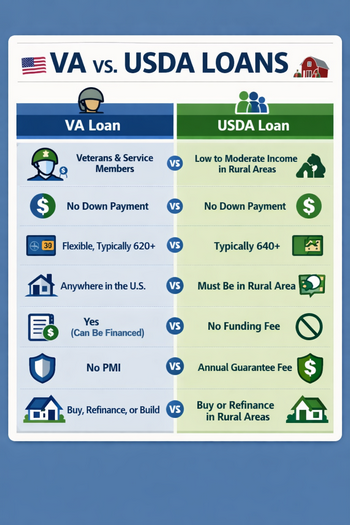 Zero down payment. That phrase catches the attention of nearly every prospective homebuyer. Both VA loans and USDA loans offer this attractive entry point. They make homeownership accessible to borrowers without substantial savings. Yet these mortgage programs cater to distinct populations. Each has its own labyrinth of requirements. Veterans in particular need to grasp these differences. The right choice can save tens of thousands of dollars over the life of a loan.
Quick Comparison: VA Wins for Veterans
For eligible veterans, VA loans outshine USDA in nearly every measurable category. The advantages are significant. No mortgage insurance. Better interest rates. More flexible credit requirements. No geographic restrictions whatsoever. USDA loans serve a specific niche. They target rural homebuyers with moderate incomes. If you're a veteran purchasing property in a rural community, VA financing remains the superior option. USDA only claims victory for non-veterans with moderate incomes buying in eligible rural zones.
Down Payment Requirements
VA Loan: Zero down payment in most cases. You finance the complete purchase price. One hundred percent financing is standard.
USDA Loan: Zero down payment as well. Similar to VA, you finance the total purchase price.
Winner: Tie - Both programs offer 100% financing with no down payment obligation.
What This Means
Both programs appear equally attractive on down payment terms. The real differentiation emerges elsewhere. Mortgage insurance structures differ. Interest rates diverge. Eligibility requirements create distinct pathways. These factors ultimately determine which loan serves you better.
Mortgage Insurance
VA Loan: Zero mortgage insurance. Ever. This holds regardless of down payment size or loan amount. The savings compound dramatically over time.
USDA Loan: Requires a Guarantee Fee with both upfront and annual components.
- Upfront Guarantee Fee: 2% of the loan amount rolls into your principal. A $300,000 loan adds $6,000 to your balance.
- Annual Guarantee Fee: 0.35% per year for the entire loan term. On a $306,000 loan, that's $1,071 annually or $89 monthly.
Winner: VA Loans - The absence of mortgage insurance gives VA a substantial cost advantage from day one.
USDA Guarantee Fee Lifetime Cost
USDA guarantee fees differ from FHA mortgage insurance. They can be waived after 20 years if you refinance into a non-USDA loan. However, most borrowers maintain their USDA loans. They pay the annual fee across the full loan term. Over 30 years on a $300,000 home, guarantee fees total roughly $32,000 to $35,000.
VA borrowers pay zero. That difference alone justifies choosing VA for eligible veterans.
Interest Rates
VA Loan: Rates typically run 0.3 to 0.6% lower than USDA loans. VA rates are competitive with or better than conventional mortgage rates.
USDA Loan: Rates generally sit higher than VA. This reflects the slightly elevated risk profile of USDA borrowers given the moderate income requirement.
Winner: VA Loans - Lower rates compound into substantial savings across 30 years.
Real Dollar Comparison on a $300,000 Home
VA Loan (zero down, 6.5% rate):
- Loan amount: $306,900 (includes $6,900 funding fee)
- Monthly payment (PI): $1,956
- Guarantee fee: $0
- Total monthly: $1,956
- 30-year interest: ~$405,000
USDA Loan (zero down, 7.0% rate):
- Loan amount: $306,000 (includes $6,000 upfront guarantee fee)
- Monthly payment (PI): $2,034
- Annual guarantee fee: $1,071 ($89/month)
- Total monthly: $2,123
- 30-year interest: ~$418,000
- Total guarantee fees: ~$32,130
The Difference:
- VA borrower saves $167/month ($2,004/year)
- Over 30 years, VA borrower saves ~$60,120 in monthly payments
- Plus avoids $32,130 in guarantee fees
- Total VA advantage: ~$92,250
These numbers speak for themselves. The VA advantage approaches six figures.
Eligibility Requirements
VA Loan: Requires military service with honorable discharge or equivalent. Service length depends on the era served, typically 90 days to 24 months. No income limits apply.
USDA Loan: Open to anyone regardless of veteran status. No military service required. Income must not exceed 115% of the county's median income. For a family of four, this typically ranges from $80,000 to $120,000, depending on location.
Winner: Tie (but different) - VA demands military service. USDA imposes income limits. Different populations benefit from each program.
What This Means
Veterans with high income over $120,000 find their path through VA. Non-veterans with moderate income turn to USDA. Veterans with moderate income can use either, but VA delivers superior financial outcomes.
Credit Score Requirements
VA Loan: No minimum credit score mandated by the VA itself. Most VA lenders prefer a score of 620 or higher. Many work with scores as low as 580.
USDA Loan: No official minimum either, but lenders typically require 640 or above. Some USDA lenders accept 580-620, but quality options shrink significantly below 640.
Winner: VA Loans - More flexible credit standards and more lenders willing to accommodate lower scores.
Property Location Requirements
VA Loan: No geographic restrictions whatsoever. You can purchase anywhere in the United States, whether in an urban, suburban, or rural area.
USDA Loan: Geographic restrictions apply. You must buy in a USDA-eligible rural area. Most suburban and urban areas are excluded. Approximately 97% of U.S. land area qualifies as rural under USDA definitions, but major cities and many suburbs are ineligible.
Winner: VA Loans - The absence of geographic restrictions gives VA much broader applicability.
What Qualifies as "Rural"?
USDA's rural definition encompasses more territory than most people assume. Small towns, exurban areas, and some outlying suburbs qualify. However, if you're eyeing property in a major city or close-in suburb, USDA won't work. The USDA website offers eligibility checks for specific addresses.
Income Limits
VA Loan: No income limits. You can earn $50,000 or $500,000 and remain eligible.
USDA Loan: Strict income limits apply. Maximum income is 115% of the county's median income. Exceed that ceiling, and you're disqualified.
Winner: VA Loans - No income ceiling makes VA accessible to higher earners.
Example of USDA Income Limits
In a county where median income sits at $70,000, the USDA limit reaches $80,500 (115% of median). If your household earns $82,000, you don't qualify. This creates obstacles for veterans with solid military careers or business owners with higher earnings.
Debt-to-Income Ratio (DTI)
VA Loan: Preferred DTI is 41% or lower. Many lenders approve up to 50% with compensating factors like residual income.
USDA Loan: Back-end ratio covering all debt should be 41% or lower. Front-end ratio for housing only should be 29% or lower.
Winner: Tie (slightly VA) - Both programs offer flexibility. VA lenders prove slightly more accommodating above preferred thresholds.
Property Appraisal Standards
VA Loan: Strict VA property standards apply. The home must be safe, structurally sound, and sanitary, and it must meet specific VA requirements. Lead-based paint is prohibited.
USDA Loan: Similar appraisal standards to VA. The home must be safe and sound and meet minimum property standards. USDA conducts equally thorough inspections.
Winner: Tie - Both programs maintain solid property protection standards.
Loan Limits
VA Loan: No limits for borrowers with full entitlement. You can borrow unlimited amounts if you qualify financially. Borrowers with partial entitlement face county limits of $832,750 standard in 2026, with high-cost areas reaching $1,249,125.
USDA Loan: No official loan limit, but income limits effectively cap borrowing capacity. If your income limit is $80,000, lenders won't approve a $500,000 loan regardless of appraisal value.
Winner: VA Loans - Higher ceilings for full-entitlement borrowers.
Occupancy Requirements
VA Loan: Primary residence only. Investment properties and second homes don't qualify.
USDA Loan: Primary residence only. Same restriction applies.
Winner: Tie - Both programs require owner-occupancy.
Processing and Closing Timeline
VA Loan: Typically 30-45 days from offer acceptance to closing.
USDA Loan: Typically 35-50 days from offer to closing. USDA appraisals sometimes take slightly longer to process.
Winner: VA Loans (slightly) - Marginally faster average closing time.
Refinancing Options
VA Loan: VA Interest Rate Reduction Refinance Loan (IRRRL), also called a streamline refinance. Minimal documentation, 0.5% funding fee, and fast processing.
USDA Loan: USDA Streamline Refinance available, but requires appraisal and more documentation than VA IRRRL. A 1% guarantee fee applies.
Winner: VA Loans - IRRRL outperforms USDA's refinance options.
Side-by-Side Comparison Table
| Feature | VA Loan | USDA Loan |
|---|---|---|
| Down Payment | 0% | 0% |
| Mortgage Insurance/Guarantee Fee | None | Lifelong (0.35% annually) |
| Interest Rates | Lower (0.3-0.6% advantage) | Higher |
| Credit Score Required | 620+ (some 580+) | 640+ (ideally) |
| DTI Flexibility | 41% preferred, up to 50%+ | 29% front-end, 41% back-end |
| Eligibility | Military service required | Income limits, no military service |
| Property Location | Anywhere in U.S. | USDA-eligible rural areas only |
| Income Limits | None | 115% of county median |
| Loan Limits | Unlimited (full entitlement) | Effectively limited by income |
| Appraisal Standards | Strict (VA standards) | Strict (USDA standards) |
| Refinancing | IRRRL (streamline) | USDA Streamline |
| Primary Residence Only | Yes | Yes |
When Should You Choose Each Loan?
Choose VA If:
- You're a veteran eligible for a VA loan
- You want zero mortgage insurance
- Your income exceeds USDA limits
- You're buying in an urban or suburban area
- You want the lowest interest rates
- You plan to refinance in the future
- Your credit score is below 640
Choose USDA If:
- You're a non-veteran
- Your income is within USDA limits
- You're buying in a USDA-eligible rural area
- You don't qualify for VA and need a zero-down option
Real Scenarios: When Each Wins
Scenario 1: Veteran Buying in Rural Area with $80,000 Income
VA Loan: Eligible. No income limit. Can buy anywhere.
USDA Loan: Eligible. Income falls within the $92,000 limit for a county with an $80,000 median.
Winner: VA - Lower rates, no mortgage insurance, IRRRL refinancing options.
Scenario 2: Veteran Earning $150,000, Buying in Rural Area
VA Loan: Eligible. Can buy any property VA will appraise.
USDA Loan: Not eligible. Income exceeds 115% of the county median (assuming a county median around $70,000-$80,000).
Winner: VA - USDA income limits exclude high-earning veterans.
Scenario 3: Non-Veteran, $70,000 Income, Buying in Rural Area
VA Loan: Not eligible. No military service.
USDA Loan: Eligible. Income within limits, rural property qualifies.
Winner: USDA - Only option available.
Scenario 4: Veteran Buying in Major City
VA Loan: Eligible. No geographic restrictions.
USDA Loan: Not eligible. Urban areas excluded from the USDA program.
Winner: VA - Clear winner due to location requirements.
The Verdict for Veterans
Eligible veterans should choose VA over USDA in almost every scenario. The financial advantages are too significant to ignore. Zero mortgage insurance alone saves tens of thousands. Lower interest rates compound into additional six-figure savings. No geographic restrictions provide freedom. No income limits eliminate barriers. The only exception involves rare cases where a veteran's income exceeds VA lender standards, and they have very low credit scores, and they're purchasing in a USDA-eligible rural area where USDA lenders offer more flexibility. This scenario occurs infrequently.
For non-veterans with moderate income buying in rural areas, USDA remains an excellent option. It often represents the best available program for that specific demographic.
The Bottom Line
Both VA loans and USDA loans offer zero down payment, which opens doors for many buyers. VA loans, however, were designed specifically for veterans and deliver superior benefits. No mortgage insurance. Better interest rates. No geographic restrictions. No income limits. If you've served your country, you've earned access to a better program. Use your VA benefit.
USDA provides valuable support for non-veterans and rural homebuyers without military service. For veterans, though, VA stands as the clear winner.
Frequently Asked Questions
Can veterans use both VA and USDA loans simultaneously?
No, you cannot use both programs on the same property purchase. You must choose one loan product for a single transaction. However, a veteran could use a VA loan for one property and a USDA loan for another property in the future, provided both properties meet the respective program requirements.
Are VA loan funding fees higher than USDA guarantee fees?
VA funding fees range from 0.5% to 3.6% depending on down payment and whether it's a first-time or subsequent use. USDA's upfront guarantee fee is 2% with a 0.35% annual fee. While VA's upfront fee can be higher, the absence of monthly mortgage insurance and lower interest rates typically make VA more affordable over the long term.
Do USDA loans require private mortgage insurance (PMI)?
No, USDA loans do not require traditional PMI. Instead, they charge the Guarantee Fee, which includes both upfront and annual components. This fee functions similarly to mortgage insurance but operates under a different structure and terminology.
Can I use a VA loan to buy a condo in a USDA-eligible rural area?
Yes, VA loans can be used for condominium purchases in any location, including rural areas. The condo must be VA-approved or meet VA condominium requirements. USDA loans, conversely, have more restrictive property type requirements and typically focus on single-family homes.
How long does the VA loan approval process take compared to USDA?
VA loans generally close in 30 to 45 days. USDA loans typically require 35 to 50 days. The VA process tends to move slightly faster, partly because more lenders are familiar with VA procedures and because of the availability of automated underwriting systems.
Connect With Us
Please share – it really helps