Income Requirements for a Conventional Loan
 In the world of home buying, conventional loans remain the most
popular choice, accounting for over 77% of all home loans in recent
years . Unlike government-backed loans such as FHA or VA,
conventional loans are private mortgages not insured by the federal
government . This distinction gives them great flexibility but also
imposes a specific set of underwriting standards - with your income
being the star of the show.
In the world of home buying, conventional loans remain the most
popular choice, accounting for over 77% of all home loans in recent
years . Unlike government-backed loans such as FHA or VA,
conventional loans are private mortgages not insured by the federal
government . This distinction gives them great flexibility but also
imposes a specific set of underwriting standards - with your income
being the star of the show.
Lenders aren't just looking for a big salary; they are looking for proof of stability, predictability, and sufficiency. Whether you are a salaried employee, a freelancer, or someone who relies on investment dividends, here is everything you need to know about meeting the income requirements for a conventional loan in 2026.
The Golden Rules: How Lenders Measure Your Income
Before diving into paperwork, it is essential to understand the two primary metrics lenders use to determine if your income is high enough to support a loan.
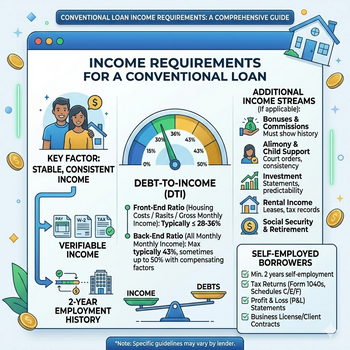
The 28/36 Rule
This is the foundational guideline for conventional loan affordability. It dictates that:
- 28%: Your monthly mortgage payment (including principal, interest, taxes, and insurance) should not exceed 28% of your gross monthly income.
- 36%: Your total monthly debt payments (mortgage, car loans, student loans, credit cards) should not exceed 36% of your gross monthly income .
While the 28/36 rule is the traditional benchmark, the mortgage landscape has loosened slightly in 2026. Many lenders now allow a Debt-to-Income (DTI) ratio of up to 45% or even 50% if the borrower has strong "compensating factors" - such as a high credit score (over 740) or substantial cash reserves .
The 2–3x Income Rule
A simpler way to estimate what you can afford is the multiplier rule. Generally, the mortgage amount you qualify for should be roughly two to three times your annual gross income . For example, if your household earns $100,000 a year, lenders will typically approve you for a loan between $200,000 and $300,000, though this varies based on current interest rates and your existing debts.
The Core Components: Stability and Continuance
According to official guidelines from Fannie Mae, the fundamental requirement for any income used to qualify for a loan is that it must be stable, predictable, and likely to continue for the foreseeable future (at least three years) .
This means a high salary earned for only one month won't suffice. Lenders want to see a two-year history of receiving that income . If your income is trending downward or if you are about to retire, the lender will use the lower, future income amount to qualify you .
Types of Qualifying Income (And How to Document Them)
Lenders can look beyond just your base salary. Here is how different types of income are treated in 2026.
1. W-2 Employment (Salaried and Hourly)
This is the most straightforward income type.
- Requirements: You typically need to provide 30 days of pay stubs (showing year-to-date earnings) and two years of W-2 forms .
- The Calculation: Lenders use your gross base salary. If you rely on overtime, bonuses, or commissions, you need a two-year history of receiving them. The lender will usually average the last two years to determine the qualifying amount .
2. Self-Employment
Self-employed borrowers face the strictest scrutiny in 2026.
- Requirements: You must provide two years of personal and business tax returns (including all schedules). Lenders will look at your adjusted gross income after business expenses, not just your top-line revenue.
- Liquidity Test: A new rule implemented in 2026 requires underwriters to run a "liquidity test" for self-employed borrowers. If you file a 1065 or 1120S (business returns) with a K-1, lenders will scrutinize your business's current ratio (assets vs. liabilities) and distribution history to ensure the business itself is financially healthy .
3. Investment Income (Interest and Dividends)
If you have significant assets, you can use the income they generate to help qualify.
- Requirements: To use interest or dividend income, you need copies of personal tax returns for the most recent two years or account statements covering the last 24 months .
- The Calculation: If the income is stable or increasing, the lender averages the two-year history. If it is decreasing, they only use the most recent year. Important: If you are using assets to also make the down payment, those funds are subtracted from the total before calculating the income .
4. Non-Taxable Income
Income that isn't taxed (such as certain military allowances, Social Security, or disability) is highly valuable to lenders.
- The "Gross-Up" Benefit: Because you don't pay taxes on this money, lenders will add a premium to your income - typically 25% of the nontaxable amount - to calculate your "adjusted gross income" for qualifying purposes . If you receive $2,000 a month in non-taxable disability, the lender might treat it as $2,500 for qualification.
2026 Specifics: New Limits and Credit Shifts
The Conforming Loan Limits
A "conventional loan" often refers to a "conforming loan" - one that meets Fannie Mae and Freddie Mac limits. For 2026, these limits have increased due to rising home prices:
- Standard Counties: $832,750 (up from $806,500 in 2025) .
- High-Cost Areas: $1,249,125 (e.g., New York City, San Francisco, and all of Alaska/Hawaii) .
If you need to borrow more than these amounts, you are entering Jumbo Loan territory, which requires higher income reserves (6–12 months of payments) and stricter credit scores .
The Credit Score Factor
As of November 2025, Fannie Mae and Freddie Mac removed their strict minimum credit score requirements . However, in practice, to qualify for a conventional loan with the best terms in 2026:
- Minimum: You generally need a score of 620 .
- Ideal: For the lowest interest rates and highest DTI flexibility, aim for 740 or higher .
Putting It Into Practice: A Case Study
Let's look at a practical example for a $500,000 mortgage in 2026.
Based on average interest rates and property taxes, the estimated monthly payment (principal, interest, taxes, and insurance) is roughly $3,669 .
Using the 28/36 Rule:
- To keep the mortgage payment at 28% of your gross income, you would need a monthly income of approximately $13,103, or $157,200 per year .
If you have no other debts, a lender using the more flexible 45% DTI cap might approve this loan with an annual income as low as $97,840, provided you have excellent credit and significant cash reserves .
What Doesn't Count?
Not all money coming into your household qualifies. According to Fannie Mae guidelines, income paid in virtual currency (cryptocurrency) is not eligible to be used to qualify for a loan . While you can sell crypto to use as a down payment, the fluctuating income from it cannot be used to demonstrate repayment ability.
Conclusion
Qualifying for a conventional loan in 2026 is less about having a specific number on your tax return and more about proving consistency. Lenders want to see a two-year history of stable income, a Debt-to-Income ratio ideally under 45%, and documentation that your earnings will continue.
As rates stabilize in 2026, buyers who come prepared with organized tax returns, clear proof of assets, and a solid credit score will find that conventional loans offer the most flexible and affordable path to homeownership.
Connect With Us
Please share – it really helps