Jumbo Loans: Financing Beyond Conforming Limits
 When homebuyers begin their journey to purchase a property, the
term "conventional loan" is often the first stop. It conjures images
of standardized paperwork, competitive interest rates, and the
familiar pillars of Fannie Mae and Freddie Mac. But what happens
when the price of the dream home exceeds the boundaries set by these
government-sponsored enterprises?
When homebuyers begin their journey to purchase a property, the
term "conventional loan" is often the first stop. It conjures images
of standardized paperwork, competitive interest rates, and the
familiar pillars of Fannie Mae and Freddie Mac. But what happens
when the price of the dream home exceeds the boundaries set by these
government-sponsored enterprises?
You enter the realm of the jumbo loan.
While jumbo loans are technically a subset of the conventional market - meaning they are not insured by the government (like FHA or VA loans) - they operate under a different set of rules. To understand the jumbo loan, one must first understand the limits of the standard conventional loan.
The Conforming Baseline
To understand why jumbo loans exist, we must look at the conforming loan limit. This is the maximum loan amount that Fannie Mae and Freddie Mac will purchase from lenders.
As of 2024, the baseline conforming limit for a single-family home is $766,550 in most of the United States. In high-cost areas (such as New York, San Francisco, or Washington D.C.), this limit rises to $1,149,825.
Any mortgage amount that exceeds the conforming limit for that specific county is classified as a jumbo loan.
The Jumbo Paradox: Higher Stakes, Stricter Rules
Intuition might suggest that if you are borrowing a massive sum of money - often $1 million or more - lenders would be eager to accommodate you. However, because jumbo loans cannot be sold to Fannie Mae or Freddie Mac, the lender must keep the loan on their books or find private investors. This lack of a government-backed safety net makes jumbo loans a higher risk for the financial institution.
Consequently, the qualification criteria for jumbo loans are significantly stricter than those for standard conventional loans.
1. Credit Score Requirements
While a standard conventional loan may accept a credit score as low as 620 (albeit with higher rates), jumbo loans typically require a minimum score of 700 to 720. Lenders want to see a proven, long-term history of fiscal responsibility before entrusting a borrower with a seven-figure debt.
2. Cash Reserves (Liquidity)
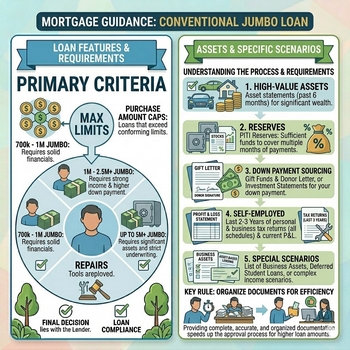
This is often the biggest hurdle for buyers. Lenders want to know that if a temporary financial setback occurs, the borrower can still make payments. For jumbo loans, lenders usually require 6 to 12 months of mortgage payments held in cash reserves (savings, stocks, or retirement accounts) after the down payment is made. For a standard conventional loan, reserves are often not required at all.
3. Debt-to-Income (DTI) Ratio
The Debt-to-Income ratio is the percentage of your gross monthly income that goes toward paying debts. For conforming loans, automated underwriting systems often allow DTIs as high as 45% to 50%. For jumbo loans, lenders are more conservative. They typically look for a DTI below 43%, and often prefer it to be under 38% to secure the best interest rates.
4. The Down Payment
The era of the "no-money-down" jumbo loan largely ended with the 2008 financial crisis. Today, jumbo loans require substantial skin in the game. While a conventional loan might allow 3% to 5% down, jumbo loans usually require 10% to 20% down. For loans exceeding $2 million, a 20% down payment or more is standard.
The Silver Lining: Competitive Rates
One of the most attractive features of the jumbo market in the current economic climate is pricing. Historically, jumbo loans carried higher interest rates than conforming loans due to the increased risk. However, in recent years, the dynamic has shifted.
Because jumbo loans are often held in the portfolios of large banks (rather than sold to Fannie Mae), these banks use them as tools to attract high-net-worth clients. As a result, it is not uncommon to see jumbo loan interest rates that are lower than conventional conforming rates. Lenders are willing to offer "relationship pricing" - better rates for borrowers who move their investment accounts, savings, or business banking to the same institution.
Who is the Jumbo Loan For?
The jumbo loan is not just for buyers of multi-million dollar mansions. In expensive coastal cities, a modest three-bedroom family home may easily exceed the conforming limit.
The ideal jumbo borrower typically fits the following profile:
- High Income: W-2 income or substantial self-employment history to satisfy the strict DTI requirements.
- Strong Liquidity: Significant assets in the bank to cover the down payment and the required post-closing reserves.
- Excellent Credit: A score well above 700 with no recent major credit events (bankruptcies, foreclosures, or late payments).
The Application Process
Applying for a jumbo loan requires patience and meticulous documentation. While a conventional loan may only require two recent pay stubs and two months of bank statements, jumbo underwriting is far more granular.
Borrowers should expect to provide:
- Two to three years of tax returns (personal and business).
- Two to three years of W-2s.
- Verification of employment (often directly with the employer).
- Extensive asset statements to verify the source of the down payment (lenders are wary of large, unexplained deposits).
Conclusion
Jumbo loans represent the "high-performance" tier of the conventional mortgage market. They offer the opportunity to finance luxury properties or homes in highly competitive urban centers without resorting to private banking or portfolio loans with balloon payments.
However, they demand a borrower who is financially robust. If you have excellent credit, substantial cash reserves, and a manageable debt load, a jumbo loan can provide competitive rates that rival - or even beat - standard conventional loans, unlocking the door to properties that lie beyond the conforming ceiling.
Before entering the jumbo market, it is advisable to work with a lender who specializes in this niche. Unlike standard conventional loans, where underwriting is largely automated, jumbo loans rely on human judgment. An experienced loan officer can help structure your assets and income to meet the rigorous standards required to secure financing for your high-value home.
Connect With Us
Please share – it really helps