Conventional Loan: Required Documentation Checklist
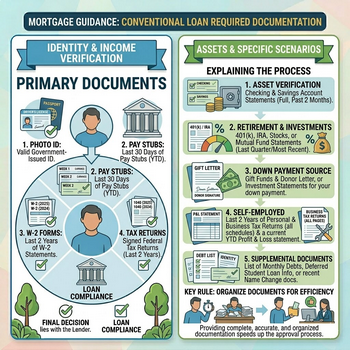 Securing a conventional loan is often viewed as the "gold
standard" of mortgage financing. Unlike government-backed loans
(such as FHA, VA, or USDA), conventional loans are not insured by a
federal agency. This means the lender takes on more risk, and
consequently, they require a meticulous paper trail to verify that
the borrower is creditworthy and the asset is sound.
Securing a conventional loan is often viewed as the "gold
standard" of mortgage financing. Unlike government-backed loans
(such as FHA, VA, or USDA), conventional loans are not insured by a
federal agency. This means the lender takes on more risk, and
consequently, they require a meticulous paper trail to verify that
the borrower is creditworthy and the asset is sound.
For many homebuyers, the documentation phase is the most stressful part of the process. It feels invasive, tedious, and never-ending. However, understanding exactly what you need and why you need it can transform this process from a source of anxiety into a smooth, predictable path to closing.
Here is a breakdown of the essential documentation required for a conventional loan, categorized by what underwriters are looking for: Income, Assets, Liabilities, and Property.
1. Income Documentation: Proving You Can Repay
The ability to repay the loan is the cornerstone of mortgage underwriting. For conventional loans, lenders typically require two years of consistent income history. However, the specific documents vary based on your employment type.
For Salaried or Hourly Wages (W-2 Employees)
- W-2s: Two years of W-2 forms. Lenders look for consistency in income; a decline year-over-year requires explanation.
- Pay Stubs: Your most recent 30 days of pay stubs. These must show year-to-date earnings to verify that your income hasn’t decreased since your last W-2 filing.
- Verbal Verification of Employment (VVOE): Within 10 days of closing, the lender will call your employer to confirm you are still employed and verify your salary and title.
For Self-Employed Borrowers
Self-employment (owning 25% or more of a business) triggers a more rigorous review. Since you don’t have a third-party employer verifying your income, the underwriter becomes a forensic accountant.
- Tax Returns: Two to three years of complete personal (1040) and business (1120 or Schedule C) tax returns.
- Profit & Loss (P&L) Statement: A year-to-date P&L may be required if the loan closes late in the year.
- Business Assets: If you use business funds for the down payment, you must provide business bank statements and a letter from a CPA verifying the withdrawal won’t harm the business.
For Additional Income
Conventional loans allow for various income streams, but each requires specific proof:
- Rental Income: Current lease agreements and two years of Schedule E tax forms.
- Social Security/Pension: Award letter and proof of receipt (bank statements).
- Alimony/Child Support: Divorce decree and proof of consistent receipt (usually 6–12 months of bank statements). Note: You are not required to disclose this unless you want to use it to qualify.
2. Asset Documentation: Proving You Have the Funds
To close a conventional loan, you need cash for the down payment and closing costs. Lenders need to verify that this money is truly yours (not borrowed) and has been "seasoned."
- Bank Statements: Two to three months of statements for checking, savings, and money market accounts. If you have a large deposit (typically defined as 25%–50% of your monthly income or more), you must provide a paper trail (source of funds) showing where it came from. Gifts from family are allowed but require a gift letter and proof of the donor’s ability to give the funds.
- Investment Accounts: 401(k), IRA, brokerage, and stock account statements. Lenders typically use 70% of the value of stocks (to account for market volatility) when calculating available assets.
- Gift Letters: If a family member is assisting with the down payment, a signed gift letter is mandatory. It must state that the money is a gift, not a loan, and that the donor expects no repayment.
3. Credit and Liability Documentation
Your credit report does most of the talking here, but underwriters need documentation to verify the context of your debts.
- Credit Pull: The lender will pull a tri-merge credit report (from Equifax, Experian, and TransUnion). Unlike FHA loans, conventional loans are sensitive to "seasoning" requirements for past derogatory events (foreclosure: 7 years; bankruptcy: 4 years; short sale: 4 years).
- Explanatory Letter (LOE): If your credit report shows late payments, a previous foreclosure, or a gap in employment, you will need to write a letter of explanation. This is a formal document that explains the circumstances and, crucially, how the issue has been resolved.
- Divorce Decree: If applicable, you must provide the full divorce decree to prove alimony obligations and to show that you are no longer liable for any previous joint mortgage debt.
4. Property Documentation
The loan isn’t just about you; it’s about the collateral (the house).
- Purchase Agreement: The signed contract between you and the seller.
- Appraisal: The lender orders an independent appraisal to determine the market value of the property. For conventional loans, the appraisal also serves as a safety inspection. If the appraiser notes health or safety hazards (peeling paint, roof damage, structural issues), the lender may require repairs before closing.
- Title Work: A title company or attorney will provide a preliminary title report to prove the seller legally owns the property and that there are no outstanding liens (unpaid contractor bills, back taxes) that would transfer to you upon purchase.
The New Frontier: Asset vs. Income Documentation
A significant recent shift in the conventional loan space is the rise of Asset-Based Qualification. For retirees or high-net-worth individuals who have substantial assets but limited "earned income," lenders now offer conventional loans that use Asset Depletion or Bank Statement Programs.
In these cases, the documentation shifts. Instead of W-2s, borrowers provide 12–24 months of bank statements or asset management account statements. Underwriters calculate an "imputed income" by taking the total assets, dividing them by a set number of months (often 60 to 360), and using that figure as qualifying income.
Tips for a Smoother Documentation Process
- Avoid the "Large Deposit" Trap: Do not move large sums of money between accounts or accept cash gifts in the 60 days leading up to your application. If you must, keep a clear paper trail (deposit slips, gift checks).
- Do Not Open New Credit: From the day you apply until the day you close, do not apply for a new credit card, finance a car, or co-sign a loan. This changes your debt-to-income ratio (DTI) and can derail approval hours before closing.
- Consistency is Key: Lenders look for stability. Your name should match exactly across your ID, pay stubs, and bank statements. Your address should be current.
- Digital Organization: Most lenders use
secure online portals (like Encompass or Blend). Upload
documents as PDFs. Ensure the file name is clear (e.g.,
Oct_Paystub_2024.pdfrather thanScan_001.pdf).
Conclusion
The documentation required for a conventional loan is extensive because the underwriting standard is high. While it may feel like a mountain of paperwork, each document serves a specific purpose: to prove that you are a reliable borrower and that the property is a sound investment.
By preparing these documents - income verification, asset statements, and credit explanations - before you start shopping for a home, you position yourself as a "low-risk" buyer. In a competitive market, a borrower with a complete, organized file is not only more likely to get approved but often closes faster than those scrambling for paperwork at the eleventh hour.
Connect With Us
Please share – it really helps