VA Loan vs Conventional: Key Differences & How to Choose
 Choosing the right mortgage is one of the most important
financial decisions you’ll make. For those who have served in the
military, the choice often comes down to a VA loan versus a
conventional loan. Both can help you purchase a home, but they
operate in fundamentally different ways. VA loans are backed by the
Department of Veterans Affairs, while conventional loans are not
backed by any government agency. Understanding these differences is
essential to saving money and finding the right fit for your family.
Choosing the right mortgage is one of the most important
financial decisions you’ll make. For those who have served in the
military, the choice often comes down to a VA loan versus a
conventional loan. Both can help you purchase a home, but they
operate in fundamentally different ways. VA loans are backed by the
Department of Veterans Affairs, while conventional loans are not
backed by any government agency. Understanding these differences is
essential to saving money and finding the right fit for your family.
This guide breaks down the requirements, costs, and benefits of each option, offering a side-by-side comparison. Whether you're a first-time homebuyer or an experienced investor, knowing the specifics of each loan type will help you make a confident, informed decision.
What Is a VA Loan?
A VA loan is a mortgage benefit available to active-duty service members, veterans, and eligible surviving spouses. These loans are provided by private lenders - such as banks and mortgage companies - but are partially guaranteed by the Department of Veterans Affairs. This guarantee protects the lender in the event of default, allowing them to offer more favorable terms than conventional loans often provide.
VA loans are designed to make homeownership more accessible for those who have served. They remove many common financial barriers, including the need for a down payment, and typically feature flexible credit requirements. However, they do come with specific rules, such as the VA funding fee and the requirement that the home be used as your primary residence.
Key Benefits of a VA Loan
- No Down Payment: Finance up to 100% of the home’s purchase price - a significant advantage for buyers without substantial savings.
- No Private Mortgage Insurance (PMI): Unlike conventional loans, VA loans do not require PMI, saving you hundreds of dollars each month.
- Competitive Interest Rates: Government backing often allows lenders to offer lower rates compared to conventional mortgages.
- Flexible Credit Requirements: The VA does not set a minimum credit score, and lenders are often more lenient with credit history.
- Lower Closing Costs: VA loans typically have lower closing costs, and sellers may pay up to 4% of the home’s price in concessions to help cover your expenses.
What Is a Conventional Loan?
A conventional loan is a mortgage that is not insured or guaranteed by the federal government. It is the most common type of financing in the U.S., available through banks, credit unions, and online lenders. Most conventional loans are "conforming," meaning they follow guidelines set by Fannie Mae and Freddie Mac.
Because there is no government guarantee, conventional loans carry more risk for lenders. To offset this, they typically require higher credit scores, larger down payments, and stricter debt-to-income ratios than government-backed loans. However, conventional loans offer greater flexibility in property types, allowing you to finance a primary residence, second home, or investment property.
Key Features of a Conventional Loan
- Low Down Payment Options: First-time buyers may put down as little as 3%, though PMI is required until 20% equity is reached.
- Private Mortgage Insurance (PMI): Required when the down payment is less than 20%. A key advantage is that PMI can be canceled once you reach 20% equity.
- Flexible Property Types: Suitable for vacation homes, rental properties, and second residences - unlike VA loans, which are limited to primary residences.
- Higher Loan Limits: Conforming loan limits are high, and jumbo loans are available for more expensive properties.
- Streamlined Process: Conventional loans can offer a more straightforward approval process, though they often require more documentation.
VA Loan vs. Conventional Loan: Key Differences
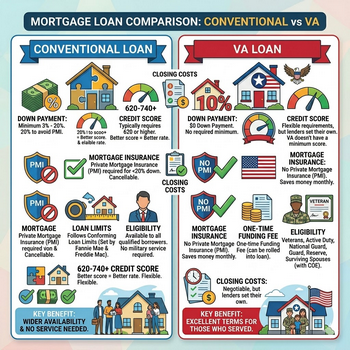
Your choice will depend on your eligibility, finances, and home-buying goals. The table below summarizes the core differences.
| Feature | VA Loan | Conventional Loan |
|---|---|---|
| Down Payment | $0 required | 3% to 20% required; 20% needed to avoid PMI |
| Mortgage Insurance | None | PMI required if down payment < 20%; cancelable at 20% equity |
| Credit Score | No VA minimum; lenders often accept 620 or higher | Typically 620 minimum; higher scores yield better rates |
| Interest Rates | Generally lower due to government backing | Vary by credit score; excellent credit may yield comparable rates |
| Property Type | Primary residence only | Primary residence, second home, or investment property |
| Funding Fee | VA funding fee (1.4%–3.6% of loan amount); may be rolled into loan | No funding fee, but closing costs and PMI apply |
| Loan Limits | No limits for borrowers with full entitlement | Conforming loan limits apply; jumbo loans available for higher amounts |
Which Loan Is Better for You?
For many eligible veterans, a VA loan is the superior option. The ability to buy a home with no down payment and no PMI - combined with lower interest rates - can result in significant savings and greater affordability, especially for those with limited savings or lower credit scores.
However, a conventional loan may be the better financial choice in certain situations. If you have excellent credit and can make a 20% down payment, you can avoid both PMI and the VA funding fee, potentially lowering your overall costs - particularly if you plan to stay in the home for many years. Additionally, if you're purchasing a vacation home or investment property, a conventional loan is your only option, as VA loans require owner occupancy.
Cost Comparison: Funding Fee vs. Mortgage Insurance
The most significant cost difference between the two loan types lies in how they address lender risk.
- VA Funding Fee: A one-time fee that ranges from 1.4% to 3.6% of the loan amount, depending on your down payment and whether you’ve used the benefit before. It can be rolled into the loan, and veterans with service-related disabilities are exempt.
- PMI (Private Mortgage Insurance): Required on conventional loans with down payments under 20%. This is a recurring monthly expense - typically 0.5% to 1.5% of the loan amount annually - that continues until you reach 20% equity.
For most buyers, the one-time funding fee is more cost-effective than years of monthly PMI payments, particularly if you plan to stay in the home for several years.
Credit and Qualification Standards
Qualification requirements differ significantly:
- Conventional Loans: Generally require a minimum credit score of 620, a debt-to-income (DTI) ratio below 45–50%, stable employment, and sufficient income.
- VA Loans: No minimum credit score set by the VA. Lenders often offer more flexibility with past credit issues, and the VA uses a "residual income" approach - focusing on leftover income after major expenses - rather than strict DTI limits.
Property and Usage Rules
Your intended use of the property may determine which loan type is appropriate:
- VA Loans: Strictly for primary residences. You must move in within 60 days and intend to live there most of the year. Multi-unit properties (up to four units) are allowed, but you must occupy one unit.
- Conventional Loans: Offer full flexibility. You can finance primary residences, second homes, or investment properties, making them the preferred choice for real estate investors.
Frequently Asked Questions
What is the main difference between VA and conventional
loans?
The primary difference is government backing. VA
loans are guaranteed by the Department of Veterans Affairs, allowing
for zero down payment and no PMI. Conventional loans are not
government-backed and typically require a down payment and PMI if
the down payment is under 20%.
Is the VA funding fee worth paying instead of PMI?
For most buyers, yes. The VA funding fee is a one-time cost that can
be financed, while PMI is a recurring monthly expense. Over time,
PMI payments often exceed the cost of the funding fee.
Can I use a VA loan to buy a second home or vacation
home?
No. VA loans are intended for primary residences
only. To purchase a second home or vacation property, you would need
a conventional loan.
Do I need a perfect credit score to get a VA loan?
No. The VA does not set a minimum credit score, and lenders are
often more flexible than with conventional loans, especially if you
have stable income and VA eligibility.
What happens to my VA loan if I move?
You
have several options: sell the home and restore your entitlement,
keep it as a rental (which uses part of your entitlement), or
refinance into a conventional loan to free up your VA entitlement
for a new purchase.
Making Your Final Choice
Ultimately, the best mortgage depends on your personal financial situation and goals.
If you are an eligible veteran or service member looking to buy a home with no down payment, lower monthly costs, and flexible credit requirements, the VA loan is an exceptional benefit. It offers a path to homeownership that is not available to the general public.
If you have a strong down payment, excellent credit, and are considering a second home or investment property, a conventional loan may be more suitable. Its flexibility in property types and the ability to cancel PMI are significant advantages.
Consider speaking with multiple lenders to compare rates, fees, and monthly payments for both options. Evaluating the long-term costs - including PMI and the VA funding fee - will help you determine which loan type leaves more money in your pocket over time.
Connect With Us
Please share – it really helps