Home Ready vs FHA Loans: A Complete Guide
 Choosing the right mortgage can feel like a big
decision. Two popular options for people with limited savings are
the HomeReady and FHA loans. Both
programs help people buy a home with a small down
payment. However, they work differently. Understanding these
differences helps you pick the best loan option for
your situation.
Choosing the right mortgage can feel like a big
decision. Two popular options for people with limited savings are
the HomeReady and FHA loans. Both
programs help people buy a home with a small down
payment. However, they work differently. Understanding these
differences helps you pick the best loan option for
your situation.
This guide compares the HomeReady mortgage and the FHA program. We will look at costs, rules, and who qualifies. By the end, you will know which path might save you money and help you become a homeowner.
What is a HomeReady Mortgage?
The HomeReady loan is a conventional loan backed by Fannie Mae. Fannie Mae is a government-sponsored enterprise that buys mortgage loans from lenders. This loan program targets low- to moderate-income borrowers. It allows for a very low down payment of just 3 percent.
One key feature is the income limit. To qualify for a HomeReady loan, your income cannot exceed a certain amount for your area. This ensures the program helps those who need it most. The HomeReady loan program also allows rental income from a basement or extra room to help you qualify.
What is an FHA Loan?
The Federal Housing Administration insures an FHA mortgage. This mortgage program is popular with first-time homebuyers. It requires a low down payment of just 3.5 percent. Because the government backs the loan, lenders can offer it to people with lower credit scores.
The FHA program does not have an income limit. Anyone can apply as long as they meet the eligibility requirements. This makes it a flexible mortgage option for many home buyers. However, the costs can be higher over time compared to other loan programs.
Key Differences: HomeReady vs FHA
Both loans help people with limited cash. But the details matter. Let's look at the main differences between a HomeReady loan and an FHA loan.
Credit Score Requirements
Your credit score plays a big role in which mortgage you can get. For an FHA loan, you can sometimes qualify with a score as low as 500. But you will need a 10 percent down payment with that low score. With a 580 score, you can get the 3.5 percent down payment option.
The HomeReady mortgage typically requires a higher credit score. Most lenders look for a score of at least 620. If your credit is good, you might save money with HomeReady. If your credit needs work, the FHA might be your only option.
Down Payment and Sources of Funds
Both loans allow for a low down payment. The FHA asks for 3.5 percent down. Homeready asks for 3 percent down. This 0.5 percent difference can affect your total cash needed at closing.
Where you get the money also differs. FHA rules require your down payment to come from your own savings or a gift from a family member. The HomeReady loan is more flexible. It allows gifts from family and also from nonprofit agencies. You can even use payment assistance programs from state or local governments with a HomeReady mortgage.
Mortgage Insurance Costs
Mortgage insurance protects the lender if you stop making payments. This is a major cost difference between the two loans. FHA loans require two types of mortgage insurance. You pay an upfront mortgage insurance premium (UFMIP) at closing, which is usually 1.75 percent of the loan amount. You also pay an annual mortgage insurance premium (MIP) as part of your monthly mortgage payment.
With a HomeReady loan, you pay private mortgage insurance (PMI). This is usually cheaper than FHA's MIP. More importantly, private mortgage insurance on a HomeReady mortgage can be canceled once you have 20 percent equity in your home. FHA mortgage insurance typically stays for the life of the loan if you put down less than 10 percent.
Income Limits and Property Rules
The FHA program has no income limit. You can earn any amount and still use this mortgage option. The HomeReady loan has strict income limit rules. Your income cannot exceed 80 percent of the area median income for your location. You can check the Fannie Mae website for limits in your county.
Both loans require you to live in the home as your primary residence. You cannot use these loans for investment properties. Both also allow for multi-unit homes, like duplexes, as long as you live in one of the units.
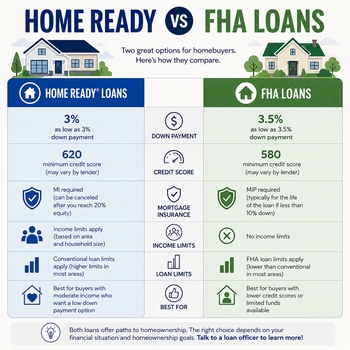
| Feature | HomeReady Loan | FHA Loan |
|---|---|---|
| Credit Score Minimum | 620 (typical) | 580 for 3.5% down |
| Down Payment | 3% | 3.5% |
| Income Limit | Yes (80% of AMI) | No |
| Mortgage Insurance | Private mortgage insurance (PMI) | Upfront MIP + Annual MIP |
| MI Cancellation | Can cancel at 20% equity | Usually for the life of the loan |
Benefits of the HomeReady Loan Program
Many first-time buyers prefer the HomeReady mortgage because of its long-term savings. The ability to cancel mortgage insurance is a huge benefit. It lowers your monthly payment once your home increases in value or as you pay down the loan.
- Lower overall cost: Private mortgage insurance rates are often lower than FHA insurance.
- Flexible income sources: You can use rental income from a boarder to help you qualify.
- Non-occupant borrowers: A parent can be a co-borrower without living in the home. This helps you qualify with their income.
- Refinancing option: The HomeReady loan offers a low-cost refinance option later.
- Works with payment assistance: You can combine it with local down payment assistance programs.
These features make HomeReady a strong choice for buyers with decent credit and moderate income. It supports homeownership in a way designed to be affordable over the long term.
Benefits of the FHA Mortgage
The FHA mortgage remains a great mortgage option for many people. Its main strength is accessibility. If your credit history has some dings or you have had a bankruptcy, FHA lenders might still work with you.
- Lower credit score floor: Easier to qualify if your credit score is below 620.
- Higher debt tolerance: FHA often allows a higher debt-to-income ratio.
- No income limit: Works for buyers in expensive areas with high incomes.
- Widely available: Almost every lender offers FHA loans.
- Streamline refinancing: If mortgage rates drop, you can use a simple process to refinance.
For buyers who cannot meet the credit score or income requirements of a conventional loan, such as HomeReady, the FHA is often the path to owning a home.
Which Loan Option is Right for You?
Your personal finance situation decides the best loan program. Look at your credit score first. If it is 620 or higher, explore the HomeReady mortgage. If it is lower, the FHA loan is likely your best bet.
Next, consider your income. If you earn more than the median income for your area, you cannot use HomeReady. You will need to look at FHA or other conventional loan options. If your income is within the limit, compare the costs.
Ask a loan officer to show you both scenarios. Ask for the total cost of mortgage insurance over time. See how long you would pay it with each loan. This will show you the real cost difference between the two programs. Also, consider how long you plan to stay in the home. If you plan to move in a few years, the upfront mortgage insurance on an FHA loan might be okay. If you plan to stay long-term, canceling PMI with a HomeReady loan could save you thousands.
Frequently Asked Questions
What is the main difference in mortgage insurance between HomeReady and FHA?
The main difference is cost and cancellation. Homeready uses private mortgage insurance (PMI), which you can cancel once you have 20% equity. FHA uses a mortgage insurance premium (MIP) that you pay an upfront fee for, and the monthly premium usually stays for the life of the loan if you made a small down payment.
Can I use gift money for my down payment with both loans?
Yes, both loans allow gift money for the down payment. However, the HomeReady loan is more flexible. It allows gifts from family and friends, as well as down payment assistance from nonprofits or government agencies. FHA loans typically only allow gifts from family members.
Is there an income limit for an FHA loan?
No, there is no income limit for an FHA loan. Anyone can apply for this mortgage program regardless of how much money they earn. This makes it different from the HomeReady loan program, which restricts borrower income to 80% of the area median income.
Which loan is better for a first-time home buyer with a 600 credit score?
A buyer with a 600 credit score would likely have an easier time qualifying for an FHA mortgage. The HomeReady mortgage typically requires a minimum credit score of 620. FHA loans are designed to help first-time homebuyers with less-than-perfect credit histories achieve homeownership.
Can I rent out my home if I buy it with a HomeReady or FHA loan?
Both loans require owner-occupancy. You must live in the home as your primary residence. However, both loan programs allow you to rent out extra rooms to generate rental income. With the HomeReady loan, you can even use that potential rental income to help you qualify for the mortgage in the first place.
Connect With Us
Please share – it really helps