Freddie Mac Home Possible Refinance Guide
What Is Home Possible?
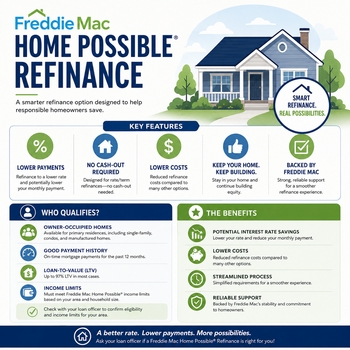 Freddie Mac offers a specialized mortgage product that allows
homeowners to modify an existing loan into a more affordable option.
The main goal of the home possible mortgage is to lower your
interest rate and monthly payment. This is a conventional loan,
meaning it is not backed by the FHA or VA. The offering provides
flexible terms to help people qualify for a home and stay in their
homes.
Freddie Mac offers a specialized mortgage product that allows
homeowners to modify an existing loan into a more affordable option.
The main goal of the home possible mortgage is to lower your
interest rate and monthly payment. This is a conventional loan,
meaning it is not backed by the FHA or VA. The offering provides
flexible terms to help people qualify for a home and stay in their
homes.
This option is distinct because it serves those with
lower to moderate income. Unlike standard loan modifications, it
provides incentives like reduced mortgage insurance cost. It also
allows for higher loan-to-value ratios, which is helpful if you lack
equity. The program supports single-family homes, condos, and other
eligible properties. To qualify for a home, your income must be at
or below 100% of the area median income for your location.
Key Features of Freddie Mac Home Possible
This program comes with several features that make it a smart
choice for eligible homeowners and low-income borrowers. It focuses
on reducing costs and simplifying the process. Below are the primary
advantages that distinguish it from other conventional loans.
Lower Interest Rate Requirement: Your new loan
must lower your interest rate by at least half a percent (50 basis
points). This ensures the transaction actually saves you money.
Monthly Payment Reduction: The new loan must
reduce your total monthly payment for principal, interest, and
mortgage insurance by at least $50.
High
Loan-to-Value (LTV): You can refinance with an LTV ratio up
to 97% for a primary residence, meaning you can have as little as 3%
equity.
Appraisal Credit: If an appraisal is
required when you refinance, Freddie Mac provides a $500 credit that
must be passed on to you. This helps cover costs and expenses.
Flexible Income Documentation: The program only
considers the income used to qualify for your home loan. If a spouse
has a high income but is not listed on the loan application, that
income is not counted toward the income thresholds for
moderate-income borrowers.
Who Can Qualify?
Understanding eligibility requirements is the first step in your
application process. This offering has specific rules regarding
income, credit, and property. Meeting these criteria does not
guarantee approval for the possible® mortgage, but it shows you are
on the right track. A lender will verify all this information during
underwriting.
The income and property eligibility rules for
the home possible® loan are strict but fair. For this program, total
borrower income must be at or below 100% of the area median income.
These income limits are updated yearly and vary by county, so
checking the latest figures is vital.
Your financial health
is also key to qualifying for a home. You need a minimum credit
score of 620. Your debt-to-income (DTI) ratio, which compares your
monthly debts to your income, cannot exceed 65%. You must also have
a clean payment history on your current mortgage loan. This means no
late payments in the last six months and no more than one 30-day
late payment in the past year.
Property and Loan Limits
Not every home or loan amount qualifies for the Home Possible®
loan. The property must be your primary residence. It can be a
single-family home, a townhouse, a warrantable condo, or a mobile
home. Investment properties and second homes are not eligible for
the home possible® program.
The loan balance must fall within
conforming loan limits for your area. This is the maximum loan
amount that Freddie Mac can purchase. For most areas in 2026, this
limit is quite high for the home possible® loan, but you should
confirm with your lender. The maximum LTV is typically 97%, but it
drops to 95% for other property types or if a non-occupant
co-borrower is on the home possible® loan.
Eligibility Summary for the home possible® mortgage
program:
Income Limit: ≤ 100% of Area Median Income
Credit Score for the home possible® loan: Minimum 620
Maximum
LTV: Up to 97% for primary residence under the home possible®
mortgage.
Debt-to-Income (DTI) Ratio: Maximum 65%
Property
Type: Primary Residence only (1-unit, Condo, PUD, manufactured home,
or other eligible types under the home possible® mortgage).
How It Compares to Other Options
Many homeowners wonder how this program stacks up against other
choices. It is one of several low-down-payment programs, but it has
unique advantages. For example, the mortgage insurance costs are
often lower than on a standard conventional loan. This is because
Freddie Mac offers reduced fees for these eligible Home Possible®
loans.
Another common alternative is an FHA loan. FHA loans
are popular for their low down payment, but they come with upfront
and ongoing mortgage insurance premiums that can last for the life
of the loan. This conventional offering can have lower overall
costs. It also offers greater flexibility for secondary financing,
such as down payment assistance programs offered by local agencies.
The standard HomeOne mortgage is another product designed to
help first-time home buyers, but it does not have the same income
thresholds as the standard HomeOne mortgage. This program is
specifically designed for lower-income households seeking to
refinance or modify a loan. It provides a clear benefit by mandating
a rate reduction and offering the appraisal credit, which a standard
refinance option might not include.
Key Advantages:
- Lower mortgage insurance premiums compared to standard conventional loans
- No upfront mortgage insurance premium, unlike FHA loans
- $500 appraisal credit helps reduce out-of-pocket costs
- Flexible income calculations allow you to exclude non-borrowing household members
- High LTV ratios (up to 97%) make it possible to secure financing with very little equity
- Allows subordinate financing to remain in place for the Home Possible® loan
- Fixed-rate terms from 10 to 30 years provide payment stability
- Must reduce your interest rate by at least 0.5% to qualify
- Primary residences only, keeping the focus on homeownership stability
- Designed for moderate-income households with specific eligibility caps
How to Apply
Starting your application is straightforward. First, you need to
find a lender that offers this product. Not all lenders are the
same, so look for one experienced with affordable loan programs.
They will help you confirm eligibility using income and property
tools.
Before you apply, gather your financial documents. You
will need proof of income, such as pay stubs and tax returns. You
also need bank statements to show your assets. The lender will use
this to calculate your debt-to-income ratio and verify your
employment. They will also run a credit check to confirm your credit
score meets the minimum requirement of 620.
The lender will
then submit your loan application information to the automated
underwriting system, Loan Product Advisor. This system checks if
your income qualifies and if the loan is eligible. It will also tell
the lender if an appraisal is required. If the system waives the
appraisal, you save time and money. If not, the $500 credit helps
offset the payment and closing costs.
Understanding the Costs and Savings
This program is designed to save you money, but it is still
important to understand the costs. You will have typical closing
costs, which include lender fees, title insurance, and recording
fees. You have the option to pay these costs out of pocket or roll
them into the new loan amount. However, the program limits how much
you can add to the loan balance - typically up to $5,000.
The
savings from the home possible® loan are realized over time. By
lowering your interest rate by at least 0.5%, your monthly payment
drops. Even after accounting for new closing costs, the goal of the
possible® mortgage is to break even quickly and then enjoy lower
payments for the life of the loan. For example, if your payment goes
down by $100 per month, you save $1,200 per year with a Home
Possible mortgage. Over a 30-year term, that is a substantial
amount.
Remember, you must be a current homeowner with a loan
in Freddie Mac's portfolio. You can use the Loan Look-Up Tool online
to see if your mortgage qualifies. If it does, and your income meets
the AMI threshold, this is an excellent opportunity to reduce your
financial stress and strengthen your homeownership future.
Frequently Asked Questions
What is the difference between this program and standard
loans for low-income borrowers?
The broader loan program
name is used for both purchases and modifications. The version
focused on securing a new rate is the specialized variant for
existing borrowers. The main difference is that this program has a
higher income limit (up to 100%) and requires you to already have an
existing loan. It mandates a rate reduction and provides the
appraisal credit.
Can I use this program for a mobile
home under the Home Possible® mortgage guidelines?
Yes,
a mobile home is an eligible property type, as long as it is your
primary residence. However, the maximum LTV for this property type
is slightly lower, at 95%, compared to 97% for a site-built home. It
must also meet your lender's property eligibility standards.
How is my income calculated?
When determining
eligibility, the lender uses the income of all borrowers who are on
the new loan. If you have a boarder or a family member living with
you who pays rent, that is not counted as your income for
eligibility purposes - only the qualifying income used to approve the
mortgage matters for the thresholds.
What if my
credit score is below 620?
The minimum credit score for
this program is 620. If your score is below this, you may not
qualify. However, you could speak with a housing counselor about
steps to improve your credit. Other options, like an FHA
modification, may have lower credit score requirements but different
costs.
Can I use this program more than once?
No, this is a one-time use program. You can only use it once for a
specific property. If you modify your loan again in the future, you
would need to use a different product or a conventional option.
Connect With Us
Please share – it really helps