FHA 203h Loan: A Lifeline for Disaster Victims
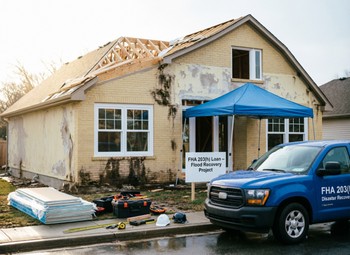 The FHA 203h loan is a specialized mortgage program from the
Federal Housing Administration (FHA) designed to help victims of
presidentially declared disasters. When a hurricane, wildfire, flood, or
tornado destroys a home, the challenge of starting over is
overwhelming. This government-backed loan provides a clear, affordable
path back to homeownership for displaced survivors, often with no down
payment required. Backed by the U.S. Department of Housing and
Urban Development (HUD), the 203h FHA loan gives eligible borrowers
access to 100% financing so they can buy or rebuild without the usual
financial barriers. This guide explains what the FHA 203h loan is, who
qualifies, how it differs from other HUD programs, and what borrowers
need to know about 203h loan requirements and guidelines.
The FHA 203h loan is a specialized mortgage program from the
Federal Housing Administration (FHA) designed to help victims of
presidentially declared disasters. When a hurricane, wildfire, flood, or
tornado destroys a home, the challenge of starting over is
overwhelming. This government-backed loan provides a clear, affordable
path back to homeownership for displaced survivors, often with no down
payment required. Backed by the U.S. Department of Housing and
Urban Development (HUD), the 203h FHA loan gives eligible borrowers
access to 100% financing so they can buy or rebuild without the usual
financial barriers. This guide explains what the FHA 203h loan is, who
qualifies, how it differs from other HUD programs, and what borrowers
need to know about 203h loan requirements and guidelines.
What Is the FHA 203h Loan?
The FHA 203h loan is a federally insured mortgage program specifically designed to help survivors of presidentially declared major disasters. The program falls under Section 203(h) of the National Housing Act and is administered by HUD through FHA-approved lenders.
Unlike conventional financing, the FHA 203h program allows eligible borrowers to purchase or reconstruct a primary residence with up to 100% financing. That means no down payment is required - a significant advantage for people who may have lost their savings, assets, and personal property in the disaster.
The 203h mortgage is not a grant or direct government loan. Instead, HUD insures the loan against default, which lowers the risk for lenders and allows them to offer more favorable terms to borrowers who might not otherwise qualify for standard financing. This makes it a critical part of the broader set of FHA loan programs available to homebuyers.
What Is FHA 203h Mortgage Insurance for Disaster Victims?
One important aspect of the FHA 203h program is mortgage insurance. Like all FHA loans, the 203h mortgage requires borrowers to pay an upfront mortgage insurance premium (UFMIP) and an annual mortgage insurance premium (MIP) paid monthly.
- FHA 203h mortgage insurance for disaster victims works the same as standard FHA mortgage insurance.
- The UFMIP is 1.75% of the base loan amount and is typically financed into the loan.
- Annual MIP varies based on loan term, loan-to-value ratio, and loan amount.
This insurance is what enables HUD to guarantee the loan and allows lenders to extend credit to borrowers in difficult financial circumstances. It is important to understand that FHA 203h mortgage insurance for disaster victims is not optional - it is a required feature of the program. However, given that the program eliminates the down payment requirement entirely, most borrowers find that the trade-off is well worth it.
FHA 203h Loan Requirements
To qualify for the 203h FHA loan, borrowers must meet a specific set of eligibility criteria. These FHA 203h requirements are established by HUD and must be verified by the lender during the underwriting process.
Presidentially Declared Disaster Area
- The borrower's previous residence must have been located in an area that the President of the United States declared a major disaster.
- The property does not have to be the home the borrower intends to purchase with the 203h loan - it simply has to be the home that was destroyed or substantially damaged.
Application Timing
- Borrowers must apply for a 203h FHA loan within one year of the presidential disaster declaration. This is a strict deadline.
Primary Residence Only
- The 203h loan is available only for a primary residence - the home the borrower will live in full time. It cannot be used for vacation properties, second homes, or investment properties.
Credit Score and Credit History
- FHA 203h loan requirements do not specify a universal minimum credit score, but most lenders look for a score of at least 580. Borrowers with lower scores may still qualify based on individual lender overlays. Review the full credit score guidelines for FHA loans.
- Lenders are instructed to consider disaster-related credit damage in context and not to penalize borrowers for delinquencies directly caused by the catastrophe.
Debt-to-Income Ratio
- Standard FHA debt-to-income (DTI) guidelines apply: a housing ratio of no more than 31% and a total DTI of no more than 43%.
- Exceptions are possible with strong compensating factors.
Stable Income and Employment
- Lenders will verify that the borrower has adequate income to support the new mortgage. This typically means reviewing two years of employment history, tax returns, W-2s, and recent pay stubs.
Loan Limits
- The FHA 203h loan is subject to the same FHA loan limits that apply in the county where the new property is located. These limits are updated annually and vary by geographic area. Check the current FHA loan limits in Pennsylvania for your county.
FHA 203h Loan Guidelines: Eligible Properties
Under FHA 203h guidelines, borrowers can use the loan to purchase or reconstruct a one-to-four unit property, as long as the borrower occupies one of the units as a primary residence.
- The purchased property must meet FHA minimum property standards (MPS) . An FHA-approved appraiser will inspect the home to confirm it is safe, sound, and structurally adequate.
- The new property does not have to be in the same disaster area as the destroyed home. A borrower can relocate to a different city or county entirely.
FHA 203h vs. FHA 203k: What's the Difference?
While both are HUD-backed products, they serve very different purposes. The 203h is a disaster relief mortgage, while the 203k loan is a rehabilitation loan for homebuyers or homeowners who want to finance repairs or renovations. If you are considering a renovation project, you may also want to explore FHA 203k vs Homestyle loan comparisons.
| Feature | FHA 203h (Disaster Relief) | FHA 203k (Renovation Loan) |
|---|---|---|
| Purpose | For disaster survivors purchasing or reconstructing a primary residence. | For buyers or homeowners who want to finance repairs or renovations. |
| Down Payment | Allows 100% financing with no down payment. | Requires a minimum 3.5% down payment. |
| Key Requirement | Requires a presidentially declared disaster. | Available to any qualified borrower - no disaster required. |
Can they be combined? Yes. In some cases, borrowers may be able to use both programs together - using the 203h to access no-down-payment financing while also incorporating 203k renovation funds to repair a damaged or outdated property. This can be especially useful for making energy-efficient upgrades or addressing needed repairs. For borrowers interested in renovation financing, a renovation cost estimate can help with planning. These construction loan programs offer flexible solutions for rebuilding.
FHA 203h Program: Step-by-Step Overview
Here is a general overview of how the FHA 203h program works from application to closing:
- Disaster occurs, and a presidential declaration is issued. The process begins when the President formally declares the event a major disaster.
- Previous home is destroyed or substantially damaged. The borrower's prior residence must have been in the declared area and rendered uninhabitable.
- Borrower contacts an FHA-approved lender. Not every lender participates, so borrowers must find one familiar with HUD 203h guidelines.
- Application submitted within one year. The borrower applies and submits documentation of disaster displacement.
- Underwriting and appraisal. The lender underwrites the loan, and an FHA-approved appraiser evaluates the new property.
- Loan closes, and borrower moves in. Once all conditions are met, the loan closes, and the borrower occupies the new primary residence.
FHA 203h Disaster Loan: Benefits Summary
The FHA 203h disaster loan offers a combination of benefits that few other mortgage programs can match for qualifying borrowers. From flexible credit score guidelines to no down payment, this program is built for recovery. Borrowers can also explore FHA loan calculators to estimate monthly payments, and check current interest rates to understand potential costs.
- No down payment required - 100% financing available.
- Flexible credit guidelines that account for disaster-related damage.
- Competitive interest rates backed by FHA insurance.
- Available for purchase or reconstruction of a primary residence.
- New property does not have to be in the disaster area.
- Can potentially be combined with 203k renovation financing.
- Government-backed security through HUD 203h insurance.
Finding an FHA 203h Lender
Not every mortgage lender participates in the FHA 203h program. Borrowers should specifically ask whether a lender is approved to originate 203h FHA loans.
- HUD maintains a searchable database of FHA-approved lenders at its official website, which can help borrowers identify participating institutions in their area.
- When contacting lenders, borrowers should ask directly about 203h loan guidelines, documentation requirements, and expected timelines.
- It is also worth noting that some states and local disaster relief agencies coordinate with FHA-approved lenders to streamline access to the program. Borrowers should check with their state housing finance agency for additional resources, including down payment assistance and low-income housing programs.
Frequently Asked Questions About the FHA 203h Loan
What is an FHA 203h loan in simple terms?
An FHA 203h loan is a government-backed mortgage that allows people who lost their home in a presidentially declared disaster to buy or rebuild a new primary residence - often with zero down payment.
What is FHA 203h loan eligibility based on?
Eligibility is based primarily on whether the borrower's prior home was in a presidentially declared disaster area and was destroyed or substantially damaged. Credit, income, and DTI standards also apply.
Can I use an FHA 203h loan to buy a home outside the disaster area?
Yes. The new property can be located anywhere, as long as the borrower's prior residence was in the declared disaster area.
Is the FHA 203h loan the same as the FHA 203h renovation loan?
No. The 203h is a disaster relief mortgage. The renovation loan is the FHA 203k. They serve different purposes and have different requirements.
How long do I have to apply for the 203h loan?
Borrowers must apply within one year of the presidential disaster declaration.
Final Thoughts on the FHA 203h Program
The FHA 203h program is one of the federal government's most meaningful tools for helping families rebuild after catastrophic events. By removing the down payment barrier and providing flexible credit treatment, the 203h mortgage makes it genuinely possible for disaster survivors to regain stable housing even when their financial situation has been upended.
If you or someone you know has been displaced by a disaster and is wondering about FHA 203h loan eligibility, the answer starts with confirming that the prior home was in a presidentially declared disaster area and acting within the one-year application window. The path back to homeownership after a disaster is never easy - but the FHA 203h loan was built to make it possible. For personalized guidance, consider speaking with a licensed mortgage professional and exploring all available mortgage options.
Connect With Us
Please share – it really helps