What Is the Mortgage Application Process and Steps?
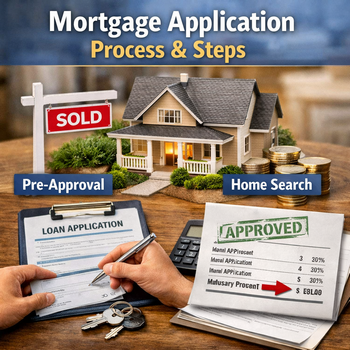 The
loan application process can seem complex, but understanding
each step helps you prepare better and move through approval
faster. This article walks you through the entire journey from
initial inquiry to closing, explaining what happens at each
stage, what documentation you'll need, and typical timelines so
you know what to expect.
The
loan application process can seem complex, but understanding
each step helps you prepare better and move through approval
faster. This article walks you through the entire journey from
initial inquiry to closing, explaining what happens at each
stage, what documentation you'll need, and typical timelines so
you know what to expect.
Step 1: Pre-Qualification (Initial Consultation)
What It Is
Pre-qualification is an informal assessment of your approximate borrowing capacity based on basic financial information. It's not a commitment to lend - just an estimate.
What Happens
You contact a lender and provide basic information:
- Gross monthly income
- Current debts (car loans, credit cards, student loans)
- Savings/down payment amount
- Credit score range (if known)
- Target purchase price
What the Lender Does
The lender plugs your numbers into a quick calculator to estimate:
- How much can you borrow
- Approximate monthly payment
- Required down payment
- Whether you likely qualify
Timeline
Same day or within 24 hours - it's quick and informal.
Documents Needed
None. Just verbal conversation.
What It's Good For
- Determining if the loan is right for you
- Understanding your approximate budget
- Shopping for properties in the right price range
What It's NOT
- An official approval
- A guarantee you'll qualify
- A locked interest rate
Step 2: Pre-Approval (Formal Application)
What It Is
Pre-approval is a formal preliminary approval based on verified financial information. It shows sellers you're a serious buyer and that a lender has verified your ability to qualify.
What Happens
You complete a formal mortgage application and provide documentation. The lender reviews your information and issues a pre-approval letter.
Required Documentation
Income verification:
- Recent pay stubs (last 30 days)
- W-2s or tax returns (last 2 years)
- Verification of Employment (VOE) from the employer
Asset verification:
- Recent bank statements (last 2 months)
- Investment account statements
- Retirement account statements
Credit authorization:
- Signed authorization to pull credit report
- Consent to review credit history
Employment history:
- List of employers for the past 2 years
- Explanation of any gaps or job changes
Other documents:
- Copy of driver's license
- Social Security card or verification
- Explanation letters for any credit issues, collection accounts, or judgments
What the Lender Does
- Pulls your credit report
- Verifies your employment and income
- Reviews bank statements for the source of funds
- Calculates debt-to-income ratios
- Confirms you meet basic loan requirements
- Issues with the conditional pre-approval letter
Pre-Approval vs. Pre-Qualification
| Pre-Qualification | Pre-Approval | |
|---|---|---|
| Verification | Verbal only | Documented & verified |
| Credit check | No | Yes |
| Income verification | Not required | Verified |
| Timeline | Hours | 1-3 days |
| Seller confidence | Low | High |
| Binding | No | Conditional |
Timeline
3-5 business days typically.
What You Get
A pre-approval letter stating:
- Maximum loan amount you're approved for
- Estimated interest rate
- Conditions that must be met before closing
- Validity period (usually 30-60 days)
Why It Matters
- Shows sellers you're a serious, qualified buyer
- Strengthens your offer in competitive markets
- Allows you to move quickly when you find a property
- Identifies issues early so you can address them
Step 3: Find and Make an Offer on a Property
Property Requirements
Not all properties qualify for financing. The property must:
- Be a primary residence (you'll live in it)
- Be a single-family home, condo, townhouse, or 2-4 unit building
- Meet the loan minimum property standards
- Have a clear title
- Not be condemned or unsafe
- Not be in a designated flood zone (or have flood insurance)
Making an Offer
When you find a property you want to purchase:
- Work with a real estate agent (optional but recommended)
- Prepare a written purchase agreement/offer
- Include financing contingency (states your offer is contingent on loan approval)
- Include appraisal contingency (allows you to walk away if the property appraises low)
- Submit an offer to the seller
Acceptance Timeline
- Seller reviews and accepts, counters, or rejects
- Negotiations may go back and forth
- Once accepted, you're under contract
Earnest Money Deposit
You typically put down a deposit (earnest money) to show good faith - usually 1-3% of the purchase price. This money goes into escrow and is credited toward your down payment at closing.
Step 4: Appraisal Ordered and Completed
What an Appraisal Is
An appraisal is an independent professional evaluation of the property's fair market value. The lender requires it to ensure the property is worth at least the purchase price (so they're not lending more than the property is worth).
Who Orders It
The lender orders the appraisal after you're under contract.
What the Appraiser Does
- Inspects the interior and exterior
- Measures square footage
- Evaluates condition and age
- Compared to similar homes that recently sold
- Determines fair market value
Cost
Typically $400-600, paid by the borrower as part of closing costs.
Timeline
5-10 business days from order to completion.
What Happens With Results
If appraisal is at or above purchase price:
- Everything proceeds normally
- You're good to move forward
If appraisal is below purchase price:
- You have options:
- Renegotiate the price with the seller
- Make up the difference with a larger down payment
- Walk away (appraisal contingency protects you)
- Lender will only lend based on appraised value, not purchase price
Example
- Purchase price: $300,000
- Appraisal value: $295,000
- Down payment was 3.5% = $10,500
- New down payment needed: $15,500 (3.5% of $295,000)
- You'd need to come up with an additional $5,000
Step 5: Full Application and Formal Underwriting
Submission of Full Application
Once you're under contract and the appraisal has been ordered, you submit a complete, formal application with all required documentation.
Underwriting Review
The underwriter - a trained analyst - reviews your complete file to determine if you meet all loan requirements:
- Income verification and calculation
- Debt-to-income ratios
- Credit history evaluation
- Asset verification
- Employment history
- Property appraisal
- Title search results
- All documentation consistency
Common Issues Found at Underwriting
- Undisclosed debts
- Recent large deposits have not been explained
- Credit inquiries requiring explanation
- Employment gaps needing clarification
- Inconsistent information on the application
Timeline
5-10 business days for initial underwriting review.
Step 6: Conditional Approval
What It Means
Conditional approval means the underwriter will approve your loan IF you satisfy specific conditions. This is the most common outcome - very few loans are approved "clear" without conditions.
Examples of Common Conditions
- Provide bank statements for large deposits
- Letter of explanation for recent credit inquiry
- Updated employment verification to confirm you're still employed
- Pay off the collection account before closing
- Clear title issue on the property
- Provide awalkthroughrification
- Provide Form 4506 (tax return verification from IRS)
- Final walkthrough at the property before closing
Your Responsibility
You must provide everything the underwriter requests - usually within 48 hours to 5 business days. Delays here delay closing.
Timeline
Conditions are usually satisfied within 3-7 days.
Step 7: Clear to Close
What It Means
"Clear to Close" means the underwriter has approved your loan, and all conditions are satisfied. You're ready to close.
Final Verification
Before issuing Clear to Close, the lender typically verifies:
- You haven't taken on new debt
- You still have your job
- No new credit inquiries have appeared
- No changes to your financial situation
- Title is clear
- Homeowners' insurance is in place
- Appraisal is final
Closing Disclosure
The lender provides you with a Closing Disclosure - a detailed summary of:
- Loan terms (amount, rate, monthly payment)
- All closing costs
- Property details
- Title company information
- Closing date and time
You must receive this at least 3 days from now.
Timeline
Use walkthrough 1- 3 days before closing.
Step 8: Final Walkthrough
What It Is
A final walkthrough is your opportunity to verify that the property is in the agreed-upon condition and that any agreed-upon repairs have been completed.
What to Check
- All appliances that should stay are present
- Agreed-upon repairs are completed
- Property is clean and undamaged
- No items have been removed
- Utilities are on
Timing
Usually 24 hours before closing.
If Issues Are Found
Contact your real estate agent immediately. Issues may delay closing or require renegotiation.
Step 9: Closing (Signing and Funding)
What Happens
At closing, you:
- Sign all final loan documents
- Sign the deed
- Pay the remaining closing costs and down payment
- Receive the keys
- The lender funds (releases) the loan money
Location
Closing typically happens at:
- Title company office
- Attorney's office
- Lender's office
- Online (some lenders offer e-closings)
Documents You'll Sign
- Promissory Note - Your promise to repay the loan
- Deed of Trust/Mortgage - Document securing the loan with the property
- Closing Disclosure - Final loan terms and costs (you should have reviewed this 3 days prior)
- Title documents - Transfer of ownership
- Miscellaneous - Insurance forms, tax certifications, etc.
Expect to sign 10-20 documents.
What to Bring
- Photo ID
- Proof of homeowners insurance
- Cashier's check or wire instructions for down payment and closing costs
- Checkbook (in case small adjustments are needed at closing)
- List of questions
Closing Costs
You'll pay:
- Down payment
- Loan origination fees
- Appraisal fee
- Credit report fee
- Title insurance
- Attorney fees
- Property taxes (prorated)
- Homeowners insurance (first year, sometimes)
- HOA fees (if applicable)
- Recording fees
Typical closing costs: 2-5% of the loan amount.
Timeline
Closing meeting typically takes 1-2 hours.
After Signing
- Lender funds the loan (transfers money to the title company)
- The title company records the deed
- Funds are disbursed to the seller
- Keys are transferred to you
- You own the home!
Step 10: Post-Closing
Recording
The deed and mortgage are recorded at the county recorder's office. This officially makes the property yours and creates a public record of the mortgage lien.
First Payment
Your first mortgage payment is typically due 30-45 days after closing, depending on your loan terms.
Escrow Account
If you have an escrow account (for taxes and insurance), the lender collects monthly amounts in addition to your P&I payment.
Homeowners Insurance
Your insurance policy must remain in force. If it lapses, the lender can purchase force-placed insurance (which is much more expensive).
Property Taxes
Ensure property taxes are paid through your escrow account or directly.
Timeline Overview: From Application to Closing
| Step | Task | Timeline |
|---|---|---|
| 1 | Pre-qualification | Same day |
| 2 | Pre-approval application & verification | 3-5 days |
| 3 | Find property & make an offer | Variable (days to weeks) |
| 4 | Appraisal ordered and completed | 5-10 days |
| 5 | Full application & underwriting | 5-10 days |
| 6 | Conditional approval walkthrough conditions | 3-7 days |
| 7 | Clear to Close | 1-3 days before closing |
| 8 | Final walkthrough | 24 hours before |
| 9 | Closing & signing | Closing day |
| 10 | Recording & first payment | 30-45 days after closing |
Total timeline from application to closing: 30-45 days (assuming no complications)
Common Delays and How to Avoid Them
Missing or Incomplete Documentation
Prevention: Provide everything requested immediately. Don't wait or provide partial information.
Undisclosed Debts
Prevention: Be completely honest on your application. Any debt discovered later must be added to DTI, potentially disqualifying you.
Employment Changes
Prevention: Don't change jobs during the application process if possible. If you must change, notify your lender immediately.
Large Unexplained Bank Deposits
Prevention: Provide documentation for any large deposits (e.g., tax refunds, inheritances, gifts). Lenders need to verify funds aren't borrowed.
Title Issues
Prevention: Get a title search early. Clear any liens or claims before closing.
Credit Inquiries or New Debt
Prevention: Don't apply for new credit, make large purchases, or take on new debt during the application process.
Appraisal Issues
Prevention: Be aware of the property's condition. If major repairs are needed, factor that into your offer.
Insurance Issues
Prevention: Get homeowners' insurance quotes early. Don't wait until closing to secure insurance.
Tips for a Smooth Application Process
-
Gather documentation early - Have pay stubs, bank statements, and tax returns ready before applying.
-
Be honest and complete - Any discrepancies or omissions will be discovered and could delay approval or disqualify you.
-
Respond quickly to requests - The lender's timeline depends on your promptness. If asked for documents, provide them within 48 hours.
-
Don't make major financial changes - No new debt, job changes, or large purchases during the process.
-
Stay in contact with your lender - Proactively communicate. Don't wait for them to follow up.
-
Review all documents carefully - Read the Closing Disclosure thoroughly. Ask questions if anything is unclear.
-
Get homeowners' insurance early - Know your insurance costs before closing. This affects your final payment.
-
Understand contingencies - Know what conditions must be met before closing. Work to satisfy them promptly.
-
Keep funds accessible - Have your down payment and closing costs in an accessible account ready to wire.
-
Ask questions - Don't assume anything. If you don't understand something, ask your lender to explain.
Key Takeaways for the Application Process
-
Pre-qualification is informal; pre-approval is verified. Pre-approval carries weight with sellers because it's backed by documented verification.
-
Documentation is critical - Have everything ready and organized. Delays in documentation delay closing.
-
Underwriting finds issues - Conditional approval is normal. Most loans have conditions that must be satisfied.
-
Appraisal can change everything - If it comes in low, you may need to renegotiate or increase your down payment.
-
Timing is predictable: the total process typically takes 30-45 days if no major issues arise.
-
Clear to Close is significant - This means you're approved and ready. Closing is imminent.
-
Closing is the final step - Multiple documents, but straightforward once you understand what's happening.
-
No major changes during the process - Job changes, new debt, and large purchases can disqualify you.
-
Communication prevents delays - Respond quickly to lender requests and proactively update them on changes.
-
Review everything at closing: the Closing Disclosure and all documents should match what was discussed and agreed upon.
Conclusion
The loan application process is structured and predictable - understanding each step helps you move through it efficiently. From pre-qualification through closing, your role is to provide complete, honest documentation promptly and avoid major financial changes. Your lender's role is to verify your information, assess your ability to repay, and ensure that the property is acceptable as loan collateral. Working together smoothly with clear communication typically results in a closing within 30-45 days. Be organized, be responsive, and don't hesitate to ask questions - a successful closing is within reach.
Connect With Us
Please share – it really helps