FHA Cash-Out Refinance: How to Get Cash from Your Home Equity
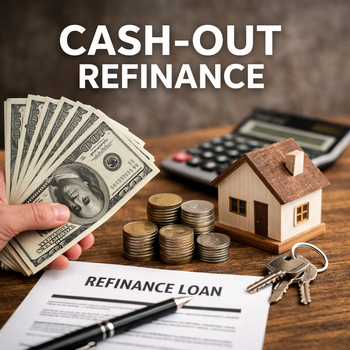 An FHA cash-out refinance is a loan refinancing option that lets you convert home equity into cash while replacing your existing mortgage with a new FHA-insured loan. If you've built equity in your home, this program provides home equity access for debt consolidation, home improvement funding, or reducing monthly payments. The Federal Housing Administration backs these loans, which means competitive mortgage rates for FHA loans are available even if your credit score isn't perfect. This guide explains fha loan requirements, the refinancing process explained step by step, and how to decide whether this strategy fits your financial planning with equity.
Try our FHA
cash out calculator
What Is an FHA Cash-Out Refinance?
Here's how it works: you take out a new FHA loan that's bigger than what you currently owe. The difference between your old mortgage and the new one becomes cash in your pocket at closing. Simple as that.
When you do a cash-out refinancing, you're essentially replacing your existing mortgage with a larger FHA mortgage. The lender pays off your old loan and gives you the extra amount directly. Since FHA loans come with built-in mortgage insurance, your new payment covers both principal, interest, and that insurance cost rolled into one monthly bill.
What makes cash-out refinancing different from a standard refinance is that you're not just looking for a better interest rate. You're actually accessing your home equity to get real money you can use right now. With an FHA loan, you can do this at rates that are hard to beat, and the credit score requirements are much friendlier than conventional options.
- You borrow more than your existing mortgage balance
- You receive the extra amount as cash at closing
- Your new mortgage payment may be higher due to the larger loan amount
- FHA mortgage insurance is required on the entire loan
- The process typically takes 30 to 45 days from start to finish
How Home Equity Works in FHA Cash-Out Refinancing
Your equity in home is basically your stake in your home. It's the gap between what your place is worth and what you still owe. Let's say your home could sell for $300,000 today and you owe $200,000 on your mortgage. That's $100,000 in equity that belongs to you.
Every payment you make builds your equity. Home values go up over time too, which means your equity grows on two fronts. When you're ready to tap into it, a lender will order an appraisal to find out exactly what your home is worth today.
Here's the important part: FHA loans typically let you borrow up to 80% of your home's appraised value on cash-out refinance loans. That means you have to keep at least 20% equity in your property after refinancing. So if your home is worth $300,000, you could borrow up to $240,000. After paying off your $200,000 existing mortgage, you'd get $40,000 in cash.
The exact amount of cash you walk away with depends on your equity, your loan-to-value ratio, and your overall financial picture. Every situation is different, and the property type can matter too. A home equity loan or home equity line of credit is another way to access your equity, but many people prefer having just one mortgage payment to manage.
- Equity builds as you pay down your mortgage
- Appraisals determine your home's current value
- FHA limits you to 80% loan-to-value on cash-out loans
- You must retain at least 20% equity after refinancing
- Rising home values can increase your available equity
Credit Score Requirements for FHA Cash-Out Refinance Loans
Let's talk about credit score for refinancing, because this is where FHA loans really shine. If you've been worried that your credit score will disqualify you from refinancing, there's good news. FHA loans are known for accepting lower credit scores than conventional lenders.
Most borrowers who want to apply for an FHA cash-out refinance need a credit score somewhere in the 600 to 620 range. Some lenders will go as low as 580, though they're usually stricter with cash-out refinancing than with purchase loans. Think of it this way: if your credit score is lower, expect to pay a slightly higher interest rate.
Your credit score tells the lender a story about your payment history. A lower credit score might signal past payment problems, but FHA lenders care more about what you're doing now than what happened five years ago. Late payments, collections, or a foreclosure can make approval harder, but if you've been paying everything on time for the last year, you're in much better shape.
Want to improve your odds? Pay all your bills on time leading up to your application. Don't max out credit cards. Keep your debt levels down. These steps can help you qualify for better rates even with a lower credit score.
- Minimum credit score is often 600 to 620 for cash-out loans
- Some lenders may accept 580 credit scores with manual underwriting
- Higher credit scores qualify for lower interest rates
- Recent late payments are bigger concerns than older issues
- Each lender sets their own credit score requirements
Common Uses for Cash-Out Refinancing and Home Improvement
So what do people actually use cash-out refinancing for? The answers are as varied as homeowners themselves.
The most popular use is tackling high-interest debt. Credit card balances can eat you alive with 15%, 20%, or even 25% interest rates. A FHA cash-out refinance lets you pay off those cards and convert that expensive debt into a much lower-interest mortgage. This is debt consolidation with FHA at its finest, and the monthly savings can be substantial.
Home improvement funding is right up there too. Maybe your roof is aging, your kitchen is stuck in the 1990s, or you need better windows for energy efficiency. A cash-out refinance funds these upgrades while potentially increasing your home's value. You get a nicer place to live and building equity at the same time. That's a win.
Other borrowers use the cash for emergencies they didn't see coming. Medical bills, job loss, car repairs, education expenses for the kids, starting a business, or investment opportunities all happen. The beauty of FHA cash-out refinance loans is that the money is yours to use as you see fit once you close.
Just remember this: the cash you get now comes with a 15, 20, or 30-year price tag depending on your loan term. Make sure your new mortgage payment actually fits in your monthly budget. For help running the numbers, try our FHA cash-out refinance calculator.
- Debt consolidation reduces overall interest payments
- Home improvements increase property value
- Emergency expenses can be covered without high-interest loans
- Education costs for children or yourself
- Business funding or investment opportunities
Closing Costs and Fees for FHA Cash-Out Refinance Loans
When you take out any mortgage, there are costs involved. Closing costs overview: on an FHA cash-out refinance, they typically run 2% to 5% of your total loan amount. On a $250,000 loan, that means you're looking at $5,000 to $12,500 in closing costs.
What goes into closing costs? There's the appraisal fee to determine your home's value, a title search to make sure there are no claims against your property, the lender's origination fee for processing your loan, and underwriting costs to review everything. Add in the FHA mortgage insurance premium, and the bill grows from there.
Here's where it gets interesting: FHA loans require an upfront mortgage insurance premium of 1.75% of your loan amount. Some people pay this at closing, but many roll it right into their new loan. That means you're borrowing the cost, which means you'll pay interest on it over time.
Beyond that upfront cost, you'll also pay annual mortgage insurance through your monthly payment. The exact rate depends on your loan amount and how much you're putting down, but generally it runs 0.55% to 0.80% of your loan amount per year. This gets divided into 12 monthly payments.
One smart move: shop around with at least three different lenders. Ask each one for a Loan Estimate so you can see exactly what they're charging. Closing costs and interest rates vary by lender, and even small differences add up fast.
- Closing costs range from 2% to 5% of the loan amount
- Appraisal, title, and underwriting fees are standard
- Upfront mortgage insurance premium is 1.75%
- Annual mortgage insurance is 0.55% to 0.80% yearly
- Some costs can be rolled into the new loan amount
Comparing FHA Cash-Out Refinance to Conventional Loans and Home Equity Options
An FHA cash-out refinance isn't your only path to equity. There are several types of mortgage refinancing, and it's worth understanding them.
A conventional cash-out refinance exists if you have strong credit and a solid financial profile. Conventional loans usually want a credit score of 620 or higher and may offer lower interest rates than FHA loans if you qualify. They're worth comparing, especially if your credit score is in good shape.
Then there's the home equity loan route. Instead of replacing your entire mortgage, you take out a separate loan against your home equity. This means two separate monthly payments: one for your original mortgage and one for the home equity loan. The upside is faster approval and lower upfront costs. The downside is managing two loans.
A home equity line of credit, or HELOC, works more like a credit card. You get approved for a maximum amount and borrow what you need when you need it. You only pay interest on what you actually use. This flexibility is great if you want to access cash gradually instead of getting a big lump sum.
So which one wins? That depends on your situation. Got a lower credit score? An FHA mortgage is usually your best bet. Want to keep your current low interest rate and not refinance your whole mortgage? A home equity loan might make more sense. Need flexibility and plan to borrow over time? A HELOC could be perfect. Also consider the impact of market trends on your decision, since rates change over time.
Steps to Apply for an FHA Cash-Out Refinance
Ready to move forward? Here's how the application for cash-out refinance process works, step by step.
Start by gathering your financial documents. Your lender will want recent pay stubs showing your income, your last two years of tax returns, bank statements to show your savings, and details about your current mortgage. They want to see the full picture: your income, your debt, and your assets.
Next, reach out to lenders and get pre-approved. During this phase, they'll review your numbers and give you an estimate of how much cash you might get, what your interest rate could be, and what your new mortgage payment might look like. This helps you figure out if applying for an FHA cash-out refinance even makes sense for your financial goals.
Once you choose a lender and move forward, they'll order an appraisal. An appraiser will visit your home, look around, compare it to similar homes in your area, and determine what it's worth. This number determines how much you can borrow.
After the appraisal comes underwriting. The underwriter digs into everything to verify you qualify and that the loan makes sense. They're checking your income, your debt, your credit score, and your home's value. This is where deals sometimes slow down, so getting your paperwork in quickly helps.
If everything checks out, you'll get a clear to close letter. You'll head to closing to sign all the paperwork and finalize everything. At that moment, the lender pays off your old mortgage, and your cash goes into your account. The whole timeline from application to cash in hand usually takes 30 to 45 days.
For more detail on the refinancing process explained end to end, see our FHA refinance programs comparison. If you're also exploring purchase options, our FHA loan requirements in PA guide covers homeownership opportunities for first-time buyers.
Refinance FAQs
What is the maximum loan amount I can get with an FHA cash-out refinance?
The maximum depends on your home's value and how much equity you have. FHA loans let you borrow up to 80% of your home's appraised value on cash-out loans. So if your home is worth $300,000, you can borrow up to $240,000 maximum. Subtract what you still owe on your current mortgage, and that's roughly how much cash you could get. Keep in mind that you'll also owe closing costs, so the actual cash in your pocket will be a bit less.
Can I get an FHA cash-out refinance with bad credit?
FHA loans are definitely more flexible than conventional loans when it comes to credit, but don't think there's no bar. Most lenders want a minimum credit score of at least 580 to 620 for cash-out refinancing. Even with lower credit scores, if you've had recent late payments or collections, you might hit a wall. Your best strategy is to make every single payment on time for at least the 12 months before you apply. That shows current responsibility, which matters more than old problems.
How long does an FHA cash-out refinance take?
Most of the time, you're looking at 30 to 45 days from the day you apply to the day you close. Speed depends on a few things: how fast you get your documents to the lender, how busy they are, and whether anything comes up during underwriting. If you have all your paperwork organized and ready before you apply, you can shave days off the timeline.
What is the difference between a cash-out refinance and a home equity loan?
Here's the key difference: a cash-out refinance replaces your entire mortgage with a new, bigger one. A home equity loan is a separate loan that sits on top of your existing mortgage. With a cash-out refinance, you get one mortgage payment. With a home equity loan, you have two separate payments. Choose based on what you want to do: fully refinance your mortgage or just borrow against your equity while keeping your current loan as is.
Will my monthly payment increase with an FHA cash-out refinance?
Almost certainly, yes. You're borrowing more money, which means a higher loan amount. Even if you get a lower interest rate, borrowing a bigger loan amount usually means a higher monthly payment. Use a mortgage calculator to run the numbers and see what your new payment would be. More importantly, make sure that new payment actually fits comfortably into your monthly budget before you apply. Getting cash now isn't worth financial stress later.
Final Thoughts on FHA Cash-Out Refinancing
An FHA cash-out refinance can be a powerful tool for homeowners who want to access equity in home without selling. Whether you're pursuing debt consolidation with FHA, funding home improvements, or reducing monthly payments by refinancing at a lower rate, this loan refinancing option deserves careful consideration. Weigh the cash-out refinance benefits against the costs, review your credit score for refinancing, and make sure the new payment fits your budget. With the right preparation, you can unlock homeownership opportunities and put your equity to work.
Connect With Us
Please share – it really helps