Conventional Loan Application Requirements Explained
 If
you’re planning to buy a home, understanding the conventional loan
application requirements is your first big step. Knowing what
lenders expect can save you time, reduce stress, and improve your
chances of approval.
If
you’re planning to buy a home, understanding the conventional loan
application requirements is your first big step. Knowing what
lenders expect can save you time, reduce stress, and improve your
chances of approval.
You might wonder: What credit score do I need? How much money should I have saved? What documents will I have to provide? This guide breaks down everything you need to know in simple terms, so you feel confident and prepared before you even start the application.
Keep reading to discover the key requirements that can unlock the door to your new home.
Credit Score Essentials
Credit score plays a vital role in the conventional loan application process. Lenders use it to measure your creditworthiness. A good credit score increases your chances of loan approval. It also helps secure better interest rates and loan terms.
Understanding the essentials of credit scores helps you prepare a stronger application. It guides you to meet the lender’s expectations. This section covers the minimum score requirements and tips for improving your credit profile.
Minimum Score Requirements
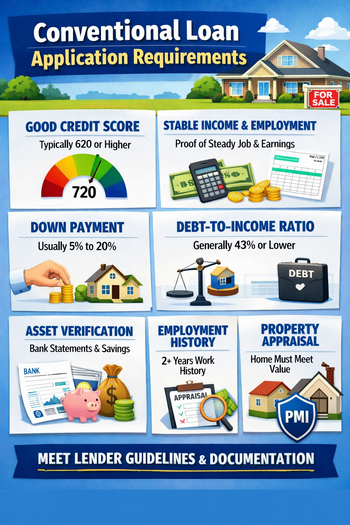
Most lenders require a minimum credit score of 620 for conventional loans. Scores below this may lead to loan denial or higher interest rates. A score above 700 often qualifies for the best loan conditions.
Each lender may have slightly different score standards. Some may accept lower scores with higher down payments. Knowing your credit score before applying helps set realistic goals.
Improving Your Credit Profile
Start by checking your credit report for errors or outdated information. Correct mistakes immediately to avoid negative impacts. Pay bills on time to build a positive payment history.
Reduce outstanding debts to lower your credit utilization ratio. Avoid opening new credit accounts before applying. A steady income and stable employment also strengthen your credit profile.
Income And Employment Verification
Income and employment verification are essential steps in applying for a conventional loan. Lenders must confirm that borrowers have a reliable income to repay the loan. This process helps reduce the risk of default and ensures the borrower can comfortably manage monthly payments. Clear proof of steady earnings reassures lenders about the borrower's financial stability.
Verification includes checking the type and consistency of income. It also involves reviewing employment history to confirm job stability. These checks allow lenders to assess whether the borrower meets the loan criteria.
Stable Income Sources
Lenders look for steady income from regular jobs or businesses. Salaries, wages, and self-employment earnings all count. Income must be consistent over time, usually for at least two years. Seasonal or temporary jobs may be less favored unless proven stable. Other sources, like bonuses or commissions, require a history of receipt. Reliable income shows the borrower can pay the loans consistently.
Documentation Needed
Borrowers must provide proof of income for loan approval. Common documents include recent pay stubs and W-2 forms. Tax returns for the past two years are essential for self-employed individuals. Lenders may also request bank statements to verify deposits. Employment verification letters or contracts add credibility. These papers help lenders clearly confirm the borrower's financial situation.
Down Payment Guidelines
Understanding down payment guidelines is key when applying for a conventional loan. A down payment shows lenders your ability to invest in the property. It also lowers the loan amount and monthly payments. Knowing typical amounts and options can help prepare you financially.
Typical Down Payment Amounts
Most conventional loans require a down payment of at least 5%. Some lenders may ask for 10% or more. A 20% down payment is common to avoid private mortgage insurance (PMI). Higher down payments improve your chances of approval. They also often lead to better interest rates.
Options For Lower Down Payments
Some programs allow down payments as low as 3%. These options suit buyers with limited savings. You might need a higher credit score to qualify. Lenders may require mortgage insurance with lower down payments. This protects the lender if you miss payments.
Debt-to-Income Ratio Limits
The debt-to-income (DTI) ratio is a key factor in conventional loan approval. It measures how much of your monthly income goes toward debt payments. Lenders use this ratio to decide if you can manage new loan payments without financial stress.
Keeping your DTI ratio within limits improves your chances of loan approval. Conventional loans usually require a DTI below 43%, but some lenders prefer even lower ratios. Knowing your DTI helps you prepare a stronger application.
Calculating Your Ratio
Calculate your DTI by adding all monthly debt payments. Include credit cards, car loans, student loans, and other debts. Then, divide this total by your gross monthly income before taxes. Multiply by 100 to get a percentage. This percentage is your debt-to-income ratio.
Example: If your debts total $1,500 and your income is $5,000, your DTI is 30%. This ratio helps lenders understand your financial health.
Maximizing Approval Chances
Reduce your debt to lower your DTI ratio. Pay off credit cards and small loans if possible. Avoid taking on new debts before applying for a loan.
Increase your income by working extra hours or adding side jobs. Higher income lowers your DTI ratio and strengthens your application.
Provide accurate and complete financial documents to your lender. Transparency builds trust and helps avoid approval delays.
Property Requirements
Property requirements play a crucial role in the conventional loan process. Lenders want assurance that the home is worth the loan amount. The property must meet certain standards for safety and value. Meeting these standards helps protect both the buyer and lender.
Each property is evaluated to ensure it meets the loan guidelines. This evaluation includes checking the home's condition and type. Some homes qualify easily, while others may face challenges. Understanding these requirements helps avoid delays and surprises during approval.
Appraisal And Safety Standards
An appraisal determines the home’s market value. A licensed appraiser inspects the property carefully. They check for damage, needed repairs, and overall condition. The home must be safe and livable. Issues such as faulty wiring or plumbing can cause an appraisal failure.
Safety standards protect buyers from hazardous conditions. The property should have secure foundations, proper heating, and no major health risks. If safety problems arise, repairs may be required before loan approval. The lender may order a reinspection after the fixes are made.
Types Of Eligible Properties
Conventional loans cover many property types. Single-family homes are the most common. Condominiums and townhouses also qualify if they meet guidelines. Some multi-unit properties (up to four units) may be eligible.
Properties must be primarily for residential use. Vacation homes or investment properties have different rules. Manufactured homes may qualify, but must meet extra criteria. Land or commercial buildings usually do not qualify for conventional loans.
Documentation Checklist
Gathering the right documents is key to a smooth conventional loan application. Having a complete documentation checklist helps avoid delays and confusion. It shows lenders you are organized and ready to proceed. This section breaks down essential documents needed for your loan process.
Personal And Financial Documents
Start with proof of identity. A government-issued ID, such as a driver’s license or passport, works best. Next, provide proof of income. Recent pay stubs from the past 30 days are typically required. Include your W-2 forms for the past two years. Self-employed borrowers must submit tax returns and profit-and-loss statements.
Bank statements for the last two to three months are needed to verify your assets. Lenders check these to confirm you have enough funds for the down payment and closing costs. Documentation of any additional income sources, such as child support or rental income, can strengthen your application. Debt information, including credit card statements and loan balances, is also important.
Preparing For The Loan Process
Organize your documents in advance to speed up the loan process. Create digital copies for easy sharing with your lender. Keep originals safe and accessible for verification. Review your credit report beforehand to identify and fix errors.
Prepare explanations for any credit issues or employment gaps. Being upfront helps build lender trust. Regular communication with your loan officer ensures you meet all document requests on time. Staying proactive reduces surprises and makes the approval process smoother.
Common Pitfalls To Avoid
Applying for a conventional loan can be straightforward. Yet, many applicants face common pitfalls. These mistakes cause delays or even denial. Avoiding these errors helps speed up the process and improve chances of approval. Knowing what to watch for makes a big difference.
Errors That Delay Approval
One common error is submitting incomplete documents. Missing pay stubs or tax returns can hold up approval. Another mistake is inconsistent information on forms. Lenders verify details carefully. Discrepancies raise red flags and slow down the process.
Many applicants also fail to disclose debts. Hidden debts affect debt-to-income ratio calculations. This omission can lead to loan denial. Lastly, changes in job or income during the application process can cause problems. Stability matters most to lenders. Sudden changes trigger extra reviews.
Tips For A Smooth Application
Prepare all required documents before applying. Include proof of income, tax returns, and bank statements. Double-check all information for accuracy. Report every source of income and debt honestly.
Keep your job and income steady during the process. Avoid large purchases or new credit cards. These actions can affect your credit score. Stay in close contact with your loan officer. Promptly respond to any requests to avoid delays.
Frequently Asked Questions
What Are The Requirements To Be Approved For A Conventional Loan?
To be approved for a conventional loan, you need a good credit score, stable income, a low debt-to-income ratio, and a down payment. Lenders also require a safe, appraised property and proof of financial reserves.
What Would Disqualify A House From A Conventional Loan?
Houses with safety hazards, severe structural damage, or appraisal issues often disqualify from conventional loans. Outdated wiring, plumbing problems, or unpermitted additions may also cause rejection. Lenders require homes to meet minimum property standards for occupancy and value to qualify for conventional financing.
What Are The Qualifications For A Conventional Mortgage?
Conventional mortgage qualifications include a credit score typically above 620, stable income, a debt-to-income ratio below 43%, and a down payment of 3% to 20%. Lenders also require a property appraisal and proof of employment. Meeting these ensures loan approval and favorable terms.
How Much Income Do You Need to Be Approved For A $400,000 Mortgage?
To qualify for a $400,000 mortgage, aim for an annual income of about $80,000 to $100,000. Lenders consider credit score, debt-to-income ratio, and down payment. Stable income and good credit improve chances of approval. Exact income needs vary by lender and loan terms.
What Are The Basic Credit Score Requirements For A Conventional Loan?
Most lenders require a credit score of at least 620 for conventional loans. Higher scores improve your chances and offer better interest rates. Low scores may need additional documentation or a larger down payment.
Conclusion
Understanding conventional loan application requirements helps you prepare better. Keep your credit score healthy and income stable. Save enough money for a reasonable down payment. Avoid debts that raise your debt-to-income ratio too high. Make sure the property meets safety and appraisal standards.
Meeting these basics improves your chances of loan approval. Stay organized and provide all requested documents promptly. This approach can make the process smoother and faster. Being informed is key to success in buying a home.
Connect With Us
Please share – it really helps