Conventional Loan: Appraisal and Inspection Requirements
 In
the world of real estate, finance, and large-scale asset
acquisition, excitement is often the enemy of due diligence.
Whether you are a first-time homebuyer, a commercial investor,
or a lender underwriting a multimillion-dollar loan, two
processes serve as the gatekeepers of security: the
Appraisal and the Inspection.
In
the world of real estate, finance, and large-scale asset
acquisition, excitement is often the enemy of due diligence.
Whether you are a first-time homebuyer, a commercial investor,
or a lender underwriting a multimillion-dollar loan, two
processes serve as the gatekeepers of security: the
Appraisal and the Inspection.
While often mentioned in the same breath, these two functions serve distinct, non-negotiable roles. One protects the wallet; the other protects the walls. Lenders, buyers, and sellers rely on these requirements to validate value, ensure safety, and facilitate transparent transactions.
Here is an in-depth look at the requirements, nuances, and strategic importance of appraisals and inspections.
Part I: The Appraisal – Establishing Value
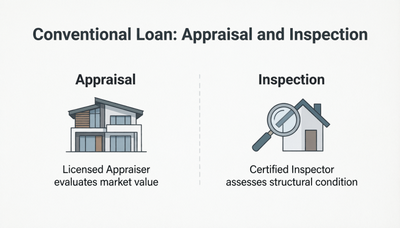
An appraisal is an objective, third-party assessment of a property’s market value. It is primarily a tool for lenders to manage risk. If a borrower defaults on a loan, the lender needs to ensure they can recoup their investment by selling the property.
The Requirements
For most conventional, FHA, VA, and USDA loans, an appraisal is mandatory. The lender orders the appraisal, not the borrower, to ensure impartiality.
- Licensing: Appraisals must be conducted by a state-licensed or certified appraiser. The level of certification (Licensed vs. Certified General) depends on the transaction complexity and value.
- Scope of Work: The appraiser visits the property to measure square footage, note the condition, and compare it to recently sold "comps" (comparables) in the immediate area.
- Health & Safety (Government Loans): For government-backed loans such as FHA (Federal Housing Administration) or VA (Veterans Affairs), the appraisal also serves as a rudimentary inspection. The appraiser is required to note safety hazards, such as peeling paint (which may indicate lead-based paint), missing handrails, or significant roof damage. If these aren’t fixed, the loan cannot close.
The Risk: The Low Appraisal
The most common hurdle in this phase is a valuation that comes in lower than the contract price. If a buyer agrees to pay $400,000 but the appraisal comes in at $390,000, the lender will only base their loan amount on the lower figure. The buyer must then cover the $10,000 cash gap, the seller must lower the price, or the deal dies.
Part II: The Inspection – Assessing Condition
While the appraisal asks, “Is this property worth the price?” the inspection asks, “Is this property safe, functional, and sound?”
Unlike appraisals, inspections are rarely mandatory by lenders. However, from a risk management perspective, they are considered non-negotiable for a buyer.
The Requirements
- The Generalist: A standard home inspection is conducted by a licensed inspector who examines the property’s major systems: roofing, electrical, plumbing, HVAC, foundation, and structure. The inspector does not “pass” or “fail” a house; they provide a report detailing the current condition and remaining useful life of major components.
- Specialty Inspections: Depending on
location or suspicion, additional inspections are often
required or highly recommended:
- Wood Destroying Organisms (WDO): In many states (particularly the South and West Coast), lenders require a separate termite or pest inspection.
- Environmental: Radon testing is common in the Northeast and Midwest; mold testing or lead paint assessments may be required based on the property’s age or local law.
- Structural/Engineering: If the general inspector finds foundation cracks, a structural engineer is often required to provide a report.
Part III: The Intersection of Appraisal and Inspection
Though separate, the appraisal and inspection converge at a critical point: the condition requirement.
For a transaction to fund, the property must meet the lender’s minimum property standards. This is where the distinction between conventional and government loans becomes crucial.
- Conventional Loans: These are typically the most lenient in terms of conditions. As long as the property is habitable (with working heat, water, and roof), the lender will usually proceed, even if the home is dated. However, the appraisal may still require repairs if there are "safety" issues.
- FHA/USDA Loans: These have strict "Minimum Property Standards." If the appraiser notes peeling paint, a broken window, or a missing railing, these items become required repairs. The seller must fix them before closing, and the appraiser must conduct a "final inspection" to verify the work was completed.
- VA Loans: These focus on "structural soundness" and "sanitary" conditions. The VA appraiser (also called a fee appraiser) is particularly strict about mechanical systems and pest infestation.
Part IV: Strategic Implications for Buyers and Sellers
Understanding the difference between these requirements can dictate negotiation strategy.
For Buyers
The Appraisal Gap: In a competitive market, buyers often waive the "appraisal contingency" to strengthen their offer. This is a high-risk strategy. If you waive this contingency and the appraisal comes in low, you cannot back out without losing your earnest money deposit unless you pay the difference. The Inspection: Never waive the inspection contingency without a clear understanding of the financial risk. An inspection is your right to know what you are buying. Even if you waive the right to request repairs (an "informational only" inspection), the data allows you to budget for future capital expenditures, such as a new roof or HVAC system.
For Sellers
Pre-Listing Appraisals: Savvy sellers often order a pre-listing appraisal to price their home accurately and avoid the shock of a low third-party valuation later in the process. Pre-Listing Inspections: By performing an inspection before listing the home, sellers can proactively make repairs. This eliminates the "surprise" repair requests that often derail transactions three days before closing.
Part V: The Final Walkthrough
The final phase that ties these two requirements together is the final walkthrough.
This occurs 24 to 48 hours before closing. For the buyer, this is the last chance to ensure that:
- Repairs required by the appraiser (for FHA/VA loans) were completed.
- Repairs negotiated after the inspection were completed.
- The property is in the same condition (or better) than when the contract was signed.
Conclusion
Appraisal and inspection requirements are not bureaucratic hurdles designed to complicate transactions; they are the scaffolding that supports the integrity of the real estate market.
The appraisal ensures that financial institutions do not over-lend on an asset, stabilizing the broader economy. The inspection ensures that families and investors do not inherit catastrophic physical or environmental liabilities.
Whether you are obtaining a 30-year fixed mortgage or liquidating a commercial portfolio, treating these two processes with respect - understanding that one defines value and the other defines condition - is the hallmark of a prudent investor. Skipping either to save time or money is a gamble that often results in financial loss, legal liability, or the heartbreak of a deal falling through at the eleventh hour.
Always consult with your lender and your real estate agent early in the process to confirm which appraisal requirements apply to your specific loan product and to ensure your inspection contingencies are structured to protect your interests.
Connect With Us
Please share – it really helps