Freddie Mac Enhanced Relief Refinance: A Guide for Homeowners
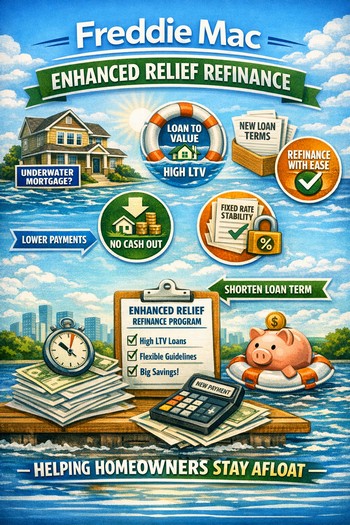 People with a home loan backed by Freddie Mac
might have a way to lower their rate, even without positive
equity. The Freddie Mac Enhanced Relief Refinance
helps borrowers who are current on payments but cannot use a
standard refinance. The program works for those
whose home value has dropped. This guide explains the steps, who
qualifies, and how to find a participating lender.
People with a home loan backed by Freddie Mac
might have a way to lower their rate, even without positive
equity. The Freddie Mac Enhanced Relief Refinance
helps borrowers who are current on payments but cannot use a
standard refinance. The program works for those
whose home value has dropped. This guide explains the steps, who
qualifies, and how to find a participating lender.
This enhanced relief refinance program replaced the older Home Affordable Refinance Program (HARP). Unlike HARP, this refinance option does not expire. It is a permanent feature for Freddie Mac homeowners facing high loan-to-value ratios. The main goal is to help people stay in their homes by lowering their monthly payments.
What is the Enhanced Relief Refinance Program?
The Freddie Mac Enhanced Relief Refinance is a special type of refinance for existing Freddie Mac loans. It permits higher LTV ratios than standard refinance programs. If you owe more than your home is worth, you may still qualify. The program is only for borrowers with a strong payment record. It is a way to secure a better interest rate or a more stable loan, even without home equity.
This refinance is part of Freddie Mac's effort to prevent foreclosures. Allowing a refinance with a high loan-to-value ratio helps both the borrower and the lender avoid larger problems. The program updates the old HARP framework with current rules.
Key Eligibility Requirements for Borrowers
Understanding the eligibility requirements is the first step. Not everyone with a Freddie Mac loan will qualify. The rules focus on your payment record and loan type. Here are the main points to check before contacting a lender.
Mortgage Ownership and Date
Your current loan must be owned or secured by Freddie Mac. You can verify this by calling your current servicer. The note date of your existing loan must be on or after October 1, 2017. Also, at least 15 months must have passed between the old loan and the new refinance loan.
Payment History Standards
Your payment history is critical for eligibility. You must show you can manage payments responsibly.
- No 30-day late payments in the last six months.
- No more than one 30-day late payment in the last 12 months.
- No late payments beyond 30 days in the last year.
Loan-to-Value and Equity Position
This program is for people with high LTV ratios. The new mortgage must have an LTV exceeding the standard limit for a "no cash-out" refinance. For a one-unit property, the LTV typically needs to be 95.01% or higher. There is no maximum LTV limit, so even borrowers with negative equity (owing more than the home is worth) can apply.
Benefits and Program Features
The enhanced relief refinance offers several advantages over traditional refinance programs. It removes common barriers for those with high LTV loans. These features make it a powerful tool for the right borrower.
- No minimum credit score requirement: While lenders may have their own rules, the program itself does not set a minimum credit score.
- No maximum debt-to-income ratio: The program does not automatically reject high debt-to-income ratios.
- Appraisal may not be required: In many cases, an automated valuation is used instead of a full appraisal.
- All occupancy types are allowed: primary residences, second homes, and investment properties.
- Multiple use permitted: You can use this program more than once, as long as you meet the 15-month rule each time.
Comparing Standard Refinance vs. Enhanced Relief Refinance
It helps to see how this program differs from a typical refinance. The table below outlines the main differences in eligibility. This shows why the enhanced relief refinance is a unique refinance option for those with high LTV.
| Feature | Standard Refinance | Enhanced Relief Refinance |
|---|---|---|
| Loan-to-Value (LTV) | Usually requires 80% or lower. | Must exceed standard limits; can be over 100%. |
| Equity Requirement | Borrower needs at least 20% equity. | Little to no equity required. |
| Credit Score | Minimum scores are often required. | No program minimum credit score. |
| Appraisal | Almost always required. | Often waived or automated. |
| Loan Ownership | Any lender. | Must be an existing Freddie Mac loan. |
Property Eligibility and Valuation for Enhanced Relief
When we talk about eligibility and valuation for enhanced relief, the rules are simpler than standard loans. The valuation for enhanced relief often relies on automated models. The high loan-to-value makes a precise appraisal less critical. The condition of the property still matters, but the process is faster.
Property eligibility and valuation rules are broad. Most single-family homes, condos, and manufactured homes qualify. The refinance must result in a benefit for the borrower. Acceptable benefits include a lower monthly payment, a lower interest rate, a shorter loan term, or switching to a fixed-rate mortgage. This ensures the refinance improves the borrower's financial situation.
Working with a Lender
To start the process, you need to find a lender that offers Freddie Mac Enhanced Relief Refinance loans. Not every lender participates, so you may need to shop around. Your current lender is a good place to start. A good lender will review your current loan, check your payment record, and explain your refinance options. They will also handle the application and guide you through closing.
The refinance must meet all program guidelines, but individual lenders may have additional rules. For example, a lender might require a minimum credit score of 620 even if the program does not. Always ask potential lenders about their specific requirements. Comparing offers from multiple lenders can help you find the best terms.
Frequently Asked Questions
What is the difference between HARP and the Enhanced Relief Refinance?
HARP was an older program that ended in 2018. The Freddie Mac Enhanced Relief Refinance replaced it. Unlike HARP, this program has no expiration date and applies to loans with note dates after October 1, 2017. You can also use the new program more than once.
Do I need to have an appraisal for the FMERR program?
Often, no. One of the benefits of the enhanced relief refinance program is that an automated home value estimate is frequently accepted. This saves the borrower the cost of a full appraisal. However, your lender might require one in certain cases.
Can I use this refinance if I have a second mortgage?
Yes, you may still be eligible. The program allows for properties with second mortgages or home equity lines of credit. The LTV and combined LTV ratios are calculated differently, but high levels are acceptable. Your lender will need details on all loans against the property.
Is there a deadline to apply for the Enhanced Relief Refinance?
No, there is no set expiration date for this program. Freddie Mac designed it as a permanent offering to help homeowners in any market cycle. However, programs can change, so it is wise to check current availability with a lender.
Will refinancing affect my mortgage insurance?
It might. If your current loan has mortgage insurance, the new loan may also require it, depending on your LTV and loan terms. However, the program does not force you to take on new, additional mortgage insurance if it was not part of your original loan structure. Your lender can explain the specific mortgage insurance implications.
Connect With Us
Please share – it really helps