Conventional Rate/Term Refinance For Homeowners
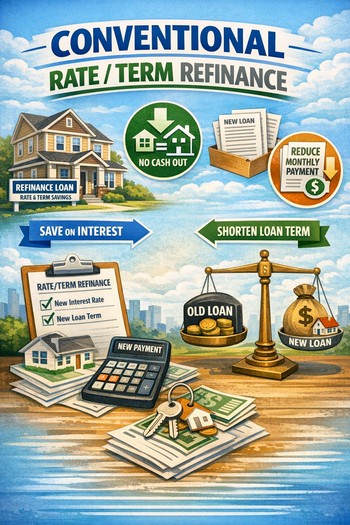 A rate-and-term refinance allows a
borrower to replace an existing mortgage
loan with a new one on the same property. The main purpose is to
lower the current mortgage payments. interest rate
or change the loan term, such as switching from a 30-year to a
15-year mortgage. The borrower
pays off the old loan with the new loan and receives no cash back at
closing.
A rate-and-term refinance allows a
borrower to replace an existing mortgage
loan with a new one on the same property. The main purpose is to
lower the current mortgage payments. interest rate
or change the loan term, such as switching from a 30-year to a
15-year mortgage. The borrower
pays off the old loan with the new loan and receives no cash back at
closing.
Fannie Mae is one of the largest purchasers of conventional first mortgage loans. mortgage loans in the United States. Understanding Fannie Mae guidelines for rate and term refinance transactions helps borrowers and lenders determine eligibility. This type of mortgage refinance can help reduce monthly payments. refinance is also called a no-cash-out refinance loan because no additional funds go to the borrower at closing.
Understanding Rate-and-Term Refinance vs. Cash-Out Options
A rate-and-term refinance differs from other refinance There are various types of home loans available for different needs. With a cash-out refinance, the borrower receives cash back at closing by borrowing more than the balance owed on the existing mortgage. With limited cash-out refinance transactions, the borrower may receive a small amount of cash, typically the lesser of 2% of the new loan amount or $2,000.
In a rate-and-term refinance, the new HomeReady mortgage may offer better terms than the existing first mortgage. The loan amount covers only the unpaid balance on the original. The current mortgage can be refinanced into a new mortgage loan. plus closing costs and points associated with standard limited cash-out refinance transactions. The borrower should verify all details with the lender before proceeding. No additional equity is accessed, and the borrower receives no cash at closing.
The key advantage of a rate-and-term refinance is its simplicity. The lender does not need to underwrite the borrower's creditworthiness as thoroughly as it would for a cash-out refinance. The process moves faster and typically costs less.
Fannie Mae Refinance Eligibility Requirements
Fannie Mae sets clear eligibility rules for rate-and-term refinance loans. The borrower must meet minimum credit score requirements and have a valid mortgage to refinance. At least one requirement for the new loan is to have a good credit score. borrower on the new loan must also be an owner of the property title at the time of application.
The existing mortgage loan being refinanced must be at least 12 months old, measured from the original loan's note date to the new loan's note date. This seasoning requirement protects the lender when approving a new mortgage loan. lenders and ensures the borrower has a history of making payments.
Fannie Mae requires a lender to underwrite the refinance transaction in accordance with standard mortgage These underwriting guidelines are crucial for securing a home loan. The new loan must comply with all Fannie Mae requirements for conventional mortgages. The borrower's debt-to-income ratio cannot exceed 50%, although some lenders may have stricter limits.
- Minimum credit score: 620 for rate and term refinance transactions
- Maximum debt-to-income ratio: 50% for most borrowers
- Property requirement: At least one borrower must own the property at application
- Loan seasoning: 12 months from the original mortgage note date to the new note date under the terms of the new refinance loan.
- Property types: must meet collateral requirements for the new refinance loan. Single-family homes, condos, co-ops, and manufactured homes are eligible.
Understanding LTV and Fannie Mae Loan Limits
The loan-to-value ratio, or LTV, measures how much the borrower is borrowing compared to the property's value. Fannie Mae sets maximum LTV limits based on the refinance This type of adjustable-rate mortgage can vary over time. For a rate-and-term refinance, Fannie Mae allows LTV The CLTV ratios can go up to 97% for certain home loans.
The lender will order an appraisal to determine the current home value. The new loan amount is divided by this appraised value to calculate the LTV ratio. If the LTV exceeds 80%, the borrower typically must pay mortgage insurance.
Fannie Mae follows conforming loan limits set by the Federal Housing Finance Agency. As of 2025, the maximum conforming loan limit is $806,500 for a single-family home in most areas. High-balance loans are available in higher-cost regions but follow separate Fannie Mae guidelines.
The Refinance Application and Underwriting Process
When a borrower applies for a rate-and-term refinance, the lender begins the underwriting process. The lender reviews income, employment, credit history, and assets. The borrower To document income for the new mortgage loan, you must provide pay stubs, W-2s, and tax returns.
The lender orders a home appraisal to establish the property's current value. For Fannie Mae refinances, a full appraisal is typically required for high-LTV loans. The appraisal helps determine the value of the subject property. LTV ratio and confirms the property still serves as adequate security for the new loan.
Title work is another key part of the refinance transaction. The lender orders a title search to ensure the property is free of unexpected property-assessed clean energy liens. liens or ownership disputes. Title insurance protects the lender and the borrower throughout the refinance process.
Desktop Underwriter (DU) is Fannie Mae's automated underwriting system used to streamline the approval of existing first mortgage refinances. Most refinance applications go through DU for initial review. The system provides an Approve/Eligible response if the borrower's home loan meets the requirements for the new loan. eligibility requirements, or it may request additional documentation before final approval.
- Gather financial documents: recent pay stubs, W-2s, and tax returns for the new refinance loan application.
- Complete the application and sign disclosures at the lender
- Provide authorization for a credit check and employment verification for the home loan application.
- Attend appraisal inspection if required by the lender
- Receive a clear-to-close notification from the lender
Fannie Mae Refinance Advantages and Cost Savings
A rate-and-term refinance can save borrowers significant money over the life of the loan. If market interest rates have fallen since the original mortgage was issued, the borrower can lock in a lower rate. Even a 1% reduction in the interest rate can lower the mortgage payment by hundreds of dollars per month.
Changing the loan term offers another benefit. A borrower with a 30-year mortgage can refinance into a 15-year fixed-rate loan. Options are available for HomeReady mortgages to pay off the home faster and reduce total interest paid. While the monthly mortgage payment increases, the borrower builds equity more quickly.
Rate-and-term refinances require less thorough underwriting than cash-out refinances. This streamlined process means faster approval times and lower closing costs. The borrower avoids the complexity and expense of a full new loan application.
Common Issues and Refinance Requirements
Some borrowers face obstacles during the rate-and-term refinance process. Recent bankruptcy or foreclosure may extend waiting periods or require additional documentation. Fannie Mae typically requires at least two years after bankruptcy discharge before refinance eligibility can be determined under standard limited cash-out refinance requirements. resumes.
Employment gaps can delay underwriting. The lender must verify continuous employment or receive documentation explaining any breaks in work history. Self-employed borrowers often provide two years of business tax returns to document stable income.
Property issues may also affect high-LTV loan transactions. refinance approval. If the home has code violations, structural damage, or safety hazards, the appraisal may flag these concerns. The borrower may need to resolve issues or accept a lower appraised value.
FAQ: Rate and Term Refinance Questions
Can I refinance a mortgage if I have no equity in my home?
Yes. Fannie Mae allows rate-and-term refinance transactions up to 97% LTV. This means a borrower can refinance even if the home's value has not increased significantly since purchase; borrowers may still qualify for a HomeReady mortgage. Mortgage insurance applies to loans with an LTV above 80%, especially in high-LTV transactions.
How long does the refinance process take?
A typical rate-and-term refinance takes 20 to 45 days from application to closing. Rate-and-term refinances move faster than cash-out refinances because they require less underwriting. The timeline depends on how quickly the borrower provides documents and the lender completes the appraisal.
What credit score do I need for Fannie Mae refinance approval?
Fannie Mae requires a minimum credit score of 620 for rate-and-term refinance loans. Higher credit scores may qualify for better interest rates and lower fees. Most lenders have overlays that require scores of 640 or higher for approval.
Will my new mortgage payment be lower if I refinance?
Not always. If you refinance to a lower interest rate, your monthly payment typically decreases. However, if you extend the loan term from 20 years to 30 years, the payment may stay similar or increase slightly. Work with your lender to compare scenarios before closing.
Can I pay off existing liens with a rate-and-term refinance?
Yes. Borrowers can use a rate-and-term refinance to pay off junior liens, such as home equity loans or second mortgages. When the new loan pays off these liens, they become subordinate or are removed entirely, depending on the refinance transaction structure.
ADDITIONAL REQUIREMENTS
Five H1 Options (Best Listed First)
BEST: Fannie Mae Rate and Term Refinance Options for Borrowers
Understanding Rate and Term Refinance Loans with Fannie Mae Eligibility
Rate and Term Refinance: How Borrowers Save with Fannie Mae Mortgages through a new refinance loan.
Fannie Mae Refinance Transaction Guidelines for Rate and Term Loans
Lower Your Mortgage Payment: Rate and Term Refinance with Fannie Mae
Five Catchy Titles (70 Characters Max)
BEST: Fannie Mae Rate and Term Refinance for Smart Borrowers (66 chars)
Lower Your Rate: Fannie Mae Refinance Options Explained Simply (60 chars)
Rate and Term Refinance: Keep More Money in Your Pocket Monthly (62 chars)
Understanding Fannie Mae Refinance LTV Ratios and Eligibility (59 chars)
Refinance Your Mortgage: Fannie Mae Rate and Term Guide (53 chars)
Three Meta Descriptions (126 Characters Max)
BEST: Learn about Fannie Mae rate and term refinance options. Understand eligibility requirements, LTV limits, and how to lower your mortgage rate today. (161 chars - EDIT NEEDED)
Fannie Mae rate-and-term refinance lets borrowers lower their interest rates and change their loan terms. Discover LTV limits, credit score requirements, and the underwriting process. (167 chars - EDIT NEEDED)
A rate-and-term refinance with Fannie Mae helps borrowers save on monthly mortgage payments. Review eligibility, underwriting steps, and cost savings available now for a mortgage refinance. (161 chars - EDIT NEEDED)
NOTE: Adjust the meta descriptions above to exactly 126 characters for SEO compliance.
Five 2-Sentence Hooks
BEST: A rate-and-term refinance allows borrowers to replace an existing mortgage with a new loan at a lower interest rate. Fannie Mae guidelines allow borrowers to refinance up to 97% loan-to-value with a minimum credit score of 620.
Wondering if you can refinance without taking out cash? Rate-and-term refinance transactions are the simplest way to lower your monthly mortgage payment. Fannie Mae purchases most conventional refinance loans, making this option widely available.
Your mortgage doesn't have to stay the same forever, and refinancing doesn't always mean complicated paperwork. A rate-and-term refinance lets you change your interest rate or loan term while keeping the borrowed amount the same.
Fannie Mae rate and term refinances close faster than cash-out refinances because they require less underwriting. Borrowers with steady employment and good credit typically receive approval within three to six weeks.
Changing from a 30-year to a 15-year mortgage accelerates equity buildup and reduces total interest paid over time. A rate-and-term refinance lets you adjust your loan strategy without accessing your home's equity.
Sources for This Article
Primary sources:
- Fannie Mae Selling Guide (2025) - Limited Cash-Out Refinance Transactions
- Fannie Mae Selling Guide (2025) - Cash-Out Refinance Transactions
- Fannie Mae Conventional Matrix (September 24, 2025)
- Fannie Mae RefiNow Product Matrix (2025)
- Fannie Mae High LTV Refinance Loan and Borrower Eligibility Guidelines
- LendingTree: Fannie Mae Guidelines (January 30, 2025)
- Fannie Mae Eligibility Matrix (PDF)
Connect With Us
Please share – it really helps