FHA 203k vs Homestyle Loan: Which Renovation Loan Is Right for You?
 Buying a home that needs work can be stressful. You find the
perfect property, but it needs repairs or updates. Two loans stand
out as solid options for buyers in this situation: the FHA
203k loan and the Fannie Mae Homestyle loan.
Buying a home that needs work can be stressful. You find the
perfect property, but it needs repairs or updates. Two loans stand
out as solid options for buyers in this situation: the FHA
203k loan and the Fannie Mae Homestyle loan.
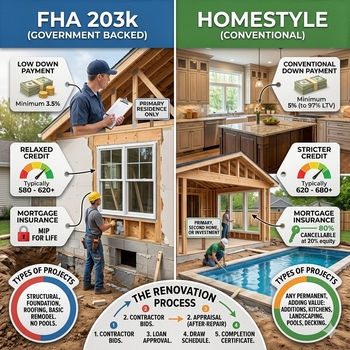
Both programs let you borrow money for the home purchase and renovations in one loan. But they work differently. Understanding the differences between FHA 203k vs Homestyle loans helps you pick the right one for your situation.
This guide breaks down everything you need to know about homestyle renovation loan vs 203k options. We'll compare costs, eligibility requirements, and benefits of each program.
Understanding the FHA 203k Loan Program
The FHA 203k loan is a government-backed mortgage designed for buyers who want to purchase and renovate a home. The Federal Housing Administration created this program to help people rebuild older neighborhoods and improve housing stock.
With an FHA 203k loan, you get one mortgage that covers both the home purchase price and renovation costs. The lender sets aside money in an escrow account for repairs. As contractors complete work, they request payment from this fund.
The program comes in two versions. The standard 203k requires a full professional inspection and detailed plans for all repairs. The streamlined 203k handles smaller projects under $35,000 and skips some paperwork.
Down payments for FHA 203k loans start at 3.5 percent of the total loan amount. This low down payment makes the program popular with first-time buyers who don't have large savings.
What Is the Fannie Mae Homestyle Loan?
The Fannie Mae Homestyle loan is a conventional mortgage that also covers purchase and renovation costs. Fannie Mae, a government-sponsored company, backs these loans but doesn't insure them the way the FHA does.
A Fannie Mae Homestyle renovation loan works similarly to the 203k. You borrow money for the home and repairs together. Contractors get paid as work finishes. The key difference is in how lenders treat qualification and risk.
The Fannie Mae Homestyle loan appeals to buyers with better credit scores and higher incomes. These borrowers often qualify for better rates than they would with FHA loans. The program allows you to borrow up to 80 percent of the after-repair value of the home.
FHA 203k vs Fannie Mae Homestyle: Key Differences
When comparing FHA 203k loan vs Fannie Mae Homestyle loan, several important factors stand out. These differences affect your monthly payment, approval odds, and long-term costs.
| Feature | FHA 203k | Fannie Mae Homestyle |
|---|---|---|
| Down Payment | 3.5% minimum | 5% to 20% |
| Credit Score Required | 580 minimum | 620 to 680 minimum |
| Mortgage Insurance | Required | Required if less than 20% down |
| Renovation Limits | No maximum | No maximum |
| Appraisal Type | As-repaired value | After-repair value |
Down payment differences matter most for many buyers. An FHA 203k vs homestyle renovation comparison shows that FHA requires only 3.5 percent down. Fannie Mae Homestyle loans need at least 5 percent, though many lenders prefer 10 percent or more.
Credit score requirements also differ. The FHA 203k loan vs fannie mae homestyle comparison reveals that FHA accepts scores as low as 580. Fannie Mae typically wants 620 or higher, and many lenders ask for 680 or better.
Mortgage Insurance and Long-Term Costs
Both loan types require mortgage insurance if your down payment is below 20 percent. However, the insurance works differently and costs vary.
FHA 203k loans require mortgage insurance premium (MIP). You pay an upfront premium of 1.75 percent of the loan amount at closing. Then you pay annual insurance of 0.55 to 0.80 percent of the loan balance each month.
Fannie Mae Homestyle loans use private mortgage insurance (PMI). PMI premiums typically range from 0.3 to 1.86 percent annually, depending on your credit score and down payment amount. PMI can be removed once you reach 20 percent equity in the home.
This is a major difference when comparing homestyle vs 203k options. With FHA loans, mortgage insurance can stay on the loan for its entire life if your down payment was less than 10 percent. Fannie Mae lets you drop insurance after building enough equity.
Eligibility and Qualification Requirements
Your personal financial situation determines which loan works best. FHA 203k loan vs fannie mae homestyle eligibility requirements differ in important ways.
For FHA 203k loans, lenders look at your debt-to-income ratio, which measures how much of your income goes to debt payments. FHA typically allows ratios up to 50 percent, though most lenders stay at 43 to 45 percent.
You need a minimum credit score of 580 for approval. If your score is between 580 and 619, you must make a 10 percent down payment instead of 3.5 percent. Many buyers with lower scores appreciate this flexibility.
Fannie Mae Homestyle loans require stronger financial profiles. Most lenders want debt-to-income ratios at 43 percent or lower. Your credit score needs to be at least 620, and competitive rates usually go to borrowers with scores above 680.
Employment history matters more with Fannie Mae loans. Lenders want to see stable income for at least two years. Self-employed buyers or those with recent job changes may face extra scrutiny.
Renovation Scope and Flexibility
Both programs let you borrow for renovations, but the process differs slightly.
FHA 203k loans allow unlimited renovation spending with no maximum project cost. You can update everything from foundation work to cosmetic improvements. The standard program requires detailed contractor estimates and detailed project plans.
The streamlined FHA 203k works for projects under $35,000 and involves less paperwork. This option suits buyers doing minor repairs or cosmetic updates.
Fannie Mae Homestyle loans also have no maximum renovation limit. Contractors bid on work, and costs get built into your mortgage. You can do major structural work or simple updates with equal ease.
One advantage of fannie mae homestyle vs fha 203k is faster processing. Fannie Mae typically requires less documentation and inspection than the standard FHA program. If you're on a tight timeline, Homestyle might move faster.
Interest Rates and Monthly Payments
Interest rates on both loan types vary based on market conditions and your creditworthiness. Generally, FHA 203k vs homestyle loan rates are close to conventional mortgage rates.
FHA loans sometimes carry slightly higher rates because of the government backing and insurance costs. However, buyers with lower credit scores often get better rates on FHA loans than they would on conventional mortgages.
Fannie Mae Homestyle loans typically offer lower rates to well-qualified borrowers. If you have excellent credit and a strong income, a Homestyle loan might save you money each month.
Your monthly payment includes principal, interest, taxes, insurance, and mortgage insurance. Comparing actual numbers for your situation matters more than general comparisons. Get quotes from multiple lenders to see which loan truly costs less.
Appraisal and Property Valuation
How lenders value your property affects how much you can borrow.
FHA 203k loans use the as-repaired value for appraisal. An appraiser looks at what the home will be worth after all repairs finish. This method means you can borrow for work that increases the property value.
Fannie Mae Homestyle loans also use after-repair value appraisals. The process is similar, but Fannie Mae may be more conservative about valuing improvements.
Both programs require that proposed renovations add value to the home. You can't borrow $100,000 to build a luxury spa if that won't add $100,000 in home value. Appraisers make sure renovation plans make financial sense.
Processing Time and Closing Timeline
How quickly you close affects your plans and stress level.
FHA 203k loans take longer to process than standard mortgages. The standard program requires inspections, detailed project plans, and more paperwork. Most closings take 45 to 60 days.
The streamlined FHA 203k moves faster since less documentation is needed. These can close in 30 to 45 days, similar to regular mortgages.
Fannie Mae Homestyle loans typically close in 30 to 45 days. Because they require less inspection and paperwork than standard FHA programs, they often move quicker.
If you're selling another home and need to close by a specific date, homestyle renovation loan vs 203k timelines matter. Talk to lenders about their average closing times.
Property Type and Location Restrictions
Where you buy and what type of property you choose matters for both programs.
FHA 203k loans work for single-family homes, townhouses, condos, and multi-unit properties up to four units. The property must be your primary residence. Investment properties don't qualify.
Your property can't be in a flood zone unless you carry flood insurance. Rural properties sometimes face issues with FHA appraisals if they're in isolated areas or have utility concerns.
Fannie Mae Homestyle loans also require owner-occupancy. You must plan to live in the home. Investment properties and vacation homes don't qualify.
The property types allowed are similar: single-family homes, townhouses, and condos with proper approval. Fannie Mae loans work better in some rural areas where FHA appraisers struggle to find comparable sales.
When to Choose an FHA 203k Loan
An FHA 203k loan makes sense if you have any of these situations:
- Your credit score is below 620
- You have less than 5 percent saved for a down payment
- Your debt-to-income ratio exceeds 43 percent
- You're a first-time homebuyer with limited savings
- You need to borrow for extensive renovations
The FHA 203k vs homestyle loan choice becomes clear when your finances don't quite fit conventional lending. FHA's flexibility on credit scores and down payments opens doors that slam shut with Fannie Mae.
Choose the streamlined FHA 203k if your project costs less than $35,000 and you want faster processing. This version skips some inspections and paperwork.
When to Choose a Fannie Mae Homestyle Loan
A Fannie Mae Homestyle loan works best if you meet these conditions:
- Your credit score is 680 or higher
- You can put down 5 percent or more
- Your debt-to-income ratio is 43 percent or lower
- You want faster closing and less paperwork
- You have strong, stable employment history
If you qualify for Fannie Mae, comparing fannie mae homestyle vs fha 203k rates and terms is worth your time. You might save money each month with lower rates and insurance costs.
Homestyle loans also win when speed matters. If you need to close quickly, this program typically moves faster than standard FHA loans.
Cost Comparison Example
Let's compare actual numbers. Say you're buying a $200,000 home that needs $50,000 in repairs. Total loan amount would be $250,000.
FHA 203k loan example:
- Down payment: 3.5 percent = $8,750
- Upfront mortgage insurance: $4,375
- Monthly insurance: approximately $155
- Interest rate: approximately 6.5 percent
- Principal and interest payment: approximately $1,580
Fannie Mae Homestyle loan example:
- Down payment: 5 percent = $12,500
- Monthly insurance: approximately $85
- Interest rate: approximately 6.2 percent
- Principal and interest payment: approximately $1,490
In this example, the homestyle vs 203k comparison shows Fannie Mae saves about $115 monthly. However, the FHA buyer needed $3,750 less upfront cash. Your specific numbers will vary based on rates, credit, and market conditions.
Common Misconceptions About These Loans
Several myths circulate about FHA 203k loan vs fannie mae homestyle programs. Let's clear up confusion.
Many people think FHA loans are only for first-time buyers. That's false. Anyone can get an FHA loan if they meet requirements. You don't need to be buying your first home.
Another myth is that Fannie Mae Homestyle loans don't work for extensive renovations. Both programs handle major projects equally well. Renovation limits are essentially unlimited for both.
Some believe FHA loans take much longer than other mortgages. While standard FHA 203k does take extra time, streamlined versions close in normal timeframes. Fannie Mae also takes time for renovation review, though often slightly less than standard FHA.
Tips for Getting Approved
Whether you choose FHA 203k vs homestyle loan, these tips improve approval odds:
- Get pre-approved before house hunting
- Bring recent tax returns and pay stubs to the lender
- Don't make big purchases or open credit cards before closing
- Have contractors prepare detailed estimates for renovations
- Be honest about your financial history
- Ask about different lenders' requirements and timelines
Work closely with your lender. Ask questions about fha 203k vs homestyle renovation details that confuse you. Understanding the process reduces stress and speeds approval.
The Bottom Line on 203k vs Homestyle Loans
Both FHA 203k and Fannie Mae Homestyle loans let you buy and renovate a home with one mortgage. Your financial situation determines which works best.
Choose FHA 203k if you have limited savings, lower credit, or higher debt. Choose Fannie Mae Homestyle if you have strong credit, stable income, and can put down 5 percent or more.
Get quotes from multiple lenders for both homestyle renovation loan vs 203k options. Compare total costs, not just rates. A slightly higher rate with lower insurance might cost less overall.
Talk to a mortgage professional about your specific situation. They can run numbers for both fannie mae homestyle vs fha 203k and show you actual costs. This helps you make the right choice for your home buying goals.
Frequently Asked Questions
Can I use an FHA 203k loan to buy any home?
FHA 203k loans work for single-family homes, townhouses, condos, and multi-unit properties up to four units. The home must be your primary residence. The property can't be in certain flood zones without flood insurance. Rural properties sometimes face appraisal challenges if they're in isolated areas. Talk to your lender about whether a specific property qualifies.
What happens if renovation costs exceed my estimate on a 203k loan?
If repairs cost more than estimated, you have limited options. You can pay the difference out of pocket, or the work stays incomplete. This is why detailed contractor estimates matter. The lender won't automatically approve more funds. Planning carefully and getting firm bids from contractors prevents this problem.
Can I get a Fannie Mae Homestyle loan with a credit score of 640?
Yes, but many lenders prefer higher scores for better rates. A score of 640 falls in the acceptable range, but you might not qualify for the advertised best rates. Getting quotes from multiple lenders helps you find one willing to work with your credit level. Expect to pay slightly more than someone with a 700 score.
How long does the escrow hold my renovation money on an FHA 203k loan?
Money stays in escrow until contractors complete work and request payment. The lender inspects the completed work before releasing funds. This process repeats for each phase of renovations. If a contractor abandons the job, money stays in escrow. The total renovation timeline usually runs 90 to 180 days depending on project complexity.
Which loan is better for a major kitchen and bathroom remodel?
Both programs handle kitchen and bathroom remodels equally well. If you have good credit and savings, Fannie Mae Homestyle likely costs less monthly. If you have limited funds and lower credit, FHA 203k opens the door. Neither program has renovation limits, so project scope doesn't matter. Compare actual costs for your specific situation with multiple lenders.
Connect With Us
Please share – it really helps