FHA Loan Income Requirements
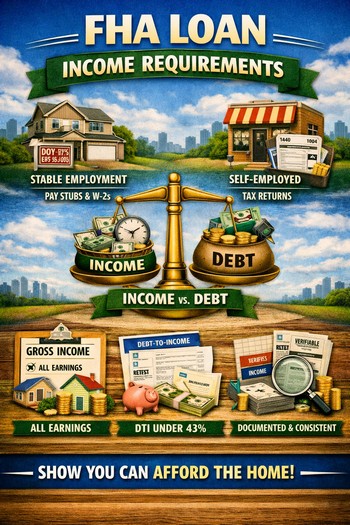 Getting approved for an FHA loan starts with one fundamental question: how much qualifying income do you have? The answer isn't always as simple as your annual salary, and that's where things get interesting. The FHA recognizes that people earn money in many different ways - W-2 wages, self-employment, rental income, disability benefits, military allowances, and more. Understanding which of your income sources count and how lenders calculate them can make the difference between approval and rejection.
This guide walks you through every income type the FHA recognizes, what documentation you'll need for each one, and exactly how lenders do the math. Whether you're a traditional employee, self-employed, seasonal worker, or receiving multiple income streams, you'll find the specific rules that apply to your situation.
Employment Income (W-2 Income)
Employment income is straightforward: money you earn working as an employee and report on IRS Form W-2. This includes your regular salary, hourly wages, overtime, bonuses, tips, and commissions from your job. It's the most reliable income type from a lender's perspective because it's documented and tax-reported.
Required Documentation for All Employment Income
Your lender needs to verify that you've been employed for the past year and that your income is real. Here's what they'll ask for:
You'll provide one of these current employment documents:
- A written Verification of Employment (VOE) covering your past year, OR
- Electronic verification through a third-party vendor approved by FHA, OR
- Direct third-party verification with your authorization
If you don't have a traditional VOE, your lender can instead use:
- Your most recent pay stub showing year-to-date earnings, PLUS
- Your previous year's IRS Form W-2 (if you've been with your employer less than a year), PLUS
- Telephone verification of your current employment with your employer, documented with the name and title of the person who verified you
For your two-year employment history, the rules are a bit more flexible. You don't need to provide direct verification of the past two years if all of these are true:
- Your current employer confirms you've worked there for two years, OR your pay stub shows your hire date, AND
- You're only using base pay (no overtime, bonuses, or tips), AND
- You sign IRS Form 4506 (Request for Copy of Tax Return) or Form 8821 (Tax Information Authorization) so the lender can verify via the IRS
But if you've changed employers within the last two years, OR if you're including variable income like overtime and bonuses, your lender will need documentation for the full two years. This means they'll ask for:
- Your W-2s from the past two years, OR
- Verification of Employment letters covering both years, OR
- Electronic verification acceptable to FHA, OR
- Evidence that you were in school, military service, or another documented absence during gaps in employment
Primary Employment and Salary Income
Your primary employment is your main job - typically full-time work, whether you're salaried or hourly. If you earn a consistent salary that hasn't changed, your lender uses that current salary amount to qualify you. It's that simple.
Example: You earn $5,000 per month in salary and have earned that consistently for years. Your lender uses $5,000/month for qualification.
Hourly Employment with Stable Hours
If you're paid hourly and your hours stay consistent, the calculation is straightforward. Your lender multiplies your hourly rate by your typical weekly hours, then annualizes it.
Example: You earn $25/hour and work 40 hours every week. The calculation is: $25 × 40 hours × 52 weeks ÷ 12 months = $4,333/month. Your lender uses $4,333 as your qualifying income.
Hourly Employment with Varying Hours
Here's where it gets trickier. If your hours bounce around from week to week, your lender must average your income over the past two years to get a realistic picture of what you typically make.
However, there's a helpful exception: if you recently got a raise, your lender can use just the past 12 months of income at your new, higher pay rate instead of averaging back two years at the lower rate.
Example with varying hours: You earned an average of $3,500/month in Year 1 and $4,000/month in Year 2. Your lender averages: ($3,500 + $4,000) ÷ 2 = $3,750/month for qualification.
Example with a recent raise: Six months ago you got a raise from $24/hour to $26/hour, and you consistently work 40 hours per week. Your lender can skip the two-year average and use just the past 12 months at $26/hour: $26 × 40 × 52 ÷ 12 = $4,493/month. That's better for you than averaging back when you were making less.
Part-Time Employment
Part-time work counts as long as you've been doing it consistently. Your lender won't consider part-time income unless you've worked that job uninterrupted for the past two years and it's reasonably likely to continue. No job hopping - lenders want to see stability.
When calculating part-time income, lenders average it over the past two years, just like variable hourly income. If you recently got a raise at your part-time job, you can use the same exception: average just the past 12 months at the higher rate.
Example: You earned an average of $800/month from your part-time work in Year 1 and $900/month in Year 2. Your lender averages: ($800 + $900) ÷ 2 = $850/month for qualifying income.
Overtime, Bonus, or Tip Income
Extra money from overtime, bonuses, or tips is great, but lenders have rules about when they'll count it. Generally, you need to have received this income for the past two years, and it needs to be reasonably likely to continue.
But there's an exception if this is newer income. If you've only been getting overtime or bonuses for one to two years, your lender might still count it if you've earned it consistently during that time and it's likely to keep coming.
Your lender calculates this income by averaging what you earned over the past two years. However, there's an important rule: if your bonus or overtime income drops by 20 percent or more compared to the previous year, your lender must use the current (lower) year's income instead of the average. This protects against qualifying based on income that's declining.
Example of standard calculation: You earned $3,000 in overtime last year and $3,200 this year. Your lender averages: ($3,000 + $3,200) ÷ 2 = $3,100/month.
Example of the 20 percent decline rule: You earned $3,000 in bonuses last year but only $2,300 this year - that's a 23 percent drop. Instead of averaging (which would give you $2,650), your lender must use $2,300, the lower current year amount.
Seasonal Employment
Seasonal work is employment that doesn't run year-round - think construction workers, holiday retail staff, or agricultural workers. Your lender will count seasonal income if you've worked in the same line of seasonal work for the past two years and you're reasonably likely to be rehired for the next season.
Interestingly, you can also count unemployment income during your off-season if you've documented that for two years and there's reasonable assurance it will continue. This is common for workers in industries with predictable seasonal layoffs.
For seasonal income, lenders average what you earned over the past two full years. This gives a fair annual picture that accounts for the off-season months.
Example: You earned $18,000 during your season last year and $20,000 this year. Your lender calculates: ($18,000 + $20,000) ÷ 2 = $19,000 per year, or approximately $1,583/month for qualifying purposes.
Employer Housing Subsidy
Some employers provide housing assistance - maybe they give you a monthly housing allowance or help with loan payments. Your lender can count this as income. They just need to verify it exists and document the amount.
Here's the important part: you can add the subsidy to your qualifying income, but you cannot subtract it from your mortgage payment. This is an income boost, not a payment reduction.
Example: Your salary is $4,000/month and your employer provides a $500/month housing subsidy. Your total qualifying income is $4,500. However, your mortgage payment cannot be reduced by that $500 subsidy.
Family-Owned Business Income
If you work for a family business but own less than 25 percent of it, your lender can consider your employment income from that business. The key requirement is that you're not an owner (or own very little).
Your lender will ask you to prove your ownership percentage using business documents like corporate resolutions, business tax returns, Schedule K-1 from partnership tax returns, or a letter from a certified public accountant. You'll also need to provide signed copies of your personal tax returns or tax transcripts.
For calculating your income from a family business, the rules are the same as regular employment: salaried employees use current salary, hourly employees with stable hours use current rate, and hourly employees with varying hours get an average over two years.
Commission Income
Commission income - money you earn when you complete a business transaction or perform a service - is workable. Your lender will count it if you've earned it for at least one year in the same or similar line of work and it's reasonably likely to continue.
Documentation Requirements Based on Commission Amount
If commissions make up 25 percent or less of your total earnings, you can use your regular employment documentation: pay stubs, VOE, W-2, and the like.
But if commissions exceed 25 percent of your total earnings, your lender gets stricter. They'll want signed copies of your tax returns for the past two years, including all schedules. Alternatively, they may accept signed IRS Form 4506 (Request for Copy of Tax Return), Form 4506-C (Current Year Tax Return), or Form 8821 (Tax Information Authorization), then they'll pull your transcripts directly from the IRS.
Calculating Commission Income
Your lender calculates net commission income (gross commissions minus unreimbursed business expenses) using the lesser of two methods:
- The average net commission income earned over the past two years, OR
- The average net commission income earned over the past one year
They use whichever number is lower. This conservative approach protects against overstating your income.
Example using two-year method: Year 1: $8,000 net commissions. Year 2: $10,000 net commissions. Two-year average: ($8,000 + $10,000) ÷ 2 = $9,000.
Example using one-year method: Most recent year: $9,500 net commissions. One-year average: $9,500.
Your lender uses the lower of the two: $9,000 from the two-year average.
If you have unreimbursed business expenses (things you pay for out of pocket that your employer doesn't reimburse), those reduce your qualifying commission income. Your lender will look at Schedule A of your tax return to see what you're claiming.
Self-Employment Income
Self-employment income comes from a business where you own 25 percent or more. This includes sole proprietorships, corporations, LLCs, S corporations, and partnerships. Self-employment income requires more documentation and scrutiny than W-2 income, but it definitely counts.
How Long You Need to Be Self-Employed
If you've been self-employed for at least two years, your lender can consider your income. Simple.
If you've been self-employed for one to two years, your lender might still count it if you were previously employed in the same line of work (or a related occupation) for at least two years before going into business. This means your total experience in the field - combining prior W-2 employment plus current self-employment - adds up to at least two years.
Example: You were a construction supervisor for three years on W-2 income. You started your own construction company six months ago. Your lender can count your self-employment income because you have five years total in the construction field.
Income Stability and the 20 Percent Decline Rule
Your lender wants to see that your business income is stable or growing. If your income shows a decline of more than 20 percent from year to year, your lender will require documentation that your business is now stable before approving you.
However, you can recover from a 20 percent or greater decline if you can show that the decline was caused by extenuating circumstances (economic downturn, industry disruption, personal emergency) and you can prove your income has stabilized or grown for at least 12 months afterward. Then you can qualify using the reduced (lower) income.
Example of decline: Year 1 net profit: $80,000. Year 2 net profit: $60,000. That's a 25 percent decline, which triggers the stability requirement. You'd need to show documentation that your business has recovered.
Documentation for Self-Employment Income
Self-employed borrowers face more documentation requirements than W-2 employees. You'll need to provide:
- Two years of complete business tax returns with all schedules (Schedule C for sole proprietors; Form 1065 and Schedule K-1 for partnerships; Form 1120 or 1120-S for corporations and S corporations)
- Two years of signed personal tax returns (IRS Form 1040) including all schedules
- Current year-to-date profit and loss statement (P&L)
- Business bank statements for the past two months
- Personal bank statements
- Business license or registration documents
- Articles of incorporation or partnership agreement, if applicable
- Accountant verification or CPA statement, if required by your lender
Instead of providing signed tax returns, you can provide signed IRS Form 4506 (Request for Copy of Tax Return), Form 4506-C (Current Year Tax Return), or Form 8821 (Tax Information Authorization) and let your lender pull the transcripts directly from the IRS. This saves you from having to hunt down old documents.
Current Year Income Verification
If more than a calendar quarter has passed since your most recent tax return was filed, your lender will want a current year-to-date P&L statement. This shows your business income up to the present and helps verify you're actually making the money you claim.
Example: Your tax year ends December 31, and it's now April 15. More than a quarter has passed, so you need to provide a current P&L statement.
Balance Sheets and Business Credit Reports
Your lender will require a balance sheet for your business, but there's an exception: if you're a sole proprietor filing Schedule C, a balance sheet is not required.
Your lender will also pull a business credit report for all corporations and S corporations (sole proprietorships and partnerships typically don't need one, though some lenders may ask anyway).
Calculating Self-Employment Effective Income
This is where self-employment gets specific. Your lender analyzes your tax returns and calculates gross self-employment income using the lesser of two amounts:
- The average gross self-employment income earned over the past two years, OR
- The average gross self-employment income earned over the past one year
They use whichever is lower. This conservative approach protects against qualifying on declining income.
Example using two-year method: Year 1 (most recent): $80,000 gross income. Year 2: $70,000 gross income. Two-year average: ($80,000 + $70,000) ÷ 2 = $75,000.
Example using one-year method: Year 1 (most recent): $80,000 gross income. One-year average: $80,000.
Your lender uses the lower amount: $75,000 from the two-year average.
But what if your business declined? Year 1 (most recent): $50,000 gross income. Year 2: $80,000 gross income. Two-year average: ($50,000 + $80,000) ÷ 2 = $65,000. One-year average: $50,000. Your lender uses the lower amount: $50,000. This protects you from overstating income when your business is declining.
Add-Backs and Deductions for Self-Employment
Your lender calculates net business income starting with net profit, then may add back certain non-cash expenses and one-time costs:
Your lender can add back:
- Depreciation (non-cash expense)
- Business interest deductions
- One-time business costs
- Non-recurring capital expenditures
- Extraordinary expenses related to the business
Your lender cannot add back (these remain deducted):
- Rent or mortgage on business property
- Utilities
- Payroll and employee salaries
- Ordinary business materials and supplies
- Vehicle expenses for business use
- Professional fees
- Ongoing operational expenses
Example of income calculation: Year 1 net profit: $50,000. Year 2 net profit: $60,000. Add back depreciation Year 1: $5,000. Add back depreciation Year 2: $5,000. Adjusted Year 1: $55,000. Adjusted Year 2: $65,000. Two-year average: ($55,000 + $65,000) ÷ 2 = $60,000 annual, or $5,000/month.
Business Losses
If your business showed a loss in any year, that loss gets subtracted from profitable years to calculate your net qualifying income.
Example with loss: Year 1: Loss of $10,000. Year 2: Net profit of $50,000. Average: ($50,000 - $10,000) ÷ 2 = $20,000 annual, or $1,667/month.
Employment Stability and Special Circumstances
Beyond the straightforward income types, lenders evaluate whether your employment is stable. Some situations require extra documentation.
Frequent Job Changes
If you've changed jobs more than three times in the past 12 months, or if you've changed lines of work, your lender will ask for additional documentation to verify employment stability. This isn't a disqualifier - they just want to understand your situation.
Your lender will ask for one or both of:
- Transcripts or certificates from training and education showing you're qualified for your new position, OR
- Employment documentation showing your income has consistently increased with each job change
Example: You changed jobs four times in the past year, but each position paid more than the last: $40k → $45k → $50k → $55k. Your lender documents the income increases and approves you. Or, if you switched careers entirely, you'd need to show training or education in the new field.
Employment Gaps of Six Months or More
A gap in employment doesn't automatically disqualify you. Extended absences (six months or more) just require special treatment. Your lender can consider your current income as qualifying if they can verify and document:
- You've been employed in your current job for at least six months at the time of case assignment (when your lender officially opens your file), AND
- You have a two-year work history prior to the absence from employment
Example: You were laid off and unemployed for eight months. You started your current job seven months ago. When you apply (at case assignment), you've met the six-month requirement. Your lender can verify your two-year work history before the layoff. Your current income qualifies despite the gap.
Employment gaps of less than six months are typically not subject to this extra scrutiny, though your lender will still want to know the reason for the gap.
Temporary Income Reduction
Life happens. You might take maternity leave, go on short-term disability, or take military service leave. Your income temporarily drops, but that doesn't mean you can't qualify for a loan.
Your lender can consider your reduced income as qualifying if they can verify and document:
- You intend to return to work
- You have the right to return to work
- You qualify for the loan using the reduced income
But here's where it gets strategic. If you'll return to work before your first mortgage payment is due, your lender can use your pre-leave (higher) income for qualification instead of your reduced leave income. This is better for you.
Example: You're on maternity leave earning reduced income. You'll return to work in two months. Your first mortgage payment is due in three months. Since you'll be back before the first payment, your lender uses your regular pre-leave income, not the reduced amount.
If you'll return after your first mortgage payment is due, your lender can use your current (reduced) income plus available surplus liquid asset reserves to supplement your income - up to the amount of your pre-leave income. The supplement is calculated as: Total surplus reserves ÷ Number of months between first payment and your return date.
Example of income supplement: Your pre-leave income: $4,000/month. Your current reduced income on leave: $2,000/month. First mortgage payment due: 45 days from closing. You return to work: four months after closing. Months between first payment and return date: 3.5 months. Your liquid assets available: $25,000. Required reserves for your loan: $5,000. Surplus reserves: $25,000 - $5,000 = $20,000. Monthly supplement: $20,000 ÷ 3.5 = $5,714/month. Your qualifying income would be: $2,000 (current) + $5,714 (supplement) = $7,714/month. However, your lender won't use more than $4,000 (your pre-leave income), so the qualifying income caps at $4,000/month.
Your lender will require:
- A written statement from you confirming your intent to return to work and the date you'll return
- Documentation from your current employer confirming you're eligible to return at the same level of hours and earnings
- Documentation of sufficient liquid assets to supplement your income through your intended return date
Nontaxable Income (Grossing Up)
Nontaxable income - money not subject to federal taxes - opens an interesting door. Your lender can "gross up" this income to add back the tax savings you're getting. This can significantly increase your qualifying income.
Nontaxable income includes:
- Certain portions of Social Security income
- Federal government employee retirement income
- Railroad Retirement benefits
- Some state government retirement income
- Certain disability and public assistance payments
- Child support received
- Section 8 Housing Choice Vouchers
- Military allowances
- Other income documented as exempt from federal income taxes
How Grossing Up Works
If you receive nontaxable income, your lender calculates the tax you would have paid if that income were taxable, then adds that amount to your qualifying income. This recognizes that you're keeping more money than you would with taxable income.
The maximum gross-up rate is 15 percent. If your actual tax rate from the previous year is higher than 15 percent, your lender may use your higher actual rate instead.
If you weren't required to file a tax return for the previous tax year, your lender can gross up your nontaxable income by the maximum 15 percent.
Example of grossing up: You receive $2,000/month in nontaxable military allowance. Your tax rate would be 20 percent if this income were taxable. Grossing up calculation: $2,000 ÷ (1 - 0.20) = $2,000 ÷ 0.80 = $2,500. Or using the simpler method: $2,000 × (0.20 ÷ 0.80) = $500 tax savings to add. Total qualifying income: $2,000 + $500 = $2,500.
Example using 15 percent maximum: You receive $1,800/month in nontaxable disability benefits. You didn't file a tax return last year. Your lender uses the maximum 15 percent gross-up: $1,800 × (0.15 ÷ 0.85) = $318 tax savings to add. Total qualifying income: $1,800 + $318 = $2,118.
Alimony, Child Support, and Maintenance Income
If you receive alimony, child support, or maintenance payments, this income counts toward qualification. Your lender will want to see documentation and verify it will continue for at least three years.
Documentation Requirements
Provide one of the following:
- A fully executed copy of your final divorce decree
- A legal separation agreement
- A court order
- A voluntary payment agreement with documented receipts
If your income is based on a court order or divorce decree, you'll need to show evidence of receipt for the most recent three months using:
- Bank deposits
- Canceled checks
- Documentation from the child support agency
If the payments are voluntary (not court-ordered), you'll need to document 12 months of canceled checks, deposit slips, or tax returns.
Calculating the Income
If your court-ordered payments have been consistent for the most recent three months, your lender uses the current payment amount.
If you receive voluntary payments and they've been consistent for the most recent six months, the current payment amount can be used.
If payments haven't been consistent, your lender will average what you've received over the past two years. If you've received this income for less than two years, they'll average over the actual period of receipt.
Military Income
Active duty, Reserve, or National Guard service provides multiple income components that count toward qualification:
- Base pay
- Basic Allowance for Housing (BAH)
- Clothing allowances
- Flight or hazard pay
- Basic Allowance for Subsistence (BAS)
- Proficiency pay
Note: Education benefits cannot be counted as qualifying income.
Documentation and Critical Timing
Your lender will ask for a copy of your military Leave and Earnings Statement (LES) and will verify your Expiration Term of Service date. Here's the critical part: if your service expires within the first 12 months of your mortgage, your lender can only count military income if you represent that you intend to continue service.
Calculating Military Income
Your lender uses the current amount of military income you're receiving. No averaging needed.
Housing Subsidies and Mortgage Credit Certificates
Government housing subsidies boost your qualifying income. These include mortgage credit certificates (tax rebates on mortgage payments) and Section 8 Housing Choice Vouchers (housing subsidies under the homeownership option).
Your lender verifies and documents the subsidy amount, then uses the current subsidy rate to calculate effective income.
Key rule for Section 8: you can only count the voucher income if it's not being used to offset your monthly mortgage payment. If it is being used to pay down your mortgage, it doesn't increase your qualifying income.
Public Assistance Income
Government assistance programs provide qualifying income. Your lender verifies the income with the government agency providing it.
Important limitation: if any public assistance income is set to expire within three years from your mortgage application date, that income cannot be used for qualifying. If there's no defined expiration date in the documentation, your lender can consider the income effective and likely to continue.
Calculating the Income
Your lender uses the current rate of public assistance you're receiving.
Retirement Income
Social Security Income
Social Security and Supplemental Security Income (not disability) count as qualifying income. Your lender will ask for one of:
- Your most recent bank statement showing SSA deposits
- A Proof of Income Letter (also called a Benefits Letter or Budget Letter) from Social Security
- A copy of Form SSA-1099 or 1042-S
You'll also need a copy of your Notice of Award letter from Social Security showing your eligibility, or equivalent documentation. If your benefits expire within three years of application, they can't be used for qualifying.
Your lender uses the current amount of Social Security income you receive.
Pension Income
Income from your former employer's pension counts. Provide one of:
- Your tax returns
- Your most recent bank statement showing pension deposits
- A pension letter from your former employer
Your lender verifies that payments are likely to continue for at least three years, then uses the current payment amount.
Individual Retirement Accounts and 401(k) Distributions
Income you're withdrawing from an IRA or 401(k) qualifies. Provide your most recent IRA or 401(k) statement plus one of:
- Tax returns
- Your most recent bank statement showing the distributions
Your lender verifies the distributions are recurring and likely to continue for three years. If your distributions are consistent, they use the current amount. If they fluctuate, they average the past two years of distributions. If you've only been receiving distributions for less than two years, they average over the actual period.
Disability Benefits
Social Security Disability Insurance (SSDI)
SSDI from Social Security counts as qualifying income. Provide one of:
- Your most recent bank statement showing SSDI deposits
- A Proof of Income Letter or Benefits Letter from Social Security
- Form SSA-1099 or 1042-S
You also need a Notice of Award letter or equivalent showing your eligibility. If your disability benefits expire within three years of application, they can't be used for qualifying.
Your lender uses the most recent amount of SSDI you received.
Private Disability Benefits
Private disability insurance payments count as well. Your lender will ask your insurance provider for documentation showing the benefit amount and expiration date (if any), plus one of:
- Tax returns showing the income
- Your most recent bank statement showing deposits from the insurance company
Your lender uses the most recent benefit amount received.
Rental Income
Income from rental properties is a significant income source. The rules vary depending on whether you have an established history of renting the property.
Types of Properties That Generate Qualifying Rental Income
Rental income counts from:
- One-unit dwellings with an Accessory Dwelling Unit (ADU)
- Two- to four-unit dwellings
- Acceptable one- to four-unit investment properties
Important: no income from commercial space may be included in rental income calculations.
Rental Income with Limited or No History
If you're getting ready to rent out a property you own but haven't rented it yet, or haven't rented it since your previous tax filing, your lender will verify the income you expect to receive.
For two- to four-unit properties, they'll get:
- An appraisal showing fair market rent using the appropriate Fannie Mae or Freddie Mac form
- Prospective leases if available
For one-unit properties:
- A Uniform Residential Appraisal Report
- A Single Family Comparable Rent Schedule
- Prospective leases if available
For one-unit properties with an ADU:
- A Uniform Residential Appraisal Report
- A Single Family Comparable Rent Schedule
Your lender calculates your rental income using 75 percent of the lesser of the fair market rent or the actual lease rate. For ADUs specifically, the income from the ADU cannot exceed 30 percent of your total monthly qualifying income.
Rental Income with Established History
If you already have a rental history with the property since your previous tax filing, your lender can use actual rental history. They'll ask for:
- Your existing lease
- 24 months of rental history with no unexplained gaps greater than three months (gaps can be explained by student renters, seasonal renters, military renters, or property rehabilitation)
- Your most recent two years of tax returns including Schedule E
- The property deed, Closing Disclosure, or other legal document showing acquisition date (if owned less than two years)
Your lender averages the rental income shown on Schedule E over the past two years. They can add back depreciation, mortgage interest, taxes, insurance, and HOA dues shown on Schedule E to the net income or loss.
Important: your lender must add the net rental income to your gross income for qualification purposes. They cannot reduce your total mortgage payment by this net rental income.
Key Takeaways for FHA Income Qualification
W-2 employment is the strongest income type. Consistent salaried income uses the current amount; hourly variable income is averaged over two years. If you've changed jobs more than three times in 12 months or changed lines of work, be prepared with documentation of training or continuously increasing income.
Employment gaps of six months or more are manageable. You need to have been in your current job for at least six months at application and have a two-year work history before the gap occurred.
Temporary income reductions have structured solutions. You can qualify on reduced income with documentation of your return to work, or use liquid asset reserves to supplement income until you return.
Nontaxable income can significantly boost your qualifying income. Military allowances, Section 8 subsidies, and other nontaxable income get "grossed up" by 15 percent (or your higher actual tax rate) to add a tax savings benefit to your income.
Commission income over 25 percent of total earnings requires full tax return documentation. Self-employment requires at least two years in the same line of work, with detailed documentation and stability verification.
The three-year rule applies across most income types. Income must be reasonably likely to continue for at least three years from mortgage application. Income set to expire within three years generally cannot be used.
Documentation is specific to each income type. Traditional employment uses VOEs or pay stubs; commission income above 25 percent requires tax returns; self-employment requires two years of complete business and personal returns with year-to-date P&L.
Multiple income sources combine. You can use W-2 employment, self-employment, rental income, retirement income, military income, disability benefits, nontaxable income, and government assistance together to meet your debt-to-income requirements.
Conclusion
The FHA's approach to income qualification is more flexible than conventional lending. The FHA recognizes that people earn money in many different ways, and if you can document it, it generally counts. Understanding what income qualifies, what documentation you need to provide, and how lenders calculate effective income helps you prepare a stronger application and understand your true borrowing capacity.
The specific calculation methods - averaging over two years, using current amounts, selecting the lower of two calculations, or grossing up nontaxable income - are critical to knowing exactly how much qualifying income you have. If you're considering an FHA loan, work with your lender early in the process. Gather your documentation, clarify which income sources will count toward qualification, and you'll have a much smoother path to approval.
Connect With Us
Please share – it really helps