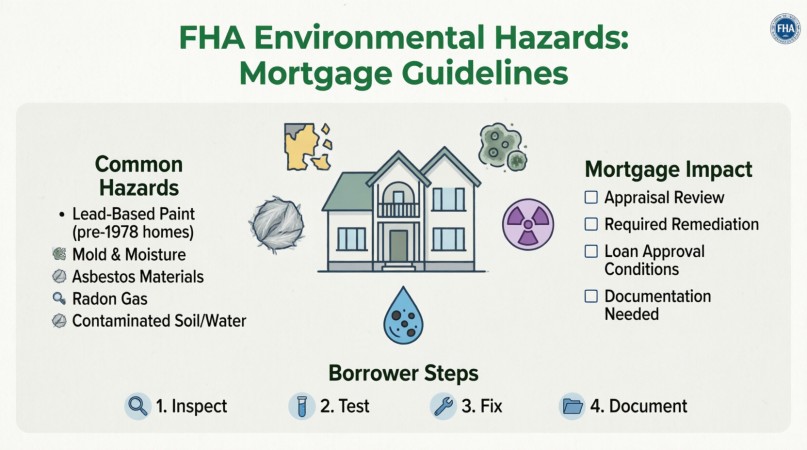
 FHA Environmental Hazards
Complete Guide to Property
Eligibility Issues
The FHA requires properties to be free of environmental hazards that could affect borrower safety, property value, or the lender's security. Understanding what environmental hazards FHA considers problematic helps you identify potential issues early and know what to expect. This article covers all major environmental hazards the FHA evaluates based on official FHA Handbook 4000.1 standards.
Methamphetamine Contamination
What It Is
Methamphetamine (meth) contamination occurs when a property has been used for the manufacture or consumption of methamphetamine. The chemicals used in meth production contaminate the property's structure, materials, and furnishings.
Health Risks
Exposure to meth-contaminated properties can cause:
- Respiratory problems and lung damage
- Headaches and dizziness
- Neurological damage (especially in children)
- Skin reactions and infections
- Chemical burns and poisoning
- Long-term developmental issues in children
FHA Standard
FHA requirement: The property is ineligible for FHA insurance if contaminated by methamphetamine manufacture or consumption until the property is certified safe for habitation.
Critical point: There is NO exception or waiver - the property must be fully remediated and certified before approval.
When It's Discovered
Meth contamination may be identified by:
- Appraiser observation during inspection
- Borrower disclosure
- Real estate agent disclosure
- Previous testing or cleanup records
- Obvious signs (discoloration, chemical odors, deteriorated condition)
Remediation Requirements
If contamination is discovered:
-
Property is immediately ineligible - Cannot proceed with FHA loan until remediated
-
Professional testing required - Certified meth lab testing to determine contamination levels
-
Professional remediation required - Specialized cleanup company must address contamination
- Decontamination of surfaces and materials
- Removal of contaminated drywall, carpet, insulation
- HVAC system cleaning
- Air quality testing to verify safety
-
Certification required - Property must be certified safe for habitation by appropriate state/local authority
Cost Implications
Meth contamination remediation is expensive and time-consuming:
- Testing: $500-2,000
- Remediation: $5,000-15,000+ depending on contamination severity
- Timeline: 2-8 weeks typically
Impact: Property may be unsuitable for purchase if remediation costs exceed property value.
Flood Hazards and Special Flood Hazard Areas (SFHA)
What Is a Flood Hazard Area?
A Special Flood Hazard Area (SFHA) is a geographic area designated by the Federal Emergency Management Agency (FEMA) as having a significant risk of flooding. Areas are designated by FEMA flood maps (FIRM maps).
Flood Zone Designations
High-risk flood zones:
- Zone A - Area of special flood hazard (high risk)
- Zone V - Coastal high hazard area with velocity hazard (high risk - near coast)
Moderate-risk zones:
- Zone AE - High-risk area with base flood elevation provided
- Zone VE - Coastal high hazard with base flood elevation
Low-risk zones:
- Zone X or Zone C - Areas of minimal flood hazard
FHA Eligibility in Flood Zones
Properties are INELIGIBLE if:
- Located in SFHA (Zone A or V)
- AND flood insurance is NOT available in the community under the National Flood Insurance Program (NFIP)
Properties ARE ELIGIBLE if:
- Located in SFHA
- AND flood insurance IS available
- AND borrower obtains and maintains flood insurance
For new construction in SFHA:
- Property must obtain FEMA Letter of Map Amendment (LOMA) or Letter of Map Revision (LOMR) removing it from SFHA, OR
- Property must obtain FEMA NFIP Elevation Certificate showing building is above 100-year flood elevation
Coastal Barrier Resources System (CBRS)
Properties are INELIGIBLE if:
- Located within the Coastal Barrier Resources System (protected barrier islands and beaches)
- NO exceptions or waivers allowed
Flood Insurance Requirements
For properties in SFHA:
-
Insurance is mandatory - For life of loan
-
Coverage amount - At least the lowest of:
- 100% replacement cost of improvements
- Maximum NFIP coverage available
- Outstanding mortgage balance
-
NFIP vs. Private Flood Insurance:
- National Flood Insurance Program (NFIP) - Government program
- Private Flood Insurance (PFI) - Private insurance carrier
- Both acceptable if PFI meets FHA requirements
-
Cost - Flood insurance premiums vary by:
- Risk level (zone)
- Building elevation
- Square footage
- Ranges: $400-2,000+ annually
Flood Zone Determination
Lender must:
- Determine if property is in SFHA (independent of appraiser)
- Obtain Life of Loan Flood Certification
- If in flood zone, maintain flood insurance documentation in file
Timeline
- Flood determination ordered at pre-approval stage
- If in flood zone, borrower must secure insurance before closing
- Proof of insurance required at closing
Abandoned Gas and Oil Wells
Definition
Abandoned gas or oil wells are drilling sites where oil or gas extraction previously occurred but is no longer active.
Why They Matter
Abandoned wells can pose hazards:
- Methane or gas leaks
- Ground instability or subsidence
- Water contamination
- Environmental liability
FHA Requirements
If property contains abandoned gas or oil wells:
- Lender must obtain - Written letter from local jurisdiction or state agency
- Letter must state - Well was "permanently abandoned in a safe manner"
- Qualified engineer - For petroleum product wells, qualified petroleum engineer must inspect property and assess risk
- State authority approval - Appropriate state authorities must concur on clearance recommendations
What Constitutes Safe Abandonment
Safe abandonment typically includes:
- Well properly capped and sealed
- Casing removed or properly abandoned
- Documentation of abandonment procedures
- State agency certification of proper abandonment
New Construction Restrictions
For new construction:
- Properties within 75 feet of operating oil or gas well are rejected unless mitigation measures completed
Airport Hazards
Runway Clear Zones (RCZ)
Runway Clear Zones are areas at the end of airport runways where aircraft may experience problems during takeoff or landing.
Types of Airport Hazards
1. Runway Clear Zones (RCZ) - Also called Runway Protection Zones
- High-risk areas at runway ends
2. Clear Zones at Military Airfields
- Areas near military runway ends
3. Accident Potential Zone 1 (APZ 1)
- Areas near military airfields with elevated accident risk
FHA Eligibility
Existing construction:
- If located in RCZ or Clear Zone - Lender must obtain borrower's written acknowledgment of hazard
- Loan may proceed but borrower must acknowledge risk
New construction:
- If located in RCZ or Clear Zone - Property is REJECTED, ineligible for FHA
- If located in APZ 1 - May be eligible if property complies with Department of Defense guidelines
Disclosure Requirements
Borrower must acknowledge in writing that property is near airport and accept the noise, safety, and other risks associated with aircraft operations.
Impact
- Properties near airports are harder to finance
- Insurance may be higher
- Property value may be affected
- Noise and safety concerns for occupants
Radon
What Is Radon?
Radon is a naturally occurring radioactive gas that comes from uranium in soil and rocks. It seeps into buildings through cracks, foundation gaps, and other openings.
Health Risks
Radon is the second leading cause of lung cancer after smoking:
- Long-term exposure increases cancer risk
- Risk increases with concentration level and duration
- Children more vulnerable to long-term exposure
- Colorless, odorless gas - cannot be detected without testing
FHA Standards
FHA requirement: Property must not have radon contamination at unsafe levels.
Testing:
- FHA generally does NOT require radon testing at appraisal
- However, borrower may request radon testing
- If testing is done and radon is found at high levels, remediation may be required
Remediation if needed:
- Radon mitigation system installation (typically $800-2,500)
- Venting radon from foundation to roof
- System includes fans and piping
- Must be installed by certified radon mitigation contractor
Radon Testing Levels
EPA recommends action if radon level is 4 picocuries per liter (pCi/L) or higher:
- Below 2 pCi/L - Safe level
- 2-4 pCi/L - Consider mitigation
- Above 4 pCi/L - Action recommended
When Radon Testing Is Recommended
- Buyer requests it
- Appraiser notes concerns
- Property in high-radon area (varies by region)
- Buyer wants peace of mind
Note: Radon testing is the borrower's choice, not FHA-mandated.
Asbestos
What Is Asbestos?
Asbestos is a fibrous mineral material used in building materials before the 1970s for insulation, fireproofing, and other purposes. It's now recognized as a serious health hazard.
Health Risks
Asbestos exposure causes:
- Mesothelioma (cancer of lung lining)
- Lung cancer
- Asbestosis (lung scarring)
- Long latency period (10-50 years before symptoms appear)
- No safe level of exposure
Where It's Found
- Pipe insulation
- Boiler insulation
- Floor tiles
- Roof shingles
- Siding
- Textured paint or popcorn ceilings
- Furnace insulation
- Brake linings
FHA Standards
FHA requirement: Property must not have exposed or deteriorating asbestos.
Testing and Abatement:
- Professional asbestos survey may be done if suspected
- Intact asbestos-containing materials that are not disturbed are often left in place
- Damaged or disturated asbestos must be professionally removed
Remediation costs:
- Testing: $400-800
- Professional abatement: $5,000-20,000+ depending on extent
- Encapsulation: $1,000-3,000 (lower cost, less permanent)
Requirements
- Exposed asbestos must be encapsulated or removed before closing
- Damaged asbestos must be abated by certified contractor
- Lender may require abatement if asbestos is friable (easily disturbed)
Mold and Moisture Issues
What Is Mold?
Mold is a fungus that grows in moist environments. While some mold is normal, excessive mold indicates moisture problems that must be addressed.
Health Risks
Mold exposure can cause:
- Allergic reactions
- Asthma attacks (in sensitive individuals)
- Respiratory problems
- Skin irritation
- Immune system issues (in severe cases)
FHA Standards
FHA requirement: Property must be free of active mold and moisture damage.
Assessment:
- Appraiser visually inspects for mold, moisture stains, and water damage
- Areas of concern: basements, crawl spaces, bathrooms, attics
- Signs include: visible mold, musty odors, water stains, soft/spongy materials
Remediation
If mold or moisture damage is found:
-
Moisture source must be identified - And corrected
- Roof leaks
- Plumbing leaks
- Foundation cracks
- Poor drainage
-
Mold must be cleaned - By professional if extensive
-
Affected materials replaced - Drywall, insulation, subflooring if damaged
-
Ventilation improved - To prevent future moisture accumulation
Costs
- Source identification and repair: $500-5,000+
- Professional mold remediation: $2,000-10,000+
- Material replacement: $1,000-15,000+ depending on extent
Underground Storage Tanks (USTs)
What Are They?
Underground Storage Tanks are tanks buried in the ground, historically used for storing:
- Petroleum products (fuel oil for heating)
- Chemicals
- Propane
- Hazardous waste
Environmental Concerns
Old underground storage tanks can:
- Leak hazardous substances into groundwater
- Contaminate soil
- Create environmental liability
- Reduce property value
- Require expensive cleanup
FHA Standards
Property may have issues if:
- Active underground storage tank present
- Abandoned underground storage tank present
- Evidence of leakage
Requirements:
-
Active tanks - Must be:
- Properly registered and maintained
- Meet environmental standards
- Have liability insurance
-
Abandoned tanks - Must be:
- Removed and properly disposed, OR
- Properly closed/abandoned in place (if allowed)
- Site assessed for contamination
-
Contamination - If evidence of contamination:
- Environmental Phase I assessment recommended
- Remediation required if contamination found
- Lender may require environmental clearance
Phase I Environmental Site Assessment (ESA)
If UST or contamination suspected:
- Professional ESA examines property history and current conditions
- Cost: $500-2,000
- Results determine if Phase II testing needed
- Phase II (soil/water testing): $2,000-5,000+
Cost and Timeline
- Tank removal: $3,000-8,000+
- Remediation if contaminated: $5,000-50,000+ or more
- Timeline: 1-3 months for removal, longer for remediation
Contaminated Soil and Hazardous Waste
Sources of Contamination
Properties may have contaminated soil if near or downwind from:
- Landfills
- Industrial sites
- Manufacturing facilities
- Gas stations
- Dry cleaners
- Auto repair shops
- Pesticide-contaminated farms
- Hazardous waste disposal sites
Health Risks
Contaminated soil can:
- Leach into groundwater
- Be ingested by children playing outdoors
- Create air quality issues
- Cause chemical poisoning
- Lead to long-term health problems
FHA Assessment
Appraiser must note:
- Proximity to dumps, landfills, industrial sites
- Visible evidence of contamination
- Unusual soil discoloration
- Dead or dying vegetation
- Chemical odors
FHA Requirements
If contamination suspected:
- Phase I ESA - Environmental Site Assessment
- Soil testing - If Phase I indicates concern
- Remediation - If contamination confirmed
- Clearance - Property must be certified safe before closing
Remediation Options
- Soil excavation and replacement
- Cap/capping of contaminated area
- Encapsulation
- Bioremediation
- Decontamination (expensive and time-consuming)
Costs
- Phase I: $500-2,000
- Phase II (testing): $2,000-5,000
- Remediation: $5,000-100,000+ depending on contamination extent
Summary of Environmental Hazards
| Hazard | FHA Status | Remediation | Cost |
|---|---|---|---|
| Methamphetamine | Ineligible until certified safe | Professional decontamination | $5,000-15,000+ |
| Flood Zone | Must have insurance | Elevation certificate or LOMA/LOMR | $400-2,000/year insurance |
| CBRS | Ineligible | None - cannot finance | N/A |
| Oil/Gas Well | Must be safely abandoned | Professional abandonment | $2,000-5,000+ |
| Airport Hazard | Acknowledgment required (existing); rejected (new) | None - accept hazard | None, but disclosure required |
| Radon | Mitigate if high levels | Mitigation system | $800-2,500 |
| Asbestos | Remove if exposed/damaged | Professional abatement | $5,000-20,000+ |
| Mold/Moisture | Must remediate | Fix source + cleanup | $2,000-15,000+ |
| Underground Tanks | Abandon or remove | Tank removal + remediation | $3,000-50,000+ |
| Contaminated Soil | Test and remediate if needed | Excavation or encapsulation | $5,000-100,000+ |
Environmental Hazard Discovery and Timeline
Pre-Approval Stage
- Lender asks about known environmental hazards
- If borrower discloses issue, lender evaluates impact
- Lender may decline or require assessment
Appraisal Stage
- Appraiser inspects for visible environmental concerns
- Appraiser notes any hazards observed
- If concerns found, further investigation may be required
Underwriting Stage
- Environmental issues identified in appraisal are evaluated
- If hazard found, remediation typically required before closing
- Environmental assessments (Phase I, etc.) ordered if needed
Before Closing
- Remediation completed and verified, OR
- Environmental clearance obtained, OR
- For flood zones: insurance proof provided
- Property declared free of hazards preventing FHA approval
Key Takeaways for FHA Environmental Hazards
-
Methamphetamine contamination - Property is ineligible until certified safe; can be extremely costly
-
Flood hazards - Flood insurance required if in SFHA; CBRS properties are ineligible
-
Airport hazards - Acknowledgment required for existing; new construction rejected
-
Radon - Not FHA-required but borrower may request testing; mitigation if high levels found
-
Asbestos - Exposed/deteriorated asbestos must be professionally removed or encapsulated
-
Mold and moisture - Source must be corrected and mold remediated; cannot have active moisture problems
-
Oil and gas wells - Abandoned wells must be certified safely abandoned
-
Underground storage tanks - Must be removed or properly abandoned; contamination must be assessed
-
Contaminated soil - Environmental assessment may be required; remediation if contamination confirmed
-
Environmental assessments - Phase I ESAs recommended if hazards suspected; results determine further action
Disclosure and Responsibility
Borrower's Responsibility
- Disclose known environmental hazards
- Request testing if concerned
- Participate in remediation decisions
- Understand ongoing obligations (flood insurance, monitoring, etc.)
Lender's Responsibility
- Evaluate property for environmental hazards
- Require assessment if hazards suspected
- Ensure remediation before closing
- Document clearance in file
- Maintain flood insurance for life of loan
Seller's Responsibility
- Disclose known environmental hazards
- Provide documentation of previous assessments or remediation
- Correct hazards or provide credits before closing
Conclusion
FHA environmental hazards range from deal-breakers (methamphetamine, CBRS) to manageable issues (radon testing, asbestos encapsulation) to disclosure requirements (airport hazards). Understanding which hazards are problematic, how they're discovered, and what remediation costs helps you navigate environmental concerns during the mortgage process. When environmental hazards are identified, work promptly with the lender and environmental professionals to address them before closing.
Connect With Us
Please share – it really helps