FHA Lead-Based Paint Requirements
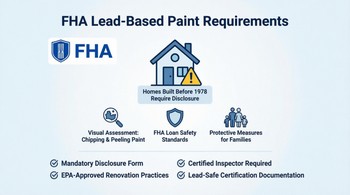 Buying an older home is exciting, but if it was built before
1978, there's something important you need to understand:
lead-based paint. The FHA has specific rules about how lead
paint is handled in homes they finance, and knowing these
requirements will help you navigate the purchase process with
confidence.
Buying an older home is exciting, but if it was built before
1978, there's something important you need to understand:
lead-based paint. The FHA has specific rules about how lead
paint is handled in homes they finance, and knowing these
requirements will help you navigate the purchase process with
confidence.
Why Lead-Based Paint Matters
Lead was a common ingredient in residential paint until it was banned for consumer use in 1978. If you're looking at a home built before that year, there's a good chance it contains lead paint - especially on exterior surfaces and windows. But here's what's important to understand: lead itself isn't always the problem. It's what happens when that paint starts to deteriorate that becomes a health concern.
The Health Risks Are Real
Lead is toxic, and children under six are particularly vulnerable. When young children put their hands, toys, or objects in their mouths, they can ingest lead dust and lead-contaminated soil. The health effects can be serious and long-lasting: developmental delays, learning disabilities, lower IQ scores, behavioral problems, anemia, kidney damage (in severe cases), and hearing impairment. This is why the FHA takes lead paint hazards seriously. Beyond protecting your family's health, the agency is also concerned about protecting property values and following federal law, which requires proper disclosure and remediation.
What FHA Actually Requires
Here's a crucial distinction that confuses many homebuyers: having lead paint in a home is not the same as having a lead paint hazard. Intact, well-maintained paint that contains lead may not need remediation. But if that paint is chipping, peeling, or flaking - especially where children might touch it - that's a hazard that must be addressed.
The FHA's core requirement is simple: the property must be free of lead paint hazards before the loan can be approved. For most homebuyers with children under six, this means hazardous conditions must be fixed. (There's an exception for reverse mortgages where no children under six will live in the home, but standard FHA loans don't get that exemption.
Your Rights During the Purchase Process
Disclosure: The Seller Must Come Clean
Federal law requires sellers of pre-1978 homes to disclose any known information about lead-based paint and lead hazards. They must provide you with written disclosure about:
- Any known lead-based paint in the home
- Any known lead hazards
- Records or reports about lead paint (if they have them)
- A lead warning statement in the sales contract
If the seller genuinely has no knowledge of lead paint or hazards, they can state that on the disclosure. But if they do know about it, they have to tell you. Your real estate agent also has a responsibility to make sure the seller understands their disclosure obligations.
The 10-Day Inspection Window
One of your most valuable rights is the opportunity to hire a professional to inspect for lead before you're obligated to buy. This 10-day inspection period begins when you sign the sales contract and gives you the chance to:
- Hire a certified lead inspector to test the paint and surfaces
- Get a professional risk assessment to identify hazards
- Negotiate repairs or credits based on what you find
- Back out of the deal if serious problems are discovered (using your appraisal contingency)
This inspection is optional - you can waive it if you prefer - but it typically costs $300-500 and is separate from the appraisal. Many homebuyers find it worthwhile, especially in older homes or neighborhoods where lead paint is more likely.
What Happens at Appraisal
When the appraiser inspects your pre-1978 home, they're specifically looking for deteriorating paint. If they spot chipping, peeling, or flaking paint, they'll note it as a deficiency. Here's where it gets important: the property won't pass FHA appraisal until that hazard is addressed. This becomes a condition of your loan approval, which means someone has to fix it before you can close.
When Paint Must Be Fixed
Deteriorating Paint Triggers the Requirement
Any paint that's chipping, peeling, or flaking on a pre-1978 home is considered a potential lead hazard. Common problem areas include windows and window sills, door frames, exterior surfaces, porches and decks, railings, and any interior surface where paint is visibly deteriorating. If the appraiser finds these conditions, they must be stabilized or removed.
In most transactions, the seller handles this before closing. But there are other options too.
How to Handle It: Your Options
Option 1: Seller Fixes It (Most Common)
The
seller hires a lead-safe contractor to stabilize or remove the
paint. The work is completed before closing, clearance testing is
done to confirm the hazard is gone, and you close on a clean
property. This is the preferred scenario for most lenders because it
eliminates risk and uncertainty.
Option 2: Seller Provides a Credit
Less
commonly, the seller might offer a credit at closing so you can
handle the remediation yourself after purchase. This creates some
risk because you're responsible for getting the work done properly,
and it requires careful escrow arrangements. Most lenders prefer
this less often than Option 1.
Option 3: Larger Down Payment
In rare cases,
the property might be appraised with the lead paint hazard present
(at a reduced value), and you'd compensate with a larger down
payment. This option is rarely preferred by lenders and typically
only appears when other solutions aren't feasible.
What Professional Remediation Looks Like
The Three Approaches to Lead Paint Stabilization
When lead paint hazards need to be addressed, contractors have three main methods:
- Encapsulation: Sealing the paint with special coatings to contain the lead. Cost: $500-$2,000 per 1,000 sq ft.
- Removal: Completely removing the paint. Cost: $1,000-$3,000 per 1,000 sq ft.
- Replacement: Removing the paint and repainting with lead-free paint. Cost: varies, but often $2,000-$5,000+ depending on home size.
Whichever method is used, the work must comply with EPA regulations (specifically the Renovation, Repair and Painting Rule) and HUD lead-based paint standards. If your state has stricter rules, those apply too. And contractors performing this work should be trained in lead-safe practices - some states require them to be licensed.
Clearance Testing Is Non-Negotiable
After remediation is complete, an independent certified inspector must perform clearance testing. This is a critical step because it verifies that the hazards have actually been eliminated. The inspector conducts a visual inspection for remaining deteriorated paint, performs dust testing if needed, and certifies that the work was done properly.
Here's the important part: the lender won't release funds for the remediation work until clearance testing is complete and the property passes. And the inspector performing clearance must be independent from the contractor who did the work - no conflicts of interest allowed.
Special Situation: FHA 203(k) Rehabilitation Loans
If you're buying an older home specifically to renovate it, you might be using an FHA 203(k) rehabilitation loan. Good news: lead paint stabilization costs can be included in your 203(k) loan. The costs of lead-safe abatement work, clearance testing, and EPA/HUD compliance can all be financed as part of your renovation.
The process works the same way - the work must meet EPA Renovation, Repair and Painting Rule standards, and funds are released only after stabilization is complete and clearance testing passes. This makes 203(k) loans a practical option for buyers who want to restore older homes.
The Paperwork You'll See
Important Documents to Know About
Throughout the loan process, you'll encounter specific forms and disclosures related to lead paint. At first contact (during pre-qualification or pre-approval), your lender will provide you with the EPA pamphlet "Protect Your Family from Lead in Your Home." You'll also need to receive and sign Form HUD-92900-B (Important Notice to Homebuyers), which includes information about lead hazards, your right to inspect, and other homebuying information.
Your sales contract must include lead warning language, the seller's disclosure of any known lead-based paint, a list of any records or reports, confirmation that you received the EPA pamphlet, and your acknowledgment of the 10-day inspection period (or your waiver of it). If a real estate agent is involved, the contract must also state that the agent informed the seller of the disclosure obligations.
Timeline: How Lead-Based Paint Fits Into Your Loan Process
Pre-Approval Stage: You receive the EPA pamphlet and sign the HUD-92900-B form acknowledging the lead requirements.
After Your Offer Is Accepted: The sales contract includes lead disclosure attachments. The seller provides their lead disclosure. You have 10 days to arrange a professional inspection if you choose to.
During Appraisal: The appraiser inspects for deteriorated paint. If it's a pre-1978 home and hazards are found, the property fails appraisal unless remediation is arranged.
Repair Negotiation: If hazards are identified, you and the seller work out who handles remediation. Usually, the seller completes the work before closing and provides clearance testing.
Before Closing: All lead paint hazards are remediated and verified. Clearance testing is complete, and the property is certified as free of lead hazards.
Underwriting Approval: The appraiser confirms the property is free of lead hazards. Your loan gets the final green light.
Common Questions About Lead Paint and FHA Loans
Does my home need to be tested for lead paint if it's pre-1978?
No, testing is optional. However, if the appraiser observes deteriorating paint, they'll flag it as a potential hazard, and testing or remediation will be required. Many buyers choose the 10-day professional inspection to know exactly what they're dealing with before committing.
What if the paint looks fine but might contain lead?
Intact, well-maintained paint that contains lead may not require remediation, even if it tests positive for lead. The FHA requirement is about hazards, not just the presence of lead. However, best practice is to have paint tested to confirm it doesn't contain lead, or ensure it's in excellent condition.
Can I negotiate with the seller about lead paint remediation?
Absolutely. If the appraiser finds hazards, you can work with the seller to determine who pays for the fix. Most commonly, the seller completes remediation before closing. Less common options include the seller providing a credit or you making a larger down payment.
What if I find lead hazards during my 10-day inspection?
You have several options: request that the seller fix the issues before closing, negotiate a credit, ask for price reduction, or use your inspection contingency to back out of the deal if the hazards are serious. This is why many buyers consider the inspection worthwhile.
Does the reverse mortgage exception mean no lead remediation is needed?
Only if it's specifically a reverse mortgage (HECM) and there will be no child under six living in the home. The borrower must certify this in writing. For regular FHA forward mortgages, remediation is required if hazards exist.
How long does lead paint remediation take?
It depends on the scope of work, the home's size, and the method used. Encapsulation might take a few days, while removal could take a couple of weeks. Add another week or so for clearance testing and final verification.
Bottom Line
Lead-based paint in older homes is a manageable concern when you understand what the FHA requires and what your rights are. The key takeaway is this: the presence of lead paint alone isn't the problem; hazardous conditions are. Deteriorating paint that could expose your family to lead dust must be addressed before the FHA will approve your loan.
You have the right to inspect for lead before committing to a purchase, sellers must disclose what they know, and remediation work must be done by qualified professionals and verified by independent testing. Most of the time, the seller handles remediation before closing, which is the cleanest solution for everyone involved.
If you're buying a pre-1978 home with an FHA loan, take the time to understand these requirements. Ask your lender about the steps involved, consider the 10-day inspection if the home shows signs of paint deterioration, and don't hesitate to negotiate with the seller if hazards are found. The goal is simple: ensure that the home you're buying is safe for your family.
Connect With Us
Please share – it really helps