FHA 203(b) Loan Program: What You Need to Know
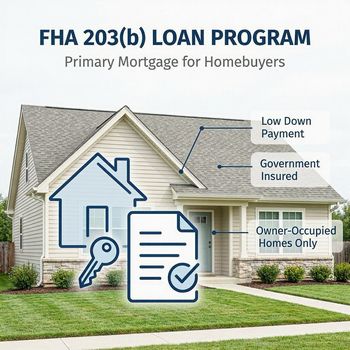 The
FHA 203(b) loan is the most common program available to
homebuyers today - and for good reason. This mortgage helps
millions of borrowers achieve homeownership when conventional
loans feel out of reach. But here's what surprises most people:
they never fully understand how it works or why lenders push it
so hard. Understanding the real mechanics behind this program
could save you thousands.
The
FHA 203(b) loan is the most common program available to
homebuyers today - and for good reason. This mortgage helps
millions of borrowers achieve homeownership when conventional
loans feel out of reach. But here's what surprises most people:
they never fully understand how it works or why lenders push it
so hard. Understanding the real mechanics behind this program
could save you thousands.
FHA Loan Basics and Program Overview
An FHA loan is a home loan insured by the Federal Housing Administration, a government agency within the Department of Housing and Urban Development. Think of it as a safety net for lenders: the FHA guarantees to cover losses if you default. That guarantee exists specifically to help borrowers who might not qualify for traditional conventional loans. If your credit took a hit, you don't have massive savings, or life threw you a curveball, this is what the program was designed for.
The 203(b) is the standard program used for purchasing a primary residence. It's straightforward: you find a property in decent condition, get an appraisal, and close. The program has been operating for decades, quietly helping first-time homebuyers and people rebuilding their financial lives without much fanfare.
What makes this option different is flexibility. You can put down as little as 3.5% of the purchase price - not 10%, not 7%, but 3.5%. With a conventional loan, you're typically looking at 5-20% down. For someone with $15,000 saved, this difference is massive: it's the difference between buying a $430,000 house or waiting another five years.
- Down payment as low as 3.5%
- Works with credit scores as low as 580
- No maximum loan amount restrictions per FHA policy
- Available in all 50 states through approved lenders
- Can be used only for primary residence purchases
203(b) Loan Requirements and Credit Score Standards
To qualify for this loan, you need to meet basic requirements. Your credit score needs to be at least 580 to receive maximum financing. But here's the real talk: most lenders prefer a minimum score of 620 because they want better odds you'll pay on time. The difference between 580 and 620 is often just one paid collection account or a year of on-time payments.
The program is significantly more forgiving than conventional lending standards. You can have bankruptcy on your record if two years have passed since discharge. You can have a foreclosure behind you if three years have passed. This flexibility exists because the FHA recognizes that people have setbacks - job loss, medical emergencies, divorce. Life happens, and you shouldn't be penalized forever.
Your debt-to-income ratio is critical for approval. The FHA allows ratios up to 50%, though most lenders prefer 43% or less (they're being conservative). Here's how to calculate it: add all your monthly debt payments - car loans, credit cards, student loans, child support - and divide by gross monthly income. For someone earning $5,000 monthly, that means your total debt payments shouldn't exceed $2,150.
Employment history matters because lenders want proof you can actually pay the mortgage. Expect to show two years of stable work history. Self-employed? You'll need two years of tax returns. The lender will verify employment directly with your employer - not because they don't trust you, but because it's required before they'll cut the check.
Mortgage Insurance and Monthly Payment Costs
Every loan requires insurance to protect the lender - and here's where FHA gets real. This is the trade-off nobody likes talking about, but it's the single biggest difference between FHA and conventional options. Understanding what you're actually paying matters.
The mortgage has two insurance charges. First is the upfront mortgage insurance premium, called UFMIP. This equals 1.75% of your loan amount. On a $200,000 mortgage, that's $3,500 added to your balance immediately. You don't pay it out of pocket - it gets rolled into your loan - but you're paying interest on it for 30 years.
Second is annual insurance paid monthly. The rate depends on your down payment and total loan size. With 3.5% down on a $200,000 mortgage, expect roughly $250-300 monthly in insurance costs. That's $3,000-$3,600 a year, every year. It never decreases, and it never goes away.
Compare this to a conventional loan with 10% down and insurance. That protection can be removed once you build 20% equity. With FHA, the insurance never disappears - even if you pay extra principal, even if you refinance, it stays attached to this loan. Over 30 years, that permanent cost creates a significant affordability gap between FHA and conventional options.
- Upfront insurance premium: 1.75% of loan amount
- Annual insurance: 0.55% for most mortgages
- Insurance rolls into monthly payment
- Permanent insurance (cannot be removed)
- Increases total cost of borrowing
Down Payment and Loan Amount Guidelines
The 203(b) allows you to finance 96.5% of the purchase price. That means your minimum down payment is just 3.5%. On a $250,000 property, that's $8,750 down. For first-time homebuyers sitting on $10,000 in savings, this isn't theoretical - it's the difference between homeownership now versus renting for another three years while you scrape together another $40,000.
Your loan cannot exceed the limit set for your county. These limits vary dramatically by location and update annually. In 2024, limits range from roughly $498,000 in low-cost rural areas to over $1.1 million in expensive coastal markets. The amount is capped based on where the property sits, not where you work or live.
The program requires you to verify your down payment source. Gift funds are allowed - parents helping is fine - but the gift-giver cannot have any stake in the property or transaction. Borrowed down payment money? Not permitted. This protects borrowers by ensuring you actually have some stake in the deal, not just the lender's hope you'll pay.
Property Requirements and the Appraisal Process
The 203(b) requires the property to meet specific FHA standards. This is where the process gets strict. The property evaluation is different from conventional appraisals because the appraiser checks for health and safety first, market value second. The property must have safe electrical, plumbing, heating, and structural systems - not nice-to-have stuff, but basic safety.
Common issues that fail inspection: missing handrails, exposed wiring, cracked foundations, roof leaks, and non-functioning utilities. These aren't cosmetic complaints about paint color or outdated fixtures. These are genuine safety hazards. The property must be in safe, livable condition for approval - period.
The appraisal is ordered by your lender and typically costs $400-600. This fee is paid upfront (though some lenders roll it into closing costs). The evaluation process takes 7-14 days. If the property doesn't meet standards, the seller must make repairs before closing, or the deal falls through. No exceptions.
Lead-based paint disclosure is required for properties built before 1978. The buyer gets 10 days to complete a lead inspection if concerned. Radon testing is not required federally, but some states mandate it. A professional home inspector (separate from the appraisal) costs $300-500 and is essential - don't skip this even though it's another fee.
Comparing FHA 203(b) to Conventional Loans
Here's the honest breakdown: when does FHA make sense versus conventional? If your credit score is below 680, you have limited down payment savings, or you're carrying past credit issues, FHA wins. The program accepts borrowers that conventional lenders won't even look at. Full stop.
A conventional loan is better if you have excellent credit scores (740+), substantial down payment savings (15-20%), and stable verifiable income. Conventional rates may be lower, and you avoid the permanent insurance that eats your budget every month. If you can qualify for conventional, the math often works out better over 30 years.
| Feature | FHA 203(b) Loan | Conventional Loan |
|---|---|---|
| Minimum Down Payment | 3.5% | 5-20% |
| Minimum Credit Score | 580 (620 preferred) | 620-680 |
| Mortgage Insurance | Permanent | Removable at 20% equity |
| Debt-to-Income Limit | 50% | 43% |
| Property Standards | Strict health/safety standards | Lender discretionary |
FHA Loan Limit Considerations and Borrower Qualification
Every county has a loan limit that determines your maximum borrowing amount. These limits vary dramatically by location. Rural counties might max out at $498,000. San Francisco? Try $1.1+ million. The maximum updates each January based on what housing actually costs in your area.
To qualify, your income must realistically support the monthly payment. Most lenders use a debt-to-income ratio of 43% as the target. If you earn $4,000 monthly, your maximum total debt (including the new mortgage payment) should be $1,720. That's a real constraint, not a suggestion.
Here's where FHA shows its real value: credit scores tell a story. The FHA doesn't require perfection. Had medical debt go to collections five years ago but paid it off two years ago? You can still qualify. Had a foreclosure seven years back? Three years have passed; the program will consider your application. This forgiveness is why borrowers choose this option over conventional alternatives when they're rebuilding.
But recent negative activity? That's a killer. Late payments in the last 12 months, active charge-offs, or ongoing collections are red flags lenders can't ignore. They want to see recent positive payment history - actual proof you've gotten your act together. Missing car payments while applying for an FHA mortgage will result in automatic denial.
- Loan limits vary by county and update annually
- Debt-to-income ratio target is 43% maximum
- Bankruptcy allowed after 2-year waiting period
- Foreclosure allowed after 3-year waiting period
- Recent negative credit activity causes denial
- Employment verification required before closing
The 203(b) Application and Approval Process
Applying starts with selecting an approved lender. Not all mortgage companies offer this program - find one that does. You'll need to gather documents: two months of pay stubs, two months of bank statements, two years of tax returns, and employment verification letters. Yes, it's a lot of paperwork. Yes, they actually check it all.
The application process is methodical. First, the lender orders a credit report and reviews your credit score - they're looking for recent activity. Second, they verify employment and income directly with your employer and the IRS. Third, they order the property evaluation. Fourth, they underwrite the loan, reviewing all documents line by line for approval. It's thorough because FHA is backstopping the risk.
Timeline is typically 30-45 days from application to approval. Some lenders close faster, especially if everything is clean. The property evaluation can delay approval if issues exist. If repairs are needed, the seller must complete them before closing, which can add weeks. Have patience - rushing a mortgage application never ends well.
Closing costs typically run 2-5% of the loan amount. On a $200,000 loan, expect $4,000-$10,000 in closing costs. Here's a pro tip: the lender can often pay some or all closing costs as a credit toward your final payment. If you're tight on cash reserves, ask about this - it's a real option.
Mortgage Refinance Options
If you already have this loan, you have options down the road. The streamline refinance is designed specifically for existing FHA borrowers. It requires minimal paperwork and no new property evaluation - just a credit pull and income verification. This works if rates drop and you want to lower your monthly payment on your existing loan.
A cash-out refinance is another path. You refinance and borrow against your home's equity. If your home is worth $300,000 and you owe $200,000, you could refinance and pull out up to $70,000. Use it for home improvements, pay off high-interest debt, or cover emergencies. It's a legitimate financial tool if you need it.
Conclusion: Is the 203(b) Loan Right for You?
The 203(b) loan program opens homeownership doors for millions of borrowers who cannot qualify for conventional loans. With just 3.5% down and credit scores as low as 580, this mortgage makes sense for first-time buyers and those rebuilding their financial lives. Understanding program requirements, insurance costs, and property standards helps you decide if it actually fits your situation - not just whether you qualify, but whether the trade-offs work for you.
The permanent insurance is the real cost. Over 30 years, that adds up to serious money. You'll pay more overall than someone with excellent credit buying conventionally. But you know what else is true? You'll own a home today instead of renting for five more years while you save a bigger down payment. That's the actual choice: better terms eventually, or homeownership now. Both are legitimate decisions depending on your life. Work with an informed lender who explains the real numbers, and then make the call based on your actual situation - not on what sounds impressive.
Connect With Us
Please share – it really helps