Understanding USDA Construction Loans for Single Family Housing
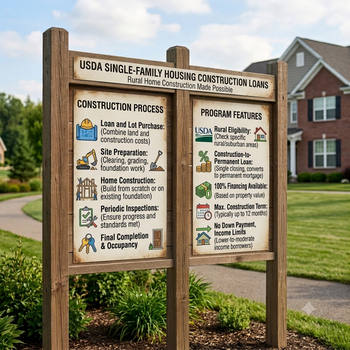 Building a home from scratch is an exciting step. Many borrowers worry about financing because traditional mortgage options seem limiting. The USDA construction loan program offers a path forward for those who want to build in rural areas. This loan program provides financing without a down payment, making homeownership achievable for more families. A USDA loan can cover both construction and permanent financing in one application, streamlining the process and reducing closing costs.
What Is a USDA Construction Loan?
A USDA construction loan is backed by the United States Department of Agriculture and designed for single-family home construction in eligible rural areas. The USDA rural development program guarantees these loans through approved lenders, reducing risk for financial institutions. This guarantee helps loan programs offer competitive interest rates without requiring a down payment.
The USDA single close construction loan combines construction financing and a permanent mortgage into one loan product. This approach simplifies the borrowing process by eliminating the need to apply for separate loans at different times. Borrowers make one loan application, complete one set of underwriting, and pay closing costs once.
Rural Development, part of the USDA, administers the family housing guaranteed loan program through participating lenders. These active lenders have experience with USDA loan requirements and understand the program's benefits. Working with knowledgeable lender professionals helps ensure smooth processing and accurate guidance throughout the borrowing journey.
- Zero down payment required for eligible borrowers
- Single-close construction financing available
- Competitive interest rates backed by USDA guarantee
- Lower closing costs compared to conventional loans
- No private mortgage insurance required
USDA Construction Loan Requirements and Eligibility
Understanding USDA construction loan requirements is the first step toward qualification. The program has specific eligibility guidelines that ensure funding reaches intended borrowers. Meeting these guidelines opens access to affordable homebuilding financing.
Property Location Requirements
The property must be located in an eligible rural area as defined by the USDA. These areas exclude major metropolitan regions and their immediate suburbs. The USDA maintains maps showing which locations qualify. Most rural communities, towns, and smaller cities fall within program boundaries. Using the USDA property eligibility tool online helps confirm whether a specific address qualifies before investing time in the application process.
The home must be a single-family housing unit. This includes site-built homes constructed on the property. Mobile homes, manufactured homes, and multi-family properties do not qualify. The eligible rural designation applies to the land location, not the property owner's residence status.
Borrower Income and Debt Requirements
USDA construction loan income requirements depend on family size and the specific area where the property is located. Generally, household income cannot exceed specified limits, which vary by county. These limits protect the program for its intended moderate-income audience. Income includes all household members' earnings from employment, self-employment, Social Security, and other reliable sources.
Debt-to-income ratio is a critical factor in loan decisions. Most lenders prefer this ratio below 40 to 50 percent. The ratio is calculated by dividing all monthly debt payments by gross monthly income. Credit score requirements typically begin at 580 to 640, depending on the lender's specific policies.
Credit and Financial History
Your credit score demonstrates your history of managing debt. While the program accepts borrowers with lower credit scores than conventional loans, a minimum score of 580 is typical. Lenders examine payment history, accounts in collections, and recent delinquencies. Showing responsible financial behavior over time strengthens your application.
Down payment assistance is not required. This removes a major barrier to homeownership. Borrowers must still have stable employment and reasonable savings for post-closing expenses, even without a formal down payment requirement.
- Property in a USDA-eligible rural area
- Single-family housing only
- Income within program limits by county
- Debt-to-income ratio typically 40-50% or lower
- Credit score of 580 or higher (varies by lender)
- Primary residence intent (owner-occupancy required)
- Valid Social Security number and immigration status
How USDA Construction Loans Work
The process of getting a USDA construction loan follows a clear timeline. Understanding each stage helps borrowers prepare documents and plan accordingly.
Application and Pre-Qualification
Begin by contacting a lender that offers USDA loans. The lender will discuss your financial situation and goals. A pre-qualification letter shows sellers and contractors that your financing is solid. This step takes a few days and requires basic financial information.
Formal Loan Application
The formal loan application requires detailed financial documentation. Lenders need the last two years of tax returns, recent pay stubs, bank statements, and employment verification. Self-employed borrowers provide additional documentation. The application triggers a credit check and an appraisal order.
Home Appraisal and Inspection
An appraiser inspects the property and evaluates its market value. For construction loans, the appraisal is based on the completed home's projected value. A separate inspection may assess the construction plans and builder credentials. These steps protect both lender and borrower by ensuring the property's value supports the loan amount.
Underwriting Review
Underwriters review all application materials for completeness and compliance. They verify employment, income, and assets. They assess whether debt and income align with program guidelines. This stage may take two to four weeks. They may request additional information to clarify discrepancies or verify details.
Construction Phase
During construction, the lender disburses loan funds in stages called draws. Typically, funds are released as construction milestones are completed. An inspector verifies the quality of the work before each draw. Borrowers pay interest only on the amount drawn, not the full loan amount. This reduces overall interest costs during the building period.
Conversion to Permanent Loan
Once construction is complete, the construction-to-permanent loan converts to a standard mortgage. The interest rate and terms remain as originally agreed. There is no second closing or additional application. This seamless transition is a major advantage of the single-close structure.
- Submit loan application with supporting documents
- Lender orders property appraisal and inspections
- Underwriting team reviews all financial information
- Loan approval and conditional commitment issued
- Construction begins with periodic fund disbursements
- Final inspection and conversion to permanent loan
Interest Rates and Loan Costs
Interest rates for USDA loans are typically lower than conventional loans. The USDA guarantee reduces lender risk, allowing them to offer better pricing. Rates fluctuate with the broader market but remain competitive.
The mortgage interest rate is set when you lock in your rate. Locking protects you from rate increases during the processing period. Typical lock periods range from 30 to 60 days. Extending the lock period costs more but provides security if processing takes longer.
Guarantee fees apply to all USDA loans. These fees, typically 1 to 3 percent of the loan amount, fund the USDA guarantee program. Some borrowers choose to pay the guarantee fee upfront; others roll it into the loan amount. Closing costs include appraisal fees, credit report charges, title insurance, and lender fees. USDA loans allow the seller to pay closing costs or include them in the loan amount, reducing out-of-pocket expenses for borrowers.
USDA 0 Down Construction Loan Options
The USDA 0 down construction loan program stands out because it requires no down payment from borrowers. This feature removes a major financial hurdle. Families who lack substantial savings can still achieve homeownership.
Zero-down financing means the lender covers 100 percent of the construction cost and land value. Borrowers must still demonstrate income stability and reasonable credit history. The USDA guarantee backing the loan reduces lender risk, making this favorable pricing possible.
For borrowers building a home with a USDA loan, the zero-down feature extends to the permanent mortgage. Once construction ends, the mortgage continues without requiring a down payment. This consistency makes long-term budgeting easier for homeowners.
Alternatives to USDA Construction Loans
Other financing options exist for home construction, though each has different requirements and costs. Understanding alternatives helps borrowers make informed decisions.
Conventional Construction Loans
Conventional loans typically require 10 to 20 percent down payment. Interest rates may be higher than USDA loans. Borrowers with excellent credit and substantial savings may qualify for competitive rates. Private mortgage insurance is required if the down payment is less than 20 percent, adding to monthly costs.
FHA Construction Loans
FHA loans require 3.5 percent down payment. They are available nationwide, not just in rural areas. FHA mortgage insurance premiums are mandatory, increasing monthly payments. The program serves borrowers with moderate income and lower credit scores, similar to USDA loans but with down payment requirements.
Builder Financing Programs
Some builders offer in-house financing or preferred lender programs. These may feature flexible terms but could have higher interest rates. Comparing builder programs with USDA options ensures you get the best deal.
Portfolio Loans
Some lenders hold loans in portfolio rather than selling them to investors. This flexibility allows custom terms. Interest rates may be higher, and qualification standards vary significantly by lender.
Steps to Get a USDA Construction Loan
The path to funding your new home through a USDA loan involves several defined steps. Following this roadmap keeps the process organized and moving forward.
Step One: Check Eligibility
Verify that your intended property is in an eligible rural area using the USDA property eligibility tool. Confirm your income falls within program limits for your county. Calculate your debt-to-income ratio to gauge your likelihood of qualification. This preliminary check saves time and effort.
Step Two: Gather Financial Documents
Collect tax returns for the last two years, recent pay stubs, and bank statements. Self-employed borrowers need profit-and-loss statements and business tax returns. Employment verification from your employer helps establish income stability. Having documents ready speeds up the application process.
Step Three: Find a USDA Lender
Contact banks, credit unions, and mortgage companies that offer USDA loans. Many lenders have USDA specialists who understand the program deeply. Interview multiple lenders to compare interest rates, fees, and customer service. Questions about their construction loan experience help you assess their capability.
Step Four: Submit Your Application
Complete the formal loan application with your chosen lender. Provide all requested documentation. Be honest and thorough in your responses. Inaccurate information can delay processing or affect approval decisions.
Step Five: Work Through Underwriting
Respond promptly to underwriter requests for additional information. Provide explanations for any credit issues or income variations. The underwriting team will verify employment, assets, and liabilities. Clear communication during this phase keeps momentum going.
Step Six: Lock Your Interest Rate
Once underwriting is nearly complete, lock your interest rate. Choose a lock period that aligns with your expected closing timeline. Rate locks give you price certainty and protection from market fluctuations.
Step Seven: Final Inspection and Closing
Coordinate with your builder to schedule final inspections. Review the loan estimate and closing disclosure documents before closing day. At closing, sign all final paperwork and receive your funding. You are now ready to begin construction.
- Verify property eligibility and income qualification
- Organize and gather required financial documents
- Research and select a USDA construction loan lender
- Complete formal loan application with documentation
- Respond to underwriter requests and clarifications
- Lock your interest rate for the loan period
- Complete final inspections and closing process
Benefits of USDA Construction Loans
The USDA construction loan program offers compelling advantages over other financing methods. These benefits make homebuilding achievable for moderate-income families in rural areas.
No down payment requirement removes the largest barrier to homeownership. Many families struggle to save 10 to 20 percent for down payments. USDA loans eliminate this obstacle while maintaining responsible lending standards.
Lower interest rates result from USDA program guarantees. The government backing reduces lender risk, allowing them to offer better rates than conventional loans. Over a 30-year mortgage, lower rates save thousands in interest.
Single-close construction loans streamline the process. One application, one underwriting, one closing means faster processing and lower costs. Borrowers avoid the complexity of managing two separate loans.
Flexible credit requirements open opportunities for borrowers with imperfect credit history. While credit scores matter, the program considers the full financial picture. A high income and employment history can offset lower credit scores.
Moderate income limits ensure the program serves its intended audience. These limits protect affordability and ensure loans reach families who need help most.
Common Questions About USDA Construction Loans
Can you use a USDA loan to build if you already own land?
Yes, you can use a USDA loan to build on land you already own. The USDA new home construction loans cover land and construction costs. If you own the land outright, the loan amount may be smaller. If you have a mortgage on the land, that lender must agree to subordinate their lien to the USDA loan. Some lenders offer loans that cover both land purchase and construction in a single package if you don't own the land yet.
What is the USDA direct construction loan program?
The USDA also offers direct loans through its Rural Development office, though most borrowers work with guaranteed loans through private lenders. Direct loans are available when USDA single close construction loan lenders are not available in your area. Direct loans have similar terms but are processed through the USDA rather than a private lender. Interest rates for direct loans may be lower for very-low-income borrowers.
How much can USDA construction loan income requirements allow?
Income limits vary by county and family size. Most areas set limits between $70,000 and $100,000 for a family of four, though some high-cost areas allow higher incomes. Your lender can tell you the specific limit for your county. Income includes household members' wages, self-employment income, and benefits from reliable sources. One-time bonuses typically don't count.
What is the interest rate range for USDA construction loan financing?
Interest rates fluctuate with the market but are typically 0.5 to 1.5 percent lower than conventional loans. Current rates depend on your credit score, loan amount, and market conditions. Rates today may differ from rates when you apply. Your lender provides rate quotes that remain valid for a specified period.
Do I need to live in the home after building a home with a USDA loan?
Yes, owner-occupancy is required. You must intend to live in the home as your primary residence. The property cannot be an investment or rental property. You typically must occupy the home within 60 days of construction completion. This requirement ensures the program serves homeowners, not investors.
The Path Forward
Building your own home represents a significant life achievement. Financing that dream shouldn't require perfect credit or substantial savings. The USDA construction loan program makes this goal realistic for families in rural areas. By understanding program requirements, comparing lenders, and following the application process step by step, you can move from dreams to construction to homeownership. Start by checking property eligibility and connecting with a knowledgeable lender in your area. Your new home awaits.
Connect With Us
Please share – it really helps