USDA Non-Streamline Refinance: A Complete Guide to Your Refinance Options
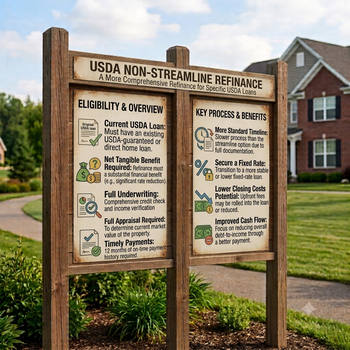 If you own a home financed with a USDA loan, you have options when it comes to refinancing. One of those options is a USDA non-streamline refinance, which allows you to refinance your existing home loan through a different process than the streamlined version. Understanding what this refinance option means and how it works can help you make the best decision for your financial situation.
Many homeowners don't realize they have multiple paths to lower their interest rate or reduce their monthly payment. A USDA streamline refinance gets most of the attention, but the non-streamline approach offers unique advantages for certain borrowers. This guide walks you through everything you need to know about USDA non-streamline refinance loans.
- Non-streamline refinancing requires a full application and underwriting process
- You may qualify for a cash-out refinance option with this type of refinance loan
- Different eligibility rules apply compared to streamlined refinance programs
- Your lender will order a new appraisal in most cases
- This path can open doors to better rates and terms for your situation
What Is a USDA Streamline Refinance vs. Non-Streamline Refinance?
A USDA streamline refinance is a simplified process designed to make refinancing faster and easier. It typically skips certain steps like getting a new appraisal and limits how much you can access in cash. The United States Department of Agriculture created this program to help existing USDA loan holders refinance without unnecessary delays.
A non-streamline refinance, on the other hand, follows the full underwriting process. Your mortgage lender will review your complete financial picture, order a new appraisal, and verify your income and debt-to-income ratio. This approach takes longer but offers more flexibility.
Think of the streamline option as a fast track and the non-streamline path as the traditional route. Both can get you to a better interest rate, but they work differently and suit different circumstances.
Who Can Use a Non-Streamline Refinance Option?
Not everyone with an existing USDA loan qualifies for a streamline refinance. That's where the non-streamline path becomes valuable. If you don't meet streamline requirements, a standard USDA refinance might be your answer.
You might be a good candidate for a non-streamline refinance loan if you want to tap into your home's equity through a cash-out refinance option. You may also prefer this route if your current USDA mortgage has performance issues or if you need more flexibility in your refinance program.
A non-streamline USDA streamline refinance program works well for homeowners who want to borrow against their equity or who have circumstances that don't fit the streamline box.
- You want to access equity through a cash-out refinance
- Your current USDA loan has delinquency or payment issues
- You don't qualify for streamline refinance requirements
- You want to change your loan term significantly
- Your financial situation has improved and you want better rates
Refinance Eligibility Requirements for USDA Refinance Loans
The United States Department of Agriculture sets specific rules about who can apply for a USDA refinance. To qualify for a non-streamline USDA refinance program, you need an existing USDA home loan first. You cannot use this program if you don't already have a USDA mortgage.
Your property must be your primary residence. USDA programs focus on owner-occupied homes, not investment properties or vacation homes. If you've moved or rented out your home, you may not qualify for USDA refinance options.
You'll need to show that you can afford the new monthly payment on your refinance loan. Your lender will examine your income, employment history, and overall debt-to-income ratio. The USDA has limits on how high your debt-to-income ratio can be.
Your home must still meet USDA property requirements. The property value and condition matter. If your home has dropped significantly in value or has needed repairs, your new appraisal might affect your refinancing options.
| Requirement | Details |
|---|---|
| Existing USDA Loan | Must currently have a USDA loan on the property |
| Primary Residence | Property must be your main home |
| Payment History | No recent USDA mortgage delinquency (rules vary) |
| Property Condition | Home must meet USDA standards and pass appraisal |
| Debt-to-Income Ratio | Income must support the new loan payments |
The Non-Streamline Refinance Application Process
Applying for a non-streamline USDA refinance follows traditional mortgage steps. You'll start by meeting with a mortgage lender to discuss your goals. Do you want to lower your interest rate? Reduce your monthly mortgage payment? Access equity through a cash-out refinance option? Your lender can explain what each path means for your situation.
Your lender will ask for detailed financial documents. Bring recent pay stubs, tax returns, and bank statements. They want to verify your income and check your savings. This step takes time but helps the lender understand your full financial picture.
A new appraisal comes next. A professional appraiser will visit your home and assess its current value. This determines how much equity you have available and what loan amount the USDA will approve. An appraisal typically costs between $400 and $700.
Once your documents are complete and your appraisal comes back, the underwriting phase begins. An underwriter reviews everything to confirm you meet USDA guidelines. They verify your employment, check your credit history, and confirm the property qualifies. This process usually takes 5 to 10 business days, though it can take longer if questions arise.
- Schedule a consultation with your lender to discuss your refinance goals
- Gather financial documents including recent pay stubs and tax returns
- Your lender orders a new appraisal of your property
- Submit a complete application for USDA refinance loan approval
- Work with underwriting to answer questions and provide additional documentation
- Receive your conditional approval or final approval decision
- Review closing documents and schedule your closing appointment
- Sign documents and fund your new loan
Understanding Closing Costs for Your Refinance Loan
When you refinance, you'll pay closing costs. These fees cover the work involved in creating your new loan. Common costs include the appraisal fee, title search, credit report, underwriting, and document preparation.
USDA loans include an upfront guarantee fee. This protects the USDA in case you default on your refinance loan. For a non-streamline USDA refinance program, the upfront guarantee fee is typically 2% of the loan amount. You can roll this cost into your new loan or pay it upfront.
A mortgage lender must provide you with a Loan Estimate within three business days of your application. This document shows all estimated closing costs. Review it carefully so there are no surprises at closing.
Total closing costs typically range from 2% to 5% of your loan amount. On a $200,000 refinance loan, that means $4,000 to $10,000 in costs. Many homeowners roll these costs into the new loan rather than paying them upfront.
Can You Get a Cash-Out Refinance With Non-Streamline Refinance?
One of the biggest advantages of choosing a non-streamline path is the ability to access your home's equity. A cash-out refinance option lets you borrow against the equity you've built in your home.
Here's how it works: If your home is worth $300,000 and you owe $200,000 on your current USDA loan, you have $100,000 in equity. With a cash-out refinance, you could take out a new loan for $240,000. After paying off your current USDA loan, you'd receive $40,000 in cash.
This cash can help you cover major expenses like home repairs, medical bills, education costs, or debt consolidation. Your monthly mortgage payment will be higher because your loan amount is larger, but you get access to funds you've earned through home equity.
A streamline refinance typically doesn't allow cash-out options. If you need money from your equity, a non-streamline USDA streamline refinance program is usually the only choice.
Interest Rates and Monthly Payment Savings
The primary reason most homeowners refinance is to save money. Lowering your interest rate directly lowers your monthly payment. Even a small rate reduction can mean significant savings over time.
If you refinanced your home when rates were higher, today's rates might offer real opportunities. A $300,000 refinance loan at 5% interest costs about $1,610 per month (for a 30-year term). The same loan amount at 4% costs about $1,432 per month. That's $178 in monthly savings, or $2,136 per year.
Your actual savings depend on your specific situation. Your credit score, loan term, and the current market all affect what interest rate you'll receive. A mortgage lender can provide a personalized rate quote based on your qualifications.
Remember that closing costs reduce your savings initially. If you pay $6,000 in closing costs, you'll need to save that amount through lower monthly payments before refinancing truly saves you money. This break-even point typically happens within 12 to 24 months for most refinance loan situations.
- Lower interest rates reduce your monthly mortgage payment
- Shorter loan terms mean less total interest paid over time
- Calculator tools help you compare your current situation to potential savings
- Closing costs are an upfront expense that impacts your overall savings
- A borrower with better credit may qualify for better rates
- Market rates change daily, affecting what your lender can offer
Timeline for Your Non-Streamline Refinance Loan
How long does a non-streamline USDA refinance take? Most applications process in 30 to 45 days from start to finish. This includes the application, appraisal, underwriting, and closing phases.
Streamline refinances can close in as little as 7 to 10 days. Non-streamline refinance programs take longer because they require more steps. The appraisal alone typically adds 5 to 7 days.
If complications arise, the timeline extends. An underwriter might need additional documentation. Your property appraisal might flag needed repairs. These issues can add 1 to 2 weeks to your timeline.
Work with your lender to stay on track. Respond quickly to document requests and provide information promptly. The faster you move, the faster you'll close on your new loan.
Comparing Streamline and Non-Streamline Refinance Options
Understanding the differences helps you choose the right path. Streamline refinance programs offer speed and simplicity. You skip the appraisal step, which saves time and money. However, you're limited to refinance only - no cash-out access.
Non-streamline USDA refinance loan programs offer flexibility. You can do a cash-out refinance option, change your loan term significantly, or refinance if you don't qualify for streamline requirements. The trade-off is time and higher upfront costs.
| Feature | Streamline Refinance | Non-Streamline Refinance |
|---|---|---|
| Processing Time | 7-10 days | 30-45 days |
| Appraisal Required | No | Yes |
| Full Underwriting | No | Yes |
| Cash-Out Available | No | Yes |
| Upfront Guarantee Fee | 0.5% | 2% |
| Rate/Term Change | Limited | Flexible |
Getting Started With Your USDA Non-Streamline Refinance
Ready to explore a non-streamline refinance option? Start by contacting a lender experienced with USDA programs. Not all mortgage companies offer USDA refinance loan options, so ask specifically about their USDA streamline refinance program and non-streamline products.
Gather your financial information before meeting with your lender. Know your current USDA loan details, recent income information, and any questions about your situation. A good mortgage lender will listen to your goals and explain how a non-streamline USDA refinance helps you reach them.
Ask your lender for a rate quote and Loan Estimate. Compare offers from multiple lenders if possible. Different companies charge different fees, even when offering the same interest rate. Shopping around can save you hundreds or thousands of dollars.
Frequently Asked Questions
What is the difference between USDA streamline and non-streamline refinance?
A streamline refinance is a faster, simplified process that skips the appraisal and full underwriting. A non-streamline refinance loan requires a full application, new appraisal, and complete underwriting process. Non-streamline options allow cash-out refinance access and offer more flexibility, but take longer.
Can I get a cash-out refinance with a USDA non-streamline refinance loan?
Yes. A non-streamline USDA refinance program allows you to borrow against your home equity and receive cash at closing. This is one of the main advantages over streamline refinance options. The amount depends on how much equity you have and what the appraisal shows.
How long does a non-streamline USDA refinance take to close?
Most non-streamline refinance loan applications close within 30 to 45 days. This includes time for the appraisal, underwriting, and document preparation. Streamline refinance options close faster, typically in 7 to 10 days.
What are the closing costs for a non-streamline USDA refinance loan?
Closing costs typically range from 2% to 5% of your loan amount. These include the appraisal, title search, underwriting, credit report, and USDA's upfront guarantee fee (2% for non-streamline). You can often roll these costs into your new loan.
Do I need a new appraisal for a non-streamline USDA refinance?
Yes. Non-streamline USDA refinance loan programs require a new appraisal as part of the full underwriting process. This determines your home's current value and how much equity you have available. Streamline refinance options do not require an appraisal.
Ready to Refinance?
A non-streamline USDA refinance could be the right move for your situation. Whether you want to lower your interest rate, reduce your monthly payment, or access your home equity through a cash-out refinance option, this path offers flexibility that streamline programs don't.
Contact a qualified lender today to discuss your USDA refinance loan options. Compare offers and review your personalized Loan Estimate. The savings you find could be substantial - both in your monthly budget and over the life of your loan.
Connect With Us
Please share – it really helps