USDA Manufactured Home Loan Programs: Rural Development Financing Made Clear
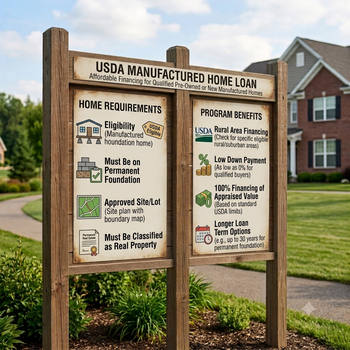 Buying a manufactured home is an affordable path to homeownership, especially for borrowers in rural areas. A USDA loan makes this goal achievable without a large down payment. The USDA manufactured home loan program helps eligible buyers finance new manufactured homes on permanent foundations across America's rural communities.
The USDA, through Rural Development, backs these loans with a government guarantee. This guarantee protects your lender and makes approval easier for borrowers with limited savings. Many people assume traditional mortgages are their only option, but a USDA manufactured home program opens doors for rural homebuyers.
What Is a USDA Manufactured Home Loan?
A USDA loan for a manufactured home is a government-backed mortgage designed for rural homebuyers. The USDA Rural Development program guarantees the loan, meaning the government promises to cover losses if you default. Your lender takes less risk, so they approve more borrowers.
Manufactured homes built to HUD standards qualify for this program. Your home must sit on a permanent foundation, not a temporary setup. The USDA manufactured home loan covers the cost of the home, foundation, and land together in one mortgage.
This program differs from FHA loans and conventional mortgages. With an FHA loan, you typically need three percent down. Conventional loans demand larger down payments and stricter credit scores. The USDA loan requires zero down payment for eligible borrowers, making it ideal for first-time homebuyers with modest incomes.
- No down payment required for eligible borrowers
- Government-backed loan through USDA Rural Development
- Available for new manufactured homes on permanent foundations
- Lower interest rates than many conventional mortgages
- No mortgage insurance premium upfront (only annual guarantee fee)
Who Can Qualify for a USDA Manufactured Home Loan?
Not every borrower qualifies for USDA loan programs. The USDA sets specific rules about income, property location, and eligible home types. Understanding these requirements helps you know if this mortgage is right for you.
Income Requirements for USDA Manufactured Home Financing
Your household income must fall within USDA limits for your county. Generally, the limit is 115 percent of the area median income. A family of four in many rural counties can earn up to $70,000 to $90,000 annually and still qualify. Income limits vary by location, so check with your lender for your specific area.
The USDA counts all household income sources. This includes wages, self-employment income, Social Security benefits, and investment returns. Your debt-to-income ratio matters too. Most lenders want your total monthly debt payments to stay below 41 percent of gross income.
Property Location and Manufactured Home Requirements
The manufactured home must sit in a USDA-eligible rural area. Over 95 percent of America qualifies as rural under this program. You can check online tools to verify if your desired property location is eligible. Homes in cities with populations over 20,000 typically do not qualify.
Your manufactured home must meet HUD construction standards. It should be new or recently constructed. The home must have a permanent foundation, not wheels or temporary supports. A double-wide or single-wide both qualify as long as they meet HUD codes.
- Property located in USDA-eligible rural area
- Manufactured home built to HUD standards
- Home on permanent foundation (not temporary or mobile setup)
- New or recent construction (generally under five years old)
- Household income below USDA limits for your county
- U.S. citizenship or eligible immigrant status
USDA Manufactured Home Age Requirements
The USDA prefers newer manufactured homes but does have exceptions. Generally, homes built within the last five years have the easiest approval. Older homes may qualify if they meet condition standards and sit on permanent foundations. Your lender will order an appraisal to confirm the home's value and condition.
A home that is 20 years old or older faces stricter inspection standards. The USDA wants to ensure your investment remains sound. Structural damage, roof leaks, or failed heating systems can disqualify an older manufactured home. Getting a professional inspection before applying helps avoid surprises.
Steps in the USDA Loan Process for Manufactured Homes
The loan process for a USDA manufactured home loan follows familiar steps. You will apply, get pre-approved, find your home, and close the deal. Each step requires specific documents and approval from your lender. Understanding the timeline helps you plan your home purchase.
Step One: Check Your USDA Loan Eligibility
Before contacting a lender, verify you meet basic USDA requirements. Gather recent pay stubs, tax returns, and bank statements. Most lenders offer free pre-qualification calls. They ask about income, debts, and desired property location. This conversation takes 15 minutes and costs nothing.
A pre-qualification is not a guarantee, but it tells you if the USDA loan makes sense for your situation. Your lender will estimate your loan amount and monthly payment. Some lenders require credit scores of 580 or higher, though 640 is more common.
Step Two: Gather Documents and Get Pre-Approved
Once you decide to move forward, provide your lender with formal documents. These include two years of tax returns, recent pay stubs, bank statements, and a list of debts. The lender runs a credit check and verifies employment. Pre-approval typically takes three to five business days.
Pre-approval shows sellers you are serious. It also locks your interest rates for 60 to 90 days. You now know your maximum loan amount, so you can shop for manufactured homes in your price range.
Step Three: Find Your New Manufactured Home
With pre-approval in hand, work with a dealer or builder to find your manufactured home. Tell them you have USDA financing. Dealers familiar with USDA loans speed up the process. They know what documentation the lender needs.
Confirm the property is in a USDA-eligible area. Verify the home sits on a permanent foundation or that the seller will install one. The price you negotiate becomes the foundation for your loan amount calculation.
Step Four: Order the Appraisal and Site Inspection
Your lender orders an appraisal to confirm the home's value. An appraiser visits the property and inspects the structure. The USDA requires a site inspection to verify the foundation meets standards. These inspections typically cost $400 to $600.
The appraisal protects both you and your lender. If the home appraises for less than the purchase price, you have options. You can renegotiate with the seller or increase your down payment.
Step Five: Final Underwriting and Closing
Once the appraisal comes back, underwriting begins. Your lender reviews all documents one final time. They verify employment again and confirm no new debts appeared. This stage usually takes three to five business days.
Closing happens at a title company or attorney's office. You sign loan papers and receive the keys. Closing typically takes two hours. You will pay the guarantee fee, property taxes, homeowner insurance, and other standard costs. Your lender explains all costs before closing day.
- Pre-qualification call with lender (same day)
- Gather documents and apply (1-2 days)
- Pre-approval from lender (3-5 days)
- Find and purchase manufactured home (30-60 days)
- Appraisal and site inspection (7-14 days)
- Final underwriting (3-5 days)
- Closing and funding (1 day)
USDA Manufactured Home Financing Costs and Fees
The total cost of your USDA manufactured home loan includes more than just the home price. Understanding every fee helps you budget accurately. Some costs are one-time charges, while others repeat annually.
USDA Guarantee Fee and Annual Payments
A guarantee fee protects the government if you default. This fee typically equals 3.5 percent of your loan amount. Unlike FHA loans, the USDA lets you roll this fee into your mortgage. You do not pay it upfront out of pocket.
An annual fee of 0.55 percent applies to loans over $35,000. This annual fee gets added to your monthly payment. On a $100,000 loan, the annual fee adds about $46 per month. This continues throughout your loan term.
Other Loan Costs and Closing Expenses
Your lender charges an origination fee, typically 1 percent of the loan. This covers processing, underwriting, and loan closing costs. You also pay an appraisal fee ($400-$600) and inspection fee ($300-$500). These protect your investment.
Title insurance and homeowner insurance are required. Title insurance typically costs $500 to $1,000 one time. Homeowner insurance runs $800 to $1,500 yearly. Property taxes vary by location. Closing costs typically total 2 to 5 percent of your loan amount.
| Fee Type | Typical Cost | When Paid |
|---|---|---|
| Guarantee Fee | 3.5% of loan amount | Rolled into mortgage |
| Annual Fee | 0.55% of loan amount | Monthly payment |
| Origination Fee | 1% of loan amount | Closing |
| Appraisal Fee | $400-$600 | When ordered |
| Inspection Fee | $300-$500 | When ordered |
| Title Insurance | $500-$1,000 | Closing |
| Homeowner Insurance | $800-$1,500 yearly | Annual renewal |
USDA Loan Restrictions and What You Cannot Buy
The USDA loan program has clear boundaries about what qualifies. Knowing these loan restrictions saves time and prevents disappointment. Some manufactured homes simply do not meet program standards.
Properties That Do Not Qualify
A USDA loan cannot be used for investment properties or vacation homes. Your home must be your primary residence. You cannot use the program to buy manufactured homes in urban areas. Properties in counties with populations over 35,000 in the main city typically fall outside USDA eligibility.
Second homes and rental properties are excluded. Used manufactured homes that are very old may not qualify. Homes without permanent foundations cannot be financed through this program. USDA manufactured home loans also cannot cover land-only purchases.
Construction and Foundation Standards
Your manufactured home must be built to HUD standards. Homes manufactured before 1976 rarely meet these codes. The home must have a permanent, properly installed foundation. Temporary blocks or mobile setup disqualifies the property.
The foundation must meet state and local codes. An engineer or inspector certifies the foundation before loan approval. Concrete piers or full basement foundations both work. Shipping costs and foundation installation are included in your financed amount.
- Home must be primary residence (not investment or vacation property)
- Property in USDA-eligible rural area only
- Manufactured to HUD standards (generally post-1976)
- Permanent foundation installed before occupancy
- Cannot be used for commercial purposes
- Cannot finance land only (home and land together)
- Cannot be used for manufactured home construction financing
Comparing USDA Loan Options: Single-Wide vs. Double-Wide Manufactured Homes
Both single-wide and double-wide manufactured homes qualify for USDA loan financing. The difference mainly comes down to size, cost, and personal preference. Your lender treats both the same way from a financing perspective.
Single-Wide Manufactured Homes
A single-wide is typically 14 to 18 feet wide and 40 to 90 feet long. These homes are more affordable, ranging from $35,000 to $80,000. They require less foundation work and are easier to place on properties. Single-wides work well for borrowers with tight budgets or smaller families.
The smaller size means lower property taxes and utility bills. Resale value may be more limited than double-wides. A single-wide manufactured home still qualifies for a full USDA manufactured home loan with the same favorable terms.
Double-Wide Manufactured Homes
A double-wide runs 20 to 28 feet wide and 40 to 80 feet long. These homes feel more like traditional houses. Prices range from $60,000 to $150,000 or more. Double-wide manufactured homes offer more space and better resale potential than single-wides.
A double-wide requires a larger permanent foundation but functions the same way. The USDA loan works the same way for double-wide purchases. Monthly payments will be higher due to the increased cost, but the loan structure stays the same.
| Feature | Single-Wide | Double-Wide |
|---|---|---|
| Typical Width | 14-18 feet | 20-28 feet |
| Typical Price Range | $35,000-$80,000 | $60,000-$150,000+ |
| Foundation Complexity | Simple to moderate | Moderate to complex |
| Space Inside | Compact | Spacious |
| Resale Potential | Moderate | Better |
| USDA Loan Eligible | Yes | Yes |
How USDA Manufactured Home Loans Compare to Other Financing Options
Borrowers often consider FHA loans, conventional mortgages, and USDA loans side by side. Each program has strengths and weaknesses. Understanding these differences helps you pick the right path to homeownership.
USDA Manufactured Home Loan vs. FHA Loans
Both USDA loans and FHA loans help borrowers with limited down payment savings. FHA loans require 3.5 percent down, while USDA loans require zero down. FHA loans charge upfront mortgage insurance and annual premiums. USDA loans charge a guarantee fee and annual fee instead.
FHA loans have no income limits. The USDA loan sets income caps based on your county. FHA loans work in urban and rural areas. USDA loans only work in rural zones. For manufactured homes in rural areas, the USDA loan typically offers better rates and terms.
USDA Loan vs. Conventional Mortgages
Conventional mortgages typically demand 5 to 20 percent down. The USDA manufactured home loan needs zero down for eligible borrowers. Conventional loans favor borrowers with high credit scores and high income. The USDA program accepts borrowers with credit scores as low as 580.
Conventional loans usually cost less in total fees. USDA loans have annual guarantee fees that continue through the loan term. However, if you cannot afford a large down payment, the USDA loan may be your only realistic option for manufactured home ownership.
Interest Rates and Monthly Payments on USDA Manufactured Home Loans
Your monthly payment depends on three factors: loan amount, interest rates, and loan term. Most USDA manufactured home loans are 30-year mortgages. The interest rates you receive depend on market conditions and your credit score.
Interest rates for USDA loans typically run 0.5 to 1 percent lower than conventional mortgages. Your credit score, debt-to-income ratio, and market conditions all affect your rate. A borrower with a 680 credit score might get 6.5 percent, while someone with a 740 score could get 6.0 percent.
Your monthly payment includes principal, interest, the annual fee, property taxes, homeowner insurance, and possibly HOA fees. A $100,000 loan at 6.5 percent over 30 years costs about $632 per month. Add the annual fee, taxes, and insurance, and the total might reach $850 to $1,000 monthly.
- USDA Loan Interest Rates typically 0.5-1% lower than conventional
- 30-year mortgage term is standard
- Credit score affects your specific rate
- Annual fee of 0.55% added to monthly payment
- Final payment includes taxes and insurance
- Rate lock available for 60-90 days after pre-approval
Five Common Questions About USDA Manufactured Home Loans
Will a USDA loan cover a manufactured home?
Yes, the USDA loan program specifically covers new manufactured homes on permanent foundations. The home must be built to HUD standards and sit in a USDA-eligible rural area. Your income must fall within USDA limits for your county. Most borrowers who meet these basic requirements can finance a manufactured home through this program.
Does USDA cover manufactured homes?
The USDA through Rural Development covers manufactured homes built to HUD codes. Older homes built before 1976 rarely qualify. The home must have a permanent foundation installed by licensed contractors. Land and home are financed together in one USDA manufactured home loan. The program requires zero down payment for eligible borrowers, making manufactured home ownership achievable.
Can you get a USDA loan on a manufactured home?
You can obtain a USDA loan to purchase a manufactured home if the property meets program requirements. The home must be new or recent, sit on a permanent foundation, and be located in a USDA-eligible rural area. Your household income cannot exceed USDA limits for your county. You must be a U.S. citizen or an eligible immigrant with a valid credit history and steady employment. Contact a lender familiar with the USDA program to discuss your specific situation.
What are USDA loan restrictions for manufactured homes?
USDA loan restrictions prevent financing for investment properties, vacation homes, or properties in urban areas. Homes must sit on permanent foundations and meet HUD standards. The loan cannot cover land-only purchases. Used manufactured homes that are very old or in poor condition may not qualify. Your home must be your primary residence located in a USDA-eligible area.
What is the USDA manufactured home age requirements?
The USDA prefers manufactured homes built within the last five years, though older homes may qualify. Homes built before 1976 rarely meet HUD codes and do not qualify. Homes between five and twenty years old face stricter inspections. Very old homes over twenty years must pass rigorous structural inspections. Your lender orders an appraisal to verify the home meets condition and value standards before approval.
Connect With Us
Please share – it really helps